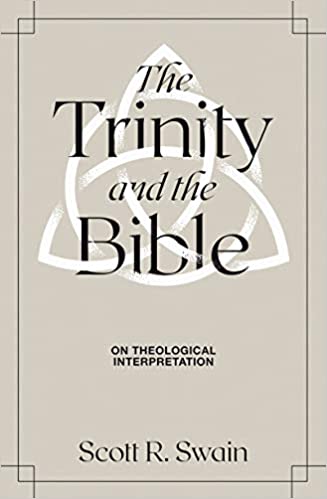
The Trinity and the Bible by Scott Swain

If you have delved into the fascinating study of the Trinity, you likely have already encountered the name Scott Swain. There are probably 4 or 5 writers who have made the greatest impact in this subject that begs for more care among Christians and Swain is unquestionably one of them. This latest title of his is not his greatest contribution on the Trinity, but it is one of those books that shows more digging and a passion to help people practically put an understanding of the Trinity to use when they open the Bible anywhere to do exegesis.

Without doubt, that is a valuable concept to entertain. In fact, even after studying the Bible for many years, when you finally do a detailed study of the Trinity, you become almost surprised at how many passages contain a Trinitarian focus. Only our Triune God knows why the Bible is designed to have the Trinity sprinkled everywhere and yet have few passages that serve as great proof texts on the subject.

When you come to this book itself, you will appreciate the big picture for sure; and yet as with any written attempt at exegesis, you might disagree at points. Occasionally, I disagreed with Swain but I was a happy traveling companion for the journey he took we readers on. Maybe you ask here: isn’t this just a collection of essays? It is. Whether the author was lucky or brilliant I can’t say, but the fragments did make a whole.

Don’t skip chapter 1 even though it is really just the preface. Chapter 2 is the best chapter and addresses profound concepts involving the Trinity. Chapter 3 on Warfield’s view of the Trinity is not merely a recap of history, but a case study on exegesis and the Trinity. The final three chapters take the Trinity into the spadework of exegesis in Mark 12:35-37, Galatians 4:4-7, and Revelation 4-5 respectively.

I enjoyed this book thoroughly as I have done much study on the Trinity recently. To be sure, this book is not a first choice when you begin a study of the Trinity, but it is a quality resource as you get farther into it. I’m glad to have to have it!

I received this book free from the publisher. I was not required to write a positive review. The opinions I have expressed are my own. I am disclosing this in accordance with the Federal Trade Commission’s 16 CFR, Part 255.
Biblical Theology According to the Apostles (NSBT)

You’ve got to admit it. Sometimes the venerable New Studies in Biblical Theology (NSBT) series finds a niche in theology that you at once hadn’t thought of before and after reading wonder why we hadn’t already. There’s a case in point here. The New Testament is rife with passages that review Israel’s provocative story. So it must be profitable to weigh how the Apostles handled the use of that story, don’t you think?


Three scholars (Chris Bruno, Jared Compton and Kevin McFadden) joined hands to produce this work. Rather than a disjointed work arising from too many cooks in the kitchen this book succeeds as drawing on the the fact the authors have been buddies since elementary school. I guess they traded the former discussions of school, sports and games for those of the Apostles thundering on the Old Testament. Maybe it’s just me but thinking about the non-typical evolution of that circle of friends brings a smile.

To maximize their contribution, the authors offer a introductory chapter that lays out a case for the importance of their idea with their criteria for inclusion and methodologies for presentation. It made sense to me.


They begin quite naturally with Matthew and his obvious connection to the Old Testament with emphasis on his genealogy and the parable of the tenants. Next, they present Luke and Acts as the climax of the Apostles telling Israel’s story with Stephen and Paul’s masterful presentation of the story in Acts 7 and 13 respectively.


Chapters on what is found in Galatians, Romans and Hebrews follow in turn. Hebrews 11 is surely a favorite of many of us. There’s a fine conclusion that sews up this unique study. Mark this work down as one of the more imaginative ones in the series that also manages to add something tangible for us.

I received this book free from the publisher. I was not required to write a positive review. The opinions I have expressed are my own. I am disclosing this in accordance with the Federal Trade Commission’s 16 CFR, Part 255.
Salvation to the Ends of the Earth [Second Ed.] (NSBT)

Andreas Kostenberger gives us a second edition of this 20-year old work in the New Studies in Biblical Theology (NSBT). This time there is no co-author other than T. Desmond Alexander contributing a chapter on mission in the Old Testament.
Though I hadn’t used the first edition, the preface explains how he organized his discussion of the theology of mission in such a way as to recast the material even if ultimate conclusions remain the same. Gone are chapters on Paul and the General Epistles and hello to one like, say, Matthew, James and Hebrews. The strikes me as merely shuffling the deck and re-dealing the same 52 cards, but if that helps crystallize the material for him to present it to us there’s no harm in it. There’s a Scripture index too so you can get when you need.
Two things stand out about this book. First, it is thorough and thoughtfully presented. I can’t think of anything he left out or any place he wasn’t clear and helpful. Perhaps you will find more or less (more likely) of mission in the passage he discusses, but I doubt you will find omissions of passages themselves. There’s also the passion that you would expect to find in a missional work.
Second, this book does not take a narrow focus on one aspect of a doctrine as is often the case in the NSBT series, but instead takes in the broad horizon of a grand biblical subject. For that reason, it will be an asset to a broader swath of Bible students too.
Kostenberger needs no recommendation from me as his scholarly work speaks for itself. I’m sure you already have some of his works around you. Add this good work to the pile!

I received this book free from the publisher. I was not required to write a positive review. The opinions I have expressed are my own. I am disclosing this in accordance with the Federal Trade Commission’s 16 CFR, Part 255.
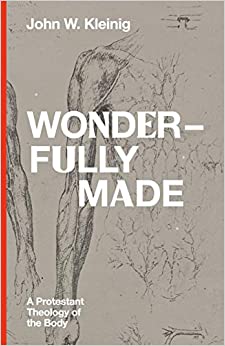
Wonderfully Made by John W. Kleinig

Here’s a book of theology that is at once timely for our days and provocative to the mind. He delves deeply in Scripture to formulate a theology of the body. With a world that’s lost its way in viewing our own bodies and a church that in some sectors has gone wobbly, such guidance as found in this book is nothing short of a tonic.

Don’t start imaging some sort of political plea, nor even much of a cultural critique. The author assumes that you know that we are culturally in a different time (though some similarities with ancient periods exist). Further, he beautifully assumes the Bible is where truth is found. He never argues how the Bible has the better blueprint. Of course it does! Let’s just find out what it says. He writes, too, with Christian love yet without fear or apology for truth. Most authors can’t score that balance.

To be sure, he writes with a Lutheran perspective that I do not share. If you are like me and don’t share his background, don’t sweat it. It was little distraction to me. He would often speak of something like, say, baptism that would make me momentarily bristle, but it was easy to keep focused on his theme and find so much that helped and even challenged me.

After a chapter on “body matters” to orient us he divides his subject into the created body, the redeemed body, the spiritual, the sexual body, the spousal body, and the living body. The chapter on the created body was top notch on issues that we used to call “the doctrine of man” (anthropology). The two chapters on the redeemed and spiritual bodies are where you most might run into his Lutheran sensibilities on salvation issues, but good things to process still abound. The chapters on the sexual and spousal bodies (this is more than you think) are interconnected as well and address burning current issues. As started earlier, it’s not presented so much as a harbinger of the end as that of what is true, what has always been true, and what will always be true. The last chapter on the living body is really a conclusion.

The world is falling apart for sure, so it’s especially nice to read a book that keeps its head as this one does. By the way, it can hold up as a solid work of theology as well. This book is theology as it should done.

I received this book free from the publisher. I was not required to write a positive review. The opinions I have expressed are my own. I am disclosing this in accordance with the Federal Trade Commission’s 16 CFR, Part 255.
Handbook of Evangelical Theology by Robert Lightner

Here is a nice book to introduce biblical doctrine to someone. Whether that be an introductory class Bible college class, or maybe for even a more valuables use, for someone alone or in a small group making a serious jab at understanding Bible doctrine, this book will fill a real need. Saying that this book is good for an introductory work by no means implies that it is shallow. There is real depth but the communication is helpful for someone who would be new at Bible study. I suppose the author’s many years of teaching made him ideal to write such a work.


The work is thoroughly conservative with no concessions to nonsense. In case you were wondering, the author subscribes to a dispensational outlook in prophecy and is committed to inerrancy of scripture throughout.


The sections of the book correspond to the great doctrines of the Bible. Near the beginning of each chapter there is historical perspective to help orient the reader but that does not dominate the discussion. Then after a careful laying out of the doctrine itself he concludes each section with a discussion of major areas of difference among evangelicals. I think that section has real value. It can come as a surprise to those studying theology for the first time that there are such differences. To my mind, it is better to go ahead and allow the reader to know that upfront. Plus, while there is not value in arguing, sometimes hearing different viewpoints can help one formulate their own more strongly.


This is a fine book. I might disagree on some little point, but how could that not be the case in any detailed work in systematic theology or Bible doctrine? I happily recommend this book to anyone interested in studying the great doctrines of the Bible.

I received this book free from the publisher. I was not required to write a positive review. The opinions I have expressed are my own. I am disclosing this in accordance with the Federal Trade Commission’s 16 CFR, Part 255.
Baptism: A Guide to Life From Death by Peter Leithart

It’s hard for me to put my review in words for this book. It’s part of a Christian Essentials series where I had already been blessed by the one on the Lord’s Prayer. I was very intrigued to look into this one about baptism. In the first few pages of the book he reminds us of the challenges of this subject. Around Christianity the battle lines are drawn and people are ready to fight at the drop of a hat. Because that is true, I did not come to this book expecting to read what I would agree with down the line. No, I was happy to learn what others thought. How can the opinions of baptism be so profoundly different?

In light of that approach, I do have a much better view of how others view baptism. Perhaps it would be best to describe the approach of this book as liturgical , which is not my viewpoint. It’s only fair, then, that I put my bias on the table before I tell you what I think might be wrong with this book.

In short, it seems to me that he puts more weight on the back of baptism than it can legitimately bear. There were paragraphs where he described what I would say happened when I received Christ where he made it sound like it happened at baptism. To be fair, I think he would argue that those benefits of Christ rolled over him at baptism. I don’t think that is the case, and so his beautiful prose might lead younger believers to a conclusion that I think would not be beneficial.

But there is another question. Did I enjoy the book? I must confess that I did even with my table full of caveats. There were paragraphs when he would write something where all I could say was, wow, I had never thought of that before. What a blessing! Then the next paragraph I might think, you shouldn’t attach that to baptism! For example, he writes so many beautiful things that the Bible says about water. They are profound! Unfortunately, if it involved water, he was convinced it was about baptism. I think that’s completely over the top, but it was good to refresh my heart about many things the Bible did say even if baptism was not the subject.

I’m sure this book on baptism could be in no way more conflicted than this review! It’s the best I could do. It will be up to you, if you are intrigued or not.

I received this book free from the publisher. I was not required to write a positive review. The opinions I have expressed are my own. I am disclosing this in accordance with the Federal Trade Commission’s 16 CFR, Part 255.
Rebels and Exiles (ESBT) by Harmon

Chalk this volume up as another smashing success in the new ESBT (Essential Studies in Biblical Theology). I love how this series takes a broader view than many similar series, yet imparts so much vital information. Matthew S. Harmon gifts us with something powerful about the doctrine of sin with a view toward redemption. After you read this book, you will agree that the concept of rebels and exiles is key in Scripture.

After making a good case in his brief introduction that “exile” is a proper rubric to study sin, he plunges into tracing that line throughout the Bible. Chapter 1 was my favorite, not because his writing deteriorated later, but because the story of Adam was like a home run out of the park to illustrate his theme. Additionally, he provided nugget after nugget that I especially enjoyed that imbibed freshness into an old story. Subsequent chapters follow the timeline of scripture seeing “exile” all along the journey. I will have to admit that it was there.

He followed through until he got to the New Creation where “exile” is finally banished. His final chapter on the practical implications of what he has written about brought theology out of the textbook and into life. I loved how he explained how we have a homesickness for a place we’ve never been!

At the end he gave some detailed suggestions for further reading as well as a thorough bibliography.

The success of this volume makes me even more excited to look at the others in the series. You have here accessible theology with real depth. What more could you ask for?

I received this book free from the publisher. I was not required to write a positive review. The opinions I have expressed are my own. I am disclosing this in accordance with the Federal Trade Commission’s 16 CFR, Part 255.

Systematic Theology (2nd Ed.) by Wayne Grudem

This release is exciting! It’s fantastic to see this widely used systematic theology get a fresh updating to extend its life and reach even further. As someone who has used the earlier edition extensively, I am happy to report that this gets helpful revision and new paragraphs without sacrificing what we loved in the older one. It does not appear to me, either, that he has changed his opinion on many matters. He just states even better what he has been saying well in this book for 25 years.

Because there have been few changes in conclusion, or even in design, it is likely that whatever shortcomings you found in the earlier edition will continue to be found in this new release. For example, I always thought his discussions about the doctrines of Christ and the Holy Spirit could have been fuller and more prominent among the other doctrines. Don’t misunderstand me; these discussions were still good. I’m just talking about their prominence among systematic theology at large.

It is obvious that systematic theologies get graded more on the reader’s agreement than its quality of work, and so if you follow Grudem’s theology this is easily going to be your favorite one. I suggest it ought to be one of your choices no matter your theological predilections. In fact, I think the best way to use systematic theologies is to have at least three or four of varying perspectives for you to wrestle through. If you take that approach, as I always have, this simply must be one of your choices. I know it’s always been that way for me. If I’m going to study a doctrine, Grudem is going to be one of those first three people I read before I branch out. This revision only makes that more happily the case for me. I don’t always agree with him, but I always appreciate what he has to say.

This is a phenomenal, well thought out, and well communicated volume that could not fail to enrich any Bible student who used it. I know the word “indispensable” can be overused and cliché in a book review, but this is that place where it must be said.

I received this book free from the publisher. I was not required to write a positive review. The opinions I have expressed are my own. I am disclosing this in accordance with the Federal Trade Commission’s 16 CFR, Part 255.
Exodus Old and New: A Biblical Theology of Redemption (ESBT) by Morales

book ex old

This title by L. Michael Morales is my first foray into the new Essential Studies in Biblical Theology (ESBT) series. Coming from the same publisher (IVP) as the highly-regarded NSBT series, it takes a different aim. Rather than narrowly focused topics that shine incredible light onto a precise point (NSBT), this series (ESBT) takes steps to re-approach with the same depth greater swathes of theology. Such synthesis is a refreshing onslaught that I applaud.

As for this title itself, I judge it an all-around success. If you read widely in theology, you will see that the Exodus motif crops up often. The average Bible reader never gets past the Exodus in Moses’ day but “exodus” is an exquisite painting of redemption that shows up throughout Scripture and provides a big picture understanding of the overall theme of Scripture. You can imagine, then, just how profitable a study like Morales delivers here can be.

The book is in three parts: the historical Exodus out of Egypt, the prophesied second exodus, and the New Exodus of Jesus. The historical Exodus is presented thoroughly and with great insight. The second part uses the Prophets to highlight the Exile and the exodus from the Captivity with equal skill. As it should be, the book climaxes with Jesus in the ultimate exodus. I gained many points of understanding in this volume but the big picture was always in view.

This book is a great help and encourages us to believe we might be having a real barn burner of a series taking off here!

I received this book free from the publisher. I was not required to write a positive review. The opinions I have expressed are my own. I am disclosing this in accordance with the Federal Trade Commission’s 16 CFR, Part 255.

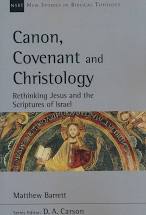
Canon, Covenant and Christology (NSBT) by Matthew Barrett

book ccc

At this point, with the multiple titles available in the New Studies in Biblical Theology (NSBT) series, you know you’re going to get something that is at once interesting and theologically weighty. I’m sure the editorship of D. A. Carson contributes to that ongoing quality. In any event, this latest title by Matthew Barrett is as outstanding as any in the series. It’s strong stance on the divine inspiration of Scripture makes it run against the grain of most modern literature, but also makes it of even more value.

To be sure, looking at the Scriptures from a Christological perspective was a brilliant idea. This book reaches the heights that the whole idea suggests to those who love the Bible.

Though this work focuses mostly on Jesus in the Gospels and what we see there about Scripture, it’s impact is even greater. The first chapter reminds us of both the overall importance and perfect credibility of divine inspiration. I particularly enjoyed the comments about Sensus Plenior. The next chapter weaves together critical ideas like progressive revelation, word – act-word revelation, and the covenant. You will not have to agree with every idea about the covenant to be profoundly blessed by this chapter.

Next, the book dives more into the details found in the gospels. There’s a chapter on the Matthean witness, one as a case study on the Word made flesh, one about the idea of living by every word from the mouth of God as found in each of these books, one on the Johannine witness, and a final concluding chapter that takes these issues and discusses their importance to the future of doctrinal studies.

I can’t think of a dud in this series, at least among those that I have looked at, but mark this one down as one of the best!

I received this book free from the publisher. I was not required to write a positive review. The opinions I have expressed are my own. I am disclosing this in accordance with the Federal Trade Commission’s 16 CFR, Part 255.