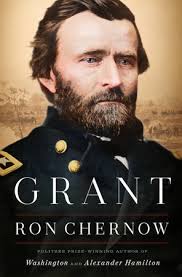
Ron Chernow has struck gold again. After writing his earlier Washington, a book that many of us feel is the best presidential biography ever written, you had to wonder if that earlier success was the biggest competition for this volume. While I would rank Grant a notch below Washington, this biography stands triumphantly beside the author’s earlier work. This book even accomplished one thing the earlier book did not: I knew Washington was great, but Chernow convinced me that Grant was far greater than I ever knew.
There were even a few astonishing similarities between Washington and Grant that may be easily overlooked because of their broad dissimilarities. Both had an annoying parent, both had financial difficulties both before and after their presidencies, both persevered at times with health difficulties, both were loved as a general even more than as a president, and both were revered at their death on a scale that few others could duplicate in American history.
In this work on Grant, Chernow makes Grant so alive that by book’s end, you feel you know him so well that you could anticipate what it would be like if he walked in the room, sat down, and begin talking to you. Though Grant was notoriously one to keep his emotions to himself, he was unable to hide them from Chernow. The portrait is so exquisitely drawn that we have the timbre of Grant’s voice, even if we lack the pitch of one who lived before the days of recordings.
Chernow doesn’t hide Grants faults. His fine trait of seeing people without guile sunk him to naïveté and made him the sucker for countless hucksters. His amazing powers of concentration were at times counterbalanced by his lack of counsel. His drinking blackened his eyes at times throughout his career even if he inwardly hated it and appeared to conquer it several years before he died.
Chernow is not as explicit with Grant’s faith as he was with Washington, but the fault was likely Grant’s. Grant’s life-long trait of holding so much inside robs us of knowing how sincere his Christianity was. We do learn in this book that he was raised in a Methodist home, and though his dad was unscrupulous in the extreme, his mother had a true piety. Grant was never known to use foul language, nor to have any substantiated trouble with women. In fact, he was a gentlemen’s gentleman in that regard. We do know he was a faithful churchgoer, attended revival meetings with D. L. Moody, and had a pastor often around him in his final days. Chernow shares the disputed stories of how sincerely Grant wanted the baptism he received in his final days. Some say he loved the idea while others say he did it to please his wife.
Chernow draws a good picture of Julia Grant as well. She was a homely Southern Belle, more ambitious than her husband, held grudges, got caught up in the glory of the White House, and seemed to have little of the Methodist piety that her husband grew up with. Still, she loved her husband and he loved her. She believed in him when it even didn’t make sense.
This book never lags. With 959 pages of text, it is quite long, but I can’t imagine what could be left out. Grant’s life of struggle before the Civil War had as much drama as a novel and made for great reading. As you would’ve guessed, the portion of the book that covered the Civil War was enthralling – both the writing and the subject were thrilling in this section. The misnomer of Grant the butcher is thoroughly laid to rest. He was an accomplished general, wrongly overshadowed by Robert E. Lee, and was both relentless and fearless in battle. Along the way, you will have a good overview of the Civil War without ever sinking into the dryness that afflicts some historical writing.
When you pick this book up, you are preconditioned to think that Grant’s life after the Civil War is boring, but I still couldn’t put the book down and found it all fascinating. His presidency was far more than the caricature of scandal that has been wrongly attached to it, even if the scandals were real. He wanted to preserve the gains of the Civil War and was sincere. It wasn’t until after his presidency that I soured somewhat on his character as one who was becoming too egocentric and one too easily piqued toward others. But then his determination to care for his wife and write his memoirs brought him back to the Grant I had grown to love.
This book is a tour de force! It could serve as a virtual clinic on how to write historical biography. Chernow, though perhaps not as well-known as the beloved David McCullough (though a play called Hamilton may have changed that observation), must in no way defer to him with this masterpiece. I’m confident that this will be THE biography on Ulysses S. Grant for my lifetime.
This book is so wonderful that it makes you ask: what’s next, Mr. Chernow? If the trend of jumping to the next century and finding the general who lead its most important war and later became president, it must be Eisenhower. Whoever it ends up being, I’ll be in line to get and read it!

 The Reagan Review