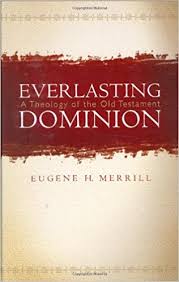
Everlasting Dominion by Eugene Merrill

book ever dom

I’ve used the works of Eugene Merrill throughout my entire ministry. He’s known for quality conservative academic work. Somehow I had overlooked this work for a long time. I’ve used several of his commentaries to great advantage, so my curiosity was piqued when I saw this volume described as his “magnum opus”. At least we can say that a major work of biblical theology requires more interdisciplinary mastery than most other theological work. Mr. Merrill’s humility is such that he almost sheepishly approaches this work in the preface. To my mind, however, he has the skills to tackle this task.

In chapter 1 he overviews what Old Testament theology is. That chapter includes a look at the winding path scholarship has taken on Old Testament theology. Much of it has been so absurd that we welcome this conservative effort. In chapter 2 he discusses the Old Testament as the autobiography of God and covers a wide range of theological concepts that you might find in a systematic theological approach. Chapter 3 upholds that the Old Testament is the revelation of God. Chapter 4 looks at what the works of God are as found in the Old Testament. Chapter 5 concludes part one with a discussion of the purposes of God.

Part two backs up and approaches the Old Testament from the perspective of mankind, who is made in the image of God. That will include chapters on the fall, redemption, and the creation of Israel.

Chapter 3 discusses the kingdom of God and in this section, we began seeing work on the individual books of the Old Testament. You may find his order of approaching Old Testament books a little unusual, but all are covered beautifully. We reach the wisdom literature of the Old Testament in chapters 18 and 19 before we find one concluding chapter that returns us to the big picture and anticipates the New Testament.

I don’t see how you could do serious work on Old Testament theology and not consult this book. It’s clearly one of the top volumes on the subject and I highly recommended it.

I received this book free from the publisher. I was not required to write a positive review. The opinions I have expressed are my own. I am disclosing this in accordance with the Federal Trade Commission’s 16 CFR, Part 255.

Understanding Biblical Archaeology by Wright

book und bib arch

At this point, Carta has several introductory atlases that could serve as a personal class on some important topics of Bible study. Paul Wright has contributed several of these outstanding introductory atlases covering the New Testament, geography, biblical kingdoms, important people groups mentioned in the Bible, as well as writing a well-received major Bible Atlas. This title gives an excellent overview of biblical archaeology. When you finish this book, you will have a working knowledge of what biblical archaeology is and what has been discovered in Israel from various archaeological periods.

Other works may probe more deeply the broader assumptions of archaeological work while this one focuses more on what we have found. These findings are presented through clear text, gorgeous pictures, and effectively chosen Bible maps. This book could have a secondary use as a guide to what archaeological sites might be worth visiting on your next trip to the holy land too. For example, on a trip, I did I enjoyed immensely visiting biblical Shechem of which there’s a fine picture on page 15.

The diagram on page 9 is worth pages of text in describing how we have such levels of archaeological finds available at many sites in Israel. We also find there an overview of archaeological periods.

The balance of the book takes us from the Early Bronze Age through the Early Roman or Herodian Era. Fortunately, there have been many wonderful archaeological finds in every major era between those two and none are given short shrift here.

This book is worth your time and I highly recommend it.

I received this book free from the publisher. I was not required to write a positive review. The opinions I have expressed are my own. I am disclosing this in accordance with the Federal Trade Commission’s 16 CFR, Part 255.

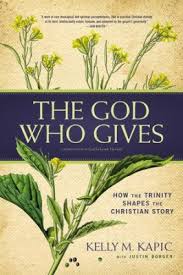
The God Who Gives by Kelly Kapic

book god who gives.jpg

The more I read by Kelly Kapic the more I like him. I had earlier read Embodied Hope and found it an inspiring overview of the doctrine of suffering. This work takes a much wider theological swath. The subtitle proclaims that this book explains how the Trinity shapes the Christian story. As I read this book, I often thought that Mr. Kapic took his theme of the God who gives on a walk across the entire landscape of systematic theology. It’s hard to grasp the terrain he covered in only 260 pages, yet this book is nothing of a superficial overview. Every doctrine traipsed over finds vibrant interaction.

This book is a revised edition of an earlier work entitled God So Loved, He Gave. Somehow I had missed that work, and so can’t speak to the extent of the revision. I can say, however, that this is a theological work not to be missed.

The first few chapters make such a brilliant contribution to the doctrine of God that I think I’ll file this book in that section of my library near other works on the Trinity. His initial premise that we belong to God is persuasively portrayed and gives at once a foundation for this book and an explanation for our lives. The discussion of creation and how it springs out of the Triune love of God tells us much about the purposes of God. Immediately we are told that God owns by giving as well as by creation.

The book continues to describe the calamity of sin, the evil of our world, creation’s bondage, and how all these things cry for our need of God. We learn how Jesus filled that role in his coming as our King to round out part one of this work.

Part two containing chapters 5-10 outlines how God reclaims all by giving all. In the chapter on the gift of the Son, don’t miss the discussion on pages 100-101. There’s further excellent discussion on belief, faith, and their differences. The gift is also traced to the Holy Spirit. There’s further discussion on how we receive the gift, what the gift of the kingdom is, and how to live within that gift.

Part three takes us through the cross, the resurrection, and the church itself to fully grasp the depths to which God gives to us.

This is one of the best theological works that I’ve come across. It provided me with several lightbulb moments. It’s accessible despite its depth. I’d recommend that any Christian give it a try. Whatever you glean can only enrich you. Mark this one down firmly in the “highly recommended” category.

I received this book free from the publisher. I was not required to write a positive review. The opinions I have expressed are my own. I am disclosing this in accordance with the Federal Trade Commission’s 16 CFR, Part 255.