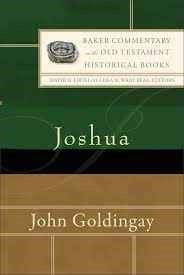
I can’t think of another witty statement for the speed at which Goldingay turns out commentaries since, apparently, I ran out of wit before he ran out of full-length major commentaries from his pen; but in any event, his latest here is on Joshua. Strangely enough, he admits in his preface that Joshua was not the book of the Bible that he wanted to write on next. As he tells it, he had a different book in mind, and the editors convinced him he needed to do Joshua. Kudos for transparency! He did, though, explain that he came around to enjoying the process of studying Joshua.
As I have so often said in other reviews, Goldingay is a living contradiction as a writer. He will make you angry in one paragraph and then grab your attention beautifully in the next. His consistency is amazing on that score. As usual, I so like his flashes of brilliance that I will put up with the other. It’s here again…in spades. Since he is so prolific as a commentary writer, I am sure you already have your opinion of him. So the first thing I can communicate to you in this review is that it will be exactly what you are accustomed to. And as usual, I must force myself to say I’m glad to have this volume.
The part I didn’t like came early in the introduction. though I overall like the lively way he approaches an introduction to one of his commentaries. He appeared in this one to too quickly fall into a defensive stance. In acknowledging critics, he came close to becoming one. As you probably know, scholars are engrossed with discussing the violence in Joshua. It wasn’t long before he was drowning with them. The problem with that whole discussion is that it presupposes that there is some higher morality or ethic than God Himself. That strikes me as quite disingenuous for a Christian commentary writer!
By page 22 perhaps he began anticipating what people like me would be thinking as he said, “In the context of modernity we assume that we can formulate views about the propriety of God’s action, and not just the other way around”. It was also grating in how he tied what might be wrong with Joshua with the failings of Western culture, and even American culture in particular. That struck me as an overexposed portrayal of Joshua thrown off by modern political pontifications of those he lives around. Or maybe the tunnel vision of the scholarly world he works in.
And just like that he gets a little deeper in the Introduction and starts pouring out that good stuff that he is equally known for. The section on theology particularly stands out.
The commentary proper continues the dichotomy pretty much along the same lines. If you are of his mind, I doubt you could find a better commentary. For those of us to his right, and who are discerning readers, the nuggets outweigh the mud enough to land a solid 4-star rating.
I received this book free from the publisher. I was not required to write a positive review. The opinions I have expressed are my own. I am disclosing this in accordance with the Federal Trade Commission’s 16 CFR, Part 255.
 The Reagan Review