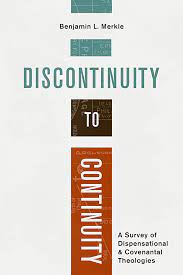
This book is needed. Or at least I needed it. I always felt books of this nature have so often in my experience been a proponent of one view at the expense of the others. To be sure, there’s a place for a few of those, but I found it helpful to have each of the positions laid out respectfully side by side. Mr. Merkle excelled with that set up. The careful reader can probably find his position, but that it was hard to find is amazing on this subject where everyone likes to be a screaming fan of the team they are on. In other words, this subject with its implications for the big picture of Scripture needed this approach. And Mr. Merkle delivered.
The only negative, and it’s not that huge, is that the terms “discontinuity” and “continuity” are loaded terms in this case. “Discontinuity” is really a negative term and is not a great distance from “chaos”. Clearly those on the side of “continuity” slyly chose these terms. In Mr. Merkle’s defense, he did not create these labels.
It’s also not surprising that this discussion is tricky. Dispensationalism and Covenant Theology have been the big boys at the table for a long time. Both have issues because they, with good intentions I’m sure, tried to make sense of the Bible at large. They both tried to pack in more than the systems could hold resulting in ruptures in places where the excess pops out. There’s as much theological positions from other major issues being crammed in as unadulterated Bible being brought in. No wonder it’s hard to keep straight.
Mr. Merkle was a gentleman in a space where few reside and it paid off. I enjoyed going through his thoughtful, careful presentation of each position. Every position had something to be commended for even though they may have been boxed in at times. You could tell (he listed them in the acknowledgements) that he genuinely interacted with those in each position. That paid off too.
His framework of comparing, a) basic hermeneutic, b) view of the covenants, c) view of Israel and the church, and d) view of the Kingdom of God was well conceived. It didn’t favor any position and got at the real goal of just explaining positions.
I didn’t change my position, but I honed a few important points in my mind. This book helped me and I suspect it could help anyone. It’s a keeper.
I received this book free from the publisher. I was not required to write a positive review. The opinions I have expressed are my own. I am disclosing this in accordance with the Federal Trade Commission’s 16 CFR, Part 255.
 The Reagan Review