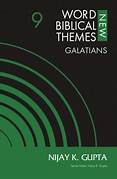
Galatians (Word Biblical Themes) by Nijay Gupta

This is the inaugural volume of the New Word Biblical Themes series. For some reason, only 15 volumes were ever written in the old series meaning that by far most in the WBC series did not have a corresponding offering in this series. The first thing you notice now is that unlike the old series each volume is not written by the author of the corresponding WBC volume. That’s not necessarily a bad thing, but it makes this new series more distinct, less likely to rehash information from the WBC series, and not bound by any of the weaknesses (or strengths) of the commentary. This series will be entirely in the hands of the new authors and the work they do.

That brings me to Nijay Gupta, who additionally happens to be the series editor. Richard Longenecker did the WBC volume back in 1990. That has been ranked as a high-class exegetical work ever since, though it has been consistently labeled a bit overboard with its entertainment of newer perspectives by many in the more conservative camp. Spring forward 34 years and I will say the same thing about Gupta. He works well from where he reasons, but do you accept that line? I found his work here easy to read and follow with all necessary scholarly spade work behind it, but he is dialed in to the wrong frequency for me.

Perhaps you’ve already guessed he is sympathetic to the New Perspective on Paul (NPP) and (full disclosure) I am not. Still, he divides how we view Paul’s thought in four main ways: 1) The Reformation Approach, 2) NPP, 3) the Apocalyptic Paul Approach, and 4) the Salvation-Historical Approach. He sees it as a combination of #2 and #4 while I would see it as a combination of #1 and #4. My viewpoint is unimportant as you are seeking a review of his book. My point is, more than in most books, your viewpoint is going to greatly affect your valuation of this book. Gupta himself says, “… leaning into one of these approaches leads to a particular kind of reading of Galatians, and promoting another one presents a different reading, sometimes starkly different.” This is a book about themes and your guiding theme orients everything else you say.

I still must commend certain things about this book. He lays the issues out well even if he, in your opinion, chooses the wrong option. There is value sometimes in reading on an entirely different track. Also, he very cogently and succinctly lays out his position in an understandable way. It’s quite easy to see what he believes, and why he believes it, even if you cannot agree with it.

And there you have it. Part of this book’s final score will be the viewpoint you had before you even cracked it open.

I received this book free from the publisher. I was not required to write a positive review. The opinions I have expressed are my own. I am disclosing this in accordance with the Federal Trade Commission’s 16 CFR, Part 255.

The Diary and Journal of David Brainerd (With Notes & Reflections by Jonathan Edwards

This is one of the great ones. It has a longstanding reputation that will not be lost when actually being read. On the other hand, it is different. It’s a biography that reads like a spiritual classic. It is a spiritual classic drawn from a man’s life. It’s like a memoir of a man who only relates to God and has no other life whatsoever. Not stylistically is it written about God, but its essence is that God is the hero and its (auto) biographic subject is the villain. At book’s end, though, you of necessity will arrive at two conclusions: 1) our God is awesome, and 2) Brainerd is a Christian you need to be much more like. And that’s just part of what this book has to offer.

The first and lengthiest part of the book is the Life and Diary. It reads like it was never meant to be read by someone else. There’s no posing, no justifying, just a man recording his wrestlings of faith. There are elements of discouragement so deep that some will suspect a mental health struggle as they read. The beauty of the reading, though, is how he groped after God. He prayed and prayed and like the wrestling Jacob would not let go till the Lord blessed him with His presence. The part that smacks me is that I might quit groping and sink down in that darkness. The impressions gained by the end of that section are that I must never quit turning to God, that I must relentlessly turn to Him rather than myself, and that an intimate relationship with the Lord is available if I will simply go after it as the most important thing in life.

The next section, the Journal, is a different animal altogether. The first surprise is that the Diary left you thinking he didn’t accomplish a thing. Now you find out the Lord used him mightily. There’s still not one syllable designed to impress you as the story is related in a Dragnet just-the-facts style. Brainerd still writes as one totally unimpressed with himself while I became one more and more impressed. The next surprise is that this humble, and dare I say even broken man, was one of the greatest missionaries ever.

Don’t miss what might seem like the hodgepodge that concludes the book. Some of the observations given explain so well the hardships of missionary work. Another feature both in Brainerd’s humble statements and Edward’s perceptive analysis is a guideline for what is real in revival.

Throughout the work, you see hardships on a level that most of us never get within a mile of. What an encouragement you’ll gain because his attitude was never O-me-O-my, but rather with an awesome God like I had why didn’t I handle it even better.

More than a book or a biography, this volume is an experience.

received this book free from the publisher. I was not required to write a positive review. The opinions I have expressed are my own. I am disclosing this in accordance with the Federal Trade Commission’s 16 CFR, Part 255.