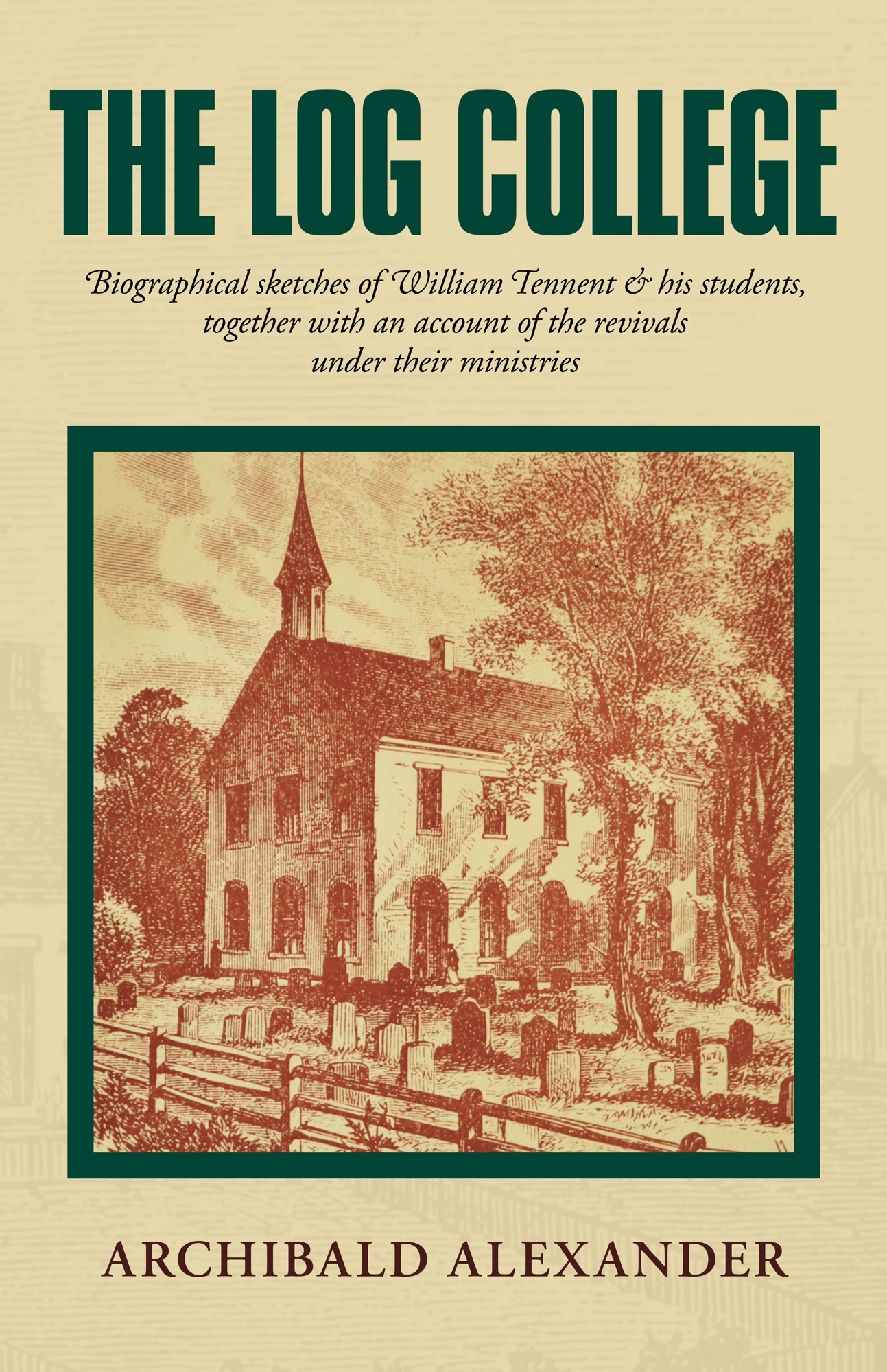
The Log College by Archibald Alexander

This Banner of Truth biography is to some degree different than their usual offerings. In this case, it’s more sketches of a variety of men who were all unheralded heroes who all had associations with a school colloquially known as the Log College. This school did not have the reputation of more famous ones, but in lacked nothing in effectiveness. In fact, the school was quite looked down on, but not for cause. The training it offered was rigorous, and more importantly, the ministry of its graduates impressive. In a word, revival describes its legacy.

After a short chapter on the Log College overall, we get 5 chapters on William and Gilbert Tennent. They were founders of the school with vision and persistence. Next, we learn about the College of New Jersey and the New Jersey and the New London School which sprang from the Log College. From here, we get more sketches of outstanding early graduates who were able servants of Christ with a near constant air of revival permeating from their ministries.

When the life of John Tennent was given, he seemed eerily similar to David Brainerd to me. He had a short life and thought so poorly of himself, yet did a tremendous work for the Lord. Next up is William Tennent, Jr. His story was at once thrilling and colorful. You’ve just got to read that section on the time that he was thought to be dead, but was not. I don’t want to give out any spoilers, but you will not want to miss that one. And there were several other totally unusual features of his life all the while he was an able servant of Jesus Christ.

From here, there are seven shorter sketches of impactful men. The consistent quality of their ministries is what stands out. Probably unknown outside this volume, these men clearly hold renown in Heaven.

This book encourages on many levels. Some of the greatest servants of Christ are little known and near forgotten. Apparently, it is the Lord that got the glory for their lives and that is how it should be. This book is a corrective for our media-driven and marketing age that has invaded the Church. We can make an impact outside of those cheap methods. This book is worth your time.

I received this book free from the publisher. I was not required to write a positive review. The opinions I have expressed are my own. I am disclosing this in accordance with the Federal Trade Commission’s 16 CFR, Part 255.
Habakkuk (CSC) by Susan Maxwell Booth

Habakkuk gets a plush treatment here. Because this volume succeeds on so many levels, I see it as the best single volume on Habakkuk around.

The depth of the Introduction quickly becomes apparent and serves as a forerunner to what the whole commentary will be. Authorship and dating are well established. The Historical Background section is thoroughly enjoyable to read and even makes good theological reflections. After the requisite section on the text, literary concerns are deeply surveyed. Next, one of the best sections on structure that I’ve seen in major commentary series in a long time is given. Whether you fully conclude as does the author, you will love the fullness with which that subject is broached. Equally helpful, Habakkuk’s place in the Book of the Twelve was quite imaginatively sketched.

The skills introduced in the Introduction cascade out through the commentary proper. 350 pages on Habakkuk is perfect for your main commentary on this prophet. I’ll give this volume the highest recommendation. 

I received this book free from the publisher. I was not required to write a positive review. The opinions I have expressed are my own. I am disclosing this in accordance with the Federal Trade Commission’s 16 CFR, Part 255

The Letters to the Colossians and to Philemon (PNTC) [Second Edition] by Douglas Moo

This is the kind of commentary that demands a second edition. Had the editors replaced it as is often the case in these major ongoing series they would have had a lot of explaining to do. This commentary went straight to the upper echelon sixteen years ago when it came out and Mr. Moo is still in his prime in commentary writing. Cliché yes, but nonetheless accurate, it was a “no-brainer” that this new edition arrived. It will not lose its lease in that upper echelon for at least a couple decades from now for sure either.

It’s specifically a blessing as well that he writes on Colossians. Many scholars today like to mug Paul and take Colossians away from him. In this work they were caught in the act and hauled to jail. Since Moo handles those critics with gentleness perhaps its surprising I’d use such a violent analogy; but then again his respectful tone does not make him any less lethal, so maybe it’s not surprising after all. Read the Introduction and you will see. When he ends the authorship section with “But Paul must be seen as the real author”, he’s in no way being condescending. His masterful analysis leaves him with nothing else possible to say.

Describing the false teaching addressed in Colossians is equally adept. His eleven points are balanced, biblical, and fog clearing. Scholars must have something against Colossians because they went quite rogue in this area as well. His theological overview was just right too. Perhaps only structure comes up short (as is usual with him) as it gets not one sentence beyond the outline.

Philemon is probably less a battleground than Colossians and ironically Moo is less certain about the big picture of the letter, though he slightly favors the traditional viewpoint. Still, he writes skillfully and mixes all the ingredients perfectly so you can make your own cake. To me, his work on Philemon is of immense value as well.

Moo needs no recommendation from me as an exegete. He has already attained something of legendary status. I can say, though, that that reputation is fully on display in this commentary. If you are studying Colossians and Philemon, avoid this commentary at your own peril.

I received this book free from the publisher. I was not required to write a positive review. The opinions I have expressed are my own. I am disclosing this in accordance with the Federal Trade Commission’s 16 CFR, Part 255.
Lexham Geographic Commentary on the Pentateuch

Having enjoyed the earlier two volumes of this series covering the New Testament, I was pleasantly surprised to come across this volume. I guess now I’ll expect the rest of the OT to be covered. On the surface, we might suspect that the Pentateuch would be the area most in need of geographical assistance. Father back in time and having generations trample over its environs, there is simply less certainty. Enter, then, this volume.

This volume is a massive undertaking. In some ways it seems like a Bible encyclopedia while at other points it’s more of an atlas. Despite the title, it’s not a commentary per se. What you get is a thorough article on any geographical subject that greatly impacts our understanding of the text. Some are quite scholarly (like ones explaining from a “socio-spatial” perspective!) but they are often still fun. I loved the one arguing, for example, for the traditional site for Sinai. Though I found it less plausible, it was worthwhile to have an article arguing for an alternate site. Not all articles are explicitly geographical like, for instance, ones on burial practices. Still, it’s all good stuff.

Sometimes even theology was addressed and usually effectively when it appeared. Perhaps my only complaint mimics mine of the earlier volumes: some maps strain the eyes to read. Charts, though, are usually fine.

I can’t help but love a book like this one. Even if every article isn’t your thing, you are bound to find several that are simply fascinating. No other volume I know brings these loose ends so tastefully together. What you have is an asset not duplicated anywhere else. That’s saying a lot these days.

I received this book free from the publisher. I was not required to write a positive review. The opinions I have expressed are my own. I am disclosing this in accordance with the Federal Trade Commission’s 16 CFR, Part 255.