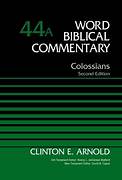
Colossians (WBC) by Clinton Arnold

This is an erudite, massive commentary in spades. Mark it down as far less tedious than we might often label commentaries on this scale. Mr. Arnold is not like some commentators who have a whole string of commentaries like, say, Douglas Moo, but he is rather that one who walks for years with one book of the Bible (well he did Ephesians too). The twenty years Arnold spent on Colossians makes him able to deliver on a magnitude that not many people can. He probably knows how many times Paul sneezed as he wrote Colossians (yes he believes Paul is the author), or what he had for lunch.

The thing that is amazing about this book is that the stars were aligned for it to be dull, but it wasn’t. For example, he wrote the most prolific section on the archaeology of the area that I have ever, and I read to the end! He has been there over and over and though he had all the requisite research, he really gave a bird’s-eye view. I simply don’t remember ever seeing something like that before.

Another trick he pulled off is in how he “interacted” with other scholars without turning into a sleep aid. He more weighed them in the balances and found them wanting. Consider the authorship of Colossians by Paul that has had pot shots taken at it for years. Arnold took the four categories of language, style, theology and historical plausibility and analyzed all the evidence for scholarly opinion. Sometimes the evidence was suspect while at other points it just didn’t exist, more like pulled out of the air. Read the excursus on Bujard where he took Bujard’s own data and proved him wrong.

In the commentary proper discussing the Hymn look how he exposed Kasemann. He wasn’t ugly about it, but proved it was merely a collection of unproven assumptions. As fascinating as it was to read, it’s also bewildering that such nonsense can enter scholarship and dominate it.

There are things mentioned in Colossians chapter 2 that are difficult to grasp even if the larger picture is quite clear. I really appreciated Arnold here. The discussion of “magic” is a weird scholarly exaggeration in many ways, but Arnold is for sure an expert on that line.

His writing on the Household Code was restrained and yet helpful. He really didn’t get in the whole egalitarian versus complementarian discussion, as much as just stating what the text was saying. He didn’t skirt it, but was as thorough as ever. I appreciated much of what he said there.

This is an outstanding commentary. Its scholarship is impeccable while what the rest of are after is here if you will invest just a bit of time. I don’t think you’ll regret it.

I received this book free from the publisher. I was not required to write a positive review. The opinions I have expressed are my own. I am disclosing this in accordance with the Federal Trade Commission’s 16 CFR, Part 255.
The Beginning of the World by Henry Morris

Some years ago, I read a few works by Henry Morris and always had warm feelings about them. He wrote on Creationism and Christianity, sometimes even commentating on books of Scripture. His forte was clearly laying science before Scripture. He always showed evidence of being studied and had no doubts of the validly of Scripture. Not really an exegete, so devotional is really the space he works in.

I’m excited to see the reprinting of several of his titles in a new series called The Henry Morris Signature Collection. They have a crisp look and are a good mixture of the familiar and the new. One of the titles that was new to me was this one that digs deep into the scientific aspects of the first 11 chapters of Genesis.

Obviously, this portion of Scripture is the battlefield of the war between Creation and Genesis. I’m amazed at what simple arguments he presents that absolutely obliterates evolution. For example, the two Laws of Thermodynamics as he well explains are simply insurmountable for evolution. Once after an incredible list he says, “The vaunted evidences of evolution are actually quite trivial”. Ouch! But after reading what went before you are thoroughly compelled to feel the same way.

This book will be helpful for a wide spectrum of users. Pastors and teachers will enjoy it beside a regular commentary to see the science boldly confronted in the text. Bible students, and even younger ones, can still follow the presentation and learn so much.

When you read this book you will wonder how it could possibly be such a minority position with both the Bible and science so clearly on its side. Warmly recommended.

I received this book free from the publisher. I was not required to write a positive review. The opinions I have expressed are my own. I am disclosing this in accordance with the Federal Trade Commission’s 16 CFR, Part 255.
Hebrews (ZECNT) by Douglas Moo

A master exegete tackles the toughest book for exegesis in the New Testament. What could be better than that? I often think of Moo as a Pauline scholar, but he already has an excellent work on James to his credit. Hebrews is not for amateurs and this book is a win for us.

At first, I saw the 17-page introduction and I thought, you’ve got to be kidding! Silly exaggerations entered my mind—was he not going to give this the same level of intense work he gave other commentaries? Reading it run all that silliness right out of my mind. When he made the case with perfect clarity for all that we just can’t know about Hebrews, things that make up the bulk of many Introductions, you realize that there was no need for more pages. Perhaps a few pages more on structure would have been nice, but that is never going to dominate his writings.

On to the commentary of the text—wow! He is an exegete par excellence. Honestly, I felt like I was reading someone in awe of the text accompanied by a rock-ribbed determination to be true to it wherever it took him. I offer up the warning passage in Hebrews 6 as a case in point. It was the text first and his theological predilections second. It’s hard for me to fully express how much I respect that. I’m not sure I agreed with his final conclusions completely, but I am better for having read it. I’ll never study the passage again without reading it.

This may be the best commentary for exegesis on Hebrews available. Peter O’Brien’s commentary is the only one I felt that way about before, but it’s in a defunct status now anyway. Moo needs no commendation from me, but I offer it nonetheless.

I received this book free from the publisher. I was not required to write a positive review. The opinions I have expressed are my own. I am disclosing this in accordance with the Federal Trade Commission’s 16 CFR, Part 255.

God Dwells Among Us (ESBT) by Beale and Kim

This is an awesome series, but mark this one with the Edward Klink volume as my favorites. In the old battle of the trees versus the forest this one pulls off a coup by taking the trees to construct a grand forest. And oak trees at that.

Strangely enough, I almost thought it might be a dud. I mean where a new author (Mitchell Kim) takes the work of an old author ( G. K. Beale) and makes a new book from the old book just didn’t sound like a winning proposition to me. Why not just get the old book? After reading this work, I’m of a different mind. Either get both books, or get this one, but I’d recommend not getting the old book over the new one.

The old book (The Temple and the Church’s Mission: A Biblical Theology of the Dwelling Place of God) is a masterwork of its kind, but this one reads better…a lot better. Mr. Kim is not just riding the coattails of a seminal work, but he took the vitamin-filled book and made it tasty to the palate. At times, it even had its devotional moments. I learned AND I enjoyed it.

So the theme of Creation, or Eden, as the first Temple is quite familiar to me, but the connections made here were the most compelling I’ve seen. As the book traveled through the Tabernacle and Temple it revealed threads that I had frankly missed. The book reached a profound level for me when it got to Jesus. Especially the statements Jesus made about the Temple were far more packed with meaning that I realized. The final chapter on the New Jerusalem as the Temple was, without hyperbole, thrilling for me.

Only the chapter on Eden’s ministry fell flat for me. The interpretation for Revelation 11 just didn’t seem plausible to me. As with every title in this series, the authors swear by Covenant Theology. I don’t fully subscribe to that viewpoint, but some of these larger concepts transcend our typical divisions. We view from the mountain tops here.

Beale is a genius. Kim has the winsome writing down. Together they made this one is a gem!

I received this book free from the publisher. I was not required to write a positive review. The opinions I have expressed are my own. I am disclosing this in accordance with the Federal Trade Commission’s 16 CFR, Part 255.