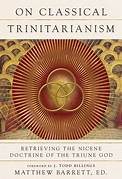
On Classical Trinitarianism–Edited by Matthew Barrett

The subtitle “Retrieving the Nicene Doctrine of the Triune God” tells what we have here. Forty authors giving forty articles covers that subject from every vantage point imaginable. The list of authors is something of a who’s-who as well. Still, it’s a book more likely to have one pick and choose which articles to read rather than reading cover to cover. It’s an incredibly learned resource.

It’s something of a polemic too. These authors are passionate for Nicene Doctrine, perhaps to a fault. I say that because you’d think that it would moor itself to Scripture first and then show how Nicene doctrine is true to Scripture. You would also think it would call for allegiance to Scripture rather than the writings of the Nicene Council. I think the case could probably be made, so why not make it? Here it was just assumed. Still, some of us feel that there are times that Greek philosophy has too much influence, and that viewpoint would never be accepted in this book.

Along the same lines, deep doctrinal understanding is assumed. A newer Christian trying to learn doctrine would not need to begin here. This book is for those already a bit seasoned in theology.

After those caveats, this book is a tremendous resource. There are so many articles that give such opportunity to wrestle with these great things. Several I read had some things that I would not fully agree with, but they gave excellent opportunity to hone my thinking. There were several articles that really interested me, and were quite helpful to me, addressing what has become the battle between classical trinitarianism and social trinitarianism. For the record, I would lean toward classical trinitarianism.

This book will be quoted for years. I simply can’t think of another book on trinitarianism that comes close to this volume in depth. It is a treasure trove of learning. If you can’t learn from this book, you aren’t even trying.

I received this book free from the publisher. I was not required to write a positive review. The opinions I have expressed are my own. I am disclosing this in accordance with the Federal Trade Commission’s 16 CFR, Part 255.
James (NTL) by Joel Green

Joel Green who has been connected to Luke for over 25 years in my mind on account of his popular commentary in another series here turns his attention to James. I’ve been hearing for some time that he also was preparing a major commentary on Acts, so this volume on James was a surprise for me. Apparently, his career has shifted to take on a lot of editorial work as well as he is now the main editor of the NICNT series. In any event, he seemed to enjoy James as he wrote this commentary. It’s as if key parts of James’ emphasis really resonated with him.

Perhaps another surprise is the length of this commentary. It barely comes in at 200 pages. That almost makes it comparable to a TNTC volume. I’ll confess that he makes good use of the pages he used, but clearly he felt no need to drone on and on. Taking it for what he clearly intended it to be, I will label it a success.

Yet another surprise about this commentary, that ultimately does it no harm, is the organization of the book. When you get to the end of the 15-page introduction, you will think to yourself, well, that was good; but where’s the rest of it? And just when you begin to think that he has cut it short, you will jump into the commentary proper and find that he has worked several other of the introductory issues into the text of the commentary.

For example, in explaining the first verse, he describes the authorship and audience of the book. He doesn’t argue for James, the Lord‘s brother, being the author, but he is ambivalent toward it. To his mind, more or less, it doesn’t matter either way. People would take it as if James wrote it according to his view. That seems bizarre to me, but at least we won’t have to hear him attack authorship the rest of the volume. My bias would be that he is more mediating in his theological position than I would be comfortable with, and I came with those expectations, but found that he did not really make those positions the focus of this work.

He covers structure in the commentary on 1:2-27. It made sense. From there, his commentary writing was a mature work. He even had helpful graphs at times. He would offer us an excursus at opportune times throughout the work. He perhaps came to James with his own bias, or at least his own pet subjects, but his professionalism kept him on track.

In an ultimate test of the work for me, I was up for studying a particular passage in James and really read slowly and carefully what he shared on that passage. To be honest, it was really helpful to me. It stretched my thinking and gave me new pathways of thought for interpretation. This volume would be a good secondary option for a commentary on the book of James.

I received this book free from the publisher. I was not required to write a positive review. The opinions I have expressed are my own. I am disclosing this in accordance with the Federal Trade Commission’s 16 CFR, Part 255.
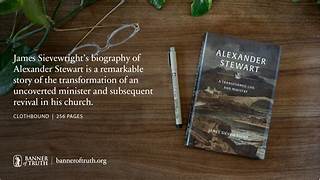
Alexander Stewart by James Sievewright

Alexander Stewart…a man we didn’t know before, but are blessed to meet here. Banner of Truth keeps gifting us with a steady supply of biographies of unknown giants. Calling them “giants” is not hyperbole. Don’t let their relative unknown status fool you. They are men of renown in Heaven, something like a continuation of Hebrews 11. Alexander Stewart is a worthy addition to the publisher’s growing collection.

If you have read some of the previous biographies from this publisher, you know to expect a few things. The man is going to be pious, zealous, and living a life consumed by the Lord Jesus Christ. In most cases, revival taking place during his life, even though justly credited to the Lord, is consistently found. All of that is true of Mr. Stewart.

What is different about him from some of the other biographical subjects they have published? Probably the thing that stands out the most to me is how he came to Christ. He was a pastor before he became a Christian. That certainly is not ideal, but the story itself is fascinating. You will always be saying to yourself as you read, I think he’s close, and yes, he reaches the point of becoming a believer and jumps right into a very dedicated life. You almost wonder if this book could be a help because it seems likely that we live in an age where many people are even perhaps deeply involved in Christian work while they do not yet know the Lord.

From there, the biography is more to the general pattern, but it is a pattern that we should hope starts happening more again. Only God can bring revival, but this is what it looks like. A book like this will make you crave it.

This book, like the others, is beautiful and is of impeccable binding. It’s a little smaller in height and looks a little different while retaining a definite attractiveness. It may not take quite as long to read as some of the others, but it is an absolute blessing. I say keep sending these biographies our way, and while we are at it , let’s pray that the Lord starts sending these revivals again.

I received this book free from the publisher. I was not required to write a positive review. The opinions I have expressed are my own. I am disclosing this in accordance with the Federal Trade Commission’s 16 CFR, Part 255.

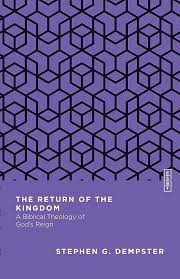
The Return of the Kingdom (ESBT) by Stephen Dempster

Here’s the latest in this delightful series on biblical theology. Several of the volumes take the same subject—the sweep of the biblical story—and tell it from a unique vantage point. So it’s Genesis to Revelation again, as always in this series it is in chunks, this time told from the standpoint of kingdom.

Perhaps more than other title in the series it tells the broader story more, and perhaps better, than that of its perspective—kingdom in this case. The book had so many interesting tidbits and theological nuggets with even a dash of helpful exegetical hints. In this volume, I’d especially glance at the footnotes if I were you.

On kingdom it was helpful. Many passages you’d expect are covered. I figured the messianic Psalms would get great coverage, but he clearly didn’t see them as essential to his discussion. Where, in the most critical omission, was Psalm 110? It seemed to me he presented more depth up to David, but was more streamlined thereafter. He saw Matthew as having its obvious importance in his theme, but could have developed it more.

He didn’t really touch Israel versus either the church or whether it was substituted, etc.. That’s a battleground for dispensationalists and covenant theologians. Most books written on kingdom would pick a hill to die on, but that wasn’t an intense theme for him. It’s obvious to me which side he is on, but he wasn’t as explicit as some in this series either. On the plus side, he was never condescending either.

I hope I haven’t made it sound like I dislike this book, or that it is a failure. It’s still a very pleasant and helpful read. It will give you a lot to chew on about biblical theology, even if I wouldn’t call it the most important book on the theme of Kingdom itself.

I don’t line up exactly where the writers of this series do theologically, but every book in the series, including this one, has been a great blessing to me.

I received this book free from the publisher. I was not required to write a positive review. The opinions I have expressed are my own. I am disclosing this in accordance with the Federal Trade Commission’s 16 CFR, Part 255.