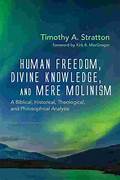
Don’t let the clunky title fool you. This is a great book. I’d come to believe that molinism was the way out of the conundrum of sorting divine sovereignty and human responsibility, but it was this book that led me fully to the invigorating air of clarity. Stratton’s gift is logical argumentation that guides you by the hand to conclusions.
So persuasive was his logical arguments that I went online and watched debates he had with others. It was as if others brought their knives to his gunfight. Strangely enough, some he debated were even more polished in the art of debate, but he just seemed to have them where it counted—actual arguments. It didn’t hurt that he was gracious either. Fortunately, that gracious spirit is also found in this book, though he is relentless in marshaling arguments and looking at the subject from all different angles.
The first two chapters are foundational and I suggest you take your time with them. Here is where you will make a quick observation. This is not casual reading. Make sure you notice that there is no fault in Stratton’s writing, but just that this is a deep subject. I think if you read an occasional paragraph over, and read slowly at all times, you will find this work quite lucid. In my judgment, we have for so long talked in broad generalities about things, and have just not followed through on what they mean. I think there’s a lot of layers inside us that have to be worked through. For example, he will explain what he calls exhaustive divine determinism (EDD), which he wisely defines as “all events are casually determined by God”. When I say there are many things that we have not thought through, you will see the profound implications if God has truly caused every single thing that happens, including every choice that’s ever made.
You probably already know, and it’s an argument that Stratton makes, that a lot of people can kind of agree with libertarian freedom until we touch upon salvation. Then we enter old battlegrounds where we must stay true to our alma mater, so to speak. Then, the focus shifts from merely seeking the truth to the propping up of the home team. I am being a bit vague on purpose here because a lot of people predetermine what they’re going to think about a book like this before they ever read the first word. This book is such a great one and it deserves better.
Chapters 3-10 survey historical periods successively to see how the debates crystallized. Sometimes I think this is not always helpful for a theological work, but in this case, it really is essential. Quite simply, many things, including definitions and categories, have all sprung from debates rather than a direct study of scripture.
Chapters 12-13 bring us back to direct theological issues. What libertarian freedom and its logical necessity simply must be addressed. I thought Stratton was masterful in showing that there logically must be some level of libertarian freedom.
The next chapter introduces us to Luis de Molina. He was a guy who made a brilliant observation that God must possess middle knowledge. Far more than anything about the guy himself, is the scriptural and logical weight of what he said. To my mind, it is profound.
Chapter 15 is the capstone of the book. Here he makes his arguments for middle knowledge and molinism. It is hard for me to see how someone coming with an open mind and a desire for truth could walk away without agreeing with what is presented here.
Chapter 16 is something of an icing-on-the-cake type of chapter. There is some apologetic ways that this teaching can help us. It’s not the heart of the book, but it is very interesting.
I rarely use the term “tour de force ” because it can be so cliche, but it fits here. Another thing I rarely say for the same reason is that I wish this book were so much better known, but I can hardly think of when I meant it more. 
I received this book free from the publisher. I was not required to write a positive review. The opinions I have expressed are my own. I am disclosing this in accordance with the Federal Trade Commission’s 16 CFR, Part 255.
 The Reagan Review