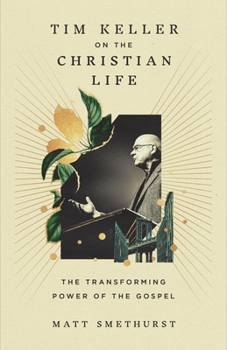
Tim Keller on the Christian Life by Matt Smethurst

This book will make a lot of people happy. People who love Tim Keller are going to see this summary of his salient teachings as an addendum to his biography, especially if they read those copious endnotes, and be happy. Those looking for some rich devotional writing with the best theological precision will be happy. You’re probably catching on, but this book makes me happy.

I admire Keller, but for some weird reason I’ve listened to many of his sermons online while not getting around to reading his works. After reading this book, that process was certainly a mistake. What was I thinking? This work convinced me that I will read him going forward. Each chapter, as best as I can tell, synthesizes his most beloved books. These chapters leave you clamoring for more. I guess this book makes the publishers of Keller’s books happy too.

This book is well written. It doesn’t only propel you to Keller’s books, but says much itself. These chapters stirred me. I prayed some prayers of repentance for the challenge and conviction I encountered (sans the guilt that you know this moralism-hater was incapable of throwing) after several chapters.

I can’t tell you which chapters were the weakest as I found none I didn’t love. I can’t tell you which chapter I love most as I loved so many of them immensely. I can tell, though, that most of them found this reviewer wanting. If I were forced to list its worst feature I guess I’d say endnotes are annoying to keep flipping to when they are so many and too delicious to miss.

Rarely does a book so gallantly reach its aims, but here’s one that did.

I received this book free from the publisher. I was not required to write a positive review. The opinions I have expressed are my own. I am disclosing this in accordance with the Federal Trade Commission’s 16 CFR, Part 255.
Zephaniah (ZECOT) by Jason Derouchie

Here’s the best solo volume on Zephaniah that I’ve encountered and that’s coming from one who has always enjoyed Zephaniah. It’s a small book that packs a punch. The author did the spadework and gave us a gift here.

The style of the this series is a great match for Zephaniah. The Discourse Analysis that is this series’ niche was well done. In fact, as much as I love and have expectations for discussion on structure, this may be the rare volume that had too much. I’ll say this for sure, you won’t need a second book covering the structure of Zephaniah because this book thoroughly weighs all the scholarly perspectives on it. I can’t even say that I agreed with every conclusion on structure, but the options are so thoroughly laid out that the work is done and all you need to do is pick among the options. Kudos to a commentary that pulls that off.

Don’t think that other important topics, however, are overlooked. The introduction discusses authorship, date and occasion, genre, literary features, and audience all before structure is addressed. After structure, there’s some excellent discussion of theology. I thought the highlight was how the author explains Zephaniah anticipating Jesus and his mission. That is taking theology down the correct avenue for sure.

The commentary was strikingly full. Unlike some prolix works, this work does not run off on weird scholarly tangents. There’s much excellent exegesis, linguistics, and thorough discussion of structure, even in every individual passage. I don’t see how preachers or scholars could go wrong with this volume. For preachers, I don’t think the scholarship is so dry that you’ll be turned off at all. Every section ends with more helpful theology, and for all the trees, the forest is never lost sight of. For Zephaniah, this is the way to go.

I received this book free from the publisher. I was not required to write a positive review. The opinions I have expressed are my own. I am disclosing this in accordance with the Federal Trade Commission’s 16 CFR, Part 255.

One, Holy, Catholic and Apostolic Church by Guy Prentiss Waters

The “We Believe” takes shape as a dandy series that taken together will finally make a major systematic theology contribution. Several of these type series are reformed in nature, as is this one, and we certainly aren’t lacking works from that perspective, but this is one to consider to cover that viewpoint. While I might disagree on points, I’ve found real help in each volume of this series.

That being said, this title is a bit more militantly reformed than others in the series. The doctrine of the Church is one that kind of forces you into a distinct lane, but did this scholarly work really need to quote a denominational source of the Presbyterian Church multiple times? Even if the author thought those sources were exquisitely worded, does it really encourage a broad readership? Perhaps, though, if you are a Presbyterian, you’ll want this title even more in the crowded field.

All of that being said, I’m not denigrating the work. Waters is a good writer who presents with clarity. You won’t misunderstood what he’s saying even if you disagree with it. I imagine him to be a good teacher. So many paragraphs are him discussing by listing items one, two, three, etc.

This systematic theology theme is run through the rubric of biblical theology here. It’s also moored to Covenant Theology. Not surprisingly then, he begins in Creation. I see the Church coming along later than that, but there are still connections worth pursuing even if I might not see them as strongly as him. I have the same reservations and enjoyments in his chapters on Abraham, Moses and the Prophets.

The work grew much more captivating in chapter 6 where we meet Jesus, the Eschatological Reconstitution of the Church. The next chapter on the Apostles returns to more expected fields for a work of this type. Part II encompassing chapters 8-13 is more traditional in its contents. Still, the parts touching on local churches especially holds to the Presbyterian mindset.

Chapter 14 felt like Bavinck to me as it addressed things like church and state as well as religious liberty. The Conclusion succeeds as a clear summary as 7 statement are winsomely made to reiterate the work.

I’ve explained a few things in this review to show that you might love this book more if you’re a Presbyterian than if you’re not. Still, it’s a book much worth having.

I received this book free from the publisher. I was not required to write a positive review. The opinions I have expressed are my own. I am disclosing this in accordance with the Federal Trade Commission’s 16 CFR, Part 255.