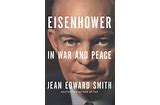
I’ve looked forward to this one for a while. Two presidential biographies ago for me was Smith on FDR. Smith was clearly enamored with FDR, so I wondered if he would be evenhanded to republican Eisenhower. I mean I read his work on George W. Bush several years ago and he proved there he was capable of letting his political bias bleed onto the pages. So I was pleasantly surprised to find him consistently fair to Eisenhower (Man, he didn’t like Nixon!) I believe he actually admired Eisenhower. And for sure he proved to be a master biographer.
As for me, I too admired Eisenhower. Upon reflection, that admiration flowed almost exclusively from WW2. Upon further reflection, I didn’t have a clue about his presidency. Now that Smith brought Eisenhower alive for me I still admire him even if that admiration is a bit nuanced. He certainly wasn’t a conservative like Reagan later on, but he was brilliant politically. He could read the room better than most any president I can think of and he had impressive instincts. In simple terms, he governed like a general with a mission to accomplish. At a minimum, he was a perfect president for his era.
The book made interesting what was a bit of a bland youth. His family connection was no where near Truman who preceded him. His life became much more interesting when he entered the army. In the earliest years of his military career he didn’t stand out as he was more interested in football and other such activities. He even got to do some coaching along the way while in the military and proved to be good at it.
When he married Mamie you got the feeling that it was at least a bit of marrying up. Hers was a wealthy family. She could be both a blessing and a thorn during his career.
Many have noticed that Eisenhower was often a recipient of the most fortuitous circumstances. He was always in the right place at the right time. Had even one of those circumstances been different I doubt we’d even know his name.
Until WW2 he often found himself in the shadow of the larger-than-life Douglas MacArthur. MacArthur helped him at times. Eisenhower served him well in the Philippines, but also saw his hubris up close. Maybe we’d call it a begrudging respect. Less known and more important to Eisenhower on multiple levels was General Fox Conner. Not only did he teach him military tactics, but would always pull strings to elevate Eisenhower any time his career stalled. That’s an advantage that most people would never have.
Eisenhower’s career steadily grew, but by the outbreak of WW2 he was only a colonel. Then those fortuitous circumstances ramped up even more. The most shocking thing for me about Eisenhower’s life was that by the time he led the European theater he had never had a battlefield command! That is mind blowing!
Still, it made sense. No one was his superior in equipping an army. He also was pretty solid in learning from his mistakes. I was amazed at how often his headquarters were far from battle (though that makes sense), even though he was incredibly busy. Through all that planning he lived like gentry. He was an extrovert and he played card games with friends regularly, a practice that followed him through life.
Then there was Kay Summersby. Smith was fascinated with her story and referred to her in every place possible. It’s the only place he really went after Eisenhower. He admitted that it was never proven that adultery happened, but he came across as convinced it did. Because he believed it, Eisenhower moving on from her apparently perturbed Smith. I’m not sure how far it went, but clearly it was inappropriate.
Without doubt, Eisenhower is critically important and is deserving the accolades he received. He was never the great battlefield general, like say Patton, but a war the scope of WW2 needed a guy like Eisenhower to be successful.
Smith went more topical than chronological in describing Eisenhower’s presidency. Some are critical of that approach, and though not ideal, it did the book no real harm. Eisenhower was pragmatic, but there was clear thinking behind it. You might not agree with all his decisions, but he kept us on a straight course. Having been a general, he helped us steer clear of war at all costs. He even clearly foresaw what the military-industrial complex would grow to in our country. I judge him a success.
Smith painted Eisenhower as not particularly religious. He only became a member of a church when his handlers thought it a liability not to in his presidential campaign. I suspect Smith painted him correctly. What he failed to record, however, is that Billy Graham led him to Christ in his later years.
Here is a great book on a great, consequential President (even if his military career is what elevated him).
 The Reagan Review