BibleWhere: An Exciting New Online Resource

book biblewhere.jpg

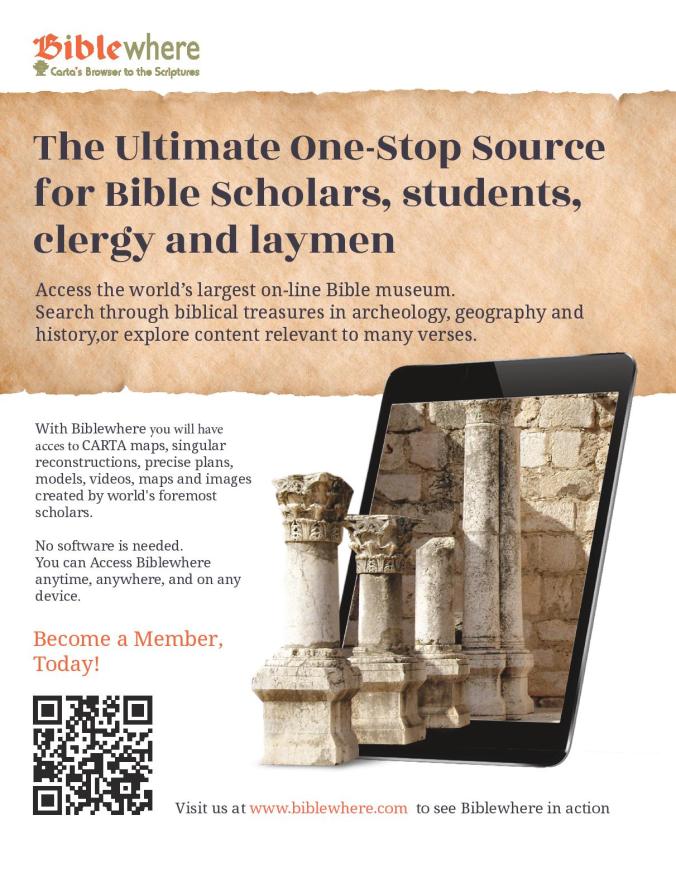
Here’s one of the best digital tools that has ever come down the pike for Bible study. Not only for your own Bible study, this resource is also an extraordinary tool to add visual content to your teaching. Biblewhere is Carta’s Browser to the Scriptures. If you are like me, you have been using Carta atlases, maps, and publications for years and are aware of their sterling quality. I’m a Bible Atlas junkie, I own most that are on the market, and I wouldn’t hesitate to say that Carta has the best Bible maps in existence. Now their treasure trove of resources is available in a searchable online collection.

On the homepage, you can access their most popular content. Even better, you can select any passage in the Old or New Testament and pull up all their content at one time. As a bonus, you can even access references to the works of Josephus. There’s also the option to do a keyword search if you are doing more of a topical study. It’s even possible to filter your results by content or historical epochs.

The content, which is clearly identified with icons, comes up as articles, photos, videos, and maps. The articles are excellent for your own personal study and understanding. The photos and videos are visually stunning and can be easily pulled into your own visual presentations. The program’s designers anticipated the need of those using in church settings, lectures, or meetings. Carta intends for subscribers to be able to use this resource in a wide array of situations, pretty much anything short of copying or pirating. The videos were well done and of documentary quality. Some were only 30 seconds long and could be easily worked into your presentation. And then there are the maps! As I sit in my office, I’ve used Carta resources so extensively that I can easily remember where to find the best Carta map. Now with the Biblewhere you will be as proficient as me with one quick search. You will love these maps! Be sure to check out the map of the Sea of Galilee from the ministry of Jesus (it’s my favorite Carta map).

The best way to check out this amazing resource is to go directly to their site: www.biblewhere.com.

I’ve been told that they have an Affiliate Program too if that would be of interest to you. As for me, I am not compensated for this review beyond the use of the resource itself. I sincerely just wanted to make this fine resource known for pastors and Bible students like me!
ad_biblewhere_26.5x20.5_2_Portrait-page-001.jpg

The Gospel of John by Frederick Dale Bruner

book john bruner.jpg

Here’s a commentary that’s just a little different. The author, Frederick Dale Bruner, who was well known for his earlier two-volume commentary on Matthew, has a writing style that is at once thoroughly academic and personally chatty. How else could I describe this commentary of over 1200 pages where Mr. Bruner seems to be having such fun? I’ve reviewed a lot of commentaries and I don’t think I’ve ever before described the author as having fun. But that is my distinct impression in this case.

The label I’ve heard (“mildly critical”) seems accurate. He follows a few critical theories that I couldn’t accept, yet in other instances he writes beautifully about the deity of Jesus Christ. His preface, again the most personal that I’ve read in a major academic commentary, almost reads like a stream of consciousness flowing happily along. You’ll read about his family and what must be an unusually large social network. He apparently loves people, and with all the interesting people that Christ will encounter in the Gospel of John, that probably makes him an ideal commentator.

There is no introduction to the Gospel of John, which is quite surprising for a major commentary. In any event, the publishers gave him all the room he wanted in the commentary itself. I don’t feel that the more academic subjects that are usually found in an introduction would be his strength anyway, as interesting theology is his forte. I’ve even read that some major reviewer’s think that he misfires occasionally on the exegetical level, but I believe that some well-done theological commentaries are excellent to use on the second pass after we’ve already used our exegetical ones. Maybe it would be fair to call him a modern, mildly critical Herman Ridderbos.

I’ll still reach for D. A. Carson, Leon Morris, and Edward Klink first on the Gospel of John, but I am genuinely happy to have Mr. Bruner on hand to draw out theological reflection and to give me something that the others will not. I found unique angles in every passage I surveyed. Eerdmans went all out with a nice hardback in a very attractive dust jacket. You should check out this lively, bubbling commentary!

I received this book free from the publisher. I was not required to write a positive review. The opinions I have expressed are my own. I am disclosing this in accordance with the Federal Trade Commission’s 16 CFR, Part 255.

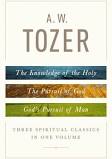
A W. Tozer: Three Spiritual Classics in One Volume

book 3 tozer

It’s hard for me to find the words for how outstanding this volume is! Count me as one of those people who finds A. W. Tozer as one of the most penetrating, spiritual writers of all time. This beautiful, hardback collection of three of his spiritual classics can’t be missed. These titles have mostly been available as paperbacks in the past, but now we have something a little more worthy of these treasures. I wouldn’t be surprised if people call this one of the great publishing events of the year.

The first title, The Knowledge of the Holy, must be included in any list of the greatest Christian books of all time. It is, out of an impressive list, Tozer’s greatest work. This book impacted me several years ago, and it was a joy to go through it again. In conversational language he presents God Almighty in a way few ever have before. The theology is incredibly deep yet perfectly accessible. He astutely feels that so much of what’s wrong with Christianity today is our misunderstandings of God Himself. The attributes of God are shorn of any sort of dry, academic language and are presented in a way that makes you love, respect, and be in awe of God more.

The second title, The Pursuit of God, is another of his best-known works. He disdains our resting on the laurels of our conversion and pushes us to go hard after really knowing God. This book makes us thirst after our Lord and is a true masterpiece.

The third title, God’s Pursuit of Man, might fall slightly below the two mountain peak titles above, but it is a true sequel to The Pursuit of God. It moved me as well.

Not only is this volume with its three incredible titles worthy of the reading time of every Christian, I imagine it would change Christianity itself if it were widely read.

I received this book free from the publisher. I was not required to write a positive review. The opinions I have expressed are my own. I am disclosing this in accordance with the Federal Trade Commission’s 16 CFR, Part 255.

Righteous by Promise by Karl Deenick

book righteous

If you are like me, this book may shatter your confidence about your understanding of circumcision in the Bible. While I might have glibly thought I knew all about the subject, this book exposed the shallowness of my thinking. Karl Deenick has contributed a worthy volume to the multifaceted, highly-respected New Studies in Biblical Theology (NSBT) series, edited by D. A. Carson. Every volume I peruse in this series raises my overall impression of it, and this volume is no exception.

Even though this book strives to produce a systematic theological understanding of circumcision, its strength lies in the exegesis of a multitude of passages about circumcision. In other words, the author makes conclusions based on what biblical passages actually say. Whether you would agree with every conclusion or not, he has done all the necessary spadework for you to make your exegetical and theological conclusions.

The design of this book was a good one to broach the subject of circumcision throughout the Bible. Circumcision clearly is used in different ways, yet the author will take you to a feasible big-picture conclusion at the end.

He begins with an introduction that defines the dimensions of scholarly debate on the subject. As you will see, scholars have not been unified in their conclusions. The next chapter looks at circumcision in Genesis and sees the sign of the promise established. The following chapter looks at circumcision throughout the Old Testament as the sign is developed. We are taken through Leviticus, Deuteronomy, Joshua, and a few other references. Chapter 4 enters the New Testament and entails a discussion of blamelessness and walking in the New Testament. Passages in Philippians, Colossians, and Ephesians are addressed. Chapter 5 is dedicated to the major discussion of circumcision in Romans 2-4. Chapter 6 does the same for Galatians. Chapter 7 is the aforementioned conclusion that looks at righteousness by promise, righteousness by faith, and righteousness through the promised seed. In this approach, the Old Testament is tied to the New Testament and the big picture view of circumcision emerges.

This book is valuable. You can use it for your own careful study of circumcision, or keep it on hand as a reference anytime a biblical passage mentions circumcision. In that case, you’ll have a fine exegetical tool. This book is well worth having!

I received this book free from the publisher. I was not required to write a positive review. The opinions I have expressed are my own. I am disclosing this in accordance with the Federal Trade Commission’s 16 CFR, Part 255.

Apologetics at the Cross by Chatraw and Allen

book apol cross.jpg

Every chapter deeper I got into this book the more it exceeded my expectations. Perhaps I expected that since this book is a textbook it would be a little stale, but I would now rate it as valuable as a read as it is a textbook. One reviewer said this book uses the template of Jesus crucified and risen in setting out to defend the faith rather than the Gospel which is used in most cases. That struck me as a non-distinction, which also lowered my anticipation, yet this book has effectively surveyed the past, brought us to the present, and stayed true to the Word of God.

The first section laid the foundation for apologetics in four chapters. That includes definitions, proof texts, examination of various approaches, and a fine review of the history of apologetics. These chapters teach us much, start the ball rolling on our grasping apologetics, and enlighten us on the successes and failures of apologists in the past. There’s also much to learn about how the culture at the time affected how apologetics was done.

The next section digs into theology in relation to apologetics in five chapters. Another pass is taken on the various approaches of apologetics so that we might glean what is good from each one. You will learn how far various methods can go, and where they might let you down in dealing with another person. I felt the chapters were ideal in helping pull out what was best from what apologists of the past have done. There’s also much emphasis on our living out our faith as a key in apologetics. I fear that is too often missed. In this theological section, apologetics are brought to the foot of the cross. Important information like how our sin nature corrupts human reason, our unrealistic expectations, and the absolute necessity of humility in apologetics. We are also taught to look at the whole person which will use reason to aim at the mind but will also look at the heart, or the whole of the person.

The final section looks at the practice of apologetics in four chapters. These chapters had brilliant insights into our age. What we call postmodernism, they call late modernism, but in any event, our times create new challenges in apologetics. The incredible amount of spin that goes on in our culture makes people think that our presentation of the Gospel is but our attempt to spin the facts to gain something from them. The authors give wonderful suggestions on how to deal with that difficulty in the most effective way. Kindness and humility are still essential.

There’s no doubt that this book beautifully succeeds in its advertised goal of being a quality textbook. To my mind, it too would win out as one of the best possible books for us to have to use in our own study of apologetics. I guarantee you it will be one of the first ones that I will reach for!

I received this book free from the publisher. I was not required to write a positive review. The opinions I have expressed are my own. I am disclosing this in accordance with the Federal Trade Commission’s 16 CFR, Part 255.

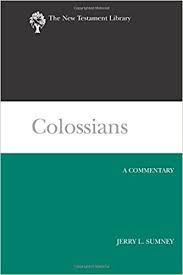
Colossians (NTL) by Sumney

book col ntl

Jerry Sumney, a scholar who has written widely on various Pauline Epistles, gives us this commentary on Colossians in the New Testament Library (NTL) series. I had heard from some well-known reviewers that this volume was “thorough” in its presentation while its outlook was “moderately critical”. Now that I have this book in my hand, I find those designations perfectly accurate.

The author provides a shorter introduction to Colossians, but one that fits with several others I’ve seen in this series. The bibliography, though, was longer than some others. In the Introduction, he jumps first into authorship and date. He reviews many factors to be found in Colossians, such as Colossians being the first New Testament letter that discusses the household code. He thinks that Colossian’s theology is different than the New Testament letters that he feels are undisputed to have Paul as the author. He feels that the Holy Spirit is little mentioned while the approach to Christology goes farther than any other letter. He says that is the key to understanding the book. No doubt, he is right as Colossians teaches us about the preeminence of Christ. The author falls on the side of pseudonymity regarding Colossians but says that authorship has no determination on a New Testament letter being authoritative. Surprisingly, he dates the letter rather early.

Next, he discusses destination, followed by the false teaching present in Colossae, though that is briefer than I would have thought. He covers all he has to say on the textual history in two paragraphs. From there, he dives into theological themes including soteriology, Christology, eschatology, and spirituality.

The conclusions presented in the Introduction helps you to anticipate the direction he will go in the commentary itself. He introduces each text, prints the text, gives copious exegetical notes, and then provides detailed commentary on each verse. Again, whether you agree with every conclusion or not his work is quite thorough and written clearly.

I really can’t think of a better commentary on Colossians from the critical side. It’s up-to-date, not as extreme as some, and you can leave its pages with a clear understanding of how critical scholarship approaches Colossians today. This volume totally lives up to what we have come to expect from the NTL series.

I received this book free from the publisher. I was not required to write a positive review. The opinions I have expressed are my own. I am disclosing this in accordance with the Federal Trade Commission’s 16 CFR, Part 255.

Deuteronomy (OTL) by Nelson

book deut otl

Prolific commentator Richard Nelson has given us this volume on Deuteronomy in the Old Testament Library (OTL) series replacing the earlier work by Gerhard von Rad. Though he is without doubt from the critical side, his work here is widely considered one of the most mature from that viewpoint. In fact, I’ve seen several scholars rank it highly. Its critical analyses are much more up-to-date than the von Rad work it replaced. We have Jack Lundbom for an exhaustive, huge exegetical work and Patrick Miller with a briefer homiletic approach from the critical camp, and that leaves Nelson standing in the middle with the more typical exegetical commentary. Though I clash with the critical viewpoint in many ways, I found Nelson clear and able to provide me a solid understanding of how critical scholarship both looks at and affects the study of the Book of Deuteronomy.

After a brief bibliography, Nelson gives us 12 pages of introduction on Deuteronomy. While that is a little short, he made use of every word in some paragraphs that contained an incredible amount of information that could be mined. After a huge paragraph that opens the discussion of what Deuteronomy is, he enters into a section he calls “shapes and structures”. In this section, he pulls out many nuggets to help you approach your own study of Deuteronomy. He talks about the linguistics of the book and all kinds of structural information. He addresses the final form of the book and while admitting the structure is complex, he makes many astute comments. As you might guess, I couldn’t agree with much of what he said about the composition of the book, but he’s no more extreme than many other writings on Deuteronomy that I’ve seen. He really shined on the section called “theological themes”. I can easily agree that he has suggested many of the main themes found in Deuteronomy while giving insights and references to help.

The commentary proper is a positive representative of the OTL style. He gives the text, a lot of exegetical footnotes, some opening comments on the passage that discusses theme and structure, and then commentary on the text itself. Depending on your theological background, you might be looking for different things in this commentary than other readers. If you know what you’re looking for in an OTL volume, there’s no doubt you will find it here.

I received this book free from the publisher. I was not required to write a positive review. The opinions I have expressed are my own. I am disclosing this in accordance with the Federal Trade Commission’s 16 CFR, Part 255.

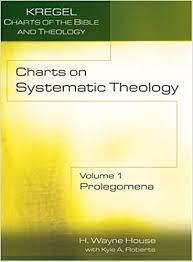
Charts on Systematic Theology: Volume 1 by Wayne House

book chart st.jpg

Wayne House has produced several well-received volumes of charts for Bible study. Kyle Roberts assists him here in producing this volume on Prolegomena, or the introductory matters in the study of systematic theology. This makes up one of the fine volumes in the Kregel Charts of the Bible and Theology series.

This book will fool you in the incredible amount of information it gathers in only 130 pages. It includes both wonderful insights for any Bible student and in-depth explanations of specialized scholarly subjects. The book is designed around 10 subjects.

The book begins with an explanation of what theology is. After a brief introduction, you have two multipage charts explaining both objective and subjective theologies. I found much more help in the former than in the latter! The second section wants to help us find out what are the possibilities of systematic theology. You may discover some camps you weren’t aware of, but the explanation of each group will give you a lot to think about as you form your own viewpoint. The third section is very helpful to encourage a Bible student to understand the different branches of theological study: systematic theology, biblical theology, historical theology, and philosophical theology.

Part four looks at the nature of doctrine and is particularly a description of current scholarly debate. The fifth section tackles what revelation is and where it’s located. For some Bible students, this will be new ground–you would be surprised how much scholarly ink is spilled on these reception theories. There’s some charts on general and special revelation as well. Part six looks at the knowledge and language of God. Since the Word of God is a book of words, these discussions raise some important questions. Part seven looks at hermeneutics and theological interpretation. This naturally goes to a description of types of hermeneutics. Once again, we will have objective and subjective viewpoints about hermeneutics. The charts contain much detail. Part eight takes us to faith and reason. The chart here has good apologetic value too. Part nine goes to the source and structure of truth. You may again be surprised that the hair was so finally split, but you will have a timely overview at your disposal in this book. The final section looks at the relationship between the testaments. The various viewpoints presented fall somewhere on the scale between unity and diversity and there’s also more objective and subjective theologies described as well. The book ends with a lengthy bibliography.

This book skews more toward the scholarly side than some other such volumes of charts. This book’s strength may also be its weakness. Yes, it contains vast amounts of information, but at times more than you’re used to finding in a chart format. In the end, that may be a matter of taste.

There can be no doubt that the authors have grasped the material, taken a snapshot of the scholarly world with all its debates, and made a thorough presentation to us. This book could be the perfect refresher course to pull off the shelf when any of these subjects we encounter with less frequency are faced in our studies. I recommend it.

I received this book free from the publisher. I was not required to write a positive review. The opinions I have expressed are my own. I am disclosing this in accordance with the Federal Trade Commission’s 16 CFR, Part 255.

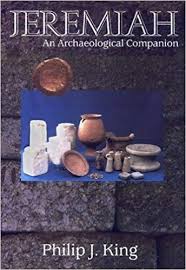
Jeremiah: An Archaeological Companion by Philip King

book jer arch.jpg

Here’s a fine supplement to your commentaries on the Book of Jeremiah. Philip King has envisioned a true resource that takes archaeology and shines it upon the text with skill. It strikes me that most books of the Bible could benefit from a volume designed as this one.

While Mr. King takes a critical stance (three of his favorite Jeremiah commentators are Robert Carrol, William Holladay, and William McKane), I was pleasantly surprised by many things he had to say. His chronological chart at the beginning of the book is not extreme at all. Though he follows some critical suppositions on sources, he upheld the widely accepted chronology and historical background of Jeremiah in most places.

In a brief introduction, he makes a good case for the value of archaeology and biblical studies. The first chapter gives the background of both the prophet Jeremiah and his book. In relating that history, he shares some pictures and information about archaeological discoveries or key places in the life and Book of Jeremiah. The historical background continued in chapter 2 and looked at superpowers that surrounded and impacted Israel in Jeremiah’s time. Chapter 4 gave a whole chapter to the relationship of Edom and Judah since it’s mentioned in detail in Jeremiah. There’s more great pictures and information throughout that chapter.

Chapter 5 brings us back to the cities of Judah and includes some in-depth information on Jerusalem. Again, pictures, drawings, and descriptions of archaeological digs provide wonderful information to the Bible student. Chapter 6 looks at inscriptions and literacy and everything that has to do with writing. Chapter 7 presents worship and architecture. Chapter 8 explains funeral customs with a good description of tombs. Chapter 9 enlightens agriculture while chapter 10 looks at crafts.

The quality of the archaeological information, pictures, illustrations, and historical insights never flag between the covers of this book. I wasn’t sure what I’d find in this book when I picked it up but I was pleasantly surprised.

I received this book free from the publisher. I was not required to write a positive review. The opinions I have expressed are my own. I am disclosing this in accordance with the Federal Trade Commission’s 16 CFR, Part 255.


Demanding Liberty by Brandon O’Brein

book liberty.jpg

This book is hard for me to categorize. The author, Brandon O’Brien, warns us in the preface that that might be the case, but I had no idea that it would be thus to such a degree. It’s not exactly a biography, though I came to know Isaac Backus much better. It’s not exactly a historical treatise, but I found places where my historical understandings were off. It’s not exactly a political statement, but I wondered if there might be one just below the surface. I found myself asking what this author was up to quite early in the book, though I never was sure I could answer that question. To be sure, I found the book deeply interesting and hard to put down.

If the author desired to only overturn the applecart of our neatly packaged conclusions, this book was a smashing success. If he had some conclusion he wanted to take us to, then not so much. The titles alone of his previous books, Misreading Scripture with Western Eyes and Paul Behaving Badly, had me wondering if he was something of a provocateur. When he admitted that he was a Baptist who had become a Presbyterian and now was writing on a Baptist hero, I wondered if he was something of a rabble-rousing raconteur too. As a Baptist myself, when some of his first comments seemed to overplay the lack of education of the early Baptists, I was sure that it was so. But alas, he was quite fair to the Baptists overall and even seemed to have a real admiration of their dedication and of Backus himself.

He did prove to me that I have been something of a reductionist in how I view the Christian heritage of my country. It was much more of a battle than I carried in my convenient memories, but I retain my amazement at where it landed. On a few occasions, he took that premise a little too far. I’m not convinced that the Jefferson described in the introduction was as anti-religion as he was portrayed, nor do I see the full weight of the parallel of conservative Christians today to their forebears with “a difference between being marginalized and feeling marginalized.” Still, there might be enough truth in it to call for some introspection.

This book held my attention until the last page. I’m still not sure whose side the author is on, or if he even knows. He did, however, ask good questions. My conclusions are ultimately the same, but I would have to admit that my views are a little more nuanced after reading this book.

We are at the point of this review where I’m supposed to give a recommendation. Perhaps if you’ve read this far you already have all the recommendation that I could give you. Clearly, this book influenced me. Maybe you will want to find out if it will have that effect on you.

I received this book free from the publisher. I was not required to write a positive review. The opinions I have expressed are my own. I am disclosing this in accordance with the Federal Trade Commission’s 16 CFR, Part 255.