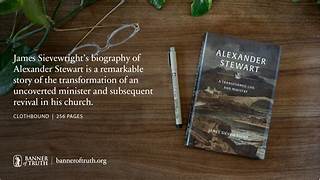
Alexander Stewart by James Sievewright

Alexander Stewart…a man we didn’t know before, but are blessed to meet here. Banner of Truth keeps gifting us with a steady supply of biographies of unknown giants. Calling them “giants” is not hyperbole. Don’t let their relative unknown status fool you. They are men of renown in Heaven, something like a continuation of Hebrews 11. Alexander Stewart is a worthy addition to the publisher’s growing collection.

If you have read some of the previous biographies from this publisher, you know to expect a few things. The man is going to be pious, zealous, and living a life consumed by the Lord Jesus Christ. In most cases, revival taking place during his life, even though justly credited to the Lord, is consistently found. All of that is true of Mr. Stewart.

What is different about him from some of the other biographical subjects they have published? Probably the thing that stands out the most to me is how he came to Christ. He was a pastor before he became a Christian. That certainly is not ideal, but the story itself is fascinating. You will always be saying to yourself as you read, I think he’s close, and yes, he reaches the point of becoming a believer and jumps right into a very dedicated life. You almost wonder if this book could be a help because it seems likely that we live in an age where many people are even perhaps deeply involved in Christian work while they do not yet know the Lord.

From there, the biography is more to the general pattern, but it is a pattern that we should hope starts happening more again. Only God can bring revival, but this is what it looks like. A book like this will make you crave it.

This book, like the others, is beautiful and is of impeccable binding. It’s a little smaller in height and looks a little different while retaining a definite attractiveness. It may not take quite as long to read as some of the others, but it is an absolute blessing. I say keep sending these biographies our way, and while we are at it , let’s pray that the Lord starts sending these revivals again.

I received this book free from the publisher. I was not required to write a positive review. The opinions I have expressed are my own. I am disclosing this in accordance with the Federal Trade Commission’s 16 CFR, Part 255.
The Return of the Kingdom (ESBT) by Stephen Dempster

Here’s the latest in this delightful series on biblical theology. Several of the volumes take the same subject—the sweep of the biblical story—and tell it from a unique vantage point. So it’s Genesis to Revelation again, as always in this series it is in chunks, this time told from the standpoint of kingdom.

Perhaps more than other title in the series it tells the broader story more, and perhaps better, than that of its perspective—kingdom in this case. The book had so many interesting tidbits and theological nuggets with even a dash of helpful exegetical hints. In this volume, I’d especially glance at the footnotes if I were you.

On kingdom it was helpful. Many passages you’d expect are covered. I figured the messianic Psalms would get great coverage, but he clearly didn’t see them as essential to his discussion. Where, in the most critical omission, was Psalm 110? It seemed to me he presented more depth up to David, but was more streamlined thereafter. He saw Matthew as having its obvious importance in his theme, but could have developed it more.

He didn’t really touch Israel versus either the church or whether it was substituted, etc.. That’s a battleground for dispensationalists and covenant theologians. Most books written on kingdom would pick a hill to die on, but that wasn’t an intense theme for him. It’s obvious to me which side he is on, but he wasn’t as explicit as some in this series either. On the plus side, he was never condescending either.

I hope I haven’t made it sound like I dislike this book, or that it is a failure. It’s still a very pleasant and helpful read. It will give you a lot to chew on about biblical theology, even if I wouldn’t call it the most important book on the theme of Kingdom itself.

I don’t line up exactly where the writers of this series do theologically, but every book in the series, including this one, has been a great blessing to me.

I received this book free from the publisher. I was not required to write a positive review. The opinions I have expressed are my own. I am disclosing this in accordance with the Federal Trade Commission’s 16 CFR, Part 255.
Colossians (WBC) by Clinton Arnold

This is an erudite, massive commentary in spades. Mark it down as far less tedious than we might often label commentaries on this scale. Mr. Arnold is not like some commentators who have a whole string of commentaries like, say, Douglas Moo, but he is rather that one who walks for years with one book of the Bible (well he did Ephesians too). The twenty years Arnold spent on Colossians makes him able to deliver on a magnitude that not many people can. He probably knows how many times Paul sneezed as he wrote Colossians (yes he believes Paul is the author), or what he had for lunch.

The thing that is amazing about this book is that the stars were aligned for it to be dull, but it wasn’t. For example, he wrote the most prolific section on the archaeology of the area that I have ever, and I read to the end! He has been there over and over and though he had all the requisite research, he really gave a bird’s-eye view. I simply don’t remember ever seeing something like that before.

Another trick he pulled off is in how he “interacted” with other scholars without turning into a sleep aid. He more weighed them in the balances and found them wanting. Consider the authorship of Colossians by Paul that has had pot shots taken at it for years. Arnold took the four categories of language, style, theology and historical plausibility and analyzed all the evidence for scholarly opinion. Sometimes the evidence was suspect while at other points it just didn’t exist, more like pulled out of the air. Read the excursus on Bujard where he took Bujard’s own data and proved him wrong.

In the commentary proper discussing the Hymn look how he exposed Kasemann. He wasn’t ugly about it, but proved it was merely a collection of unproven assumptions. As fascinating as it was to read, it’s also bewildering that such nonsense can enter scholarship and dominate it.

There are things mentioned in Colossians chapter 2 that are difficult to grasp even if the larger picture is quite clear. I really appreciated Arnold here. The discussion of “magic” is a weird scholarly exaggeration in many ways, but Arnold is for sure an expert on that line.

His writing on the Household Code was restrained and yet helpful. He really didn’t get in the whole egalitarian versus complementarian discussion, as much as just stating what the text was saying. He didn’t skirt it, but was as thorough as ever. I appreciated much of what he said there.

This is an outstanding commentary. Its scholarship is impeccable while what the rest of are after is here if you will invest just a bit of time. I don’t think you’ll regret it.

I received this book free from the publisher. I was not required to write a positive review. The opinions I have expressed are my own. I am disclosing this in accordance with the Federal Trade Commission’s 16 CFR, Part 255.
The Beginning of the World by Henry Morris

Some years ago, I read a few works by Henry Morris and always had warm feelings about them. He wrote on Creationism and Christianity, sometimes even commentating on books of Scripture. His forte was clearly laying science before Scripture. He always showed evidence of being studied and had no doubts of the validly of Scripture. Not really an exegete, so devotional is really the space he works in.

I’m excited to see the reprinting of several of his titles in a new series called The Henry Morris Signature Collection. They have a crisp look and are a good mixture of the familiar and the new. One of the titles that was new to me was this one that digs deep into the scientific aspects of the first 11 chapters of Genesis.

Obviously, this portion of Scripture is the battlefield of the war between Creation and Genesis. I’m amazed at what simple arguments he presents that absolutely obliterates evolution. For example, the two Laws of Thermodynamics as he well explains are simply insurmountable for evolution. Once after an incredible list he says, “The vaunted evidences of evolution are actually quite trivial”. Ouch! But after reading what went before you are thoroughly compelled to feel the same way.

This book will be helpful for a wide spectrum of users. Pastors and teachers will enjoy it beside a regular commentary to see the science boldly confronted in the text. Bible students, and even younger ones, can still follow the presentation and learn so much.

When you read this book you will wonder how it could possibly be such a minority position with both the Bible and science so clearly on its side. Warmly recommended.

I received this book free from the publisher. I was not required to write a positive review. The opinions I have expressed are my own. I am disclosing this in accordance with the Federal Trade Commission’s 16 CFR, Part 255.
Hebrews (ZECNT) by Douglas Moo

A master exegete tackles the toughest book for exegesis in the New Testament. What could be better than that? I often think of Moo as a Pauline scholar, but he already has an excellent work on James to his credit. Hebrews is not for amateurs and this book is a win for us.

At first, I saw the 17-page introduction and I thought, you’ve got to be kidding! Silly exaggerations entered my mind—was he not going to give this the same level of intense work he gave other commentaries? Reading it run all that silliness right out of my mind. When he made the case with perfect clarity for all that we just can’t know about Hebrews, things that make up the bulk of many Introductions, you realize that there was no need for more pages. Perhaps a few pages more on structure would have been nice, but that is never going to dominate his writings.

On to the commentary of the text—wow! He is an exegete par excellence. Honestly, I felt like I was reading someone in awe of the text accompanied by a rock-ribbed determination to be true to it wherever it took him. I offer up the warning passage in Hebrews 6 as a case in point. It was the text first and his theological predilections second. It’s hard for me to fully express how much I respect that. I’m not sure I agreed with his final conclusions completely, but I am better for having read it. I’ll never study the passage again without reading it.

This may be the best commentary for exegesis on Hebrews available. Peter O’Brien’s commentary is the only one I felt that way about before, but it’s in a defunct status now anyway. Moo needs no commendation from me, but I offer it nonetheless.

I received this book free from the publisher. I was not required to write a positive review. The opinions I have expressed are my own. I am disclosing this in accordance with the Federal Trade Commission’s 16 CFR, Part 255.
God Dwells Among Us (ESBT) by Beale and Kim

This is an awesome series, but mark this one with the Edward Klink volume as my favorites. In the old battle of the trees versus the forest this one pulls off a coup by taking the trees to construct a grand forest. And oak trees at that.

Strangely enough, I almost thought it might be a dud. I mean where a new author (Mitchell Kim) takes the work of an old author ( G. K. Beale) and makes a new book from the old book just didn’t sound like a winning proposition to me. Why not just get the old book? After reading this work, I’m of a different mind. Either get both books, or get this one, but I’d recommend not getting the old book over the new one.

The old book (The Temple and the Church’s Mission: A Biblical Theology of the Dwelling Place of God) is a masterwork of its kind, but this one reads better…a lot better. Mr. Kim is not just riding the coattails of a seminal work, but he took the vitamin-filled book and made it tasty to the palate. At times, it even had its devotional moments. I learned AND I enjoyed it.

So the theme of Creation, or Eden, as the first Temple is quite familiar to me, but the connections made here were the most compelling I’ve seen. As the book traveled through the Tabernacle and Temple it revealed threads that I had frankly missed. The book reached a profound level for me when it got to Jesus. Especially the statements Jesus made about the Temple were far more packed with meaning that I realized. The final chapter on the New Jerusalem as the Temple was, without hyperbole, thrilling for me.

Only the chapter on Eden’s ministry fell flat for me. The interpretation for Revelation 11 just didn’t seem plausible to me. As with every title in this series, the authors swear by Covenant Theology. I don’t fully subscribe to that viewpoint, but some of these larger concepts transcend our typical divisions. We view from the mountain tops here.

Beale is a genius. Kim has the winsome writing down. Together they made this one is a gem!

I received this book free from the publisher. I was not required to write a positive review. The opinions I have expressed are my own. I am disclosing this in accordance with the Federal Trade Commission’s 16 CFR, Part 255.
The Giver of Life (WB) by J.V. Fesko

This second volume in the We Believe (WB) holds up the high expectations established by the first one on Christology. Most major Christian publishers have a series of this sort covering various doctrines that together form a systematic theology and this one so far is standing out in a crowded field.

This volume gets two of the key topics of such systematic theologies—salvation and the Holy Spirit. I judge it far more passionate on the subject of salvation than that of the Spirit. My guess is that the author gets consumed with the Spirit carrying out the application of salvation and that swallows the discussion at large. The discussion on the Trinity and, for example, the gifts, almost seemed tacked on to get to the heart of what he really wanted to talk about—salvation.

On other quick caveat is that this book is overtly reformed. I could almost jokingly say that it is more reformed than it is Christian, but not everyone might appreciate my humor.

With that out of the way, that passion he has that I spoke of is quite beneficial and enjoyable in studying salvation in all its glorious beauty. Mr. Fesko comes across as a captivating teacher. You of necessity will learn. Isn’t that the target we’re aiming for in this type of series? You will often love what he’s saying too, and when you occasionally disagree, you’ll at least have the consolation that he’s having a good time.

I have a system of jotting brief notes and page numbers in the front cover of books where what’s being written really resonates with me. I have 17 such notations in this one of things that really rang the bell for me. In case you’re wondering, that means this one ranks high for me. I’ll consult it again too—that’s another dead giveaway for me that we have a winner here. I wouldn’t make him your only guide, but this author is a teacher at whose feet you should spend some time.

I received this book free from the publisher. I was not required to write a positive review. The opinions I have expressed are my own. I am disclosing this in accordance with the Federal Trade Commission’s 16 CFR, Part 255.
A Guide to Biblical Commentaries (11th Ed.) by John Evans

Here’s a book I love and use regularly, at least I have for over a decade with previous editions. So I deliciously devoured this new edition when it arrived. I have personally reviewed several of the new entries here that have been published since the last release, but I really value his assessments.

He’s the best in the field for these kinds of recommendations and it isn’t even close. And, yes, I’ve seen all the others. His presentation is the most logically organized and his evaluations, though a bit complex, can be followed to advantage if you read his explanation a time or two.

His work is what Spurgeon’s was long ago and Cyril Barber’s works were a generation ago. Strangely enough, he denigrates Barber for being too dispensational. Methinks a few reformed/covenantal theology titles got extra stars for that alone here just as Barber flipped it before. And let’s don’t even discuss what Spurgeon said of Plymouth Brethren writers. But it’s no problem in any of them. Find their bias and adjust accordingly. The bias is real enough that not holding Mr. Evans’ theology may get more negative comments than, say, a very critical or liberal volume. I’ll never understand that, but the world has passed me by in many ways anyway . Still, I wouldn’t even think of not having and using this book.

He tries to write for pastors, but he’s just as interested, and maybe more, for the scholarly volumes. Pastors, don’t worry about that as you’ll know inherently how to adjust. If you compensate for the few biases, you will I think find evaluations easy to line up with. At least I did. You might occasionally disagree. For me, he’s far too harsh on the EEC on the Epistles of John (Gary Derickson). He drowned on the differing theology and overlooked the impeccable exegesis. But that is mostly rare.

This can really help you plan and build a library. Even if like me you have a fair number of the books reviewed, you’ll see something you’ve just got to have. I’ve just got to grab Morales on Numbers after reading here. Grab this book, read it, and let the fun begin.

I received this book free from the publisher. I was not required to write a positive review. The opinions I have expressed are my own. I am disclosing this in accordance with the Federal Trade Commission’s 16 CFR, Part 255.
Esther (CSC) by Andrew Steinmann

Esther gets its own volume now as the NAC morphs into the CSC. The old volume was combined with Ezra-Nehemiah, and though serviceable, this one improves the commentary on Esther. Andrew Steinmann has produced quite a body of work by this point and is getting a good reputation. He is pleasantly reliable in his approach to the text.

Esther is a challenge for some scholars and the result is that plenty of commentaries have been written on this lovely book that have the equivalent value of a mechanical pencil without lead. Here the pencil is stocked and writes again.

Steinmann marshals fine material and helpfully presents it even in areas that are often dull. In my estimation, he is better presenting the trees than the forest. To be sure, he beautifully presents the trees, picks the right trees to present, and leads us to being proficient spiritual arborists. I’m not saying he never presents the big picture, it just doesn’t seem he carries it over with the right oomph. In fairness, he discusses things like reversals and things that God is doing and so he doesn’t miss it. Fortunately, he gives you every thing you need so that if you are paying attention at all, you will arrive at the big picture on your own.

In the introduction, he covers everything well except structure. An outline is all he offers on that score.

The commentary is sufficiently detailed and is exactly what most people will need. If you need a massive exegetical commentary, check out the superb EEC volume on Esther. If you just need something for teaching and preaching or personal study, you will likely highly value this work. It would in my opinion substantially outrank the similarly styled TOTC volume on Esther.

I feel this commentary might be exactly what many are looking for.

I received this book free from the publisher. I was not required to write a positive review. The opinions I have expressed are my own. I am disclosing this in accordance with the Federal Trade Commission’s 16 CFR, Part 255

Proverbs (ZECOT) by Christopher Ansberry

I’ve often not been satisfied with the newer exegetical commentaries on Proverbs. My complaints run from brevity on individual verses or even saying nothing meaningful to drowning in scholarly issues and still saying very little. To be sure, I cracked this book open with expectations. Were they met? You bet they were.

It took a few pages to figure out how much I liked it. The Introduction started slowly. Maybe he buried the lead for a bit. At length, I realized that he was giving me the pieces before he weaved them together. What I ended with was an articulate presentation of what’s really going on in the Book of Proverbs. Along the way, he obliterated the common criticism that Proverbs is either moralistic at best or boringly cliche at worst.

The discourse analysis that is the hallmark of this series was tangibly good. The scholarly minutiae was handled well without bogging down the periscopes. The exegesis was rich and the theology thoughtfully given.

And here’s the best thing: no verses are passed over or given a cursory, bland sentence or two. You can go to that specific verse and get real help. That’s what I was wanting and I got it.

I received this book free from the publisher. I was not required to write a positive review. The opinions I have expressed are my own. I am disclosing this in accordance with the Federal Trade Commission’s 16 CFR, Part 255.