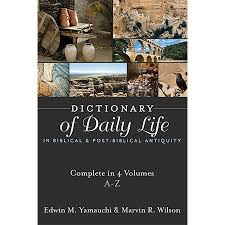
Dictionary of Daily Life–A Great 4-Volume Set

book-4-set

Finally, this wonderful set is complete in four volumes. It took years to put together and the volumes have been released over the course of a couple years or so, but now this fun resource edited by the outstanding scholars Edwin Yamauchi and Marvin Wilson is available to us.

Why secure this set compared to so many others on the market? It’s really two things: 1) the unique approach, and 2) the valuable, scholarly, and well-written entries.

This dictionary did not limit itself to Bible words only, but to subjects as they occur to us. The value there is making accessible Bible times in a way that overcomes our cultural biases. Think of something that you would really like to know and I suspect you will find an entry on it.

You may read a line that you disagree with, but there’s enough depth to really wrestle with the subject. Bibliographies will chart you a course for further study, though I doubt you will need it.

This set isn’t designed as a visual resource as is the current rage, but the text here will teach what you are really looking for.

This set is in paperback (it can hold its own with its big hardback competitors too) and so its retail price is much more in line with what an individual student might pay. Those other sets only end up in libraries.

I guarantee you will enjoy and learn from this set!

I received this book free from the publisher. I was not required to write a positive review. The opinions I have expressed are my own. I am disclosing this in accordance with the Federal Trade Commission’s 16 CFR, Part 255.
Since I individually reviewed every volume except volume 3, here’s a review of it:

Volume 3 upholds the high standards we have found in the previous releases. The design is exactly the same, and fortunately so are the fine results.

Highlights in this volume include marriage,  libraries and books, laws and crimes, medicine and physicians and even unique subjects like nursing and wet nurses.

This book, just as the whole set, is a treat and an amazing resource!

I received this book free from the publisher. I was not required to write a positive review. The opinions I have expressed are my own. I am disclosing this in accordance with the Federal Trade Commission’s 16 CFR, Part 255.
Exploring the Old Testament: A Guide to the Historical Books

book-hist

This attractive volume by scholars Philip Satterthwaite and Gordon McConville is part of the four-volume set on Exploring the Old Testament published by IVP. This book has been widely used since its publication a few years ago and now there is a new release of this volume in paperback while the hardback edition is still available.

Much like its companion volumes it aims at serious beginning students, though anyone will find it useful. Because undergraduate students are a big part of the intended audience, there’s some discussion of scholarly trends that pastors will not find interesting. Still, because of the useful layout, those irrelevant sections are easily passed over.

Personally, I found too much coverage in the Introduction on the historicity, or the lack thereof, among some scholarship of these books. Though this book usually came to the right conclusion, most of us who preach the Word are not concerned with that dubious scholarship.

The chapters on the books themselves were much more interesting and valuable. Structure, outline, and theology were all well presented. This volume had the most meaningful charts in these series too from my point of view.

This volume is enlightening and I recommend it. For that matter, the whole set (there’s two more volumes that cover the New Testament as well) would be a boon to any student.

I received this book free from the publisher. I was not required to write a positive review. The opinions I have expressed are my own. I am disclosing this in accordance with the Federal Trade Commission’s 16 CFR, Part 255.
Inductive Bible Study by Fuhr and Kostenberger

book-inductive

This book is ideal for pastors, teachers, or students to get a grasp of studying the Bible either for personal study or sermon preparation. Though it covers some of the classroom jargon, it is written on an accessible level to help any of us. The well-respected authors rightfully admit there is both science and art at play in digging out the real meaning of Scripture. Then they proceed to help us learn the science side while confessing what the science side cannot provide. To my mind, they are highly successful in what they set out to do.

Inductive Bible study is simply hermeneutics with an evidence-based approach rather than a deductive, or assumption-based, approach. With so many bad habits out there, this is critically needed information. If you grab a handful of these type books, you’ll see that the authors often create their own design and, at times, terminology to present the rules of Bible interpretation. Some use a spiral, etc., but the author’s approach here is one of the best I’ve seen to practically understand the concepts.

They present the inductive approach as observation, interpretation, and application. The chart on page 45 shows the 5 steps of observation and each step gets a chapter. All are well done and the one on “determining literary units” provided a special and often-overlooked balance. Interpretation has 5 steps as well and application has three.  The chapter on determining word meanings should be read by everyone. Be sure to read to the end as I really appreciated how they concluded the subject. The charts throughout the book were outstanding as well.

This book is likely the best one out there for pastors and students today.

I received this book free from the publisher. I was not required to write a positive review. The opinions I have expressed are my own. I am disclosing this in accordance with the Federal Trade Commission’s 16 CFR, Part 255.
Dictionary of Daily Life: Volume 4

book-dictionary

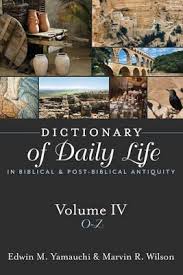
This is the final volume of an unique set. Editors Edwin Yamauchi and Marvin Wilson continue the high quality of work, here  covering O-Z, that we found in the previous volumes. Many scholars joined forces to provide us with this special resource. The setup that even includes a few pictures at the end matches the previous volumes. Together these volumes make an attractive paperback set.

The feature that makes this a special set is what it chooses to cover. It does not limit itself to specific Bible words, but addresses daily life issues in the way we think of them.  That means that things like sanitation, spectacles, trade, and viticulture get covered. There are also things that you would expect like slavery, taxation, and threshing and winnowing, but at more detail than you would imagine. Touchy subjects like prostitution and same-sex relations are well covered too. Those articles were solidly scholarly and conservative.

The best compliment I can pay this volume is that I never failed to learn more than I knew of information worth knowing. I recommend this volume and wish more such sets were modeled after it..

I received this book free from the publisher. I was not required to write a positive review. The opinions I have expressed are my own. I am disclosing this in accordance with the Federal Trade Commission’s 16 CFR, Part 255.

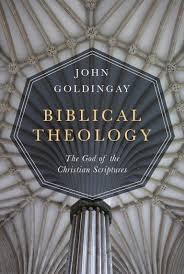
Biblical Theology by John Goldingay

biblical-theology

John Goldingay, who has already produced a three-volume theology of the Old Testament and another on Isaiah’s theology among many other works, has now broadened his sights to the theology of the entire Bible. Because of his stature in the scholarly world, I predict this will become an influential volume.

As for me, I picked it up with a fair amount of skepticism. As a staunch conservative,   I find Mr. Goldingay sometimes on the other side side of the tracks. (There is a debate out there about whether he is really an evangelical or not). For the record, I found several sentences that were subversive to my eyes in this book. I thought I should pick one such statement for this review to prove my point. On page 74 in an explanation of Jesus as the I AM he says, “… The New Testament’s references to ‘worship’ of Jesus need not imply that he is seen as divine.” Are you kidding? To be fair, in the next paragraph, he returns to a more orthodox description, yet he has some such statements along the way. He is clearly a provocative writer, but where he succeeds as a writer may also be where he fails. As a provocateur he should stop short of inciting cardiac arrest in his readers!

Not that I am the standard, but I found myself disagreeing with many of his conclusions  along the way too. I only mention that because of what I want to say next.

This book threw away the mold of traditional theologies. I had never noticed before just how close a script all such volumes had in the past. From differing theological perspectives, they all present the same way. Here’s the Doctrine of God and off they go …1, 2, 3. Goldingay, for the better or worse, wrote his own script. That approach makes for creative new Approaches to study, even if you are a conservative like me who says often as you go, “O, you’re wrong again there, Mr. Goldingay.”

If you are as conservative as me, this is not going to be your first choice for a theology on your shelf. But if you are like me, you are going to make it one of a handful you always consult just to help you think outside the box. He simply made me think about things that I had never thought of before. I like that! I’ll make my own conclusions anyway, thank you. So I unashamedly give 4 out of 5 stars and recommend a book that I thought I might not.

I received this book free from the publisher. I was not required to write a positive review. The opinions I have expressed are my own. I am disclosing this in accordance with the Federal Trade Commission’s 16 CFR, Part 255.

Exploring the OT: A Guide to the Psalms and Wisdom Literature

book-exp-wisdom

Ernest Lucas provides a helpful introduction to the Wisdom literature of the Old Testament in this fine volume. It is, perhaps, the best of the four volumes that make up this series on Exploring the Old Testament. Together with the corresponding volumes covering the Pentateuch, the historical books, and the prophets, these books make for a solid Introduction the the whole Old Testament.

The strength of this volume is far and away the skill at which he describes the special elements of studying the Wisdom literature of the OT, particularly for those who might never have studied it before. He guides the student through poetry, parallelism, and how wisdom was used in ancient culture. He also spends a fair amount of ink explaining classifications of psalms. He provides a fine general introduction to each of the 5 books of Wisdom literature as well.

The only negative is too much respect was given at times to some scholars too far off the reservation. For example, in his fascinating review of psalm classification I wish he had considered more conservative scholars as well. Still, even that part was instructive. The psalms he chose to explain in depth could be argued if his premise was that they were the most important. For example, where were the Pilgrim Psalms? Overall, the strengths far outweigh the weaknesses.

I recommend this volume for your studies of the Wisdom literature of the OT.

I received this book free from the publisher. I was not required to write a positive review. The opinions I have expressed are my own. I am disclosing this in accordance with the Federal Trade Commission’s 16 CFR, Part 255.

2 Volumes for NT Introduction

book-explo-nt

Exploring The New Testament: A Guide to the Gospels and Acts

This is the Second Edition of a well-received volume by scholars David Wenham and Steve Walton. It’s part of a 2 volume set with another volume by different scholars covering the rest of the New Testament. Actually, there are 4 other corresponding volumes that cover the Old Testament as well. Currently, this volume is available in either an attractive hardback volume or a more economical paperback edition.

It’s aimed at first- or second year college students. Though it has features that will appeal more to those planning to become scholars than pastors or Bible students, it is still a fine volume for anyone.

The page layout is appealing and there are multiple things to look at depending on what you’re studying at the moment. It is not set up as a chapter per NT book only as are so many such volumes. There’s over 40 pages to set the stage of Jesus and the NT. Next there is a a good bit of critical discussion that is not as interesting to many readers. There’s three chapters that discuss the direction of scholarly studies of Jesus. The balance of the book is on the four Gospels individually and Acts .

This book is my favorite of those I’ve used in this series and I recommend it.

I received this book free from the publisher. I was not required to write a positive review. The opinions I have expressed are my own. I am disclosing this in accordance with the Federal Trade Commission’s 16 CFR, Part 255.

book-nt-letters

Exploring The New Testament: A Guide to the Letters and Revelation

Here’s the Second Edition of a book by I. Howard Marshall, Stephen Travis and Ian Paul that is often paired with “Exploring the NT: A Guide to the Gospels” by different scholars. Currently, this volume is available in either an attractive hardback volume or a more economical paperback edition.

Aimed at beginning college students, this volume sometimes addresses issues that are more important to scholars than everyone else. Still, it is best that we all be aware at least of where current scholarship is trending.

The setup is exactly the same as its counterpart and that is a plus. In addition to presenting typical introductory issues, the authors give us sidebars to get us thinking. There’s a good introduction to Paul over a few chapters and a chapter for each of the NT books after Acts. Most are helpful, though the one on Revelation is too vague to be of use to the student.

This book and its counterpart are a great asset on studying the New Testament.

I received this book free from the publisher. I was not required to write a positive review. The opinions I have expressed are my own. I am disclosing this in accordance with the Federal Trade Commission’s 16 CFR, Part 255.

How To Find Economical Used Books

books-used

On occasion people ask me questions about books and I imagine the biggest book question anyone could have is how to find books on the cheap.Whether you just want to buy someone you love a few books for a gift, or whether you are trying to build a first-rate library yourself, it’s imperative to find the best deals as the current retail, and even some used book prices, are exorbitant.

The first step is making a list of the books you most want. If you focus on just one book at a time you will pay more–far more. From a list you can next buy the book that is at the best bargain now. You never know what book you’ll be buying next, but you’ll likely get them all over time and at a great discount. I’ve waited years for some volumes. Maybe you are setting a budget for a certain period of time and you will work in that constraint, but you can still build the best library for the best price that way. My wife and I give ourselves around $20 a week for play money, and since there is absolutely nothing I want in the world other than books, I usually buy from my current list the first of every week based on the best bargain I find.

As we discuss the tools to find these books, just remember the best sites may change over time. There was a time not that long ago I bought the most books from eBay, but that has changed to Amazon as many used sellers list there now. It’s also best, though, to double-check alternate sources before you click “buy” on your favorite site as the price may have dropped too.

Things To Do To Buy Cheap Books: 

  1. Camelcamelcamel.com

This is a site that monitors Amazon. You make a list by searching out the books you want and putting in the price at which you want a notification. There’s also data on what it has sold for in the past on Amazon. If the current price is substantially higher than the listed “lowest price ever”, then likely you should wait a while. Apparently, sellers set prices based on other Amazon sellers. If one seller puts in an absurd price, then several other sellers may do so for a while. It will come back down. Just wait.

2. Addall.com

This is another site that checks many other sites for the cheapest price. It has superior search options and you will likely find the best price. The downside is that you can save your lists by the “memo” options, but it erases every time you clean cookies or other big technical stuff on your computer.  There’s no notifications either.

3. Ebay.com

Ebay has changed over the years and there are now far more “buy it now” listings with a set price than actual auctions. Still, bargains can sometimes be had, and you will get notifications for items in your watch list.


There are a few other sites out there like abebooks.com, alibris.com or half.com, but I rarely find the best bargains there. Still, they’re worth checking if you need one specific book only, though addall.com monitors some of them too. Don’t forget to check library sales (even from theological libraries) or thrift stores for a good deal on a more common title.

A Word On Which Book To Buy

Sometimes you can find an inexpensive paperback edition of a book often found in nicer hardback editions. Here it’s best to think about what uses you plan for the book. Will you refer to it often for years to come? In that case, a few extra dollars for a better edition will be worth it.

Best wishes on building your theological library or trying to find that desired volume for a loved one!


2 Corinthians and 1 Peter by Lightfoot

book-lightfoot

This unique book finishes IVP’s The Lightfoot Legacy Set of the recently discovered unpublished writings of J. B. Lightfoot. If you ever peruse used book listings you will see just how popular his commentaries have been for many years. The book has a gorgeous cover and is, to my mind, as much a collectible item for those who are assembling fairly complete libraries as it is a usable commentary.

On the negative side, you really couldn’t call the portion on either 2 Corinthians or 1 Peter a complete commentary. There is a good bit of untranslated Greek as well. His disdain for the Textus Receptus is palpable too. Still, his logical mind is really good in many places. For example, he makes careful arguments on the chronology of Paul and takes some colleagues to task for carelessness. I wouldn’t agree with all his conclusions, but find interacting with him quite helpful.

Other things are added to this volume that makes it even more valuable. There is an expanded rendition of his justly famous “The Christian Ministry.” The volume concludes with some nice articles by others that have appeared on Lightfoot himself.

If you already have the first two in this series, you will definitely want this one as it is of equal value. The set is a nice one too.

I received this book free from the publisher. I was not required to write a positive review. The opinions I have expressed are my own. I am disclosing this in accordance with the Federal Trade Commission’s 16 CFR, Part 255.

Unceasing Kindness: A Biblical Theology of Ruth

book-ruth

It’s a tale of two books. There’s the narrow part on Ruth’s canonical placement and how that affects theology and the warm part on the great theological themes of Ruth. One is esoteric and the other is quite helpful to anyone who might be studying the Book of Ruth.

Peter Lau and Gregory Goswell provide this latest entry in the reputable New Studies In Biblical Theology series edited by D. A. Carson. It’s clear they have studied their subject carefully even if there is a mixture of the obscure and the enlightening.

As for that canonical placement there was no information given that would have made me reject Ruth’s current placement and its closest relation to Judges. I’m not saying their conclusions were bad, but I wonder if that whole section would have been better placed in a lengthy appendix.

The book gives its value to our studies when it takes theology straight on as is more traditional in such volumes. For example, the authors really mined the significance of famine and tied it in to the Bible at large. There were profound insights in that section. The volume also, as you would expect, tackles redemption in Ruth. The corollary thoughts on typology (Is Boaz a type of Christ?) are also discussed to advantage.

Overall, despite some chapters that would only appeal to specialists, this is a helpful volume.

I received this book free from the publisher. I was not required to write a positive review. The opinions I have expressed are my own. I am disclosing this in accordance with the Federal Trade Commission’s 16 CFR, Part 255.