The IVP Atlas of Bible History

This is a nice Bible atlas! I’d seen in the past its earlier iteration called “The Lion Atlas of Bible History”. When I saw that work decades ago, I kind of thought it stood out in some ways, but over the years it started to look quite dated, and I didn’t often consult it. In this polished rebroadcast, it again has “pop”. Its being so easy on the eyes serves to highlight its judicious choices for coverage. In short, it has exactly what you’ll likely be looking for in a Bible Atlas.

The list of things that I like about this volume is quite long. Its maps are vivid, scaled appropriately, and imaginatively designed. The charts and graphs are well chosen. The pictures, especially of Bible sites, were fantastic and nice to just pause and drink in. A Bible Atlas is not a book that you usually read from cover to cover, but anything that tickled your fancy certainly had wonderful text to go with it. I thought every article was excellent and said so much without overly accumulating paragraphs.

It was one of the better Atlas as well in providing a variety of maps for specific Bible events. Some Bible Atlases try to cram large swaths of Bible history into one map. What you have here is more to my liking for sure.

I thought this atlas was especially successful in providing chronological and archaeological data. It always mentions conservative dating respectfully, even if the authors appear to lean another way. Actually, it’s even good at laying out the reasons why there is debate about certain dates in the first place. For example, the dating of the Exodus, and why it is debated, is clearly presented.

We as Bible students are particularly blessed as there are a plethora of outstanding Bible atlases in print. Be sure to consider this one as one of your main options.

I received this book free from the publisher. I was not required to write a positive review. The opinions I have expressed are my own. I am disclosing this in accordance with the Federal Trade Commission’s 16 CFR, Part 255.
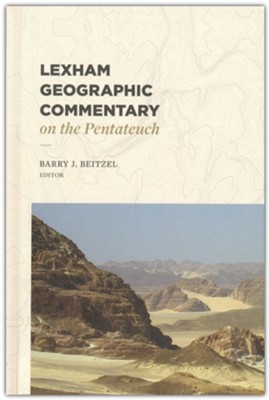
Lexham Geographic Commentary on the Pentateuch

Having enjoyed the earlier two volumes of this series covering the New Testament, I was pleasantly surprised to come across this volume. I guess now I’ll expect the rest of the OT to be covered. On the surface, we might suspect that the Pentateuch would be the area most in need of geographical assistance. Father back in time and having generations trample over its environs, there is simply less certainty. Enter, then, this volume.

This volume is a massive undertaking. In some ways it seems like a Bible encyclopedia while at other points it’s more of an atlas. Despite the title, it’s not a commentary per se. What you get is a thorough article on any geographical subject that greatly impacts our understanding of the text. Some are quite scholarly (like ones explaining from a “socio-spatial” perspective!) but they are often still fun. I loved the one arguing, for example, for the traditional site for Sinai. Though I found it less plausible, it was worthwhile to have an article arguing for an alternate site. Not all articles are explicitly geographical like, for instance, ones on burial practices. Still, it’s all good stuff.

Sometimes even theology was addressed and usually effectively when it appeared. Perhaps my only complaint mimics mine of the earlier volumes: some maps strain the eyes to read. Charts, though, are usually fine.

I can’t help but love a book like this one. Even if every article isn’t your thing, you are bound to find several that are simply fascinating. No other volume I know brings these loose ends so tastefully together. What you have is an asset not duplicated anywhere else. That’s saying a lot these days.

I received this book free from the publisher. I was not required to write a positive review. The opinions I have expressed are my own. I am disclosing this in accordance with the Federal Trade Commission’s 16 CFR, Part 255.
The New Testament Handbook

This new resource delivers at the same stellar level the earlier Old Testament Handbook did. Same beauty. Same value. Same variety. Same pathway to hours of study. Same success. I see them as a pair where one demands the other.

What will you get out of this book? Whatever you put into it. In other words, there’s too much to run out quickly. Charts have a unique value to say so much on one page. If you are a visual learner your value is double. I love to read, but I’ve long been sold on the value of charts. For me, they are often a crystallization of a large amount of material. Sometimes they plant a long-term portrait in your mind.

In my opinion, the charts on the Gospels are the richest here. Some charts explain something of a presentation of the individual contribution of a particular Gospel while others trace an idea across all of them. There are some helpful maps as well. They don’t because of color scheme look exactly like any other work either.

The only negative is that Revelation seemed a little under covered. Likely a desire to not get labeled with a specific perspective was the reason.

I hope the creativity of the publishers continues with other works in this style. I think they’ve struck a rich vein and should keep digging. For now, you will want to get this one.

I received this book free from the publisher. I was not required to write a positive review. The opinions I have expressed are my own. I am disclosing this in accordance with the Federal Trade Commission’s 16 CFR, Part 255.
The Old Testament Handbook

Here’s a lovely, and I might say fun, new resource. I’m a sucker for books with this kind of hardback (Smyth-sewn) and lavish, colorful insides about the Bible. To be honest, this is one of the nicest books of its type that I have seen in a while.

This book gives us materials on every book of the Old Testament. Each book gets an Introduction page that carries an impressive synopsis of typical introductory issues. What follows is a collection of charts chosen to bring that particular book to life. They are well chosen and well illustrate the uniqueness of that book. All of them pop with eye appeal as well.

There’s little you could criticize here. Maybe one book is a little better served than another. Maybe something you wish was covered isn’t, but this type of book must be subjective in its choosing even if it strikes you as arbitrary. Only one chart in the book failed in my opinion. The one called “The Route of the Exodus” should have been labeled “We Have No Earthly Idea”.

Still, on any criteria this book is a winner. You could literally do hours of worthwhile study with it. I hear a companion volume on the New Testament is in the pipeline. Sign me up!

For a gift or a resource for study—you just can’t lose here.

I received this book free from the publisher. I was not required to write a positive review. The opinions I have expressed are my own. I am disclosing this in accordance with the Federal Trade Commission’s 16 CFR, Part 255.
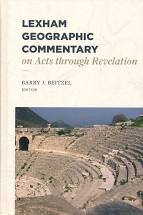
Lexham Geographic Commentary on Acts through Revelation

book lexham comm

If you happened to have the Lexham Geographic Commentary on the Gospels, You will be glad to see this wonderful volume that finishes the New Testament from Acts through Revelation. The quality and depth of geographic information and how it plays into the story on the page remains just as high. Maybe you are like me and you are not as up to speed on the geography outside of Israel as you are that of Israel itself. If that be true for you as it is for me, then perhaps this volume will be even more important than the first one.

The quality of writing by a group of top-notch scholars, the appropriateness of pictures and illustrations, and the usefulness of maps make this an incredible resource. Mark this down as one of the greatest Bible study needs you have that you weren’t even aware of. My only small complaint is that the size of the font and particularly of maps is smaller than ideal. My guess is that the smaller font became necessary because of the incredible amount of information they are giving us. It would have been much more expensive but I wonder if this might have been better as two volumes than one. In any event, it is an extraordinary resource that could be a blessing to anyone at any level from Bible student to scholar. I give this attractive hardback volume the highest possible recommendation.

I received this book free from the publisher. I was not required to write a positive review. The opinions I have expressed are my own. I am disclosing this in accordance with the Federal Trade Commission’s 16 CFR, Part 255.

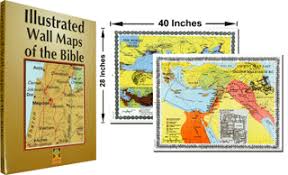
Illustrated Wall Maps of the Bible–A Great Resource!

book ill maps set.jpg

This beautiful resource is the perfect choice for Sunday School, college classes, or any sort of Bible class. The size of these wall maps (28 X 40 inches) is ideal. The maps themselves are attractive and loaded with the best information. Carta maps are my favorite and the ones chosen for this package are the most important for a teaching setting.

When you open the container that holds these maps you will first see an 18-page Bible atlas that will aid your use of the larger maps and help you prepare to teach. All 12 maps are included in this atlas along with 5 additional maps. The bonus maps in this atlas include: The Land of Canaan with an inset of the walls of Jericho, The World of the Greeks with a small insert of the empire of Alexander the Great, The Roman Empire with a small inset of the city of Rome, Jesus in Galilee (an exceedingly helpful map), and the Growth of Christianity. Don’t miss the chronological table on the back cover either. All of these will give you a leg up as you use the large wall maps in the classroom.

The first wall map, Culture and Commerce in the Ancient Near East, provides a helpful overview of the ANE and why population centers gravitated to where they did. The second map, ANE in the Second Millennium B.C., helps you see that Israel falls between the dominant areas of Egypt and the peoples near the Tigris and Euphrates Rivers. In that millennium Egypt was the more dominant. The map that covers the next millennium shows the ascendency of the Arameans and Babylonians.

A map on the Coming of the Israelites narrows the focus to Israel and includes an inset of the Exodus. The next two maps cover respectively the Kingdoms of David and Solomon and the Kingdoms of Judah and Israel after the Kingdom split. The insets include a map of Megiddo and Jerusalem in the 6th Century B.C.

Next, the maps turn to the New Testament with the first one showing Palestine in Greco-Roman Times with an inset of Jerusalem in the Hasmonean period. The next map, Jesus In His Land, shows some of the broad sweeps of Christ’s life and the inset brings Jerusalem to Christ’s time as well. A map called The Journeys of the Apostles shows from Israel to Tarsus and covers Philip and Paul’s work there. The inset shows Caesarea Maritima. The next map, the Spread of the Early Church, views Christianity from Babylon to Rome and to Egypt to the south with an inset of Paul’s Missionary Journeys. I might have swapped the map and the inset there, but both are good. The final two maps show physical maps of Israel with wonderful detail and many place names for each Testament respectively.

I’d easily label this the best set of wall maps I’ve ever encountered. This collection a winner!

I received this book free from the publisher. I was not required to write a positive review. The opinions I have expressed are my own. I am disclosing this in accordance with the Federal Trade Commission’s 16 CFR, Part 255.
Understanding the Creation–Another New Carta Release!

book und crea.jpg

You will not have encountered a work on Creation like this new title by Menashe Har-El before! It’s not a polemic on Creation, but a look at the landscape of Israel fashioned by the hands of the Creator. He has already co-authored the outstanding Understanding the Geography of the Bible in this same lavish photogenic series of unique books (9 X 12 inches) that wonderfully supplement your atlas library.

After an Introduction that overviews the physical aspects of Israel, there’s a section based on “who laid the foundations of the earth” from Psalm 104 that describes how the land formed the way it did. Several Scriptures are marshaled to make the case. Next, there is a section on volcanic activity and how it shaped Israel. Earthquakes and waves are also reviewed. The Book of Job is mined thoroughly in putting this incredible picture together.

He looks at stone, rock, and flint (zur), as well as gold. From there, he surveys iron, copper, and other raw materials. The book turns toward early craftsmen in Israel before looking at trees and other vegetation. You will be surprised by all the author uncovers.

As you would expect, the Carta maps, graphs, and other pictorial treasures are featured to advantage throughout. All these specialty atlases are a treat and this one is no exception!

I received this book free from the publisher. I was not required to write a positive review. The opinions I have expressed are my own. I am disclosing this in accordance with the Federal Trade Commission’s 16 CFR, Part 255.
Understanding the Gospels as Ancient Jewish Literature–a New Carta Title!

book und gos gar.jpg

Carta continues its line of interesting, creative, and colorful titles that address something that you will be hard pressed to find somewhere else here in this lovely volume. Though only 40 pages, they are 40 large (9 x 12inches) eye-appealing pages. In every case, Carta’s unparalleled Bible atlas resources fill out the work of a text prepared by an accomplished scholar. In this title, Jeffrey Garcia, takes the Gospels and looks for what they reveal about ancient Judaism. Really, it’s a look at how the Gospels and Judaism shed light on each other.

The introductory section covers the journey of scholarship on these issues. He works his way through a succession of what he calls sources for understanding the Gospels including the Hebrew Bible, other Jewish literature, the Dead Sea Scrolls, Josephus, rabbinic literature, and Philo.

Even better is the section that delves into the geography of Israel in the times of the Gospels. The pictures and maps here are superb. From there, he takes us through Jewish political history. Be sure to check out the chart on the family of Herod the Great. Then, as you might have predicted, he looks at Jewish life in those days in a helpful, detailed section that covers several pages.

In the section on Jewish styles of teaching that exams Jesus’ use of parables as well as Halakhah. Along the way, you get a penetrating overview of Jewish methods of Bible interpretation. The final section looks at some unique elements of what Jesus shared with insights from Judaism.

I’ve you’ve had the privilege to use some of these titles from Carta, you know what to expect. Mark this down as another title worthy of the reputation that Carta has developed over the years.

I received this book free from the publisher. I was not required to write a positive review. The opinions I have expressed are my own. I am disclosing this in accordance with the Federal Trade Commission’s 16 CFR, Part 255.
Qumran: A Carta Field Guide by Hanan Eshel

book qumran.jpg

Let’s load up the buses and ride! I want to visit Qumran after seeing this fine book by Hanan Eshel. Somehow I missed visiting Qumran when I was in Israel, and now I regret it after seeing what the site has to offer. This Carta field guide covers history, biblical archaeology, and serves as a nice tour guide as well.

Eshel was a professor in Israel and has the historical and archaeological credentials to be the ideal writer of this book. He has personally led several excavations in Israel and knows how to lead the reader around a site of archaeological significance.

There’s a short introduction that outlines the importance of the Dead Sea Scrolls. Next, we get a thorough description of the near turbulent acquisition of the scrolls. That story would make a movie and it must’ve been the providence of God that they were attained!

As it turns out, there were 11 caves involved (see the map on page 83) so there’s a lot of stories to tell. The photos are gorgeous throughout! By page 96, the book shifts focus to helping you plan a trip to Qumran. Without this book, you would miss so much of what can be seen at Qumran National Park. Don’t miss the panoramic view provided by the photo on pages 138-139.

As you would expect, you will also find those awesome Carta maps and illustrations throughout. This book is the second Carta field guide that I’ve seen (En Gedi being the other) and I think we need these field guides done for every major site in Israel. I assure you that whenever I get to visit Qumran, this book will be in my hand!

I received this book free from the publisher. I was not required to write a positive review. The opinions I have expressed are my own. I am disclosing this in accordance with the Federal Trade Commission’s 16 CFR, Part 255.

Ein Gedi: A Carta Field Guide by Hanan Eshel

book ein g.jpg

I want to go back! Ein Gedi was one of the most beautiful and interesting sites for me when I visited Israel. Now that I’ve had the chance to look at this Carta field guide by respected author Hanan Eshel, I realize I missed so much.

This attractive resource with its sumptuous photography, fine illustrations, and superb maps as you would expect in a Carta title enables you to have an intense tour of Ein Gedi from your armchair. I will review this work again before any subsequent trips.

The book begins with a topographical map and introduction that gives a broad overview. The first half of the book is an outstanding historical survey of the site. The history is placed within accepted archaeological periods and the archaeological evidence is carefully presented. The section that covers the biblical period is, for most of us, the most insightful. Don’t miss the map of David’s wanderings on pages 16 and 17. Beyond David’s time, Ein Gedi’s archaeological evidence continues to unlock its history all the way to the Hasmonean Period.

The second section provides an actual tour of Ein Gedi. A map covering pages 72 and 73 show the extensive possibilities of a visit to the site. The photo on page 76 that gives an aerial view of Ein Gedi looking west is breathtaking. What follows is a thorough coverage of all that can be seen there. There’s a final section that covers things to visit that are nearby to Ein Gedi.

This is a perfect title for either Bible students or travelers to Israel. I can’t imagine ever studying or planning to visit this site again without turning to this volume. It’s beautiful in every way.

I received this book free from the publisher. I was not required to write a positive review. The opinions I have expressed are my own. I am disclosing this in accordance with the Federal Trade Commission’s 16 CFR, Part 255.