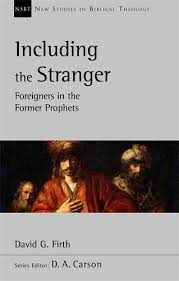
Including the Stranger (NSBT) by David Firth

book in str

This book has two things in his favor. It’s another of these unique entries in the New Studies in Biblical Theology (NSBT) series, edited by D. A. Carson, that are theologically astute and make a distinct contribution to both scholarship and biblical studies.The other plus is that renowned scholar David Firth contributes this volume in his area of expertise, the Former Prophets which include Joshua, Judges, Samuel, and Kings. In fact, Firth has already delivered an outstanding commentary on the books of Samuel. His deft hand shows throughout this volume.

His premise is that a unifying theme of these Former Prophets Is the treatment of strangers or foreigners. It is a theory that he very well may convince you on because (It made sense to me). Even if it isn’t the overarching theme of these books, it is at least in play in a key way.

To my mind even if you don’t agree with his premise, you have something of a fine introduction to each of these historical books of the Old Testament. In fact, I could not imagine studying these books without consulting this work going forward. To me, it almost does what Barry Webb’s “Five Festal Garments” does for the Five Scrolls. Count this another winner in an outstanding series.

I received this book free from the publisher. I was not required to write a positive review. The opinions I have expressed are my own. I am disclosing this in accordance with the Federal Trade Commission’s 16 CFR, Part 255.
The Book of the Twelve by Michael Shepherd (Kregel Exegetical Commentary)

book mp kec

This commentary will serve as a handy help to pastors and Bible students. Since there is only a little over 500 pages of actual commentary covering all 12 of the Minor Prophets, it is obvious that Mr. Shepherd has not attempted to produce the typical prolix commentary of our day. What he has provided, however, is direct help on grasping both the meaning and overarching theme of these prophets. His stated niche,that to my mind he has accomplished, is presenting these 12 prophets as a unified composition. In other words, instead of 12 random prophecies that so lacked cohesiveness that they were not even fully integrated within themselves, he paints a portrait of the Lord designing them as so unified that they should never be completely thought of by themselves. You can’t deny that that is a refreshing approach after years of commentators trying to decide if each passage within each of these prophecies is even legitimate!

It will be extra important to read the introduction to this work as he makes his case for the cohesiveness and unity of these prophecies. I personally thought this introduction read well and made a lot of sense.

The commentary proper lacks the thoroughness of some other works, but what he shares is good all around. Perhaps it shows the forest better than the trees, but that is no problem. There are plenty of other commentaries to analyze those trees!

I received this book free from the publisher. I was not required to write a positive review. The opinions I have expressed are my own. I am disclosing this in accordance with the Federal Trade Commission’s 16 CFR, Part 255.
Revelation (ZECNT) by Buist Fanning

book rev zec

This latest release of the ZECNT Is a fine exegetical commentary on the highly-debatable Book of Revelation. Personally, I always give commentators a little slack because this book manages to trip them coming out of the gate in almost every instance. In other words, the reader is going to approach both the book and the commentary with his or her own theological system. For that reason, no matter what the perspective of the commentator happens to be, he or she is going to start out with a much higher group of detractors than if, say, they had written on the Gospels or one of the Epistles. Fanning has done the best that could be done. He has tried to write a commentary that would be helpful to the widest number of readers without rigidly lobbing off whole swaths of them. He does, however, lean toward positions that would be labeled futurist as opposed to historist. Still, he is fair to all. More importantly, the exegesis and examination of structure are both rock solid. No, I don’t agree with every interpretive point he makes, but what commentator on Revelation could hope for that from any of us? The point that must not be lost is that this commentary can help you as you wrestle with this challenging book of the Bible.

I thought the introduction was exceptional. Throughout, he both lays out varying opinions and respectfully submits his own. He begins by talking about authorship and really does not land on one outlook himself in this case since he doesn’t find it critical to the overall interpretation of the book. He discusses date and setting, genre with an emphasis on prophecy, imagery and symbols, all before he addresses the thorny subject of hermeneutical approaches. He explains both the importance and the specifics of the use of the Old Testament in this book and how to view prophecy and typology. I thought his discussion of topology was particularly apropos. He discusses text, language and style, before he dives into structure and outline which is an emphasis of this series. He gives a lot of outstanding insights before he provides his own outline. There is a select bibliography given as well.

The commentary proper follows the typical style of this series and is quite helpful. There were just a few places I wish he had said a little more. Still, when you talk about what you really need to learn in an exegetical commentary you will find it all here in spades. The end of the book gives a nice summary of the theology of Revelation too.

He probably does for a futurist position what Beale does for the modern fad of an eclectic position. You’ll need both. Therefore, you should probably put this in the must-get category.

I received this book free from the publisher. I was not required to write a positive review. The opinions I have expressed are my own. I am disclosing this in accordance with the Federal Trade Commission’s 16 CFR, Part 255.
Joel (ZECOT) by Joel Barker

book joel zec

I have really enjoyed these early volumes in the ZECOT series and this new title is no exception. Joel Barker provides another competent exegetical commentary with an emphasis on discourse analysis this time on the Book of Joel. Unlike other mostly unprofitable types of criticism, discourse analysis renders real insights into the text. If you are looking for a standalone commentary on the Book of Joel, this volume will definitely meet your needs.

After he offers his own translation of Joel he jumps into an effective introduction to the Book of Joel. By the first few paragraphs, you can tell that the author enjoys Joel. To be sure, that always makes a commentary better. He offers six theories for the historical context of Joel. He lays them out clearly and makes it easy for one to evaluate. I might not agree with his final conclusion, but I appreciate his defining the issues. He makes a wonderful case for the literary integrity of Joel. I tend to find that with every book of the Bible, but I appreciate his compelling case that should answer any critic. He looks at Joel’s place among the Minor Prophets as well as describing Joel from the perspective of rhetorical discourse. He proves here that he is up to speed on those issues as you would expect for this series. I really appreciated his thoughts about the structure of Joel as well.

The commentary proper follows the usual ZECOT pattern. He does an outstanding job here. My only caveat to that statement is his discussion of 2:28-32. I know we have to first place these scriptures in the context of the prophet’s time, but I just felt he was a little brief on the importance of this passage in the New Testament. Still, this is first-rate commentary on a book of the Bible where you’re likely to need it. I’d rank this commentary a winner!

I received this book free from the publisher. I was not required to write a positive review. The opinions I have expressed are my own. I am disclosing this in accordance with the Federal Trade Commission’s 16 CFR, Part 255.
The Gospel of the Son of God by David Bauer

book gospel son god.jpg

David Bauer is the right person to write this academic introduction to the Gospel of Matthew. I’ve known for years that Mr. Bauer has followed in the footsteps of Jack Dean Kingsbury. Kingsbury’s writings on Matthew first fascinated me well over a decade ago. In fact, this volume divides the book of Matthew in the same three places that Kingsbury first did. I find that division to be quite helpful and accurate. Bauer takes the best of Kingsbury and expands it to all that we have learned since and offering his own additional conclusions.

Part one called an orientation covers form and genre, approach and method, circumstances of composition, and shape of composition in four chapters. I got the least out of this section especially as the theories of composition don’t do much for me. Academic tops will still likely work through it.

Part two is where the book starts to shine offering an interpretation in three chapters along the lines of the aforementioned division of Matthew’s gospel. There is brilliant insight to be found here.

Part three entitled reflection gives us 5 chapters looking at the Christological titles of Jesus, additional aspects of christology, God, salvation history and eschatology, and discipleship. You will find outstanding nuggets along the way even if there are occasional statements that you find totally subversive to your thinking. Take the book as one requiring a little digging to remove its treasure with a little junk to move out of the way and the gospel of Matthew will come alive to you in a whole new way.

I see this book as the pinnacle of a key interpretive arc of Matthew’s gospel. In that sense, it will be an indispensable volume.

I received this book free from the publisher. I was not required to write a positive review. The opinions I have expressed are my own. I am disclosing this in accordance with the Federal Trade Commission’s 16 CFR, Part 255.
Lexham Geographic Commentary on Acts through Revelation

book lexham comm

If you happened to have the Lexham Geographic Commentary on the Gospels, You will be glad to see this wonderful volume that finishes the New Testament from Acts through Revelation. The quality and depth of geographic information and how it plays into the story on the page remains just as high. Maybe you are like me and you are not as up to speed on the geography outside of Israel as you are that of Israel itself. If that be true for you as it is for me, then perhaps this volume will be even more important than the first one.

The quality of writing by a group of top-notch scholars, the appropriateness of pictures and illustrations, and the usefulness of maps make this an incredible resource. Mark this down as one of the greatest Bible study needs you have that you weren’t even aware of. My only small complaint is that the size of the font and particularly of maps is smaller than ideal. My guess is that the smaller font became necessary because of the incredible amount of information they are giving us. It would have been much more expensive but I wonder if this might have been better as two volumes than one. In any event, it is an extraordinary resource that could be a blessing to anyone at any level from Bible student to scholar. I give this attractive hardback volume the highest possible recommendation.

I received this book free from the publisher. I was not required to write a positive review. The opinions I have expressed are my own. I am disclosing this in accordance with the Federal Trade Commission’s 16 CFR, Part 255.
Thessalonians, Timothy, Titus, Philemon (RCS), edited by Gatiss and Green

book RSC XII.jpg

This latest entry in the Reformation Commentary on Scripture (RCS) series covers six small Pauline epistles (1-2 Thessalonians, 1-2 Timothy, Titus, and Philemon). Though these letters of Paul are not quite as pivotal as recent releases in the series on Romans in understanding the Reformation, they still give great insight into both Paul and key Reformation thinking. Two scholars, Lee Gatiss and Bradley G. Green, combine forces to provide us this helpful volume in a series that makes a unique contribution to our studies.

There is the usual general introduction that adorns every volume in this series which lays out how this series is put together and what it hopes to accomplish before we receive an introduction to the six letters. This introduction begins by stating how the Reformation seized on Paul in laser-like fashion. I was almost surprised at how often the authors acknowledge the New Perspective on Paul. It almost seems that they assume it might be guiding reader’s opinions and must be often taken into account. To my mind, the NPP didn’t exist in the Reformation and doesn’t have the credence in many of our minds that some may think today and so might not need much discussion in a commentary like this one. Still, I don’t think these acknowledgments really detract from the commentary overall. More to the point, they did a great job of addressing how each of these letters was received in the Reformation. In another capitulation to modern times, they cited the few writings that were positive about women in the ministry. Whatever your view on that subject, there is no denying how few believed in that possibility prior to the last century.

I found the same strengths and weaknesses as with other volumes in the series. To be fair, the weaknesses can’t be helped as citations in the commentary are of necessity arbitrary. Someone must make the call for which writings to use in the commentary from the plethora of primary sources to choose from. The strengths are from the same area in that the authors have chosen well and given wonderful food for thought. They are wonderfully fair to a variety of teaching within and near the Reformation as well.

This series is far enough along to have earned a high rating and this volume clearly upholds the standard we have come to expect.

I received this book free from the publisher. I was not required to write a positive review. The opinions I have expressed are my own. I am disclosing this in accordance with the Federal Trade Commission’s 16 CFR, Part 255.
Amos, Jonah & Micah (EEC) by Hoyt

book eec jonah

Every new release of the Evangelical Exegetical Commentary (EEC) series that I come across reinforces my thoughts that this series has something special brewing. It’s almost like when this series releases a new volume it immediately becomes the go-to exegetical commentary, especially for pastors who want a truly scholarly work. This latest volume covering Amos, Jonah, and Micah by Joanna Hoyt lives up to the lofty standards this series has already established. This volume is easily one of the best on either of these three prophets and you are blessed to have all three of them covered in this large (800+ pages) impressive volume.

For this review, I gave the most attention to Jonah because so many scholars today seemingly fall off the cliff when they get to Jonah. Delightfully, I found a commentary here that is not ashamed of Jonah, does not laugh off his historicity, or roll its proverbial eye at his grand message. Pastors will get solid help here. Scholars, though so many of them run left of the line found here, will find this an incredibly detailed scholarly look at the prophet. It seems no stone is unturned. In fact, the weakest area of contribution would be on structure, but the volume is still too wonderfully thorough to criticize.

I’m not saying that I agree with every sentence the author writes in this volume, only that everything is so well explained and in such depth that I have a thorough grasp of the issues involved to make my own decision. That is always what I’m looking for in an exegetical commentary.

To be sure, Amos and Micah are as well handled as Jonah in this book. The introductions to each are ideal and the things that scholars need beyond what pastors are looking for can all be found as well. Every passage bears traces of painstaking care and work. There are no signs of haste. From what I’ve read, Hoyt is a young scholar who strikes me as making quite a splash here. I’ll be using this book for years to come!

I received this book free from the publisher. I was not required to write a positive review. The opinions I have expressed are my own. I am disclosing this in accordance with the Federal Trade Commission’s 16 CFR, Part 255.
Jonah (ZECOT) [Second Edition] by Youngblood

book jonah 2

When I reviewed the original volume of this work just a few years ago, I was thoroughly impressed with it and gave it the highest rating. Quite simply, it was one of the best exegetical commentaries I had ever seen on Jonah. As it turns out, this Second Edition is very little changed from the earlier one. Nevertheless, my opinion has not changed either. There’s a new EEC volume that covers Jonah with two other prophets. It would be fair to say that these two volumes supersede all exegetical commentaries in print today on Jonah.

I love the approach of a ZECOT volume. Modern scholarship has had many developments that are of no detectable value for pastors, but discourse analysis really opens up the understanding of a passage. Youngblood is outstanding in handling the discourse analysis and gives dependable, conservative help throughout.

As I said for the first edition, Mr. Youngblood’s Introduction to the book of Jonah struck me as being of the perfect length and depth. He discussed the usual suspects – placement in the Canon, historical context, literary context, and an outline – with verve. Much of the information was of the kind that really aids one preaching on Jonah. He beautifully wove in his discourse analysis as well throughout the entire work.

The commentary itself is superb. Again, he always keeps us grounded in the context at large. Still, he draws out the needed background, word meanings, and other important detail. At the end of every periscope, there is fine theological reflection too.

You may not need to replace your first edition, but this is a commentary that you cannot do without!

I received this book free from the publisher. I was not required to write a positive review. The opinions I have expressed are my own. I am disclosing this in accordance with the Federal Trade Commission’s 16 CFR, Part 255.

Handbook on Acts and Paul’s Letters by Thomas Schreiner

book handbook acts ept

If you use modern scholarly works, you already know Thomas R. Schreiner. He has written a multitude of well-received, highly helpful books including major exegetical commentaries. Now he tackles a handbook on Acts and the Epistles of Paul. Fortunately, when we say the Epistles of Paul, Schreiner means all 13 of them! That alone was totally refreshing. Schreiner is simply more conservative than several other major scholars of our day. For that reason alone, any work he writes is worth checking out.

I would label this volume a content survey. Those can be quite tricky to produce and some such volumes have almost no value. Rather than giving an overview, they provide so little depth that they add nothing. In this case, however, Schreiner has succeeded. You can truly follow the flow of the book you’re studying and have a real understanding of what’s going on. Think big picture rather than minutia, but a real drawing out of the theme of what that book is trying to say to us.

Perhaps I liked a few of the introductions better than others. In some cases like the one on Acts, he added a few helpful charts that just brought it alive in the opening statements that discussed structure and themes. In fact, that would be my only minor fault of the book is that a few of the books of the Bible covered do not have that material with the helpful charts. In any event, I feel he totally succeeded both in the broad introduction and the overview of the content. This volume is a total winner on providing what I would want in a handbook on these New Testament books. I don’t see how you could go wrong in using it!

I received this book free from the publisher. I was not required to write a positive review. The opinions I have expressed are my own. I am disclosing this in accordance with the Federal Trade Commission’s 16 CFR, Part 255.