First, Second, and Third John (Interpretation) by Smith

book ept jn i.jpg

Moody Smith delivered this commentary on the Epistles of John in the Interpretation Bible Commentary series. You may have noticed his name showing up in the literature on the Gospel of John so he was a natural choice to tackle the Johannine Epistles in the series. As you are probably aware, this series is known for its critical outlook and its homiletical/theological contributions. Though a thinner volume than I expected, it succeeds in reaching the aims of the series. Probably his background on John made him able to say much in fewer words.

He offers a somewhat breezy introduction to these epistles. Even where I could not agree with his conclusions, there was an evident love for these epistles which always raises the value of a commentary to my mind. In the unusual buildup within this introduction, I was beginning to believe he was going to suggest that the Apostle John himself was the writer. That was a surprise because it would not be typical in this series. As it turned out, he closely followed the well-known critical scholar, Raymond E. Brown, and his well-known thesis of the Johannine school or community. Though some of us have never bought into that theory, even critical scholarship has backed away from it in recent years. He does share some good information on how the same person could have written the gospel and these epistles, but his conclusions in my judgment on the impossibility of John himself as the writer fell flat.

He also discussed the audience and purpose of the letters, had some discussion of the composition and structure of these letters that also reminds one of Raymond Brown’s positions, and the use of these letters in the church. From there, he discussed interpretation and shared a few good insights along the way. The final two sections that describe the commentary itself and biological reflection were of less value.

Though it was somewhat brief and guided by some of the earlier critical conclusions mentioned, his exegesis was well done. There are reports that he plans a more substantial volume on these epistles in the future. Overall, I would label it a solid volume in the style I have come to expect from this series.

I received this book free from the publisher. I was not required to write a positive review. The opinions I have expressed are my own. I am disclosing this in accordance with the Federal Trade Commission’s 16 CFR, Part 255.

Judges (OTL) by Niditch

book judges ntl.jpg

This new volume in the Old Testament Library (OTL) series replaces the old volume by J. Alberto Soggin. Niditch has improved on that older entry. I always turn to this series to grasp the critical viewpoint and to get some theology that you just don’t get in other places. This volume generally falls within the expectations of the series yet would not necessarily be my favorite. In the plus column, the book is well-written and it’s easy to follow the author’s train of thought, but on the negative side it pushes the envelope too far in some places and is too brief in others.

There’s a lengthy bibliography provided at the beginning of the book. The commentary section is substandard and only lists seven titles. On the other hand, the rest of the bibliography is quite thorough.

The Introduction begins by describing the Book of Judges as epic-style literature. There’s a discussion of the office of a judge that is quite interesting. Folklorist insights calling them epic heroes, social bandits, etc., are a little much for me. There’s discussion of the war and fighting in the Book of Judges, the history of the Book of Judges (the author at least sees the material as “meaningful” to the time of the Kings). I had trouble accepting the redaction history that was given as well as some of the discussion about genre. The discussion of the voice of the theologian and the humanist gave some food for thought. The section called texture provided some helpful structural insights. There seemed to be, however, an over-emphasis on the oral nature of the material in the text-critical section.

Where the commentary wasn’t too brief, there were some interesting observations in the commentary proper. At times there’s too much of a feminist angle, but at other times you will find some real help. The exegetical work is sufficient within the framework of the author’s outlook.

Critical scholarship is usually never too kind to the book of Judges. In any event, this book is probably as good as any in understanding a critical approach to the book. While not the equal of some in the series, it does have value.

I received this book free from the publisher. I was not required to write a positive review. The opinions I have expressed are my own. I am disclosing this in accordance with the Federal Trade Commission’s 16 CFR, Part 255.
II Corinthians (NTL) by Matera

book ii cor ntl

Frank Matera, a well-known New Testament scholar, contributes this volume on II Corinthians in the New Testament Library (NTL) series. Though this volume would be labeled critical in its approach, he took a surprising number of positions that you might find in a less critical work. For that reason, I thought this volume one of the better in this series. You will still be made aware of some of the critical outlook that this series usually provides, yet you might appreciate his opinion on the unity of the letter and his exegetical work too.

After a bibliography, the author begins the introduction by addressing ministry and conflict in the letter. He labels II Corinthians as “perhaps the most personal and revealing of Paul’s letters”. He sees it as “an intensely personal writing it which the apostle speaks more extensively and intimately than in any of his other letters”.

Next, he dives into the argument and structure of the letter. He divides the letter into three parts and explains his reasoning for the division as well as for the subdivisions. He summarizes his position in a list of four things that Paul is defending. His reasoning and the subsequent outline give good food for thought. From there, he tackles the theology of the letter. He sees the theology as rich and it would be hard to disagree with the importance of the six things he lists as the key theology of the letter.

In the next section, when he considers the time between I and II Corinthians, he wades into the morass that often entangles the scholarly world. The next few sections of the introduction continue to look at this subject from various angles. Along the way, you get a good overview of where the scholarly world has twisted and turned on this issue. Pleasantly, he argues for the unity of the letter.

In the commentary proper, I thought the exegetical work to be some of the best I’ve seen in this series. There are many good insights to be found.  This book could profitably be added to the list of those you consult when studying II Corinthians.

I received this book free from the publisher. I was not required to write a positive review. The opinions I have expressed are my own. I am disclosing this in accordance with the Federal Trade Commission’s 16 CFR, Part 255.
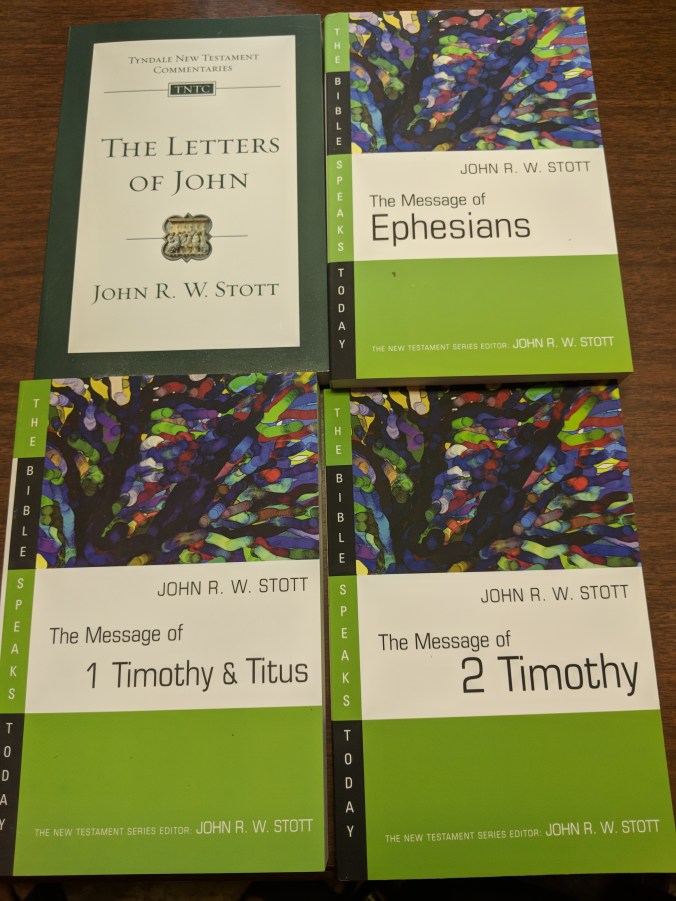
Some Great John Stott Commentaries!

MVIMG_20180624_150656_exported_3451528252453627044.jpg


Mr. John Stott remains one of the more beloved writers of Christianity today even though he’s been passed away for a few years now. He was widely published and has books carried by several publishers, but he had a special relationship with IVP and they carry all his great commentaries. In this blog post we will review a sampling of four of these great commentaries. In addition to these reviewed below, he has some equally fine commentaries on the Sermon on the Mount, Acts, Romans, Galatians, and Thessalonians.

  1. The Letters of John (TNTC)

This commentary is, perhaps, his most well-known. At the least, I’ve seen it quoted time and again in later major exegetical commentaries on the Epistles of John. It’s his only commentary in the wildly popular Tyndale New Testament Commentary (TNTC) series. I imagine this series has been one of the best-selling of all time because of its broad usefulness. Despite its age, I still see it widely recommended and even called the best in this series by many reviewers.

The thorough introduction is wisely divided into three parts: authorship, occasion, and message. He reasons beautifully for the authorship of the letters by John. He has wonderful things to say about occasion and message. There is much learning there. He seems to conclude much as the earlier commentator Robert Law did, though he’s far easier to follow in my opinion. I don’t exactly agree with Law’s premise, but it’s well explained here.

The commentary proper is model commentating. The introduction and commentary on II and III John are equally compelling. This book lives up to all its hype.

The TNTC is currently going through its second major revision. That means this title will likely be replaced by a new author. I’m confident that IVP will not allow this book to go out-of-print and if you ever can’t find it in the TNTC look for it is as a classic reprint by them. Get this one!

I received this book free from the publisher. I was not required to write a positive review. The opinions I have expressed are my own. I am disclosing this in accordance with the Federal Trade Commission’s 16 CFR, Part 255.
  1. The Message of Ephesians (BST)

You could never accuse the beloved Mr. John Stott of shying away from the more difficult books of the New Testament. I mean he’s written on Romans and Galatians and has also tackled the sublime Book of Ephesians here in the Bible Speaks Today (BST) series. In fact, as the editor for the New Testament volumes of this series, it appears the whole series was a labor of love for him. For the record, he produced its best volumes in the eight he contributed. This series has a different design than the TNTC and he excelled in both.

He allows the introduction to the letter to be handled in his commentary on Ephesians 1:1-2. I personally don’t see any loss in that design. With skill he argues for the authorship of Paul even though the scholarly world has mostly gone in the ditch on the subject. He covers the recipients and the message of the letter here as well.

The commentary is wonderful. It has the positive aspects of both good commentary with all the requisite background information as well as the warmth of an outstanding sermon. Whether this book is in the BST series or not, it has no shame on the shelves among the big boys. It would be a mistake to not own it!

I received this book free from the publisher. I was not required to write a positive review. The opinions I have expressed are my own. I am disclosing this in accordance with the Federal Trade Commission’s 16 CFR, Part 255.
  1. The Message of 1 Timothy & Titus (BST)

This fine commentary by the late John Stott is a two-for-one special as you get commentary on both I Timothy and Titus. It’s another of Mr. Stott’s outstanding commentaries in the exposition – friendly Bible Speaks Today (BST) series. I consider this volume one of his more underrated commentaries. His pastoral heart made him the ideal commentator for these two New Testament books.

This book begins with a special section discussing the authenticity of the Pastoral Epistles. I’ll never understand why the scholarly world is so preoccupied with denying Paul authorship of a handful of his letters, but I wish scholars would punt the ball and make what Mr. Stott says here the 20-yard line.

The commentary on both these letters is warm, accessible, yet in no way shallow. Perhaps the comments are shorter, yet they say more than many commentaries twice the length. Mr. Stott has lived up to his own subtitle of “guard the truth” in this fine volume that you need in your library!

I received this book free from the publisher. I was not required to write a positive review. The opinions I have expressed are my own. I am disclosing this in accordance with the Federal Trade Commission’s 16 CFR, Part 255.

  1. The Message of 2 Timothy

The quality of Mr. Stott’s commentating never wavers as you can see in what is, perhaps, one of his lesser-known works in this commentary on II Timothy in the valuable Bible Speaks Today (BST) series. Until this whole series is revised and replaced, I won’t be able to think of it in any other way than Mr. Stott’s baby.

I have no idea why II Timothy has its own volume while I Timothy and Titus are put together, but since you need all these commentaries anyway it’s better to have to buy two instead of three! Don’t be surprised if someday when this series is revised that all three Pastoral Epistles found in these two of Mr. Stott’s commentaries end up in a classic reprint by IVP.

He gives an introduction that champions Paul as author and explains the contents in regards to his life and work with Timothy. While the commentary is not especially long (only 127 pages), there’s not a wasted word. I’ll always consult it no matter how many thick volumes sit beside it on my shelves. For pastors, this book is indispensable.

I received this book free from the publisher. I was not required to write a positive review. The opinions I have expressed are my own. I am disclosing this in accordance with the Federal Trade Commission’s 16 CFR, Part 255.

Revelation (TNTC) by Ian Paul

book rev tntc

Here we are in the early stages of the second full revision of the venerable Tyndale New Testament Commentary (TNTC) series and we have a new entry on the Book of Revelation. This replaces the volume by the second series editor, Leon Morris. As much as I love the works of Mr. Morris, I’ve never heard his commentary on Revelation being talked up as his best. This new volume by Ian Paul is a substantial entry at 370 pages. I feel that Mr. Paul fully grasped the parameters of this series and put it to good use.

I’m going to rate this commentary highly even though I subscribe to a different theological perspective on prophecy than is entertained here. In my judgment, this book has these key superlatives: incredible background information of the time John wrote, profound but sane discussion of numerology, a fairness in mentioning other viewpoints since Revelation is one of the most debated books of the Bible, and solid exegesis. Even as one who takes a pre-millennial outlook, I think every pastor or Bible student needs a book from this viewpoint, especially since it dominates current scholarship. The beautiful thing about this volume is that it covers the same ground well and much more succinctly. Osborne, Beale, or Aune would take much more of your time while Paul here can give you all you need.

Even with my differing viewpoint, I found his introduction filled with good things worth pursuing. No matter your theological perspective, you will find much to mine here. The commentary itself, though if you’re of a different theological persuasion you may broadly disagree, is still filled with great insights into the words of the text and other parallels. You won’t regret consulting this book!

I received this book free from the publisher. I was not required to write a positive review. The opinions I have expressed are my own. I am disclosing this in accordance with the Federal Trade Commission’s 16 CFR, Part 255.
I and II Thessalonians (NTL) by Boring

book thess ntl.jpg

Prolific writer Eugene Boring gives us this thorough commentary on I & II Thessalonians in the New Testament Library (NTL) series. A decade earlier he produced the commentary on Mark’s Gospel in this same series. That shows that he has far-ranging interests in New Testament scholarship. You will find that the same areas that he received praise for in the Mark commentary are true here. In short, he excels in historical scholarship and background information.

The book is designed with an introduction to I Thessalonians followed by commentary on it, and then an introduction to II Thessalonians followed by its commentary. I enjoyed the introduction to I Thessalonians much more than that for II Thessalonians because I just can’t agree that the second letter came from some hand other than Paul’s.

He begins the introduction by explaining what it is to read in varying contexts including the reader, the canonical context, the mediating context that reviews church tradition and academic research. He also has some insight on recent scholarship. What follows is the highlight of the introduction: his description of the historical context of I Thessalonians. That includes a look at Paul’s life, the city of Thessalonica, and the church therein. He has a few words on the genre and rhetoric of the letter. After an outline and a brief discussion of structure, he gives his theological perspectives on the book. The commentary proper is quite helpful and teems with great historical information.

The introduction to II Thessalonians is consumed with it being Deuteropauline. Though that is a common thought modern scholarship, I find the arguments particularly weak and circular. The commentary, however, is equal to that in the first letter.

Mr. Boring is one of the most respected writers in this series and I can understand why. This is a fine commentary.

I received this map free from the publisher. I was not required to write a positive review. The opinions I have expressed are my own. I am disclosing this in accordance with the Federal Trade Commission’s 16 CFR, Part 255.

First and Second Samuel: Interpretation Bible Commentary

book i sam.jpg

I’ve thought for some time that the value of the Interpretation Bible Commentary series is in its theological reflection. It’s a critical series, but I often find the theology valuable enough to check out even though I don’t agree with the criticism nor the methodology that’s used. Walter Brueggemann is perhaps the best writer in the series for pulling out these theological gems that no one else thinks of. People all across the theological spectrum are impressed by his creative writing.

The introduction given is hardly an introduction for the books of Samuel at all. In only a few words, he describes the period of the books of Samuel as one of major social change. Going from a tribal system to a monarchy would indeed be quite a transition. He sees three factors in that social change that we can easily agree with. From there, in a few more pages, he provides more introduction to his approach than to the overall books of Samuel themselves. This is not a standard academic introduction.

While he may have had little interest in the introduction, he poured all his efforts into the commentary itself. Again, there are critical perspectives you may not agree with, but there are nuggets all around for those who are looking. Every passage will likely have them. These nuggets will be both theologically profound and exquisitely stated. This commentary is worth looking up.

I received this map free from the publisher. I was not required to write a positive review. The opinions I have expressed are my own. I am disclosing this in accordance with the Federal Trade Commission’s 16 CFR, Part 255.

The Bible Unfiltered by Michael Heiser

book bible unfiltered.jpg

This book is unique. There are 60 short chapters that cover many topics. What makes the book stand out on the shelves is that the topics it covers are often those you won’t find many other places. His title suggests his point – we place too many filters on our Bible before we even open it to study. The subtitle “approaching Scripture on its own terms” is a call to fresh study with real attempts to remove those filters.

The 60 chapters are divided into three parts. Part one addresses the broad issues involved in interpreting the Bible responsibly. It’s in this section that he attempts to prove to you that you do, in fact, have unhelpful filters on your Bible. Parts two and three cover the Old and New Testaments respectively. These two sections are different than the first one in that they are not really looking at broad hermeneutical mistakes made in either Testament, but rather specific points where we drop the ball.

If I had a criticism of this book, it would spring from the same place where its celebrated uniqueness comes from. At times, it seems Mr. Heiser interprets on the edges. Too much time on the edges is dangerous for some Bible students because they lose the big picture. To get around this criticism, you must accept this book for what it is: a provocative attempt to force you to see if you are reading from the Scriptures rather than into them.

Several of the topics covered were fascinating. A few I simply could not agree with based on the scriptural evidence. A case in point would be chapter 12 where he claims that all our Genesis commentaries are eight-track tapes. I’m sorry, but what one scholar wrote about in 2010 does not instantly become the gold standard for all Christians, even on an obscure topic like the one in that chapter.

You have got to appreciate what this book is trying to do. We often neither search the Scriptures diligently enough nor think deeply enough. This book will push us to do better and that’s its value. Along the way, you will likely gain some new insights on scriptural subjects you have thought about in some time.

I received this book free from the publisher. I was not required to write a positive review. The opinions I have expressed are my own. I am disclosing this in accordance with the Federal Trade Commission’s 16 CFR, Part 255.

The Lord Is Good by Christopher R. J. Holmes

book lord good

This book by Christopher R. J. Holmes challenged me. For sure I enjoyed it, and I learned great things, but this is no lazy summer afternoon reading. You can decide for yourself, but I need books like this. I need to be pushed past the fluff that prevails in Christianity today. I can’t say I agreed with every single word he said or every conclusion he drew, but I felt a connection with Mr. Holmes because I felt on every page that he sincerely believed that the Lord is good!

Don’t let the subtitle “seeking the God of the Psalter” lead you to believe that this is some sort of commentary on the Book of Psalms. Truth be told, had the printer accidentally left off the subtitle, I would probably have only thought that he quoted Psalms more than other books of the Bible. This observation is no criticism, however, because this is a profound theological work. Still, you will likely see a few verses in the Psalms far differently after reading this book.

As I read this book, I thought at times that the author could easily go to the field of philosophy and succeed. Still, his biblical observations were rich. At other times, I thought he had something of a love affair with Thomas Aquinas and was at least a member of the fan club of Augustine and Barth. For me, what he drew from each of them and put together was closer to what I would think than any one of the three individually. Mr. Holmes deserves credit because it would be a gross misrepresentation to say that he merely regurgitated what others had said. These three theologians have put such a strong stamp on what Christianity believes on the subject of the goodness of God that it would be impossible not to greatly interact with them in a book like this one.

There are nine chapters in this book that cover the subjects of simplicity, you are good (that doesn’t mean what you first think), goodness and the Trinity, you do good, the good Creator, goodness and evil, teach me your statutes, goodness and Jesus Christ, and perfection. I could only read one chapter, or sometimes only half a chapter, at a time. There was too much to take in! Every chapter was great, but my personal favorite was the one on goodness and evil. That one really helped some light bulbs come on for me.

I’ve learned that this book is part of IVP’s series entitled Studies in Christian Doctrine and Scripture. Though this is by far the most interesting subject to me of those released, if this series can turn out more works like this one it will be a dandy.

We all have our systematic theologies on our shelves, but this is the type of theological work that needs to find its place beside them. The Lord’s attribute of being good is brought alive here and I’m a richer person for it.

I received this book free from the publisher. I was not required to write a positive review. The opinions I have expressed are my own. I am disclosing this in accordance with the Federal Trade Commission’s 16 CFR, Part 255.

Leviticus (OTL) by Gerstenberger

book lev otl

Erhard Gerstenberger replaces Noth in the Old Testament Library (OTL) series with this volume. It strikes me differently than many other volumes in this series. Whereas many volumes in the series make a greater theological contribution than an exegetical one, this one gives us little theology around its exegesis. The whole series is known as a critical one yet in this volume it seems more pronounced to me. Known as a form critic, the author talks much about sources. Those discussions seem nebulous and unprovable to my mind and give the text a devastating uncertainty. How deeply you fall into the critical viewpoint will determine how high you rate this volume. If you’re more conservative like me, you may not find the theological compensations that some others in the series provide.

The Introduction begins by describing difficulties in reading the Bible. The aforementioned subject of sources arises immediately. He describes the audience as “a colorless someone” and does not demonstrate a passion for the book of the Bible that he commentates on that is found in the best commentaries. He discusses authorship, subsequent influence of cultic law, and structure. He takes the critical line across the board.

In the commentary proper, he does provide a lot of exegesis (the best trait of the book) and a lot of detail about the ceremonial things that are foreign to our thinking. He would bring up things like feminist concerns that put him at odds with the text.

In a nutshell, critical scholars will likely rate this book highly, those doing exegesis will appreciate some details, and more conservative readers will likely not enjoy this book as much as several others in the series. In fairness, it could be that the Book of Leviticus doesn’t lend itself to the same kind of theological treatment several others in this series provide.

I received this book free from the publisher. I was not required to write a positive review. The opinions I have expressed are my own. I am disclosing this in accordance with the Federal Trade Commission’s 16 CFR, Part 255.