The Expositor’s Bible Commentary (Rev. Ed.)- Volume 3, Samuel-Kings


book ebc 3.jpg

Volume 3 of the Expositor’s Bible Commentary (EBC revised) covers the books of Samuel and Kings. In this case, the original commentators were given the opportunity to update their material. I had used the original editions extensively on these four books of the Bible, and I’m glad to see their usefulness extended by this revision. Just think, you get over 950 quality pages on Samuel and Kings!

The books of Samuel were handled by the respected scholar Ronald Youngblood. His work on Samuel was one of the highest rated volumes in the original set, and it appears he will be able to keep that designation. His introduction is not extensively revised, but is well done.

In the introduction, he covers the title of the book, authorship and date, historical context, literary context and unity, purpose, literary form, canonicity and text, and theological values. His conclusions are wonderfully conservative, particularly on dating. He feels that Edwin Thiele is quite accurate in the chronology he developed. The bibliography is extensively updated.

The commentary is outstanding. In every section, he gives an overview, a translation, commentary on the verses, and exegetical notes. It is truly one of the better commentaries on Samuel that we have available today.

The commentary on Kings is a joint effort by Richard Patterson and Hermann Austel. It was never rated quite is highly as the work on Samuel, and was somewhat briefer, but I always found it a solid help. I always checked it when I was working in Kings. In any event, it did receive more of a revision in the commentary section.

As was the case with Samuel, the introduction is not extensively revised either. It covers historical background, unity, authorship, and date, origin, occasion, and purpose, literary form, theological values, canonicity, text, and chronology. You will notice several conservatives quoted in the introduction, and though no one really knows who the author of Kings is, you find some pretty conservative conclusions here.

The commentary section mirrors the style found in Samuel. It’s really good at drawing out the details of the story itself. You can glean much from its pages.

I grow ever more impressed with the EBC series. Here’s another outstanding, economical value for the pastor or Bible student. It would not be wise to be without it.

I received this book free from the publisher. I was not required to write a positive review. The opinions I have expressed are my own. I am disclosing this in accordance with the Federal Trade Commission’s 16 CFR, Part 255.
 

The Expositor’s Bible Commentary (Rev. Ed.)- Volume 13, Hebrews-Revelation

book ebc 13

This volume 13 in the Expositor’s Bible Commentary (EBC) series, revised edition, thoroughly updates the old volume 12 of the original series. In fact, only one author from the original series is retained in this volume. What you have here is an outstanding commentary covering nine books of the New Testament.

On the book of Hebrews, R. T. France has replaced Leon Morris. Though I love the writings of Leon Morris, I must admit that it was in need of updating as it was never rated as highly as Mr. Morris’s other commentaries. Mr. France is a highly respected scholar who has written major exegetical commentaries on other books of the New Testament. In the Introduction, he covers an overview of what sort of writing Hebrews is, which is basically a discussion of genre. From there, he discusses author, destination, and date, basic theme and structure, Hebrews as an expositor of other biblical text, its use of the Old Testament, and theology. He also gives a bibliography and outline before he jumps into the commentary. The commentary proper is a success, though if you’re familiar with his other writings his brevity might seem out of place. Actually, he hits perfectly on what this commentary series aims for.

The Book of James is handled by George Guthrie, who is another highly respected New Testament scholar who has written several major commentaries. The introduction only comes in at eight pages and discusses authorship, date, destination on occasion, structure and main themes, before jumping into a bibliography and outline. The commentary itself is well done.

The Books of First and Second Peter and Jude are handled by J. Darrell Charles, who replaces Edwin Blum. He gives a separate introduction and commentary for each of these three books. The outline of the introduction is similar in all three cases. He will discuss, in one way or the other, history of interpretation that will include authorship and dating questions, canonical considerations, composition and literary form, literary relationship to the other two letters, recent scholarship, and purpose and prominent themes. It’s an outstanding work for pastors.

Tom Thatcher handles the Epistles of John. With brevity and clarity, he provides another solid conservative commentary. The introduction offers some opening comments, discusses authorship and historical setting, followed by structure and summary. He also gives a short bibliography and outline.

Alan F. Johnson revises his work on Revelation. Though it is not a major revision, it gives new life to one of the most respected pre-millennial interpretations in a nice scholarly vein on the Book of Revelation. The EBC series has been unjustly criticized by some reviewers because pre-millennial scholars were given the main prophecy books of the Bible in the series. What can’t be overlooked, however, is the quality of good writing and scholarship that are present in these books. Johnson does a marvelous job here. His introduction discusses the general nature and historical background of the book, unity, authorship and canonicity, date, purpose, theological problems, text, interpretive schemes, use of the Old Testament, and structure. I count this book a major success.

Volume 13 holds up to the lofty standards and reputation of the EBC series. It is an economical, helpful commentary on the last nine books of the New Testament. Pastors and Bible students will love it and I highly recommend it!

I received this book free from the publisher. I was not required to write a positive review. The opinions I have expressed are my own. I am disclosing this in accordance with the Federal Trade Commission’s 16 CFR, Part 255.
I & II Kings (OTL) by Sweeney

book kings otl

Marvin A. Sweeney, an author who has written several major exegetical works, turns out this volume on First and Second Kings in the Old Testament Library (OTL) series. There seems to be a consensus that this volume is an improvement on the earlier volume on Kings in this series by John Gray that it replaced. I’ve noticed several positive reviews on this volume, and if you wonder how it compares to others in the series, I’d say it’s stronger on exegetical matters and weaker on theological ones. Just as the others in the series, though, it well expresses the viewpoint of the critical camp.

After a lengthy bibliography, Mr. Sweeney begins his Introduction by explaining the big picture of First and Second Kings being a narrative history of Israel and Judah. In presenting his historical views that a conservative reader like me could never agree with, he explains that he feels these books are more designed to tell us why Israel and Judah were exiled rather than to present with historical accuracy. He further explains that the people and the kings have failed to obey the Lord and His word, and have brought God’s hand against themselves. While I could easily believe that along with the historical accuracy of these books, there is no doubt that the explanation of what happened to Israel and Judah is in view in these books.

With a peculiar confidence, he reviews sources, or as he calls it, deuteronomistic history. He will trace that through Josianic, Hezekian, Jehu Dynastic, and Solomonic histories. While I couldn’t get into that sort of thinking, it’s there if that’s your cup of tea. He well explains the textual history of Kings by looking at the Masoretic version, Hebrew manuscripts from Qumran, the Septuagint version, Peshitta and Syriac versions, and even the Vulgate. Which version you favor also plays into how he explains the chronology of Kings. To my mind, he seems antagonistic to the Masoretic text and arrives at a chronology I couldn’t agree with. Still, he explains the common critical assumptions with aplomb.

In the commentary proper, he commentates mostly on the final form of the text. He does at times mention some of these issues regarding sources, but the forte of this volume is its rigorous exegesis. As I see it, this is the best volume to grab to get a clear presentation of the critical viewpoint on the books of First and Second Kings.

I received this book free from the publisher. I was not required to write a positive review. The opinions I have expressed are my own. I am disclosing this in accordance with the Federal Trade Commission’s 16 CFR, Part 255.

Luke (TNTC) by Leon Morris

book luke totc

This jewel of a commentary and was first written in 1974 and revised in 1988 by the venerable Leon Morris. It will likely be replaced soon as the whole Tyndale New Testament Commentary (TOTC) series is under revision, but I suggest you secure a copy as it is the ideal brief commentary on Luke. Leon Morris was the editor of the whole series before this latest round of revision kicked in, and understood what made a good commentary. In addition, there’s always a glowing spiritual warmth that pervades good scholarship in his writings. This volume on Luke is one of his great ones.

In the Introduction, he discusses authorship, date, language, Luke as a theologian, and the relationship of Luke to the other Gospels. He is thoroughly conservative throughout. The commentary is sterling. In fact, I fail to see how any reader couldn’t benefit from this fine book. If I were reading Luke and just wanted to grab one volume to orient myself or ask a question about the passage, this is the one I would grab. I hope IVP prints this commentary as a standalone volume when it comes time for Luke to be replaced in their TOTC series. Just in case they don’t, you’d better grab a copy while you can.

I received this book free from the publisher. I was not required to write a positive review. The opinions I have expressed are my own. I am disclosing this in accordance with the Federal Trade Commission’s 16 CFR, Part 255.
Proverbs (OTL) by Clifford

book proverbs

If you are like me, even though you are conservative Bible student, you like to turn to the Old Testament Library (OTL) series to get a good grasp of the critical position. Though there are some things you will greatly disagree with in the series, there often observations on structure and theology that others miss. This volume by Richard J. Clifford that replaced McKane’s earlier one accomplishes all those things. It does it in spite of the fact that the Book of Proverbs lends itself less to such observations.

After a bibliography, Clifford jumps into an Introduction of the Book of Proverbs. There’s a very interesting outline given. The discussion of dating and the editing of the text matches the critical position, as does the historical context. My least favorite aspect of the introduction that can also be found in the commentary itself is the author’s conviction that the book of Proverbs is modeled off Mesopotamian, Egyptian, and other such cultures. When Clifford addresses the distinctive ideas found in Proverbs he’s especially helpful. He has a unique way of expressing himself that really gets you to thinking.

Any commentary on the Book of Proverbs, including the best ones out there, is of necessity a little hit-or-miss on any specific verse. In any event, what’s found here is much helpful exegesis and theology, despite the sentences you may have to dismiss out of hand.

This book fully lives up to the OTL standard and is worth consulting if you can ignore his Mesopotamian obsession.

I received this book free from the publisher. I was not required to write a positive review. The opinions I have expressed are my own. I am disclosing this in accordance with the Federal Trade Commission’s 16 CFR, Part 255.
 

Judges and Ruth (TOTC) by Evans

book jud ruth totc

This volume on Judges and Ruth by Mary J. Evans is the latest new one in the highly-respected Tyndale Old Testament Commentary (TOTC) series that is being completely revised. The volume it replaced was nearing 50 years old, and was done by Arthur Cundall and Leon Morris. Morris, who was a prolific scholarly writer on New Testament issues, handled Ruth in the older book, which I thoroughly enjoyed. No doubt, however, it was time for IVP to produce a new volume to keep the series up-to-date. Evans, who produced this new volume, has written a commentary on Samuel in IVP’s BST series several years ago.

As I read through the introduction to both Judges and Ruth by Evans, the strengths and weaknesses of the book became quickly apparent. When matters of history or sources were under discussion, I was completely unimpressed. When the discussion turned to background, theology, or other such matters, I found it quite readable and enjoyable.

In the Introduction to Judges, the author first tackles literary issues including overall structure. When she finally worked her way to recurring motifs, I found it quite interesting as well as a discussion of author’s intention. When overviewing canonical context, discussion of sources somewhat marred the relationship of Judges to Deuteronomy, Joshua, or Samuel. Particularly helpful was a discussion of all the surrounding tribes and nations and false gods found in Judges. The discussion of theological themes was solid, and even if I think more could have been said regarding the ethical issues facing readers today from the difficult Book of Judges, at least the questions were brought up. The commentary itself shared some of the same pluses and minuses as were found in the introduction, but there was real help to be found.

I found Evans more inspiring in the Book of Ruth. The background information was excellent as were the character studies. The theological discussion of themes found in Ruth was excellent, only falling short when discussing the Kinsman Redeemer. Her discussion of recurring motives brought up some things I hadn’t thought of before and was quite interesting.

This book is a solid entry in a great series!

I received this book free from the publisher. I was not required to write a positive review. The opinions I have expressed are my own. I am disclosing this in accordance with the Federal Trade Commission’s 16 CFR, Part 255.
 

Announcement: 2 More of My Books Are Now Published!

book meant

This book is designed for those who want to learn to study the Bible. Filled with charts to aid understanding, the book is laid out in the order I taught a class. It makes an emphasis on arriving at a proper interpretation before jumping into application. Sadly, many pastors are skimping on careful methods for handling the text of God’s Word. This book is offered as an antidote.

book pilgrim.jpg

This book covers the precious, but little known Pilgrim Psalms (120-134). They are a fascinating guide to coming to God’s presence.

Dr. Scott Pauley says, “This is a book to read with your Bible open. You will find that these amazing Psalms serve as a road map for the journey we are all on. As an evangelist who spends a great deal of time in travel these “Pilgrim Psalms” have become very special to me. Pastor Jimmy Reagan has been used of God to help them come alive in my heart. I recommend this resource to you and hope you will share it with other travelers along your journey!”

Pastor Tom Otto says, “Pastor Jimmy Reagan’s study on Psalms 120-134 in the book “The Pilgrim Psalms Our Pilgrimage to God’s Presence” is wonderful. As we travel with the Old Testament pilgrims on their pilgrimage to Jerusalem, we quickly see the parallels of their journey to our own journey. Each of these psalms are thoroughly examined, explained, and applied to the modern day Christian. As a pastor, I was reminded of the seriousness of my personal journey as it relates to those journeying with me. A great study for an individual, a Sunday School class, men’s group or ladies’ group. I would highly recommend this and all of Pastor Reagan’s works.”

I’ve come to really enjoy writing and appreciate all those who have encouraged me along the way.

Follow this link to My Books Page for more information.


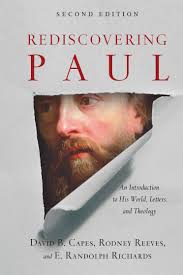
Rediscovering Paul (2nd Ed.) by Capes, Reeves, and Richards

book redis paul

If you are looking for a quality textbook on Paul, then you should consider this second edition of “Rediscovering Paul” by David B. Capes, Rodney Reeves, and E. Randolph Richards. It addresses enough of modern scholarly debates on Paul to please students while being well-written enough to please pastors or Bible students.

I felt that chapter 1 about placing Paul in his times and world was worth the price of the book. It read so well, and so engages the reader, that it was a pure joy. Some works that explain to us how we err in viewing Paul through Western eyes are so dry, but that could not be said of this one.

The next chapter addresses what the authors call the Christophany. Some modern scholars almost paint Paul and Christ as rivals, but these authors do a good job of making them friends. Still, they reference and interact with some of those wild scholarly theories. In fairness, as a textbook they had no choice.

Chapter 3 looks at Paul as a letter writer and contains some interesting information I had not seen anywhere else. The next four chapters consider Galatians, the Thessalonian letters, the Corinthian letters, and Romans. The other Pauline letters are addressed in chapters 8 and 9. The final chapters consider Paul’s theology, his legacy, and then viewing his letters in modern times.

There are some maps, a very helpful glossary for students, a lengthy bibliography, and several helpful indices at the end of this attractive hardback.

There were some capitulations to some of the newer scholarly conclusions that I couldn’t agree with, but overall this is a quite helpful book. It succeeds on every level as a textbook, but as a pastor I’d label it an asset to the rest of us too. It’s engaging writing style was its best asset. Some of the interesting asides covering no more than a page or so were also appreciated. I warmly recommend this volume.

I received this book free from the publisher. I was not required to write a positive review. The opinions I have expressed are my own. I am disclosing this in accordance with the Federal Trade Commission’s 16 CFR, Part 255.
Jude (EEC) by Bateman

book jude

These early volumes of the Evangelical Exegetical Commentary (EEC) series are impressive. Just think, if they hadn’t decided to start printing these formerly digital-only volumes, I would’ve missed it completely. This volume on the Book of Jude by Herbert W. Bateman IV is of the same high quality of the earlier volumes I’ve seen.

Bateman has turned out a fine Introduction to the Book of Jude. I love the way he clearly expresses his conclusion at the end of each section. He begins with discussing some of the textual issues before he jumps into authorship and place of writing. As you would expect, he discusses which Jude this book is about and other theories of authorship. His conclusions are conservative. When he addresses the recipients of the letter, he seems to feel that we are to decide between either Jewish or Gentile Christians. He concludes a Jewish ethnicity of Jude’s readers and that affects everything he discusses thereafter. He next discusses dating the letter and has an outstanding overview of other scholarly opinions. He sees it as written during the apostolic period.

He reaches a unique conclusion that the revolutionary forces of the Judean rebels are the false teachers, or opponents, of Jude. To be honest, I wasn’t convinced of his conclusion, but found it fascinating. You couldn’t accuse this volume of being a regurgitation of some other commentary for sure. The Introduction is thorough and including the bibliography almost reaches 100 pages.

The commentary is outstanding and holds up well with any major exegetical commentary. The depth is good, the options well-defined, and the conclusions are carefully stated. He interacts with scholarship both ancient and modern in this carefully researched volume. Every passage receives an introduction, textual notes, translation, and detailed commentary, followed by biblical theology comments and application and devotional implications.

If you pick up this commentary, I think you’ll agree that it has to be in the running for the best exegetical commentary we have on the Book of Jude today.

I received this book free from the publisher. I was not required to write a positive review. The opinions I have expressed are my own. I am disclosing this in accordance with the Federal Trade Commission’s 16 CFR, Part 255.
The Expositor’s Bible Commentary (Rev. Ed.)-Volume 12, Ephesians-Philemon

book ebc 12

Volume 12 of the Expositor’s Bible Commentary (EBC) is a major revision of volume 11 of the old series that also covered Ephesians through Philemon. Only two authors revised their earlier works and every other commentary is a new treatment by a different scholar. What we have here will be a real blessing to pastors and Bible students.

The Book of Ephesians is now handled by William Klein. Considering the importance of Ephesians, some will label it a very concise volume. Still, don’t see the brevity as superficiality. This volume is well done. In the Introduction he discusses authorship, structure, setting, date of composition, purpose, the relation to Colossians, theology, and textual issues. There’s also a fine bibliography and outline. If you see a negative review of this one, you may find that it’s not for any lack of quality work, but his corporate view of election and the fact that he’s a complementarian may be the real reason. I appreciate this work.

The Book of Philippians now has highly-respected scholar David Garland as its commentator. That’s a coup for this series. The writer of massive, major commentaries has proven himself adept here with a briefer entry. In the Introduction, he discusses background, date and place of origin, integrity of the letter, purpose and occasion, literary form, followed by a bibliography and outline. The commentary itself is outstanding.

Todd Still does Colossians. In his introduction he begins by discussing the overarching Christological theme. He surveys all the other typical introductory issues, also providing a bibliography and outline. The commentaries in the same fine style as the rest of these in the series.

Robert Thomas revises his earlier work on Thessalonians. Some criticize him for his dispensational viewpoint, but I’ve always enjoyed reading it. It appears to me that he took care in doing the revision and it’s even a far better work than before.

Andreas Kostenberger replaced two authors from the old series in his handling of the Pastoral Epistles. He has since written other commentaries on those epistles and this is a fine improvement over the older series (though I like them as well). He tackles each of those three epistles separately. Again, this is a quality commentary for pastors to have.

Philemon sees a revision by the previous author and continues to be a very usable entry.

This book is another economical, wonderful tool for pastors and teachers. Many of us have used the older set for several years, and appreciate the care that went in producing this new set that will last for years to come. I give it the highest recommendation.

I received this book free from the publisher. I was not required to write a positive review. The opinions I have expressed are my own. I am disclosing this in accordance with the Federal Trade Commission’s 16 CFR, Part 255.