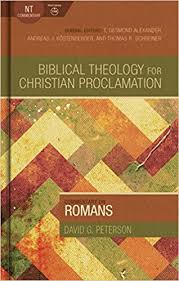
Romans (BTCP) by Peterson

book romans btcp

The young Biblical Theology for Christian Proclamation (BTCP) series continues its impressive start with this fine volume on Romans by scholar David Peterson. When I saw that Mr. Peterson was scheduled to produce this commentary on Romans, I fully anticipated an excellent volume because of his track record in producing a top-flight commentary on the Book of Acts in the Pillar New Testament Commentary series. Though this series may not go as deep on the exegetical level, it creates its own niche by carefully probing biblical theology with competent exegetical work behind it. Mr. Peterson has proven himself adept at both types of commentary. In other words, he has succeeded with this BTCP volume on the Book of Romans.

The learning that Mr. Peterson brings to the table is clear in the Introduction he writes on the Book of Romans for this volume. Although this series required that he summarize more on introductory matters, the research behind what he says is obvious. He begins by discussing the character of Romans and dives immediately into the epistolary framework of the book. This approach requires deeply probing what Paul was doing at this point of his ministry. The next section is on structure and argument. He agrees with those who see four main divisions in the argument Paul presents. He finally arrives at a new approach that he presents in four literary factors: alternation, refrain, progression/digression, and recursion. Next, he tackles purpose and puts Jews and Roman Christianity in its proper context along with Paul’s mission. He ends with a discussion of continuing relevance for the Book of Romans and an outline of the book.

There’s another introductory chapter that discusses biblical and theological themes found in the Book of Romans. This chapter effectively draws out in accordance with the aims of this series what will be developed throughout the commentary itself. In my view, there’s much to glean in this section to greatly enrich one’s understanding of Romans.

The commentary itself begins with the text, a discussion of context, another of structure, followed by verse by verse commentary. That is followed by a section entitled “bridge” that ties the discussion together and makes some helpful conclusions.

All the volumes in this series so far have been of high quality, and snagging Mr. Peterson for the Romans volume is something of a coup for the editors. It raises the stature of this series. This volume will be appreciated by pastors and I recommend it.

I received this book free from the publisher. I was not required to write a positive review. The opinions I have expressed are my own. I am disclosing this in accordance with the Federal Trade Commission’s 16 CFR, Part 255.
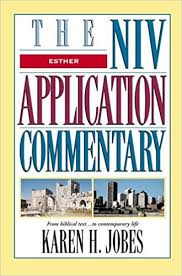
Esther (NIVAC) by Jobes

book esther jobes

The NIVAC commentary series has successfully found a niche as a resource to pick up after you’ve studied the major exegetical commentaries and now need to think about application and contemporary significance. This commentary on Esther by Karen Jobes fulfills the aims of the series effectively.

In the Introduction the author begins with a somewhat subversive illustration to turn our minds toward the subject of the Book of Esther, but becomes much more helpful when she discusses the Book of Esther itself. The style is more succinct, and even breezy, than in some other series, yet the main points are still well covered. The historical background, as well as authorship and date, are all well covered before the author asked the question: is Esther reliable history? I appreciated, especially after having read as many commentaries on Esther as I have, her saying that the objections raised against the historicity of Esther are not “beyond explanation”. She approaches genre in a section about ancient storytelling and argues that Esther has great value whether it’s historically accurate or not. I’m a firm believer in the historicity of Esther, but love seeing her say that the relationship between biblical narrative and history “consciously rests on the concept that God has in fact worked in history through events that really happened”.

Her love of Esther’s story becomes clear in the section on literary structure. Again, this section is not as lengthy as in some of the larger commentaries, but the bases are still well covered. The same could be said of the section on the theology of Esther. Even more in line with the design of this series is the final section on contemporary significance. You will gain some helpful insights.

After a bibliography, she jumps right into the commentary itself. As with every volume in this series, it is divided into original meaning, bridging contexts, and contemporary significance. That design can’t help but have some repetition, but the author did a good job with it. I rate this volume as a success and a worthy addition to your library.

I received this book free from the publisher. I was not required to write a positive review. The opinions I have expressed are my own. I am disclosing this in accordance with the Federal Trade Commission’s 16 CFR, Part 255.

Esther (EEC) by Tomasino

book eec esther

This commentary on Esther is my first foray into the Evangelical Exegetical Commentary (EEC) series. I don’t, therefore, know how this volume compares to others in the series, but I can assure you that this volume by Anthony Tomasino is outstanding. It’s my understanding that this series is produced by Logos Bible Software in digital form for readers. For guys like me who simply must have a hard copy in their hands and can’t quite put up with digital volumes of anything, I’m glad Lexham was produced to release these volumes in print. The good news, then, is that this fine commentary is now available to tech savvy readers and dinosaurs like me.

The Introduction to Esther runs to 130 pages! Don’t let that scare you away. All the pages are put to good use and the layout is such that you can easily skip areas that are not of particular interest to you. After opening with proof that this story has incredible relevance by the repeated attempts at Jewish extermination across the years, he gives a thoughtful synopsis and historical background to Esther and her times. He covers textual issues, sources, date and provenance from every angle. While I could not agree with all the author sees in sources and redaction, this commentary falls firmly into the conservative category. He further explains canonicity. All scholars obsess over genre and historicity when it comes to Esther. I appreciate that when he lists the historical difficulties that most every Esther commentary mentions, he at least doesn’t deny that they could have happened.

If the aforementioned subjects are not that important to you, please pick up reading again on page 70 with the purpose of the book of Esther. Purim, resistance, and all kinds of other literary features are discussed. The characterization is fully developed and well done. I underlined many sentences in the section on motifs, and for the record, I’ve never seen that better done. That takes him through structure and then he dives into theology. When he is finished, it’s clear that he is written the best Introduction in a commentary on the book of Esther that we have today.

The commentary proper includes his own translation, textual notes, commentary biblical theology comments, application and devotional implications, and a selected bibliography. Though it is a scholarly heavyweight, pastors can jump right in and enjoy this commentary thoroughly. At least, I know I did. Mark this down as holding the number one position in major exegetical commentaries on the book of Esther. I highly recommend it!

I received this book free from the publisher. I was not required to write a positive review. The opinions I have expressed are my own. I am disclosing this in accordance with the Federal Trade Commission’s 16 CFR, Part 255.

The Expositor’s Bible Commentary (Rev. Ed.)-Volume 4: Chronicles-Job

book ebc 4

Volume 4 of the Expositor’s Bible Commentary EBC) series continues the winning record this revision has had of the popular, much beloved original EBC series. In the revised set, volume 4 covers from Chronicles to Job. In this case, we have two new authors (on Chronicles and Esther) creating completely new works along with two authors (on Ezra and Nehemiah and Job) doing a revision.

The new work on Chronicles was handled by Frederick Mabie. By all accounts this is a thorough, conservative improvement over the older series. He provides a succinct, interesting Introduction to First and Second Chronicles. In addition to great text, he provides a few charts and graphs that greatly enhance the work. He deviates from the usual synoptic approach to Chronicles with Samuel and Kings. That makes this a stronger commentary on the Chronicles itself. I’m particularly glad to have this work.

Edwin Yamauchi revises his work on Ezra and Nehemiah. Immediately I noticed substantial updating in the Introduction in some places. He’s clearly an expert in history and packs an incredible amount of great information into the Introduction. The maps were much improved as well. This is a helpful commentary including textual notes after each commentary.

Elaine Phillips writes on Esther. Not only is this a substantial improvement over the older set, it superior to many other commentaries on Esther available today. For one reason she’s not so skeptical of Esther’s history! She admits the problems, but doesn’t find them insurmountable. The Introduction is brief, but good. I consider this a real asset.

Tremper Longman revised Elmer Smick’s well-received commentary on Job with the goal of updating the scholarship but keeping Smick’s conclusions intact. Since this commentary was well received in the past I think this was an outstanding way to handle Job in this series. There’s conservative conclusions, a fine chart on page 682, followed by good explanation on parallelism. There is good description of the characters and language before we get into the commentary. Again, it’s very helpful.

This would be a great volume for pastors, especially if you consider its great value in covering from Chronicles through Job for a fair price. Don’t miss this one!


I received this book free from the publisher. I was not required to write a positive review. The opinions I have expressed are my own. I am disclosing this in accordance with the Federal Trade Commission’s 16 CFR, Part 255.

John (TNTC) (Revised) by Kruse

book john tyn

Colin Kruse has revised his popular commentary in the beloved Tyndale New Testament Commentary (TNTC) series to extend its life for another generation. It was one of the last releases in the older set and has proven to be one of the most popular. I’ve never seen anything but positive reviews for the older edition. While we could not call this a major revision, the series editors were wise to secure Mr. Kruse for this revised edition. Aimed at pastors and Bible students, this book strikes a great balance between scholarly information and helpful exegesis and exposition.

This volume continues to have a major Introduction for a mid-level series. Some sections are little revised while others have additional paragraphs that brings the discussion up-to-date. The author’s love of the Gospel of John is clearly displayed from the earliest pages. He begins by explaining the significance of John’s Gospel followed by an overview, a brief discussion of distinctive features, and a scenario for both the Gospel of John and the Epistles of John. Next, he briefly addresses sources.

He explains John’s purpose as well as the likely readership. He’s very favorable to the Apostle John being the author and examines both external and internal evidence. He summarizes reasons found in the scholarly world for the frequent rejection of John’s authorship before concluding with his comfort in seeing John as the author. From there he goes into the date and place of writing and speaks favorably of the historical reliability of John’s Gospel.

One of the most enhanced sections is entitled “recent trends in the interpretation of the gospel of John”. As before, he discusses it as a Gospel of signs, a two-level drama, and explains the narrative criticism scholars see in John. He adds, though, discussion of structural exegesis, reader-response approaches, feminist approaches, and postcolonial approaches. There’s a great section on the theology of the Gospel of John covering all the important elements that are even found in larger exegetical works. He ends the Introduction with a brief discussion of the structure of the Gospel of John.

The commentary itself is also unchanged in places while others receive substantial upgrading. I don’t know how you couldn’t rank it as one of the very best of the mid-level commentaries on the Gospel of John. Factor in its economical price, and this is a volume pastors and Bible students must consider.


I received this book free from the publisher. I was not required to write a positive review. The opinions I have expressed are my own. I am disclosing this in accordance with the Federal Trade Commission’s 16 CFR, Part 255.

Esther (Interpretation) by Bechtel

book i esther

This commentary in the Interpretation Bible Commentary series by Carol Bechtel is another option for those looking for a critical commentary on the Book of Esther. Strangely enough, it’s strongest competition is another book by the same publisher, WJK, in the OTL series by John Levenson. While not as astute or lengthy as the OTL volume, it does in some ways build upon it.

Bechtel begins her Introduction by examining what she calls the vital statistics of Esther. In that section, she discusses versions of Esther, date and historicity to which she is hostile, followed by discussion of form and structure. She summarizes well other scholar’s opinions and even shares Levenson’s fine chart on structure. She decides Esther is a work of historical fiction, and turns to theological themes without really developing her own exact structure. Her points on theological things are unique and interesting. She sees a discussion of “a healthy sense of proportion” as the main theological thrust of Esther. Next, she discusses the theological implications of the challenge of living a faithful life in an unfaithful culture, followed by one on the power of the written word. I found these insights to make a real contribution to our thinking about Esther. I didn’t, however, get as much out of her final section on reading, preaching, and teaching the book of Esther.

The commentary proper was well written. Though it didn’t have the theological punch of the Levenson volume, it would still serve as a fine backup volume to it if you are studying the point of view of the critical camp of scholarship.

I received this book free from the publisher. I was not required to write a positive review. The opinions I have expressed are my own. I am disclosing this in accordance with the Federal Trade Commission’s 16 CFR, Part 255.

Esther (OTL) by Levenson

book otl esther

Jon Levenson has written in the Old Testament Library (OTL) series one of the very best commentaries available from the critical camp on the exciting Book of Esther. As a conservative reviewer, any critical commentary on Esther grates on my nerves more than usual because of critical scholar’s disdain for Esther’s history, but if you are like me and want at least one of the better critical commentaries in your library on every book of the Bible, you should probably consider this one.

There’s no doubt that Mr. Levenson writes with skill. When he says in the first paragraph, “it is also a tale of the ascent of an orphan in exile to the rank of the most powerful woman – and perhaps even the most powerful person – in the Empire and, arguably, the world”, his writing prowess becomes clear.

He begins his discussion in the Introduction on the plot of the Book of Esther. I thought his comment that there’s more narration than quoted speech as compared to similar biblical stories as perceptive. He gives a great overview of the plot. Next, he tackles structure and style and after surveying various scholarly opinions, he gives an outstanding visual representation of his thought of the structure of the Book of Esther. I can’t follow him in all his thoughts about the messages of the book of Esther, but he does give much food for thought. I totally disagree with his discussion of historicity. He gives a fine summary of the textual history of the book of Esther, though he could be disagreed with at points.

Though it has some of the same critical conclusions as the Introduction, the commentary proper is illuminating and thought-provoking. Let’s just say that he provides what I’m looking for in this type of commentary. You might want to check it out.

I received this book free from the publisher. I was not required to write a positive review. The opinions I have expressed are my own. I am disclosing this in accordance with the Federal Trade Commission’s 16 CFR, Part 255.
 

Matthew (NIGTC) by Nolland

nigtc matt

John Nolland delivered this major, massive commentary on Matthew in the highly-respected New International Greek Testament Commentary (NIGTC) series. I’ve had his three-volume commentary on Luke in WBC for several years, and had heard that most scholars found this volume on Matthew more energetic and robust than the earlier one on Luke. After my own interaction with this commentary, I fully agree with that assessment. Further, though this is a Greek series, those who do not read Greek will find no problem as most every Greek phrase has its English counterpart nearby. For that reason, a wider range of readers than you might expect can check out this thoroughly scholarly volume.

The bibliographies in this book are gigantic. On the other hand, the Introduction is shorter than I expected. The commentary proper is the perfect length for the important Book of Matthew. If you want to know the author’s viewpoint, he defines it himself in the preface as a “redaction-critical” work that also uses narrative criticism.

He begins the Introduction with a discussion of the authorship of Matthew. Unfortunately, he finds it unlikely that Matthew wrote the book. In the next section, he wrote about the sources of Matthew with a grating certainty that I could not follow at all. In fairness, however, he’s no worse than many other scholars who write the major exegetical commentaries. In a surprising twist for one who doubts the authorship of Matthew as being Matthew, he still finds the book written fairly early, at least before 70 A.D. The Introduction became much more helpful when he wrote about the provenance of Matthew and other structural and unique features of Matthew. He managed to dip back into the unproductive conversation of sources at other points of the introduction, but was much more productive when he discussed the theology of Matthew. What you don’t want to miss his annotated structural outline of Matthew. That was an awesome way to present an outline!

In the commentary proper, each passage has his translation, brief textual notes, a bibliography for just that passage, and clearly marked off commentary of each verse. He is very thorough in what he addresses. While there are plenty of examples of some esoteric features that only appeals to scholars, there’s much productive, interesting, and helpful information to be gleaned from what he has written.

The competition is fierce among major exegetical commentaries on the Gospel of Matthew, but this volume cannot be overlooked because of the important contribution it makes to scholarship.

I received this book free from the publisher. I was not required to write a positive review. The opinions I have expressed are my own. I am disclosing this in accordance with the Federal Trade Commission’s 16 CFR, Part 255.
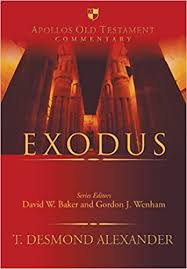
Exodus (Apollos Old Testament Commentary) by Alexander

book exodus apollos

Careful, detailed, cautious, seasoned, thorough – these are the first words that come to my mind after perusing this latest volume in the Apollos Old Testament Commentary series. Mr. Alexander has literally spent his career in the Book of Exodus. Beyond his background in Exodus, the author’s preface states: “I write from a position of believing that the book of Exodus carries an authority that is of divine origin, being more than simply the product of a human author.” In admitting his bias, he makes me feel that I’m in better hands.

For years I’ve been hearing that we should expect a major, conservative exegetical work for Mr. Alexander on Exodus. From what I can see, he has lived up to the hype. It seems that Exodus has been blessed with more pastor-friendly volumes than top exegetical works that the scholars would salivate over. Mr. Alexander has managed to write in the commentary sections material that will please pastors while his lengthy discussions of form and structure on every passage would give the scholars all they could hope for.

I genuinely enjoyed the Introduction. He began with a section on what he called the Exodus Story that exposed the big picture and showed the author particularly adept at theological observation. His discussion of the literary context of Exodus, the relation of Exodus to the rest of the Old Testament, and especially the section on relating Exodus to the New Testament were all brilliant. After that, he got more into the scholarly issues like structure, authorship and date, and criticism. I feel more comfortable with Moses having written Exodus than he does, and can’t be as generous to some critical scholars as he is, but he clearly describes the boundaries of the discussion. He seems to want to date the Exodus in the 15th century BC, but a few arguments that didn’t impress me pushed him into the 13th century BC. His section on the text of Exodus was short as he deals with so many things in the commentary itself.

Mr. Alexander well handles the Apollos commentary framework. Each passage has his own translation that focuses more on pointing out unique things in the text rather than flowing English, appropriate notes on the text, all followed by an extensive form and structure discussion that ranges from worthwhile information to interacting with esoteric, critical viewpoints. Next, we find a commentary section that is of great value followed by a shorter explanation section that is helpful to expositors.

There’s not many reviews out there before mine, so I will venture a prediction that this volume will be highly respected and important for decades to come. I highly recommend it.

I received this book free from the publisher. I was not required to write a positive review. The opinions I have expressed are my own. I am disclosing this in accordance with the Federal Trade Commission’s 16 CFR, Part 255.

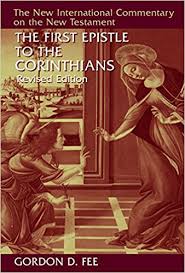
First Corinthians (NICNT) (Revised) by Fee

book corinth NICNT

This revised edition of Gordon Fee’s highly-respected commentary on First Corinthians in the New International Commentary on the New Testament (NICNT) series should be in every pastor’s library. I’ve used the old edition in my studies for some time, and I’m glad to see it revised to now extend its life several more decades. Fee is an acknowledged master of commentary writing. In other words, he knows how to argue his points and be interesting in every passage.

Though the bibliography is greatly expanded, the Introduction has not changed much since the original edition. I appreciate such an engaging Introduction in only 20 pages that really hits on what I’m looking for in the introductory material. He begins by describing the city and its people and transitions beautifully into the problem the Corinthian church faced. I’m not sure I fully reject, as he does, that this letter is a response to divisions becoming parties in the church. His proposed reconstruction that the problem is between Paul and the church itself is at least interesting, even if we can’t fully agree with it. There’s so much learning to be found whether you agree with that or not.

He covered critical questions in two paragraphs. I loved it! In one power-packed paragraph, he completely dismantles many of the critical theories floating around about the Corinthian letters today. From there, he dives into theological issues and begins with eschatology. He discusses the gospel and ethical life, and ends with the church itself. It’s good all around.

I found more editing and updating in the commentary proper. The overall conclusions are unchanged, but it is spiced up a bit. I still can’t agree with his extreme egalitarian viewpoint on some of the text (for example, check out page 545 for his somersaults on the idea of “head”). I can’t follow him in chapters 12 through 14 when he talks about his views on the Spirit, nor can I accept his excising of 14:34-35. That’s not a reasonable way to dodge a text you don’t like. Even with those caveats, this is a top-flight commentary.

At minimum, this is a top-three commentary among all commentaries on the Book of First Corinthians. Some of my friends say it’s number one. In any event, every pastor needs it at hand. You simply can’t do without it!

I received this book free from the publisher. I was not required to write a positive review. The opinions I have expressed are my own. I am disclosing this in accordance with the Federal Trade Commission’s 16 CFR, Part 255.