Hearing the Message of Daniel by Christopher Wright

book-daniel

Christopher J. H. Wright has turned out some terrific commentaries on Old Testament books in the past, and now provides us with a little jewel on the Book of Daniel. This time out he does not provide us a commentary, but a book of expository preaching. As he explains in his preface, he does not get into critical questions, but intends the book to be “an encouragement to God’s people in the midst of hostile and threatening cultures, and to affirm God’s sovereign control of all that happens….” In my estimation, he fulfills his intention.

His introduction is brief, but encourages us to view Daniel from so long ago in a proper way for our day. He scolds what he calls the “end- times prediction industry” with criticism that is warranted. I say that as a premillennialist who would differ with Mr. Wright on several points involving prophecy. Books on Daniel tend to be judged on the prophetic views of the author rather than what he or she actually says about Daniel. It’s what Mr. Wright has to say about Daniel and his times that I find so compelling.

The historical background provided is superb. To my mind, he is at his best when the text is historical narrative. His theological observations are astute and helpful. Leaving out the issue of prophetic interpretation, this is what preaching should look like.

This book is one of those volumes that attempts to hit two targets at once – pastors and devotional readers. Most books in this category can’t quite pull off that feat, but Mr. Wright did with the best such effort that I’ve seen in a while.

The book reads well and yet is never superficial. I’m glad to have it on my shelves now and I predict you won’t be disappointed.

I received this book free from the publisher. I was not required to write a positive review. The opinions I have expressed are my own. I am disclosing this in accordance with the Federal Trade Commission’s 16 CFR, Part 255.

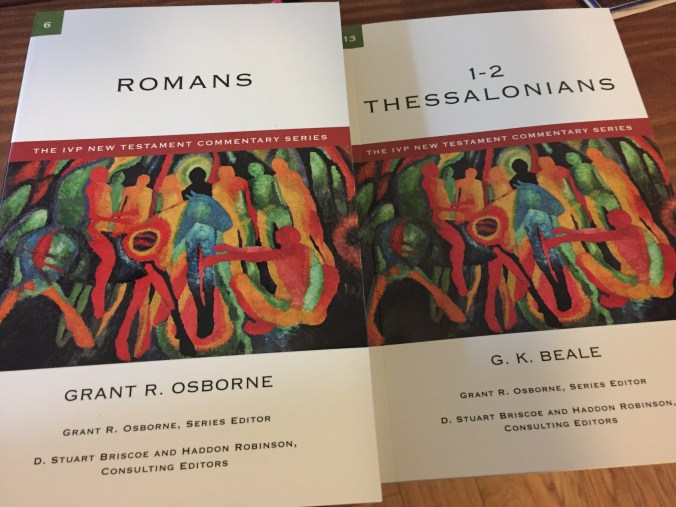
2 Helpful Commentaries in the IVPNT Series

I haven’t reviewed any volumes in this series, so I have two books here that I have heard good things about and here’s my review:

Romans by Grant Osborne

I looked forward to reviewing this book. I’d heard several complementary things said about it, but I wanted to see for myself. Just like is advertised about the IVPNT series, this book is aimed at the church instead of the seminary. There’s plenty of scholarly information given, but great care is taken in the accessibility of the presentation. Pastors, Sunday School teachers, and anyone doing in-depth studies will benefit from using this book. The author, Grant Osborne, is also the editor of this series and produced a well thought out volume here himself.

The Introduction given here on Romans is short, but is not superficial. In discussing authorship, he agrees with the scholarly consensus that it was written by Paul somewhere between A.D. 54 and 58. He does not believe that Peter or Paul founded the church at Rome, but that it originated when Claudius expelled the Jews and Christians and A.D. 49 during a time of conflict between the Jews and Christians. In his section, Genre, Purposes and Themes of the Letter, he succinctly summarizes what has been thought about the point the book of Romans is trying to make. He feels that Paul saw the church at Rome as the ideal sending church to reach that area much too far from Antioch. He states that Paul is not writing a systematic theology in the book of Romans, but that questions raised required much theological discussion.

After an interesting outline, Osborne is off and running on the commentary itself by page 27. I found his commentary at once thoughtful and helpful. I had read some Calvinistic reviewers say that he was the fairest writer against their position out there, and his respectful tone is clearly evident. In fact, he faithfully shares their arguments and then raises some great ones of his own that might be difficult for them to answer.

This book will give you much help while providing deep reflection for your studies without some of the more esoteric discussions that major exegetical commentaries can at times drown in. I highly recommend this volume.

I received this book free from the publisher. I was not required to write a positive review. The opinions I have expressed are my own. I am disclosing this in accordance with the Federal Trade Commission’s 16 CFR, Part 255.

1-2 Thessalonians by G. K. Beale

Scholar G.K. Beale fulfills the designs of the IVPNT series and writes for preachers, teachers, and Bible students rather than scholars. That is not to say that there isn’t careful scholarship behind what he says, but that great care is given in being accessible for readers.

In his Introduction of the Thessalonian letters he explains the historical context of Paul establishing churches at Thessalonica around A.D. 49 or 50. While he feels it’s hard to explain “the exact composition of the Thessalonian congregation”, he is much more certain about why he feels Paul wrote the epistle. Paul defends his apostleship in order that they may follow the Christian teaching he shares. With that apostleship defended, he can branch out into other areas where they are struggling as Christians.

He explains in a few paragraphs the scholarly debate on the sequence of First and Second Thessalonians. He even provides what strikes me as the silly arguments of scholars who think Second Thessalonians should come first. He follows the traditional viewpoint. When he discusses the theological context of these letters, he rightly sees the eschatological emphasis that is given. Both here and in the commentary proper, your evaluation of this commentary will likely be influenced by your own prophetic viewpoint. Frankly, I do not subscribe to Mr. Beale’s viewpoint, but I don’t want to review the work based on agreement with myself. The truth is, there was still much insight to be gained by reading here. His opinion that the “last days” encompasses all the New Testament age, and not only the last few years of it, is one that I agree with. Beale loves to write on the prophetic parts of New Testament and I always gain something from him even if I find much to disagree with.

The commentary itself is quite helpful. Before I received my copy for review, I had read where some other reviewers said this work didn’t live up to other volumes in the series, but I personally don’t see how that could be true. Again, you may disagree with him on the prophetic passages, but at least he will give me something to think about and you will be a better Bible student for it. This book is worth having.

I received this book free from the publisher. I was not required to write a positive review. The opinions I have expressed are my own. I am disclosing this in accordance with the Federal Trade Commission’s 16 CFR, Part 255.
John (ZECNT) by Edward Klink

book-john

Edward Klink has provided us with a major commentary on the beloved Gospel of John. It’s the latest title in the emerging Zondervan Exegetical Commentary on the New Testament (ZECNT) series. Though Mr. Klink has been a successful scholar, he has broadened his outlook for we pastors who use this commentary by himself going into a pastoral ministry. He is very conservative in his viewpoint and strives to be true to the Scriptures. I believe his orthodoxy and vibrant faith will be apparent to any reader. It immediately gives me a greater sense of trust than I find in many commentaries today.

When I began reading the Introduction in this commentary, I at first began wondering exactly where he was going. His approach did not seem the standard fare of most commentaries. By page 25 it all came into focus and I loved it. In short, he says, “Scripture becomes its own kind of genre”. So many modern commentators miss this obvious fact. His arguments were unanswerable, and as he showed, this fact must define all interpretation. He continued making brilliant hermeneutical observations. For example, he said, “the meaning is derived from the event about which the text speaks” rather than the other way around. This volume not only gives good coverage of typical introductory issues, but also suggests several needed interpretive corrections. He covered most all the questions you will have. In my view, only the structure section was a little meager.

Then there’s the outstanding commentary he gave. Though there is some Greek in this commentary, the English is always there making this volume accessible to all. Every passage is given a concise main idea, a literary context section to tie into big picture, an outline of the passage, a synopsis of the structure and literary form, an explanation of the text (regular commentary), and ends with a fine section on theology and application. In my estimation, the commentary given is of excellent quality.

The Gospel of John is greatly loved by most Christians. We are blessed to have a particularly high number of outstanding exegetical commentaries on it. Though the competition is fierce, this new volume will have to be in the discussion of the best exegetical commentary on John available today. I recommend it.

I received this book free from the publisher. I was not required to write a positive review. The opinions I have expressed are my own. I am disclosing this in accordance with the Federal Trade Commission’s 16 CFR, Part 255.
Ruth (ZECOT) by Daniel Block

book-ruth

Daniel Block’s commentary on Ruth is a prototype commentary in the major exegetical commentary category. Perhaps you are like me, and already loved his commentary on Judges and Ruth in the New American Commentary series. Most reviewers always thought his section on Ruth was not quite as outstanding as the one on Judges. Though I still found it valuable, that was probably a fair assessment. So what did Mr. Block go and do here? He has given us what is likely the best exegetical commentary on the Book of Ruth that we have today.

This book is one of the early volumes in the emerging ZECOT series. The bar remains high for future volumes. It continues the discourse analysis approach, which is merely keeping the narrative flow ever in view.

His Introduction to Ruth was tantalizing. He uncovers things usually overlooked and that provides us great help in our goal of grasping the book of Ruth. For example, I hadn’t thought about the fact that the namesake of the book speaks the least often of the three main characters. These kinds of clues really tell us something. His following of the narrative flow helps bring out wonderfully the structure and literary style of the book. Best of all, his brief overview of the theological message of Ruth was outstanding. I might see more in the messianic significance than he does, but the Introduction is still top-notch.

The commentary itself is all that you could hope for. It follows carefully the ZECOT layout and uses it to the best advantage. In addition, there are some charts along the way that really added something helpful to my comprehension. As a bonus, he provides a dramatic reading of the Book of Ruth in an appendix.

Not only is this an extraordinary commentary, it was enjoyable to read someone who not only loved the book of Ruth, but the God of Ruth as well. Label this one – a must buy!

I received this book free from the publisher. I was not required to write a positive review. The opinions I have expressed are my own. I am disclosing this in accordance with the Federal Trade Commission’s 16 CFR, Part 255.
Interpreting Apocalyptic Literature by Richard Taylor

book-apoc

This book is the latest release of Kregel’s helpful “Handbook for Old Testament Exegesis” series, edited by David Howard. It tackles what is, perhaps, the most difficult genre in the Bible—Apocalyptic Literature. Though the volumes in this series are designed for graduate-level courses, this volume by Richard A. Taylor is accessible and reads well.

Chapter 1 sets the stage by carefully answering the question, what is apocalyptic literature. That chapter begins by explaining the importance of genre in exegeting the Old Testament. He also relates well that which most surprises the student as he reads – scholars have trouble even agreeing on what the definition of apocalyptic literature is. Taylor does give us a definition on page 33, but its paragraph length shows the difficulty of definition here. He also defines the kind of apocalyptic literature types that we may encounter in the Old Testament. Perhaps, like me, you don’t see a lot of “ex eventu” prophecy in the Old Testament as he does.

The next chapter is quite helpful as it surveys the places in the Old Testament that you encounter apocalyptic literature. He also discusses a great deal other extrabiblical Jewish apocalyptic texts. I personally find those texts to be of much less value in understanding true Old Testament apocalyptic texts than modern scholars, but every such book is bound to discuss those spurious texts.

There’s much help for the preacher in carefully defining types of figurative language you might encounter. Clearly, that type of language cannot be explained in the same manner as we do with narrative texts. From there, he goes on to explain the process of interpreting apocalyptic literature.

Along the way, you will find words well-defined, lists of other books you might need for exegesis, and examples of his method on specific Old Testament texts. In addition, there’s a very helpful glossary at the end of the book. The appendix on antecedents of apocalyptic literature would be far less help to most preachers.

Because he covers his subject in about 200 pages, this is probably the perfect book to have on the subject. Some folks might be satisfied with the apocalyptic literature chapter in a regular hermeneutic volume, but if you want more, this is the book for you.

I received this book free from the publisher. I was not required to write a positive review. The opinions I have expressed are my own. I am disclosing this in accordance with the Federal Trade Commission’s 16 CFR, Part 255.

The Voices of the New Testament by Tidball

book-voices

At first glance this is a book idea that seemed a little cutesy, or at least that’s what I was thinking. In fact, this idea of having the different New Testament writers discuss theology as if they were around the table seemed like a gimmick. It wasn’t until I actually read the book that I found it to be a unique and engaging way to think about how doctrine is presented in the New Testament.

Derek Tidball’s first chapter gave a good, brief overview to the different approaches to New Testament theology. When he discusses the authorial approach, you can’t help but think how many such works set the writers of the New Testament against each other almost as competing voices for Christianity. That is not the case here. Besides an imaginary Chair and observer, his panel is made up of Luke, James, John, Jude, Mark, Matthew, Paul, Peter, and the Hebraist.

In chapter 2 he goes big picture and discusses the common thread of the New Testament as being the Good News. It’s in this first chapter of the panel going at it that you find out just how interesting and helpful this work is. The quality is maintained all the way to the end and the great doctrines of the New Testament are gone through in a very logical sequence. The amazing part is that this method actually reads much better than many other such theologies.

In addition to the theology, you get a great picture of the emphasis of each New Testament writer. For example, if you were study in Matthew you can go through this book and read Matthew’s statement in each of the theological discussions and you have a good idea of the uniqueness of the book of Matthew. Not only does this book read well, it lends itself to future consultation on a variety of New Testament subjects.

You won’t agree with every single theological description in this book, but you will get a conservative, Scripture-affirming treat for your studies. To my mind, this volume can take his place among much larger works on our shelves and I highly recommend it.

I received this book free from the publisher. I was not required to write a positive review. The opinions I have expressed are my own. I am disclosing this in accordance with the Federal Trade Commission’s 16 CFR, Part 255.
The Book of Isaiah and God’s Kingdom by Abernathy

book-isaiah

Here’s a book that digs deeply into the meaning of the book of Isaiah. Andrew Abernethy believes that seeing the kingdom in the book of Isaiah is the key to discovering its meaning. I believe that you, as I, will come to believe that he made an outstanding case for what he believes to be true about the concept of the kingdom in Isaiah. This volume makes a great addition to the New Studies in Biblical Theology series published by IVP and edited by D. A. Carson.

In the Introduction, he points out how words about the king in the kingdom are found all through the book of Isaiah–far more actually than most of us realize. He states that he wants to frame the entire study on: God the King, the lead agents of the King, the realm of the kingdom, and the people of the King.

Throughout the book, he approaches how Isaiah covers the concept of kingdom in its three main sections (1 – 39, 40 – 55, 56 – 66). He begins in the incredible vision of God in Isaiah 6, and though that is a familiar passage to most Bible students he points out examples of the concept of kingdom where we might have missed them.

Though he makes interesting, conservative observations throughout the book, there are places where I would not be able to agree with him. His handling of Isaiah 7:14, for example, is not something I could fully agree with.

The ultimate praise that I can draw from this book in this review is that I will never again read the book of Isaiah without thinking of the concept of God’s kingdom. When the author accomplishes what he sets out to do with the reader, as he has done with me, he obviously has succeeded. Therefore, I highly recommend this volume to students doing an in-depth study of the book of Isaiah.

I received this book free from the publisher. I was not required to write a positive review. The opinions I have expressed are my own. I am disclosing this in accordance with the Federal Trade Commission’s 16 CFR, Part 255.

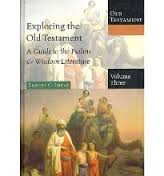
Exploring the OT: A Guide to the Psalms and Wisdom Literature

book-exp-wisdom

Ernest Lucas provides a helpful introduction to the Wisdom literature of the Old Testament in this fine volume. It is, perhaps, the best of the four volumes that make up this series on Exploring the Old Testament. Together with the corresponding volumes covering the Pentateuch, the historical books, and the prophets, these books make for a solid Introduction the the whole Old Testament.

The strength of this volume is far and away the skill at which he describes the special elements of studying the Wisdom literature of the OT, particularly for those who might never have studied it before. He guides the student through poetry, parallelism, and how wisdom was used in ancient culture. He also spends a fair amount of ink explaining classifications of psalms. He provides a fine general introduction to each of the 5 books of Wisdom literature as well.

The only negative is too much respect was given at times to some scholars too far off the reservation. For example, in his fascinating review of psalm classification I wish he had considered more conservative scholars as well. Still, even that part was instructive. The psalms he chose to explain in depth could be argued if his premise was that they were the most important. For example, where were the Pilgrim Psalms? Overall, the strengths far outweigh the weaknesses.

I recommend this volume for your studies of the Wisdom literature of the OT.

I received this book free from the publisher. I was not required to write a positive review. The opinions I have expressed are my own. I am disclosing this in accordance with the Federal Trade Commission’s 16 CFR, Part 255.

2 Volumes for NT Introduction

book-explo-nt

Exploring The New Testament: A Guide to the Gospels and Acts

This is the Second Edition of a well-received volume by scholars David Wenham and Steve Walton. It’s part of a 2 volume set with another volume by different scholars covering the rest of the New Testament. Actually, there are 4 other corresponding volumes that cover the Old Testament as well. Currently, this volume is available in either an attractive hardback volume or a more economical paperback edition.

It’s aimed at first- or second year college students. Though it has features that will appeal more to those planning to become scholars than pastors or Bible students, it is still a fine volume for anyone.

The page layout is appealing and there are multiple things to look at depending on what you’re studying at the moment. It is not set up as a chapter per NT book only as are so many such volumes. There’s over 40 pages to set the stage of Jesus and the NT. Next there is a a good bit of critical discussion that is not as interesting to many readers. There’s three chapters that discuss the direction of scholarly studies of Jesus. The balance of the book is on the four Gospels individually and Acts .

This book is my favorite of those I’ve used in this series and I recommend it.

I received this book free from the publisher. I was not required to write a positive review. The opinions I have expressed are my own. I am disclosing this in accordance with the Federal Trade Commission’s 16 CFR, Part 255.

book-nt-letters

Exploring The New Testament: A Guide to the Letters and Revelation

Here’s the Second Edition of a book by I. Howard Marshall, Stephen Travis and Ian Paul that is often paired with “Exploring the NT: A Guide to the Gospels” by different scholars. Currently, this volume is available in either an attractive hardback volume or a more economical paperback edition.

Aimed at beginning college students, this volume sometimes addresses issues that are more important to scholars than everyone else. Still, it is best that we all be aware at least of where current scholarship is trending.

The setup is exactly the same as its counterpart and that is a plus. In addition to presenting typical introductory issues, the authors give us sidebars to get us thinking. There’s a good introduction to Paul over a few chapters and a chapter for each of the NT books after Acts. Most are helpful, though the one on Revelation is too vague to be of use to the student.

This book and its counterpart are a great asset on studying the New Testament.

I received this book free from the publisher. I was not required to write a positive review. The opinions I have expressed are my own. I am disclosing this in accordance with the Federal Trade Commission’s 16 CFR, Part 255.

2 Corinthians and 1 Peter by Lightfoot

book-lightfoot

This unique book finishes IVP’s The Lightfoot Legacy Set of the recently discovered unpublished writings of J. B. Lightfoot. If you ever peruse used book listings you will see just how popular his commentaries have been for many years. The book has a gorgeous cover and is, to my mind, as much a collectible item for those who are assembling fairly complete libraries as it is a usable commentary.

On the negative side, you really couldn’t call the portion on either 2 Corinthians or 1 Peter a complete commentary. There is a good bit of untranslated Greek as well. His disdain for the Textus Receptus is palpable too. Still, his logical mind is really good in many places. For example, he makes careful arguments on the chronology of Paul and takes some colleagues to task for carelessness. I wouldn’t agree with all his conclusions, but find interacting with him quite helpful.

Other things are added to this volume that makes it even more valuable. There is an expanded rendition of his justly famous “The Christian Ministry.” The volume concludes with some nice articles by others that have appeared on Lightfoot himself.

If you already have the first two in this series, you will definitely want this one as it is of equal value. The set is a nice one too.

I received this book free from the publisher. I was not required to write a positive review. The opinions I have expressed are my own. I am disclosing this in accordance with the Federal Trade Commission’s 16 CFR, Part 255.