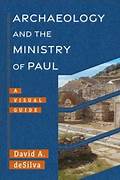
Archaeology and the Ministry of Paul by David deSilva

This book is a fascinating resource. Its varied uses cover more territory than you’d ever imagine. It is so profusely illustrated that I’d love to take it on a trip to the sites of Paul. I can imagine reading it every evening as a precursor to the next day’s adventures. As nice as that is, it’s not a travel guide though, but a Bible study guide. Written in the order of Paul’s ministry, this book would be phenomenal to have at your side as you work through Paul’s itinerary.

It addresses what archaeology tells us about these sites, but that’s not the lead. Foremost it’s the biblical background that makes the book what it is. David deSilva is a scholar rather than an archaeologist. He’s quite an accomplished one at that. Most books of this type totally get immersed into archaeology at a level that is beyond what Bible students are looking for. Here the balance is perfect.

My only criticism is that he is a bit more critical in his scholarship in a few places than I’d prefer. You might add that a few maps would have helped. Its gorgeous content probably would have been appropriate for a hardback as well, but maybe the publishers anticipated that many might carry the book to these Bible sites. The pictures more than make up for any deficiencies and the text reads well too. I’d call this one a winner right out of the gate.

I received this book free from the publisher. I was not required to write a positive review. The opinions I have expressed are my own. I am disclosing this in accordance with the Federal Trade Commission’s 16 CFR, Part 255.

The IVP Atlas of Bible History

This is a nice Bible atlas! I’d seen in the past its earlier iteration called “The Lion Atlas of Bible History”. When I saw that work decades ago, I kind of thought it stood out in some ways, but over the years it started to look quite dated, and I didn’t often consult it. In this polished rebroadcast, it again has “pop”. Its being so easy on the eyes serves to highlight its judicious choices for coverage. In short, it has exactly what you’ll likely be looking for in a Bible Atlas.

The list of things that I like about this volume is quite long. Its maps are vivid, scaled appropriately, and imaginatively designed. The charts and graphs are well chosen. The pictures, especially of Bible sites, were fantastic and nice to just pause and drink in. A Bible Atlas is not a book that you usually read from cover to cover, but anything that tickled your fancy certainly had wonderful text to go with it. I thought every article was excellent and said so much without overly accumulating paragraphs.

It was one of the better Atlas as well in providing a variety of maps for specific Bible events. Some Bible Atlases try to cram large swaths of Bible history into one map. What you have here is more to my liking for sure.

I thought this atlas was especially successful in providing chronological and archaeological data. It always mentions conservative dating respectfully, even if the authors appear to lean another way. Actually, it’s even good at laying out the reasons why there is debate about certain dates in the first place. For example, the dating of the Exodus, and why it is debated, is clearly presented.

We as Bible students are particularly blessed as there are a plethora of outstanding Bible atlases in print. Be sure to consider this one as one of your main options.

I received this book free from the publisher. I was not required to write a positive review. The opinions I have expressed are my own. I am disclosing this in accordance with the Federal Trade Commission’s 16 CFR, Part 255.
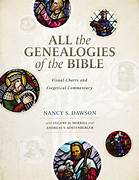
All the Genealogies of the Bible by Nancy Dawson

Here’s is one of the most unique resources I’ve seen. When I say there’s nothing quite like it, I mean there is NOTHING quite like it. This is not a coffee table book even if it looks just like one. The research behind this book is off the charts. Made for real work, it was still quite fun anyway.

If you think about it, there are a substantial number of genealogies in the Bible. My experience has been that I naturally know very little about them, and only the most complete commentaries dig into them. Actually, some of them even fail to. None are given short shift here.

Besides the appealing layout, it’s the exegetical help that is so impressive. The book isn’t big because of pictures, but because of the voluminous exegesis and research.

I have already cleared up a few matters in my mind here. If my question is specifically about a genealogy in the Bible, I will forgo the commentary and come straight here going forward. Hardly do we ever get a research volume that can make such a distinct contribution and fill in such a cavernous lacuna as this outstanding book does.

I received this book free from the publisher. I was not required to write a positive review. The opinions I have expressed are my own. I am disclosing this in accordance with the Federal Trade Commission’s 16 CFR, Part 255.
A Bird’s-Eye View of Luke and Acts by Michael Bird

Think of this book as a nice Introduction like you might find in a good commentary but presenting in a more appealing, accessible format. Its style extends past scholars only, while most of their issues are addressed, to other Bible students. The writing is easy to follow.

To my mind, the work covers much of the basics in the first few chapters. Chapter 8 on discipleship was thoroughly enjoyable and my favorite of the book. I might have discussed “salvation” differently in some ways, but he did a good job illustrating how big it is in these two books. The chapter on empire was interesting.

The design and even layout of the book is favorable. Several of the charts met a need too.

The book misses in some cases. The chapter that asks if Jesus is a feminist is a perfect example. Luke, as has long been noted, mentions women more often than other Gospels. That fact is, too, worthy of study. But why use the term “feminist”? It’s true that there has been a substantial bit of literature on feminism in the Bible, such as it was, that a comprehensive commentary might have to address, but a book to a wider audience would do better to avoid a word with so much baggage. The term means more than pro-woman and those modern notions are no where in Luke. Why write as if they were? I could argue the same way on the next chapter when he asks if Luke is a socialist. Luke speaks of the individual ethical use of money and just isn’t on the capitalist/socialist spectrum at all. It also sounds in these examples like we are taking our thoughts and judging Luke, and ultimately God, rather than the other way around.

Another problem for me is that in a work like this you can analyze Luke at the expense of the rest of the Bible. Of course, it’s good to study what he includes and excludes. But if the Spirit is the true author, then the inclusions and exclusions are better addressed theologically than with some discussion of Luke, say, just being a product of his time. Luke’s times are in play but mistakes because of it, for example, could not be.

My criticisms, to be fair, are not unique to Bird. After he traverses the landscape including some faint trails going no where, he finally concludes in a better place in most cases. I’m probably dwelling on the negatives and not sufficiently covering the far more numerous positives as well.

You’ll have to learn in this book; it’s inevitable. Luke/Acts is worthy of our learning. If your questions are exactly those scholarly questions that are hot at the moment, rather than just what you might ask usually, add a star to the rating.

I received this book free from the publisher. I was not required to write a positive review. The opinions I have expressed are my own. I am disclosing this in accordance with the Federal Trade Commission’s 16 CFR, Part 255.
The New Testament Handbook

This new resource delivers at the same stellar level the earlier Old Testament Handbook did. Same beauty. Same value. Same variety. Same pathway to hours of study. Same success. I see them as a pair where one demands the other.

What will you get out of this book? Whatever you put into it. In other words, there’s too much to run out quickly. Charts have a unique value to say so much on one page. If you are a visual learner your value is double. I love to read, but I’ve long been sold on the value of charts. For me, they are often a crystallization of a large amount of material. Sometimes they plant a long-term portrait in your mind.

In my opinion, the charts on the Gospels are the richest here. Some charts explain something of a presentation of the individual contribution of a particular Gospel while others trace an idea across all of them. There are some helpful maps as well. They don’t because of color scheme look exactly like any other work either.

The only negative is that Revelation seemed a little under covered. Likely a desire to not get labeled with a specific perspective was the reason.

I hope the creativity of the publishers continues with other works in this style. I think they’ve struck a rich vein and should keep digging. For now, you will want to get this one.

I received this book free from the publisher. I was not required to write a positive review. The opinions I have expressed are my own. I am disclosing this in accordance with the Federal Trade Commission’s 16 CFR, Part 255.
The Old Testament Handbook

Here’s a lovely, and I might say fun, new resource. I’m a sucker for books with this kind of hardback (Smyth-sewn) and lavish, colorful insides about the Bible. To be honest, this is one of the nicest books of its type that I have seen in a while.

This book gives us materials on every book of the Old Testament. Each book gets an Introduction page that carries an impressive synopsis of typical introductory issues. What follows is a collection of charts chosen to bring that particular book to life. They are well chosen and well illustrate the uniqueness of that book. All of them pop with eye appeal as well.

There’s little you could criticize here. Maybe one book is a little better served than another. Maybe something you wish was covered isn’t, but this type of book must be subjective in its choosing even if it strikes you as arbitrary. Only one chart in the book failed in my opinion. The one called “The Route of the Exodus” should have been labeled “We Have No Earthly Idea”.

Still, on any criteria this book is a winner. You could literally do hours of worthwhile study with it. I hear a companion volume on the New Testament is in the pipeline. Sign me up!

For a gift or a resource for study—you just can’t lose here.

I received this book free from the publisher. I was not required to write a positive review. The opinions I have expressed are my own. I am disclosing this in accordance with the Federal Trade Commission’s 16 CFR, Part 255.
Proverbs, Ecclesiastes, Song of Songs (RCS)

This latest entry in the Reformation Commentary on Scripture (RCS) may not be as overtly helpful as some in the series as a commentary of this pattern probably doesn’t lend itself to the design of Proverbs, Ecclesiastes and the Song of Solomon. What it lacks in general effectiveness, though, it more than makes up for in sheer fascination. These three, and especially the Song, have veered from the approach of the Reformation era. For my money, it has not changed for the better, so maybe the potential value of this volume should be that of reorientation.

The Introduction is well done and perhaps admits to the changes I alluded to above. Mr. Fink, does not, perhaps, want to go back as far in approaching the Song as me, but he doesn’t obscure the differences. You will want to check this out. Even in Proverbs and Ecclesiastes the Reformers simply found more treasure than we do today.

In these three books, the selective nature of the materials marshaled here could hardly be more fatal to gaining the big picture. You’ll likely be perturbed that the passage you want to address isn’t here in depth, but honestly how could anyone have done better?

Use this one more as a guide of how to do it rather than straight commentary and you will have uncovered its cache.

I received this book free from the publisher. I was not required to write a positive review. The opinions I have expressed are my own. I am disclosing this in accordance with the Federal Trade Commission’s 16 CFR, Part 255.
Dictionary of Paul and His Letters (Second Edition)

It’s the breadth of this volume that immediately grabs you. As you continue perusing, the scope and then the depth impresses. There’s 1160 double-columned pages on, just think, Paul and his letters. I know Pauline studies take on a life of their own in scholarly circles, but that’s still amazing. Those modern tangents are of course covered, but the classic subjects are as well. Such massive productions are more a thing of the past for whatever reason, but this work can stand up to any of them.

The updating of this volume is so extensive that it’s almost a brand new work. It’s predecessor was well received, but it is here superseded, though the older work is still worth having as either a comparison of 20 years of developments or an alternate angle.

There’s nothing I could think of that is missed, nor did I find anything superficially handled or glossed over. You might not, as I, always agree with conclusions offered, but the elements that we might debate are usually clearly given.

What’s my favorite feature out of the many positive attributes I found in this volume? It’s the extensive coverage of each letter of Paul that really amounts to an Introduction of each—like maybe what you’d find in a really good commentary. That coupled with all the extensive background material and you’ve got a winner here. There’s good theology too here where the absence of can at times sink other such works. Additionally, even if you don’t find some of the more esoteric subjects riveting, you’ll at least have a place to remind yourself what they are should the need arise.

Easily, this book is the best of its kind.

I received this book free from the publisher. I was not required to write a positive review. The opinions I have expressed are my own. I am disclosing this in accordance with the Federal Trade Commission’s 16 CFR, Part 255.
2 Corinthians (RCS), edited by Scott Manetsch

We are far enough along now to see a consistent quality in the volumes of this RCS series even though each one is edited by a different individual. I suppose that redounds to the general editor, but I’ve not seen an inferior one yet. The design is perfectly consistent across the releases as well. Each volume in fact carries the same general introduction in case this particular volume is your first. So you see it hardly needs saying that this latest release on 2 Corinthians is good, but it is.

It’s worth noting, too, that this series is more attractive than many out there today. I’m no bookbinder but these large hardbacks look like they will hold up for years and the dust jackets are beautiful.

The best place where history meets commentary in this book is in the introduction to 2 Corinthians that Manetsch provides. It’s fascinating really. It allows you to see who wrote on 2 Corinthians in the Reformation period as well as what issues and disagreements arose. Apparently, the “presence” at the Lord’s Supper was the thorny issue between Luther and his cohorts and other Reformation personalities.

I always say that in the commentary proper there is unavoidable value judgments in this series. We would have no way of knowing what good selections he omitted, but at least we can say that he doesn’t put any duds in there. One thing I did notice, though, was more names of Reformation characters that I hadn’t heard of than usual. They were still good. Don’t worry—the usual suspects are here too.

Whether you are building a set or just interested in 2 Corinthians, you can’t go wrong with this one.

I received this book free from the publisher. I was not required to write a positive review. The opinions I have expressed are my own. I am disclosing this in accordance with the Federal Trade Commission’s 16 CFR, Part 255.

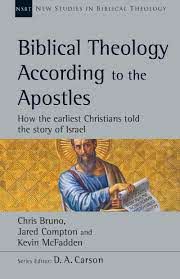
Biblical Theology According to the Apostles (NSBT)

You’ve got to admit it. Sometimes the venerable New Studies in Biblical Theology (NSBT) series finds a niche in theology that you at once hadn’t thought of before and after reading wonder why we hadn’t already. There’s a case in point here. The New Testament is rife with passages that review Israel’s provocative story. So it must be profitable to weigh how the Apostles handled the use of that story, don’t you think?


Three scholars (Chris Bruno, Jared Compton and Kevin McFadden) joined hands to produce this work. Rather than a disjointed work arising from too many cooks in the kitchen this book succeeds as drawing on the the fact the authors have been buddies since elementary school. I guess they traded the former discussions of school, sports and games for those of the Apostles thundering on the Old Testament. Maybe it’s just me but thinking about the non-typical evolution of that circle of friends brings a smile.

To maximize their contribution, the authors offer a introductory chapter that lays out a case for the importance of their idea with their criteria for inclusion and methodologies for presentation. It made sense to me.


They begin quite naturally with Matthew and his obvious connection to the Old Testament with emphasis on his genealogy and the parable of the tenants. Next, they present Luke and Acts as the climax of the Apostles telling Israel’s story with Stephen and Paul’s masterful presentation of the story in Acts 7 and 13 respectively.


Chapters on what is found in Galatians, Romans and Hebrews follow in turn. Hebrews 11 is surely a favorite of many of us. There’s a fine conclusion that sews up this unique study. Mark this work down as one of the more imaginative ones in the series that also manages to add something tangible for us.

I received this book free from the publisher. I was not required to write a positive review. The opinions I have expressed are my own. I am disclosing this in accordance with the Federal Trade Commission’s 16 CFR, Part 255.