The Gospel of John (NICNT) by Michaels

book-john-nicnt

J. Ramsey Michaels has provided us with a massive commentary on the Gospel of John in the New International Commentary of the New Testament series. This volume replaced the much-used and much-loved commentary by Leon Morris in that series. I had read good things about this book, and even had a few people say it was their favorite, so I was happy to delve into it for myself. Though I was ultimately convinced that I must give this book a high rating, I did find a few things not in its favor.

The Introduction, in my view, was not up to par for commentaries of this size. In defense of Mr. Michaels, he purposely kept it short and feels that Introductions would be better written after the fact. It almost read like a few reflections he wanted to share when he was finished. There’s not a lot of background either, but he also chose not to go that direction. He feels such background makes better sense in specific passages. The first part of his Introduction on the nature of John’s Gospel was interesting. He commented most on the authorship of the Gospel of John and was sympathetic to the traditional position, but choose to keep it anonymous since the author’s name is not mentioned. He almost sees anonymity as a trait of this gospel. He speaks only briefly of truth claims, the relationship of John to the other Gospels, and the structure of John’s Gospel, which I thought was the most lacking in the Introduction. He barely spoke of textual issues, and his section on theological contributions, which was good, was only four pages.

One other issue I had with the volume was that what he called the first tier of commentaries that helped him write his was Bultmann (!), Schnackenburg, Brown, and Barrett. At least Morris, Carson, and Keener were in his second tier. I felt at times that his first tier had too much influence on what he said. On the other hand, I would agree with many others who say that he came up with his own unique, fresh perspective.

You may ask why I would still rate this a five-star commentary considering the issues I have stated I have with it. Why must I? It’s the incredible, thoughtful content in the commentary itself. Every passage I interacted with taught me things that I had read nowhere else. Even though there might be a sentence that I disagreed with, in the next paragraph he would tie the passage into the larger context of John, or tie it into some other passage in John, or give some amazing exegetical insight that I found extremely helpful.

All in all, while this may not be my first choice on the Gospel of John, it is one that I will always consult going forward. A book that gets me thinking and opens other side paths in grasping a passage’s meaning is a winner in my book. I recommend it.

I received this book free from the publisher. I was not required to write a positive review. The opinions I have expressed are my own. I am disclosing this in accordance with the Federal Trade Commission’s 16 CFR, Part 255.
A Biblical History of Israel (Second Edition)

book-bible-history

Iain Provan, V. Philips Long, and Tremper Longman, well-respected scholars all, have extensively updated this book for its second edition. Apparently, the first edition raised the dander of the extreme left side of scholarship. There’s even an appendix that you might want to read first called “In Praise of Critical Thought” that addresses the misunderstandings and over-the-top criticisms leveled at the first edition. To my mind, some of these criticisms were so absurd that trying to answer them was tantamount to killing those you have already slain.

Part one covering five chapters and 150 pages tackles history, historiography, and the Bible. That section can best be summarized as explaining and refuting the worst that extreme, radical scholarship has thrown at the credibility of Bible history. For the scholar who needs that interpretive history outlined and answered, you will love that section. Others may already feel a complete confidence in the credibility of biblical history.

I found Part Two, which covers the different phases of Old Testament history in order, to be much more beneficial. In fact, these pages will make a nice reference when studying the various passages. Again, the authors laid out the scholarly attacks against the history in each of these epochs clearly and answers them. Archaeology, historical detail, the biblical text, and logic are all brought to bear to prove the point that Old Testament narratives are historically trustworthy.

The detail presented is incredible. For example, when studying the historical time period of the days of Joshua, some great detail on Jericho, Bethel, and Ai was brought out that showed some scholarly conclusions that are often crammed down our throats are not all they’re cracked up to be. Again, you will find here some fine material to reference in your studies. The book just goes through the Exile and after, meaning this history just covers the Old Testament.

This book is a more advanced biblical history of Israel than many on the market. Many other volumes just go through the material almost as a historical survey and ignores the broadsides from the critical camp. This volume respects those scholars enough to interact with their views. To handle its goal, the material is more challenging than some others. Without a doubt, though, scholars will love it.

Despite the circuitous route it must take, this volume lands at many conclusions where a more conservative student of the Scriptures would agree. It succeeds in what it sets out to do, and so is a voice to be reckoned with in the scholarly world.


I received this book free from the publisher. I was not required to write a positive review. The opinions I have expressed are my own. I am disclosing this in accordance with the Federal Trade Commission’s 16 CFR, Part 255.
KJV Word Study Bible

bible-word-study

Are you looking for a Bible that in addition to the text can teach you how to do word study? Do you use the KJV? I think you’re really going to like this new Bible by Thomas Nelson. (You can get it in hardback or in imitation leather). The Bible is a book of words. Our understanding of the Bible boils down to an understanding of the words. Every Bible student should be particular about understanding the words, especially the keywords. This new Bible will greatly help you in that endeavor.

Each book of the Bible is given a short overview in a few paragraphs with some especially important keywords to watch for. Then, in the KJV text every word that is especially studied in their added notes is underlined. Some of the discussions will take place on the page you are on while others require you to look at a list in the lower right corner of the page and go to another passage where that word is discussed. While what words are discussed may strike you as arbitrary, many words in the text get covered.

You can expand your studies by the indexes provided in the back. There’s an English word index which will guide you to the passage and Strong’s number where you can do further study of the word. Next, there’s a Scripture passage index that takes Scriptures in order from Genesis to Revelation to let you see what words will be discussed. Finally, there is a separate Hebrew and Greek index tied to the Strong’s numbers to open yet another way for further study. In addition, there’s an abbreviated concordance followed by some attractive, full-color maps.

This Bible is not a reference Bible. A reference Bible aids study by providing background information or brief commentary. This Bible is exclusively to help you develop your word study skills and get more out of your Bible reading. I consider it an awesome tool for all Bible readers out there.

I received this book free from the publisher. I was not required to write a positive review. The opinions I have expressed are my own. I am disclosing this in accordance with the Federal Trade Commission’s 16 CFR, Part 255.
Knots Untied by J. C. Ryle

books-ku

Banner of Truth has brought most of J. C. Ryle’s works back into print. Though Mr. Ryle is from another century, his works still have something to say to our generation. Not only have they brought these works back into print, but they have done so with nice bindings and attractive covers that will make these works last for years. This title, Knots Untied, is made with the same design as several others that they print to make a beautiful collection. For the record, they have also recently published an outstanding biography as well as Mr. Ryle’s autobiography.

Mr. Ryle did not write this volume for scholars. You could tell that he aimed at regular Christians, and perhaps, even new Christians. Since almost everyone in his generation attended church, he did write with the assumption that people knew about the churches in England at least. Still, there is at once no superficiality and clear, accessible guidance.

Unlike some of his volumes, this is not a book of sermons. Or at least if they are, they are of the topical nature. He never wavers in loving Scripture, being conservative, and clearly and logically laying out his case.

A few of the chapters were not especially interesting to me as they were too tied to the Church of England. I’m referring to things like the Thirty-Nine Articles and the chapter on prayer book statements about regeneration. In a few other chapters I did not completely agree with him, particularly on the mode of baptism, but don’t let a few disagreements keep you away from this fine book.

And in so many other places he wrote the things we so badly need to hear today. I rejoice in the clarity of his teaching on there being only one way of salvation, or in the help he brings to the subject of private judgment. I assumed I would not like his chapter on the church, but found it a great encouragement. My favorite chapter of all was on the fallibility of ministers. It was the tonic needed in our days.

This is a fine book and I warmly recommend it.

I received this book free from the publisher. I was not required to write a positive review. The opinions I have expressed are my own. I am disclosing this in accordance with the Federal Trade Commission’s 16 CFR, Part 255.

Mark (ZECNT) by Mark Strauss

book-mark-st

Mark Strauss has provided another winner in the ZECNT series. As with other volumes in the series, scholarly information is provided for the studious pastor. As it turns out, I imagine scholars will love it too. Mr. Strauss writes as one in love with the Gospel of Mark. To me, that is often the most important element in producing a successful commentary.

His Introduction of Mark really provokes the reader’s understanding of what the Gospel of Mark seeks to accomplish. As is a key focus with this series, he begins by explaining Mark’s story of Jesus. In describing Mark’s fast-paced story, he says, “this is a gospel narrative on steroids!” He explains that Jesus is both the mighty Messiah and the Son of God. He sees the book of Mark as having two distinct halves, which includes the time where the people were amazed at Christ followed by a time of opposition. He traces out the suffering servant motif with good effect too. Next, he explains Mark’s place in scholarly history, and well defines the various criticisms that have been in vogue over the years. He sees narrative criticism as the most significant of our day and then includes a section explaining his approach in this commentary. He says it is “eclectic, drawing insights from historical-critical, social-scientific, and narrative methodologies”.

He goes on to discuss genre, authorship, audience, and date with conservative conclusions in each. I enjoyed it even more when he got into occasion and purpose and brought out what was, in my view, some of the most interesting features of Mark. In literary features, he discusses Mark’s structure and a few other unique details that I found extremely helpful.

The commentary proper is in the fine ZECNT style that I’m growing to appreciate more each day. He puts each passage and literary context, provides a main idea, explains the structure, provides an outline, and then jumps into detailed explanatory commentary of the text. Though Greek words are used in the text, the English words are nearby and are easy to follow. In both the Introduction and in the commentary itself, this volume is theologically rich.

I recently had the privilege to review the volume on John in this same series and am amazed by the consistent quality. When it comes to an up-to-date, quality exegetical commentary, these volumes cannot be beat. I give this book the highest recommendation!

I received this book free from the publisher. I was not required to write a positive review. The opinions I have expressed are my own. I am disclosing this in accordance with the Federal Trade Commission’s 16 CFR, Part 255.

I Corinthians (NIGTC) by Anthony Thiselton

book-ant-cor

Anthony Thiselton’s influential, important tome on First Corinthians is now made available in paperback. This more economical version will make it more widely available for Bible students. Before I received my review copy, I had heard several reports of how impressive it scholarship was. With it now in my hand, how would I best describe it? Scholarly, encyclopedic, exhaustive, theological, and comprehensive are the words that come to mind.

The Introduction demonstrates what you’re going to get in the whole commentary. There’s 52 pages, but it seems like enough information for twice that amount. In other words, there’s never any fluff, only more and more material for insight. Further, you see its value for both pastors and scholars. It begins with setting the stage in the most vivid way imaginable for Corinth. You immediately see that understanding the cultural milieu is critical to understanding the book of First Corinthians. He proves his conclusions with historical and archaeological evidence. He even hints at a few cultural peculiarities of Corinth that will affect interpreting later passages in this discussion. He also describes how important Corinth is to the overall ministry Paul.

When he gets into other issues common to an Introduction he slides beyond what most pastors would need or want and gives the scholars everything they could ever want; for example, when he discusses argument and rhetoric. His conclusions on Paul and dating are mostly conservative.

His thoroughness continues in the commentary proper. Even though there’s a good bit of Greek in his text, there’s usually the English in the same sentence that makes following his argument easy. There might be some paragraphs that a pastor would skip, but plenty of others that so thoroughly explains what is at stake that would still make it an incredible asset to them. I know I look forward to using it in the years ahead. It’s place in the scholarly world is set too. No scholar writing in the future on First Corinthians will dare to skip Thiselton. I warmly recommend this volume to anyone trying to build a first-class exegetical library.

I received this book free from the publisher. I was not required to write a positive review. The opinions I have expressed are my own. I am disclosing this in accordance with the Federal Trade Commission’s 16 CFR, Part 255.

Hearing the Message of Daniel by Christopher Wright

book-daniel

Christopher J. H. Wright has turned out some terrific commentaries on Old Testament books in the past, and now provides us with a little jewel on the Book of Daniel. This time out he does not provide us a commentary, but a book of expository preaching. As he explains in his preface, he does not get into critical questions, but intends the book to be “an encouragement to God’s people in the midst of hostile and threatening cultures, and to affirm God’s sovereign control of all that happens….” In my estimation, he fulfills his intention.

His introduction is brief, but encourages us to view Daniel from so long ago in a proper way for our day. He scolds what he calls the “end- times prediction industry” with criticism that is warranted. I say that as a premillennialist who would differ with Mr. Wright on several points involving prophecy. Books on Daniel tend to be judged on the prophetic views of the author rather than what he or she actually says about Daniel. It’s what Mr. Wright has to say about Daniel and his times that I find so compelling.

The historical background provided is superb. To my mind, he is at his best when the text is historical narrative. His theological observations are astute and helpful. Leaving out the issue of prophetic interpretation, this is what preaching should look like.

This book is one of those volumes that attempts to hit two targets at once – pastors and devotional readers. Most books in this category can’t quite pull off that feat, but Mr. Wright did with the best such effort that I’ve seen in a while.

The book reads well and yet is never superficial. I’m glad to have it on my shelves now and I predict you won’t be disappointed.

I received this book free from the publisher. I was not required to write a positive review. The opinions I have expressed are my own. I am disclosing this in accordance with the Federal Trade Commission’s 16 CFR, Part 255.
Gospel Fluency by Jeff Vanderstelt

book-gf

Mr. Vanderstelt is on to something. We are not fluent with the Gospel. As he strives hard to point out, a lack of gospel fluency is far worse than a little broken English. The stakes are so much higher. Getting the directions wrong to a tourist site because of ineffective language is of so much less consequence than getting wrong the directions to God because we don’t know how to talk about the Gospel.

This book is written for broad appeal among Christians. In other words, the net is cast all the way to the edge where the newest Christian lives, and yet is still meant to reach longtime Christians on the other side. Though that means some pages might seem to be on an elementary level, all Christians can be challenged.

The book is in five main parts. The first part explains what gospel fluency is and how so much of our attempts to speak to others lacks the Gospel. In a nutshell, if we don’t give them Jesus, we don’t give them the Gospel. I loved how he explained that even as Christians we like to speak the gospel to ourselves and really deal often with unbelief. He says a few shocking things like: “I have met too many people who love their Bibles yet have no genuine relationship with Jesus Christ”.

The second section is about the Gospel itself. In three chapters, he reminds us of what the Gospel is and how powerful it really is. Some of that is basic as many of his readers may not even have a fundamental understanding of the Gospel, but anyone will enjoy when he illustrates how wonderful it is. Part three covers the Gospel in me in three chapters. Don’t miss the chapter “Fruit to Root” as it had outstanding insights.

Parts four and five covered in six chapters attempts to take what we have learned and make it practical. His discussion of the importance of listening is a great reminder.

The book is easy to read. The only fault I found with it, and it is only a personal preference on my part, is that he illustrates too often with discussions that he had with people where he gave them great answers. While that strikes me as a little too self-promoting, we might remember that, in his defense, he might feel the need for us to know that he practices what he preaches.

The book is a success in the sense that it makes me remember that I need to put the Gospel so much more into my conversations with people. I pray the Lord will help me to do much better.

I received this book free from the publisher. I was not required to write a positive review. The opinions I have expressed are my own. I am disclosing this in accordance with the Federal Trade Commission’s 16 CFR, Part 255.

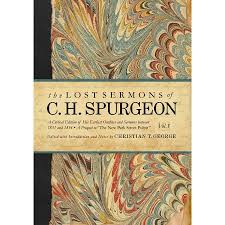
The Lost Sermons of Spurgeon: A Publishing Event!

book-spurgeon


This book is a call for celebration for any Spurgeon lovers or any who appreciate great preaching in general. If you are like me, you already read often from the pool of sermons available in either the New Park Street Pulpit or the Metropolitan Tabernacle Pulpit sermon sets. Perhaps you would agree with me as well in saying that Spurgeon is one of the greatest preachers who ever lived. This gorgeous volume is the first in what will be an indispensable set.

Spurgeon himself meant to publish these sermons from his earliest ministry, but it never worked out. His notes have languished in storage for these many years. Now Christian T. George has rescued the sermons and B & H Publishing has blessed us all by committing to print them in quality, beautiful editions. What will be obvious the minute you pick up these volumes is that both Mr. George and the publishers have treated the sermons as a labor of love.

Once you open this beautiful volume you will find a treasure trove. You will read a history of how the project came together, an interesting timeline that puts Spurgeon in historical context, and introduction, two interesting essays on Spurgeon, and an essay about the sermons themselves. Mr. George then describes his sources and methods and even gives a sermon analysis that reviews the number of words in his sermon notes and other interesting facts. I must confess that I found every page of the introductory material to be interesting reading. Don’t miss the incredible amount of information in the footnotes as well.

Then there’s the sermons. Many of them are only an outline, but Mr. George has put such incredible research of interesting tidbits both historical and personal that are loads of fun for Spurgeon fans. Who would’ve thought that Spurgeon’s first outline mostly came from John Gill! As I read the sermon outlines, I could tell that these were, perhaps, before Spurgeon completely hit his stride, but they still showed the homiletic genius that he was. It also demonstrated how Spurgeon can teach us all to find great sermons in unlikely texts.

I look forward to getting each volume as they come out and can’t wait to have the set completed. If you are a book lover, this is the release of the year. I pray this series has great success and mark me down as its first admirer.

I received this book free from the publisher. I was not required to write a positive review. The opinions I have expressed are my own. I am disclosing this in accordance with the Federal Trade Commission’s 16 CFR, Part 255.

The World’s Oldest Alphabet by Douglas Petrovich

book-woa

This book is one paradigm-shifting title. Douglas Petrovich is a diligent scholar who is considered an expert in “epigraphy, palaeography, lexicography, and comparative linguistics and literature”. The scholarly world has been in an ongoing debate for many years over what language has the world’s first alphabetic script. Mr. Petrovich has worked through the ancient specimens that we have with their proto-consonantal script and has proven conclusively that it is Hebrew. He has even translated these previously untranslated specimens. That the highly-respected scholar Eugene Merrill has studied his work and given it the highest recommendation proves its trustworthiness.

The beautiful thing about this new book is the boon this it is to those of us who believe in the complete veracity of the Bible. I don’t mean it’s a substitute for faith, but that it is another help to doubters. A quick Google search will show you that several major news organizations have already carried stories on Mr. Petrovich’s work. While many of us so appreciate this book, it will probably be something like a bomb going off in the scholarly world where so many do not believe the Bible they study. Going forward, all doubters should be sent to this book.

Though this book has all the necessary minute data to prove its thesis, non-specialists like me can still follow the argument. He well presents the history of what has been thought over the years and carefully outlines what he went through to reach his conclusions. He is not just pulling his conclusions out of the sky. No, he put an incredible amount of work into solving this long-standing puzzle.

The book itself is attractive and has the design of other fine Carta Jerusalem titles. The maps and illustrations are outstanding and really help you to follow what Mr. Petrovich is saying. This book will be discussed for many years and will likely reach the status of one of the most important volumes ever in its field. I highly recommend it.

I received this book free from the publisher. I was not required to write a positive review. The opinions I have expressed are my own. I am disclosing this in accordance with the Federal Trade Commission’s 16 CFR, Part 255.