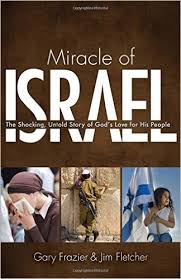
Miracle of Israel by Frazier and Fletcher

israel

The miracle that is Israel is a story too little told in our day. Gary Frazier and Jim Fletcher wisely subtitle their work “The Shocking, Untold Story of God’s Love for His People.” Hatred of Israel is on the upswing yet again,and the saddest part of it is that many Christians fail to see the significance and rank evilness of it.

The book is an easy read and is appropriate for anyone. It begins with three chapters that review Israel’s history in the Old Testament. It is a satisfactory overview.

Part Two is four chapters that present the information that is most likely to be unknown to readers. Particularly, chapters 6 and 7 tell the incredible story of modern Israel. The Lord has worked in several miraculous and thrilling instances and that story is told here. It is my favorite part of the book.

The last Part is three chapters on the future. Here prophecy involving Israel is discussed. It is handled from a premillennial perspective. It was good, but occasionally saw something in the Biblical text that was perhaps at best a guess.

Some of the prophecies used from the Old Testament seemed a stretch too. Still, if this volume can help stem the tide among Christians against Israel, it will be a blessing. Those with genuine questions will find some answers as well.
I received this book free from the publisher. I was not required to write a positive review. The opinions I have expressed are my own. I am disclosing this in accordance with the Federal Trade Commission’s 16 CFR, Part 255.
The New Testament: Its Background and Message (2nd ed) by Lea and Black

nt 2

Are you looking for a fine, conservative New Testament background for your studies? This volume appears to me to be aimed more at pastors and Bible students than scholars, though you will be made familiar with more important scholarly questions.

Part One was exceptional in the big picture background of the NT. The history from the end of the OT to the beginning of the NT well sets the stage. Daily life and the unique religious background of the times are carefully explained. The chapter on the text illumined canonicity in a small compass.

Part Two combines a study of the background of Jesus’ ministry and of the Gospels themselves. The four chapters on Jesus’s ministry and its changing geographical emphasis are essential to properly understanding the New Testament.

The balance of the book covers Paul and the Epistles. It ends with a chapter on Revelation where various viewpoints are covered. Each NT book has its contents, unique features, themes, and an outline given.

There are helpful charts interspersed throughout the text. One of the best traits of this volume that is often missing in such volumes is that it reads well. I recommend it.

I received this book free from the publisher. I was not required to write a positive review. The opinions I have expressed are my own. I am disclosing this in accordance with the Federal Trade Commission’s 16 CFR, Part 255.
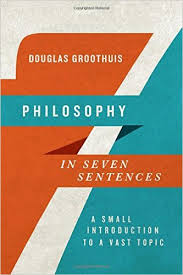
Philosophy In Seven Sentences by Groothuis

philosophy

This book is an experience. It takes an impenetrable subject for many and makes it fascinating. I found this volume far superior to a semester-long undergraduate class I took years ago. He makes it relevant, interesting, and all with a Christian guide to take you along. The writing style is engaging, enjoyable, and captivating. I only use the cliche “I couldn’t put it down” because I never dreamed that would be the case.

Taking seven great philosophers along with their most famous statements was a masterstroke in giving an introduction to philosophy in a small compass. Again, I opened the book thinking that would never work, only to discover it did.

He begins with Protagoras, who I knew nothing about, and taught me about using a measurement outside ourselves. He taught something about today. When he used a statement that many agree with,  including his students,  and then shocked us with the knowledge that it was a philosophy statement of a serial killer, you knew he had something worthwhile to say.

He brought Socrates to life. In fact, I feel I never knew him at all until this book. I learned too how we hear more of a caricature of these philosophers rather than what they really believed. It’s the same with Aristotle. We learn too that if we ignore the basic Law of Noncontradiction we give up everything we could ever know.

He well explained Augustine from a philosophic viewpoint while in no way damaging his theology. He made plain Descartes and Pascal too. He made me realize I had Kierkegard all wrong in that superb chapter.

All in all, this is a masterpiece.
 

I received this book free from the publisher. I was not required to write a positive review. The opinions I have expressed are my own. I am disclosing this in accordance with the Federal Trade Commission’s 16 CFR, Part 255.
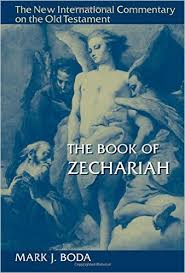
Zechariah by Mark Boda (NICOT)

zech

This is what an exhaustive commentary looks like. This commentary on the Minor Prophet of Zechariah is almost as large as the one on Psalms in this same New International Commentary series. I am not suggesting it is exhausting though. A judicious use of footnotes has made for a volume at once effective for scholarly pastors and academia. I can’t imagine the hours Boda must have put in here.

You would expect the Introduction to be massive in a volume so large, yet it is a manageable 45 pages. That means the bulk of the book is actual commentary on the text.

The Introduction contains a textual history as well as a competent historical background. A section called “Compositional History” overlapped with structure and was worthwhile. I couldn’t personally agree with some of his other conclusions on how the composition came together, but he still trusts the text. His section on the message of Zechariah was good as far as it went.

Again, it’s the actual commentary that will make this volume important for the next 50 years. It seems most every angle is discussed and it is almost encyclopedic. Still, as most will read it one text at a time, the depth will be appreciated. For that reason, I must give a strong recommendation.

I received this book free from the publisher. I was not required to write a positive review. The opinions I have expressed are my own. I am disclosing this in accordance with the Federal Trade Commission’s 16 CFR, Part 255.
The Message of Ezra & Haggai (BST) by Fyall

ezra

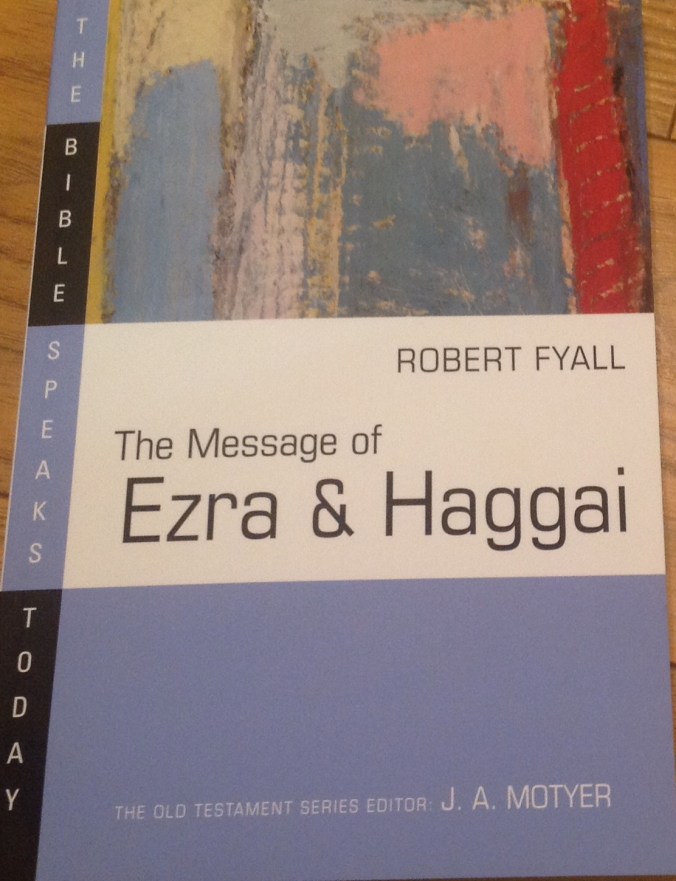
This is a helpful commentary on two books of the Bible that are not only less studied than others, but rarely seen packaged in one commentary. That is not to say that the combination doesn’t make sense; it does. As Robert Fyall explains, Ezra gives the exciting history while Haggai gives the prophetic voice.

The Introduction is a little longer for Ezra than Haggai, but that is partly because the historical setting is the same and needs no repeating. Particularly, his discussion on the structure of Ezra was fascinating. His selections for the leading themes of Ezra (God, worship of God, the people of God, Scripture and prayer) were well discussed and seemed spot on.

The shorter Introduction on Haggai still sufficiently covered similar territory. Again, the approach was well thought out.

The commentary proper was outstanding in the BST style that we have come to love and expect. In the Preface he pays homage to Derek Kidner’s fine volume on Ezra, but this is clearly a worthy companion to it. I’m sure glad to have it on my shelves when studying these two books, and I highly recommend it.

I received this book free from the publisher. I was not required to write a positive review. The opinions I have expressed are my own. I am disclosing this in accordance with the Federal Trade Commission’s 16 CFR, Part 255.
From The Pen of Pastor Paul by Daniel Hyde

paul

This new volume gives help for studying I & II Thessalonians. The style is sermonic rather than a regular commentary style. Whether reading for study purposes, or just for devotional reasons, you will likely enjoy it.

The approach may vary from one text to another, and it may not cover all that could be said, but what is said is of value. You do sense a pastor at work and that the approach was first to address his own congregation. You also pick up on his closely following the thinking of his denomination–the Reformed Church.

The book’s greatest feature is Hyde’s ability to trace Pastor Paul in the two letters. It strikes me that he may he on to something that I will want to think about in my own future studies of Thessalonians. Those sermons that highlighted the ministry were the most penetrating in this volume.

There is some repetition from one sermon to another as might happen in a preaching series, but this is a solid volume to pick up for your studies.

I received this book free from the publisher. I was not required to write a positive review. The opinions I have expressed are my own. I am disclosing this in accordance with the Federal Trade Commission’s 16 CFR, Part 255.
The Message of Joshua (BST) by Firth

joshua

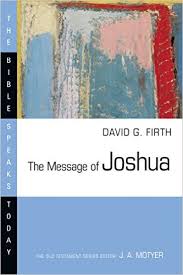
It’s finally complete! Now every book of the Bible is represented in the BST series. It’s strange that Joshua would be the last to get coverage in the series, but it is an outstanding volume in any event. David Firth, the contributor of this volume, has shown in recent years his mettle as a commentator on the historical books of the Old Testament. His superb quality is upheld here.

The Introduction is unique, and yet a joy. The typical elements of an Introduction, which are of varying worth to readers, were skipped to focus on what he felt was the biggest issue in studying Joshua–the violence in Joshua. Since that violence is often parlayed into an attack on God, and a reason to completely discount Joshua, his approach has merit.

His conclusions are interesting. He argues that the violence is not as widespread as it sounded, and that the line was not as racial as imagined. Rahab and others seem to prove his point. Even his explanation that the land is owned by Jehovah as the overriding justification is helpful. This novel approach to Introduction is, in my judgement, a success.

The commentary proper exhibits those qualities you love when studying a text. Great insights and good theology abound. For example, read all he explains on the story of Rahab and see what I mean. He addresses the violence all through the text as well.

This is a fine commentary and I highly recommend it.

I received this book free from the publisher. I was not required to write a positive review. The opinions I have expressed are my own. I am disclosing this in accordance with the Federal Trade Commission’s 16 CFR, Part 255.
The Message of Esther (BST) by Firth

esther

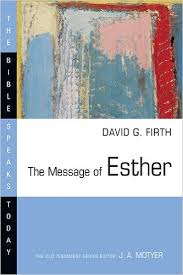
The Bible Speaks Today series by IVP continues its high standard of excellence in this fine volume on Esther by David G. Firth. Firth is emerging as a preeminent commentator on the historical books of the OT. He writes with quality, consistency, and a conservative outlook that pastors or teachers will love and scholars will respect.

The Introduction is short, but succinct in getting you going on studying Esther. He explains the options out there on genre for the Book of Esther and he concludes it is “an historical work”. His assessment of purpose makes much sense. He devotes the largest portion of the Introduction to the main characters of the book. That was an effective approach that i enjoyed.

The commentary itself was outstanding. He kept the flow, saw the forest along with the necessary trees, and gave many valuable insights along the way. I highly recommend this volume.

I received this book free from the publisher. I was not required to write a positive review. The opinions I have expressed are my own. I am disclosing this in accordance with the Federal Trade Commission’s 16 CFR, Part 255.
Christian Mission In The Modern World by Stott and Wright

stott

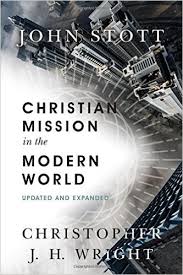
This Stott classic has been ably updated and expanded by Christopher J. H. Wright. In fact, this volume is double the size of the old edition as Wright follows each Stott chapter with one of his own. Not only were Stott and Wright colleagues and friends, but Stott was something of a mentor to Wright. They share many specialities including the subject of this book. Stott is known as the master expositor, and Wright follows him in that way too with several fine, medium-length commentaries if his own. 

Stott does not give us another how-to-do-missions books, but looks deeply as what missions even is, what it entails, and what qualifies as God’s idea of missions. He wrestles with what part social work has in missions, but balances with a critique of the picture of a traditional missionary. There is exceptional exposition in places–like on page 60ff where he unwraps the meaning of evangelism (“euangelizomai”). I loved how he explained it is never defined in terms of results.

This book also clears up a false accusation against Stott that I remember hearing. He was charged with capitulating to pluralism. That is most certainly not the case. See page 178 where Wright clarifies that Stott believed that salvation was exclusively in Christ. What Stott said that some twisted is that who can say about people who respond to God with the light they were given. That does not mean, say, they can respond to Mohammad and get to a God. His discussion makes sense to me.

This is top flight title on Christian Mission and I recommend it. 

I received this book free from the publisher. I was not required to write a positive review. The opinions I have expressed are my own. I am disclosing this in accordance with the Federal Trade Commission’s 16 CFR, Part 255.

Holman Illustrated Bible Dictionary

dictionaryt

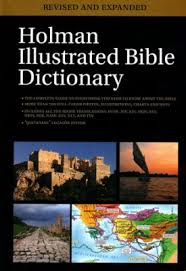
In-depth, conservative, attractive, scholarly, accessible–this is the best single-volume Bible Dictionary we have today. Revised and expanded from its popular previous edition, it covers just about anything you could think of researching.

You get the typical person, place, and thing common to Bible Dictionaries. Then you theological ideas and introductions to books of the Bible. There are helpful charts in places. For example, the chart beginning on page 1359 “Millennial Perspectives on Revelation” covers 5 pages and includes an incredible amount of helpful information.

The book is appealing to the eye as well. Choice pictures are found on almost every page. The maps are high quality and very helpful. You might read an entry and want more, but this the greatest amount of information that you can get in one volume. It comes in at around 1700 pages and you would have to go to an expensive, multi-volume Bible Encyclopedia to get more.

This dictionary is perfect for pastors, Sunday School teachers, or any serious Bible student. I give it the highest recommendation!

I received this book free from the publisher. I was not required to write a positive review. The opinions I have expressed are my own. I am disclosing this in accordance with the Federal Trade Commission’s 16 CFR, Part 255.