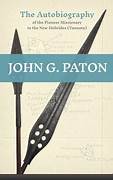
The Autobiography of John Paton

I know it’s a bit grandiose to say, but I must label this the best autobiography around. I’ve not read all autobiographies, of course, but I’d probably be ready to debate you if you nominated a contender. I’m not a particularly great debater, but I bet I’d win that one simply on the merits.

What are you looking for? Thrills? There’s no shortage here. But there’s something more here. This book is on an epic man, written exquisitely, and yet the author has no earthly idea he’s a great man. To his mind, he only has a great God. I’m not talking about laying it on thick with super-spiritual prose, but a man throughly impressed with our Lord line by line. I’d like to be John Paton when I grow up. I’m 55 but only a child compared to this mature man whose spiritual timbre lifts your heart up toward Christ.

His story is told in three parts. Each part has its own distinct flavor. The first part tells us about his childhood and the wonderful family he came from. It also told his preparation for his mission work. Even this part of the story was totally engaging.

Then he goes to the island of Tanna in the New Hebrides. Instantly I noticed two things in reading this part of his story. First, the hardships he faced were off the scale. He lost his wife and child. At times, it seemed like everything that could go wrong did go wrong. I lost count of the times it looked like he was going to die. One of those stories would’ve made his life story interesting, and yet there were so many. Second, the lack of tangible results also stood out. When he left to go to Australia for a furlough and to raise money, he had far more stories than converts. The part that is so challenging is how his faith held so incredibly strong.

The second part of his story is taking those trips and returning to a different island, Aniwa. He had taken on a new wife by this point and still faced several hardships. He had a few close calls, but nothing like the earlier times. One of my favorite parts is how he dug a well, and how that was used to lead those on the island to Jesus. I’ll not describe the details to avoid a spoiler, but you will be so moved by that story. I sure know I was. The other part of the story that is so different is that the island basically turned to Christ. Though I admire Mr. Paton so much, reading his story presses me to say, what a mighty God we serve!

In the last part of the story he tells about his later years when he traveled around the world, preaching and sharing the story of what God did in those islands. While not as thrilling as the first two parts, it’s still such an enjoyable read. He still just trusted God moment by moment. Don’t skip any of it or you won’t notice him meeting George Mueller or Charles Spurgeon. There is one more twist to the story. When the ship he spent so much time raising money for unexpectedly sank, I almost felt a wave of sadness myself. Again, he gave such an example in how to handle even something of that magnitude.

This book is completely beyond criticism. The world at large doesn’t know the story of John G. Paton, but it’s one of the greatest stories I have ever read.

I received this book free from the publisher. I was not required to write a positive review. The opinions I have expressed are my own. I am disclosing this in accordance with the Federal Trade Commission’s 16 CFR, Part 255.

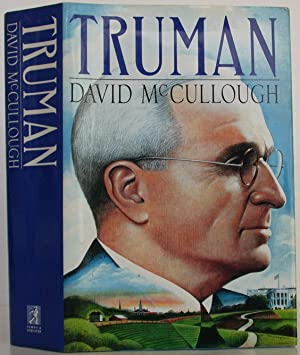
Truman by David McCullough

You know you’re a great presidential biographer if your work substantially moves the needle on how that president is viewed. That’s exactly what master biographer David McCullough did here. It amazes me how many people tell me they’ve read this book.

I even enjoyed the early section on his family background as it touched on several exciting events that happened around Missouri. His family history is colorful to say the least. Hard workers though they were, they could lose money with the best of them. Strangely enough, that’s exactly how it was for Truman himself. He failed in so many ways, lost so much money while having as strong a work ethic as any president I’ve read about, and got to middle age without ever hitting his stride. Had he not fallen in with the shady Pendergast machine he likely never would have. That association would always plague him, but he wouldn’t have a political career in the first place without it.

What is even more startling is how honest he was and how he managed to keep that reputation throughout his career. He is one of the rare politicians that earned that reputation. He had a very high ethical standard as well. He is the only Democratic president of the 20th century they can list avoiding a whole slew of sins that all the rest of them committed.

There was something real about him. He was who he was. He was incredibly practically minded. Perhaps you should say it was Providence itself that brought him into office at that moment in history. It could be said because that good practical nature came in handy. He was intelligent, but occasionally, I wondered if he could be a bit naïve. He had his limitations, but was one of those rare people who knew what they were. His lack of pride and hubris was perhaps his most compelling trait.

He clearly had much exposure to Christianity. He did profess to believe in it on many occasions. Perhaps the only thing that McCullough didn’t know how to uncover was whether or not it was a deeply personal faith or not. It was hard to tell whether or not he was more of a moralist than a Christian, but we will give him the benefit of the doubt by several statements that he made, and several actions he did like kissing the Bible at his swearing in.

Pretty much an afterthought on the presidential ticket of an ailing, dying FDR, no one even thought to bring him up to speed on the most pressing issues of the war. He was not prepared the day FDR died, and he openly admitted it, which was so refreshing, and yet acquitted himself quite well to see the war through to the end. He will always be the president who dropped the atomic bomb, but it clearly made sense to him from even a moral level. There weren’t many voices around him tell him not to do it either. Those voices didn’t arise till later on. He was sobered a bit more about it later as well.

His stratospheric poll numbers dropped quickly after his success with a war won quickly in his term. I personally appreciated the way he handled the Soviet Union. Just as he should have with a major WW2 ally, he gave them a chance. His domestic policies are not to my taste, but he was fairly successful in pushing them. In my view, he perfected the whole “we are for the people and Republicans are for Wall Street.” What stands out is how passionately he believed it. For many, that is just playing the game of politics, or strategy if you will; but in his simple way he was a true believer.

Perhaps his greatest political feat was pulling off his unexpected reelection in 1948. It’s almost as if he was the only person who thought he could win. He never wavered and shocked his opponents and friends.

That second term had several challenges, chiefly the Korean Conflict. I’m not a fan of the UN, but I agree with his stance overall. He set the ground rules for the Cold War and that made it possible for handling Communism without it becoming a hot war. His firing of the legendary MacArthur was a bold move too and I feel likely the correct one.

By the end of his term, Truman showed a few cracks in his amazing vitality. There were a few episodes of pettiness that were surprising, but no failings that would sully his overall reputation as a decent guy who wasn’t too big for his britches.

I wonder if McCullough exaggerated his conflict with Eisenhower. I sure hope so. It never struck me that McCullough liked Eisenhower as he described him as being unduly ugly to Truman. The two men had worked well together before.

His retirement years showed that Truman was perhaps the most “common man” modern president and tremendously likable. I don’t think he liked the work of any of his successors, but that may be only the cantankerousness of an old man. As much as I dislike his progressive domestic policies ( he was pretty good on foreign policy), I think he’d be one of the few presidents of the Twentieth Century I feel I could have related to enough to share, say, a meal or a long chat. I believe I like him personally more than professionally in some cases, or is that just attributed to master biographer McCullough swaying me? In any event, the book is majestic as presidential biographies go.

Check out other presidential biographies here.

Shapers of Christianity by Nick Needham

What an interesting little book! I love books that take several faith heroes and in a chapter try to pique our interest. Mr. Needham aced that assignment. How or why he picked these twelve men is beyond me. I think he tried to pick from various epochs of church history, but beyond that I have no idea. I guess he picked mostly theologians, but then he threw in John Wesley who is remembered more for piety and revival. He even alternated the well known with the not so well known. The unusual setup notwithstanding, this book was a joy to read.

Mr. Needham is well equipped to write this book since he has produced the much larger “2000 Years of Christ’s Power”. I have not seen that work, but judging by this book, it must be a good one.

One little icing on the cake that I noticed is that he often surveyed their writings. That was especially helpful when covering someone not known to you. The only problem is that it might add many listings to your buy list.

While he judged every biographical subject by their adherence to Reformation thinking, he did dip outside those actual boundaries. That made for some of the most interesting chapters in the book. Theophylact (completely unknown to me) was one of the most engaging in this volume. It was so good that it made you wonder, why have I never heard of this guy?

He had some of the usual suspects as well. There was Jonathan Edwards, B. B. Warfield, and J. Gresham Machen among others.

He did really well in a short space of showing why these men are compelling to know, and to know more about. This book will not take you long to read, but mark it down in the pleasant category. 

I received this book free from the publisher. I was not required to write a positive review. The opinions I have expressed are my own. I am disclosing this in accordance with the Federal Trade Commission’s 16 CFR, Part 255.

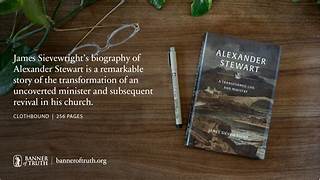
Alexander Stewart by James Sievewright

Alexander Stewart…a man we didn’t know before, but are blessed to meet here. Banner of Truth keeps gifting us with a steady supply of biographies of unknown giants. Calling them “giants” is not hyperbole. Don’t let their relative unknown status fool you. They are men of renown in Heaven, something like a continuation of Hebrews 11. Alexander Stewart is a worthy addition to the publisher’s growing collection.

If you have read some of the previous biographies from this publisher, you know to expect a few things. The man is going to be pious, zealous, and living a life consumed by the Lord Jesus Christ. In most cases, revival taking place during his life, even though justly credited to the Lord, is consistently found. All of that is true of Mr. Stewart.

What is different about him from some of the other biographical subjects they have published? Probably the thing that stands out the most to me is how he came to Christ. He was a pastor before he became a Christian. That certainly is not ideal, but the story itself is fascinating. You will always be saying to yourself as you read, I think he’s close, and yes, he reaches the point of becoming a believer and jumps right into a very dedicated life. You almost wonder if this book could be a help because it seems likely that we live in an age where many people are even perhaps deeply involved in Christian work while they do not yet know the Lord.

From there, the biography is more to the general pattern, but it is a pattern that we should hope starts happening more again. Only God can bring revival, but this is what it looks like. A book like this will make you crave it.

This book, like the others, is beautiful and is of impeccable binding. It’s a little smaller in height and looks a little different while retaining a definite attractiveness. It may not take quite as long to read as some of the others, but it is an absolute blessing. I say keep sending these biographies our way, and while we are at it , let’s pray that the Lord starts sending these revivals again.

I received this book free from the publisher. I was not required to write a positive review. The opinions I have expressed are my own. I am disclosing this in accordance with the Federal Trade Commission’s 16 CFR, Part 255.

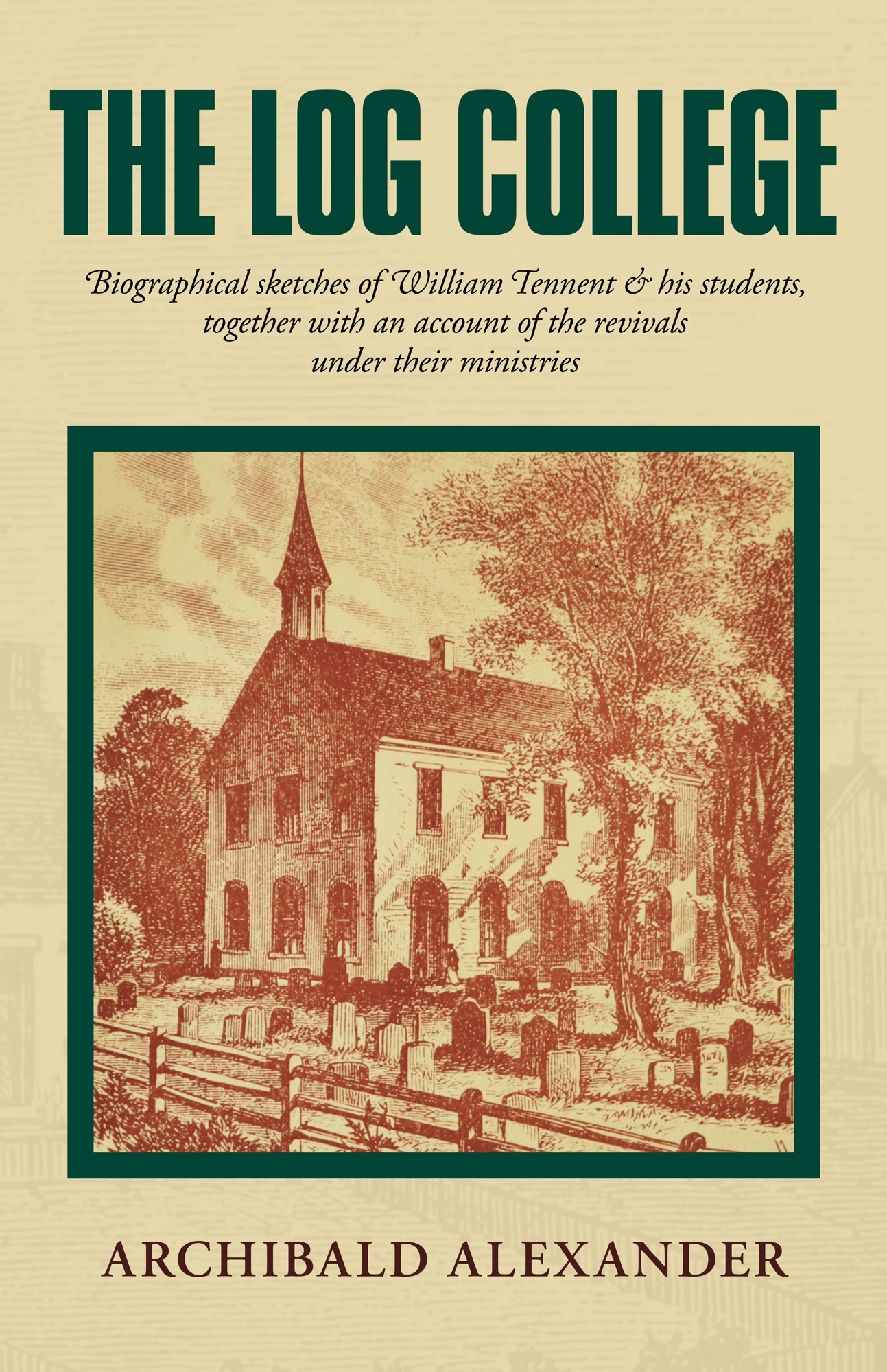
The Log College by Archibald Alexander

This Banner of Truth biography is to some degree different than their usual offerings. In this case, it’s more sketches of a variety of men who were all unheralded heroes who all had associations with a school colloquially known as the Log College. This school did not have the reputation of more famous ones, but in lacked nothing in effectiveness. In fact, the school was quite looked down on, but not for cause. The training it offered was rigorous, and more importantly, the ministry of its graduates impressive. In a word, revival describes its legacy.

After a short chapter on the Log College overall, we get 5 chapters on William and Gilbert Tennent. They were founders of the school with vision and persistence. Next, we learn about the College of New Jersey and the New Jersey and the New London School which sprang from the Log College. From here, we get more sketches of outstanding early graduates who were able servants of Christ with a near constant air of revival permeating from their ministries.

When the life of John Tennent was given, he seemed eerily similar to David Brainerd to me. He had a short life and thought so poorly of himself, yet did a tremendous work for the Lord. Next up is William Tennent, Jr. His story was at once thrilling and colorful. You’ve just got to read that section on the time that he was thought to be dead, but was not. I don’t want to give out any spoilers, but you will not want to miss that one. And there were several other totally unusual features of his life all the while he was an able servant of Jesus Christ.

From here, there are seven shorter sketches of impactful men. The consistent quality of their ministries is what stands out. Probably unknown outside this volume, these men clearly hold renown in Heaven.

This book encourages on many levels. Some of the greatest servants of Christ are little known and near forgotten. Apparently, it is the Lord that got the glory for their lives and that is how it should be. This book is a corrective for our media-driven and marketing age that has invaded the Church. We can make an impact outside of those cheap methods. This book is worth your time.

I received this book free from the publisher. I was not required to write a positive review. The opinions I have expressed are my own. I am disclosing this in accordance with the Federal Trade Commission’s 16 CFR, Part 255.

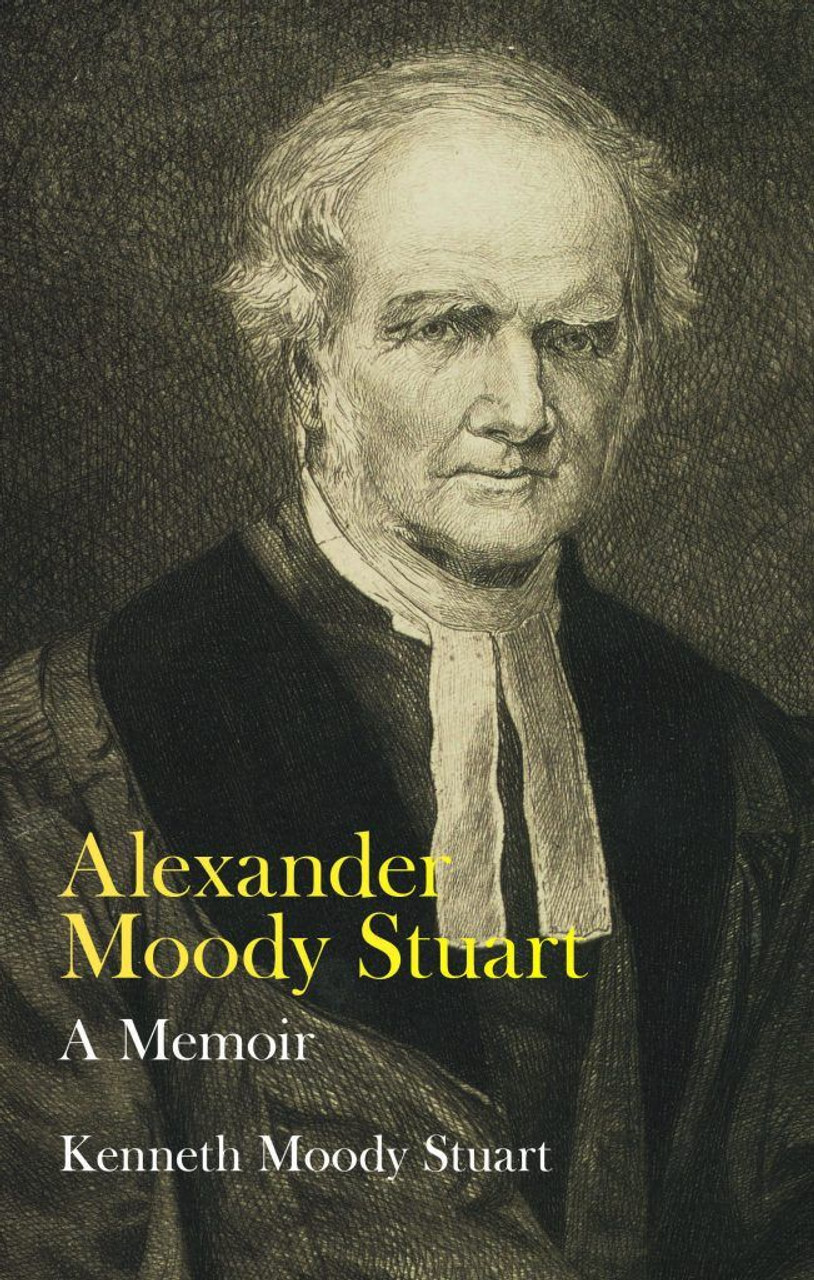
Alexander Moody Stuart: A Memoir

I have long loved these gorgeous Banner of Truth biographies and this one stands out. Spurgeon spoke highly of Stuart and I can see why. I’ve even used a few of his commentaries and they strike the perfect balance between being weighty and warm. This humble servant of Christ is worth knowing.

The biographer is the subject’s son. Often that is a disaster. He, however, never allowed the hyperbole to start rolling. His respect is through the roof, but this isn’t a work of hagiography. Though Stuart lived an exceptional Christian life, his weaknesses though not serious were clear to me in this work. He was gentle and I don’t think he enjoyed conflict even if he got drawn in to it. He never completely dodged anything, but he didn’t perhaps dig in his heels like some of his contemporaries did.

His early life is brief and the story really takes off in his college days. His conversion wasn’t spectacular, but incredibly interesting to read. Quickly, he jumps into serving the Lord. He begins his ministry in Edinburgh and marries. A love of missions soon takes shape. Later he becomes passionate for mission to Jewish people. Along the way, there’s thrilling exposure to revival.

You’ll cross other names as his life seemed to intersect with other awesome servants of Christ regularly. There’s devotion throughout as well as he is an encouragement toward prayer, service, impact and holiness. He is the kind of man I’d like to be.

Banner publishes or reprints one or more biographies a year. Making them part of my reading for the year has richly blessed me over several years. Count this one in that exalted company!

I received this book free from the publisher. I was not required to write a positive review. The opinions I have expressed are my own. I am disclosing this in accordance with the Federal Trade Commission’s 16 CFR, Part 255.

Daniel Rowland by Eifion Evans

Here’s another offering in the long line of biographies of Christian heroes by Banner of Truth of men who are, sadly, far too little known. They seem to especially mine Welsh preachers, not because Wales is better than anyplace else, but because of the landmark revival experienced there. The Great Evangelical Awakening there had less of the excesses of some revivals, which, perhaps, partially corresponds to the main players in it. They were dedicated, magnetic while maintaining humility, doctrinally consistent, and zealous. In what stands out from the pack, their zealousness was fully for Christ rather than an unholy mixture of carrying the Gospel and self promotion. Daniel Rowland is a good fit in this string of biographies.

Eifion Evans has written previously on Revival as it was clearly his niche. The full title is “Daniel Rowland and the Great Evangelical Awakening in Wales.” In my opinion, this book succeeds more on the history than on pure biography of Rowland. I suspect a lack of source materials is the culprit. The trail of humble men doesn’t often lead back to themselves.

Still, Rowland was an incredible man worthy of our revisiting his life. He was, as you will see in this biography, far more stable than Howel Harris. In my view, Rowland was on the right side of the divide with Harris.

There’s plenty of exciting revival described here. To the author’s credit, the bumps along the way were given too. The division that popped up didn’t diminish the beauty of the revival as I read as it only reminded me that we have a wickedly diligent enemy that probably hates revival as much as anything. You could also see the enemy could not ultimately prevail.

Beautiful book. Beautiful cover. Beautiful read. What more could you want?

I received this book free from the publisher. I was not required to write a positive review. The opinions I have expressed are my own. I am disclosing this in accordance with the Federal Trade Commission’s 16 CFR, Part 255.

FDR by Jean Edward Smith (Presidential Bio. Series)

FDR is clearly one of our most consequential presidents. Smith is one of the best presidential biographers. I knew, then, this would be a good read and I was not disappointed.

Admittedly, I started this biography with some negative impressions of him. Since Smith is an ardent admirer of Roosevelt (and a near worshipper of Eleanor), I felt I’d be giving my best shot at not viewing all through the lens of my bias. Where did I land when I finished this book? As I thought, the New Deal did a few short term positives (CCC) but I am even more convinced of it being a long term disaster. In a sense, WWII bailed it out from full exposure. On a positive note, he was, I readily admit, an effective war time leader. This book raised my grade substantially on his war leadership.

This biography showed his being raised in privilege, his tight relationship with his mother, his charming nature, his ambition, and his pride. He was a master politician who perfected the art of propaganda and was a user of people. For example, early in his political career he aligned with the Prohibition wing of his party while being famous for loving to drink and mix martinis for guests. He often fought for progressive policies for the disadvantaged while never living a moment of his life in their shoes. He was vengeful and if you ever really crossed him he never forgot. Just before the war and after unprecedented legislative success, he had a period of political missteps that even Smith admitted were born of his hubris.

The book didn’t cover up his sham of a marriage, at least after having several kids. He carried on an obvious affair that he little tried to hide. Finally, it put his career in jeopardy and he stepped back though he kept her in his life at times and she was with him when he died. Strangely, Smith praises them for sticking together in a completely loveless marriage to remain a powerful political couple.

In my presidential biography reviews, I always try to notice the religious side of the man. Had you asked FDR, he would have quickly said he was a Christian . Perhaps he helped create a Christianity that is pervasive in our day. More than a matter of faith reaching the heart, his was more tied up in his heritage. It’s what the Roosevelts and Delanos were much like they were New Yorkers. It really didn’t affect his life in any meaningful way except being against the more grotesque atrocities. Though you might could argue that he took what Woodrow Wilson started and put it over the top, he in no way had the deep religious feelings that Wilson had. I think Wilson was off base, but he thought he was following the Bible. FDR would be more likely to quote the Bible when it was politically expedient.

This book also showed me that he should be commended for how he had the grit to face the crippling affects of polio. He also likely would not have run for a third and fourth term had not the events leading up to World War II started happening. Also, everyone knew around him that he would never survive his fourth term though everyone kept it quiet. Finally, despite all the glaring character flaws I’ve mentioned, he was eminently likable.

How he rose to the heights he did in WW2 is beyond me. I agree with most of his decisions throughout. The friendship he forged with Churchhill was both real and prudent. I even see his wisdom regarding Stalin. He stretched the rules at times, and though I despise his sometimes blatant disregard for the Constitution, I can begrudgingly agree with a few wartime choices, kind of like a few things Lincoln did. Can you imagine our country today had Hitler won? Those are the only cases where the lines can be legitimately fudged I would cautiously argue.

FDR deserves some credit for saving the republic in WW2 while he set in motion actions that may still destroy it. How’s that for consequential?

For the biography itself, it’s top notch. A step below Chernow and McCullough, but not below many others. It’s only failure was its ending. You’re reading along and FDR dies and the book abruptly ends. No funeral, no postscript, no nothing. Still, I so enjoyed reading it.

Thomas Charles of Bala by John Aaron

Having recently read Thomas Charles’s Spiritual Counsels, I was excited to get into this new biography of this formerly unknown-to-me servant of Jesus Christ. Rather than a reprint from earlier times, this book is a fresh production by John Aaron. The preface showed that Aaron’s previous work has been more geared to translation and editing so I began reading wondering if he could handle the unique task of biography writing. When I finished this book, I wondered no more. He could and did. It matches the quality of many of the fine Banner of Truth biographies in print.

The quality of biographical writing is one thing while the biographical subject is distinctly another. What of Thomas Charles? Let’s just say I tip my hat to this humble but zealous man whose life was all wrapped up in Jesus Christ. He is not as well known as some other preachers but deserves to be in their circle. Why is this so? My conjecture after reading this biography is that he was less bombastic than others but not less effective. He probably didn’t dominate a room when he entered, nor did he feel the need to. In modern parlance, he was comfortable in his own skin. In more spiritual language, he was aware of his God-given spiritual gifts and he quietly, persistently put them to steady use for God’s glory. We must get through our fleshly fascination with the spectacular to fully appreciate the faithful following of “the still, small voice”. When we emerge from that fog, we find that the results are often more rooted and can extend farther. Think of Charles as an Elisha following the Elijahs who called down the fire in great Welsh revivals.

Like Elisha’s vision in the school of the prophets, Charles’s innovation in the creation of Sunday Schools to teach doctrine and reading so as to enable Bible reading was a master stroke that affected Wales for generations. His wisdom in Bible printing for the common people in Wales showed incredible spiritual perception as well. Charles lived in Bala, which was the spiritual wasteland of Wales even after the great revivals, but by Charles’s death Bala was the most lush green field of spirituality in Wales.

His life story was instructive as well. His is a test case for the value of diligent labor enveloped by a love of his Lord. He died shy of his 59th birthday and its cause humanly speaking was overwork. Yet he died triumphantly, without an ounce of regret, on his sick bed saying, “There is a refuge”. Well, there is. This biography reminds us.

Like in so many biographies of great servants of God, we see the valleys of suffering walked through. Death of children, the poor health of his wife, early ministry setbacks, and his own bouts of debilitating heath including severe frostbite of his hand was the shape of his agonies. As always in these great lives, these sufferings were the anvil on which the Spirit hammered a spiritual masterpiece.

This is a wonderful biography. Much of the last chapter strikes me as an appendix to prove his orthodoxy in doctrine, but who would doubt it by the end of his life’s story? I need biographies like this one. They remind me of things I’m prone to forget. I predict you will love this lovely biography as well.

I received this book free from the publisher. I was not required to write a positive review. The opinions I have expressed are my own. I am disclosing this in accordance with the Federal Trade Commission’s 16 CFR, Part 255.

Warren G. Harding by John Dean (Pres. Bio. Series)

Probably the only thing that we really associate with Warren Harding a century after his life is scandal. Even there, we wouldn’t call it exciting scandal, because it essentially forgotten in our country. Perhaps you remember a history teacher saying something about the Teapot Dome scandal, but then again, probably not. If you are into presidential history and biography , perhaps you have noticed that Harding has always been a serious competitor for the worst president ever. At least that is what I have always thought. Now enter this biography by John W. Dean. Believe it or not, he moved my opinion of Harding… a little.

This biography is part of the American Presidents Series, a series I always turn to for the lesser known presidents. Lesser known presidents who have no particularly outstanding accomplishments generally don’t have an awesome biography anyway. For an investment of less than 200 pages you can get a concise biography in your quest to cover every president. Some of them are better than others, and this one is at least well written for what it is.

This one is perhaps unique in the series as the one that is the most driven to rehabilitate the reputation of its subject. One of Harding’s scandals is his fathering a child out of wedlock just before he assumed the presidency. Mr. Dean was convinced Harding was innocent, but subsequent DNA testing has proved the accusation was, in fact, true.

Still Mr. Dean lead me to believe that something of a hatchet job was done on Harding. As he points out, Harding‘s wife burned his papers thinking she was doing his reputation a favor when in fact any proof to counteract wild claims went up in the smoke of her actions.

Perhaps Harding did pick a few cabinet members who were crooks without his knowledge. His legislative record was not outstanding but was sufficient for his times. He took no egregious positions and showed some real political skills in a variety of ways. He is still miles away from being a great president, but as long as John Tyler is remembered he should be spared from being the worst!

As I usually do, I kept my eyes peeled for the religious background of this president. To be frank, very little existed beyond some perfunctory religious statements. He clearly had some personal life issues. Still, he was likable and decent to all those he worked with. In fact, he often tried to be very cautious about needlessly angering his opponents. For what it’s worth, both the opinion of his friends and the public was phenomenally higher before his untimely death than when several took up the pen to destroy his name afterward. My opinion: The real Warren Harding probably fell somewhere between the high marks given in this biography and the flunking grades given by many over the years. To be fair, had he not died unexpectedly of heart trouble, he might have been able to have addressed the scandal and got it turned around. There’s really no other failure in his term of office that should cause his reputation to get so thoroughly creamed. The dark stain on his reputation is exclusively from his private life and scandal involving subordinates.

I will also judge this biography a success because even beyond it’s near whitewashing of some aspects of his life it got me, the reader, to slightly sway my opinion of Harding. That would have to be a win for the biographer.