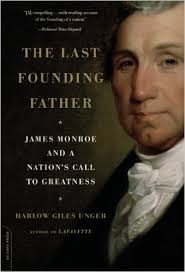
The Last Founding Father (James Monroe) (Presidential Bio Series)

james monroe

Harlow Giles Unger gives us a lively easy-to-read volume on President James Monroe here. His subtitle “James Monroe and a Nation’s Call To Greatness” shows his belief that Monroe’s presidency was great times for our nation. That Monroe was our last Founding Father is open to debate and may depend on how you define it. Had Mr. Monroe died before 1800, I doubt he would have been thought a Founder.

In any event, he was the first Revolutionary War veteran since Washington, and for that matter, the last. A young man in Washington’s army, and one with close experiences with Lafayette, he was even seriously wounded in the line of duty.  He loved Washington but came under the spell of Jefferson and became one of his protegees. To be fair, he was protegee number two after Madison.

He had the same Virginia background as three of his four predecessors, including money problems, the typical troubles of one trying to be somebody in Virginia, and being a slave owner. Like them too he had some troubled family members. The difference was that he was not really born into this life and aspired to it, including the slavery. He left nothing for us to know his religious beliefs.

He career as Virginia’s governor and his time in France was productive. He showed initiative and had to make decisions in those days where communication across the Atlantic was so slow. Unger well highlighted his many accomplishments.

The flaws of the book were usually to do with getting carried away praising Monroe. He paints an inaccurate picture of James Madison being incompetent and Monroe carrying him the last two years of his presidency. Besides Monroe he seemed to praise only Washington and even suggested Monroe was another Washington in many ways. A biography where the biographer comes to really respect his subject is often a good read, but this one got carried away.

On the plus side, I left this volume feeling I had underestimated Monroe. He actually was one of the good ones. His time in office was greatly prosperous and he greatly aided the expansion of our country. His end in poverty and ill health was sad.

There must be a better biography of Monroe somewhere, but it would likely have to work hard to be as entertaining as this one. Here is a pleasant read.

Find other review in the series here.

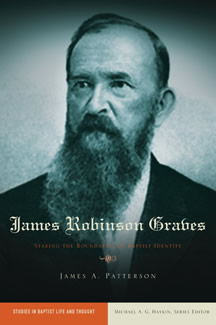
James Robinson Graves by James Patterson

j r graves

Here is a man probably not known by many today, but who had an incredible impact on Baptist thought in America. This biography tells us of the man and we see the development of Baptists clearly as well. He particularly molded the early Southern Baptist Convention. His career was mostly as a Baptist editor and he spent his life battling for his views.

Mr. Patterson, a Baptist professor, dug deep to make this scholarly contribution. Though the scholarly style may repel some, his contribution is likely to always be the definitive volume.

He also traces the actual viewpoints that still show up in some circles that are called Landmarkism. Though Graves picked up thoughts in several places, it was his writings that put Lankmarkism on the map. Very few people believed his view on Baptist succession and rigid church and baptism beliefs before he popularized them.

Patterson shows that these beliefs matched the political thinking of the times. As a biographer, he went to great pains to be fair to Mr. Graves. The problem was, however, that Mr. Graves makes that hard to do. Mr. Graves was so rigid and harsh he failed to keep the testimony he should have held to have the ear of so many.

Frankly, the book is fascinating if you have ever been part of the Baptist world. In fact, I don’t know how we could understand Baptists accurately today if we did not know what this biography told us. I highly recommend it.

I received this book free from the publisher. I was not required to write a positive review. The opinions I have expressed are my own. I am disclosing this in accordance with the Federal Trade Commission’s 16 CFR, Part 255.

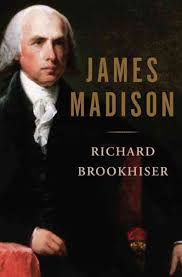
James Madison by Richard Brookhiser (Presidential Bio Series)

madison

Prolific writer Richard Brookhiser tackles President James Madison in this short biography. Though the writing skills I have come to respect in Brookhiser are present, this volume is not quite as good as the others of his that I have read. As a biography, I did not think it was as good as David Stewart’s “Madison’s Gift” either.

The book begins with a riveting retelling of the British marching on Washington during his time as President. Then, it backed up and took the story chronologically. When you finally got back to that point of his life’s story, you could never figure out what device the author had in mind by opening the book with it. I thought of it as a missed opportunity.

Still, the prose is agreeable and the reading easy in this volume. While the biography is not standout, his premise that Madison brought us the partisan politics that since has defined us was much more successful. Some think he overstated his case, and surely Jefferson had a role, but he was an essential element as Brookhiser proves.

This is not my first choice for Madison, but still a fine read.

Find all others in this presidential series here.

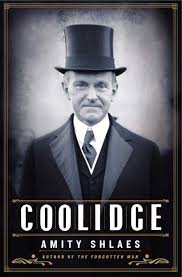
Coolidge by Amity Shales (Presidential Bio Series)

coolidge

Here is an awesome book bringing to life a man I have wanted to know ever since I heard he was a role model of Ronald Reagan. Shales was a good biographer who stepped out of the way and let us know Cal.

In her deft hands, the simply telling the story helped us see that Coolidge was a good man. He was ever motivated by principle and was, perhaps, the least politician who ever sat in the office.

He was a hard worker, and especially tireless in going after budget cuts. The country and the economy thrived in his time in office.

Shales shows us his full orbed personality. He likely was a little harsh at times. His moniker of “Silent Cal” was no exaggeration. He was a little jealous of his beautiful wife too, but he clearly adored her. Shales related one strange episode where his wife and a secret service agent got lost hiking. He exploded and the agent was transferred. It did seem he was at least a nominal Christian.

He seemed to be the perfect President for his times and you wonder if he would have done quite as well at other times. He handled the Boston Police Union strike in such a way that perhaps he could have well handled a major foreign policy crisis, but we will never know as he was spared that in his term.

I did get the feeling that he would have better handled the Depression than Hoover, as he fully realized the market was overvalued in his day.

I came to really like this man and came to love this biography along the way too. This is a real winner.

Read all in the presidential series here.

The First American Evangelical: A Short Life Of Cotton Mather

mather

Have you fallen prey to the prevalent misconception that Cotton Mather was the moralistic, harsh perpetrator of the Salem Witch Trials? If that is the case, you do not really know the man. Author Rick Kennedy takes us to the heart of the man and Mather is, in fact, a man worth knowing. Kennedy succeeds in a short biography at what some massive tomes can’t even deliver—a winning biography that is enjoyable to read and brings life to the subject.

I must confess that I came to greatly admire Mather by the end of this book. His faith was real. Though he worked at scholarly efforts on many occasions, he never lost his full confidence in God’s Word. He was in no way a fake. He was sincere in his home and ministry. The members of his church loved him and stood by him all his days. His faith was tested and stood as he buried 13 of 16 children and 2 of 3 wives.

Kennedy makes a good case that Mather is not the last American Puritan, but rather the first American Evangelical. He had only a cursory involvement in the Salem Witch Trials, but has had his reputation altered by a disreputable rival.

You will see just how good this book is in the first chapter entitled “The Pastor’s Study”. While that title may bore you, I have never come to know someone better in the first chapter before. The scene he draws is vivid and makes the study a vibrant place.

He doesn’t hide Mather’s weak points. He almost took his thoughts on angels too far. He relentlessly promoted his own books. His last marriage had problems and he always had trouble managing his own finances. All these things only made him real. The fine man remained. I simply loved this book!

I received this book free from the publisher. I was not required to write a positive review. The opinions I have expressed are my own. I am disclosing this in accordance with the Federal Trade Commission’s 16 CFR, Part 255.

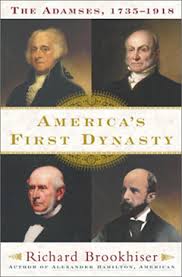
America’s First Dynasty: The Adamses by Brookhiser (Presidential Bio Series)

adams

This volume is like presidential biography plus. You get President John Adams as well President John Quincy Adams. It doesn’t stop there as you will trace the family to its dissolution too. Living up to its title “America’s First Dynasty”, Richard Brookhiser gives us another of his fast-paced, brief biographies that are a joy to read.

Brookhiser writes well on John Adams, though I found him to be less sympathetic than David McCullough. The political and historical side were adequately presented, but his niche is clearly familial. This family with two Presidents certainly had a cadre of failures too.

John Quincy Adams was shown as the striking, successful character he was. It is interesting that John Adams had only one good son (John Q) and John Quincy in turn had only one too. It seemed to me that Brookhiser missed what made for the success in these cases: time from a father. This was clearly missing in the others who failed.

The rest of the book is almost depressing. Each generation lost sons (often to alcohol) who went really bad. The last Adams was Henry and his story was one of despairing of life. He had no children and the dynasty ended, though as you read, you will see it actually ended before.

This is a fine book and the succeeding generations do not, at least for me, take away any admiration for our two President Adams.

Find other titles in Presidential series here.

The Scariest Book I Ever Read And What It Taught Me!

third reich

It was beyond belief. The story of Nazi Germany and its maniac leader, Adolf Hitler, is more than history; it is a parable of what can happen. It is the ultimate lens through which to view current events. It is the worst case scenario of the proverbial history repeating itself. The Rise and Fall of the Third Reich will grip you in unexpected ways.

Strangely enough, it was not the war itself, or even the bloody terror before and during it, that was most horrifying in this episode of history. No, it was that an Adolph Hitler could rise from where he did, have such complete control over a people, and go on to get away with all he did with the masses following like deranged sheep.

Hitler was nothing. He had no track record of anything other than finding ways to bluff or manipulate his way to power. This proponent of the superior German race was actually an Austrian. This great warmonger had only been an undistinguished corporal in WWI. He failed at all he did and kept going forward as if he had greatly succeeded. (It kind of reminds you of other leaders who were only community organizers). He came out of no where and seized power by effective propaganda and shrewd political moves. During his whole career he habitually told lies and so effectively that you wondered if he grew to believe them himself.

He was consistent in some things. He never wavered on who was subhuman–Jews first and foremost, then Poles and Russians. (Like some see the inferiority of Christians today). He always believed the state was supreme and people dispensable to uphold the state. Of course, it took a while to realize that he was the state! Any amount of blood was legitimate to shed in propelling the state and its aims forward. (For him I suppose it took a village to raise a child).

Nothing he said was too ludicrous for the masses to swallow. There was a sizable number of Christians in pre-WWII Germany, but they made no outcry. Somehow he convinced them that what he said fit Christianity, at least until it was too late to do anything about it. He rewrote history (the circumstances of the end of WWI) until he convinced people who had actually lived through it! (American history is not matching what I remember when it is told today either).

He incredibly manipulated other countries. His first two major conquests of territory were bloodless. He simply made baboons out of other European leaders. He never kept his word in any deal he made and yet spoke as if he had the greatest moral authority when it was time to discuss the next one.

He mastered the art of controlling the conversation. He developed methods to stop the mouths of those who disagreed. (Christians, do you feel our mouths being silenced?) He realized that getting the minds and hearts of the younger people was essential and so started the Hitler Youth. (Do you feel like we just woke up and found a generation that finds things like gay marriage perfectly acceptable?)

As I read I kept trying to tell myself that in America we have more background in freedom and would never get sucked in to this extent. We have many who could not be forced into silence. Yet this tale shows just how far things can go. It is a horrifying portrait of people closing their eyes along with the exceeding depravity of men.

Actual Book Review

An actual masterpiece! No novel could ever hold your attention to a greater degree. William Shirer was the perfect man to write this book. As a reporter who reported from Germany until the war and again after in the Nuremberg trials, he saw many things firsthand including appearances by Hitler and his associates. In addition to that familiarity, he did extensive and effective research. Finally, he brings the skills of a gifted writer. It is a page turner.

The two criticisms that are most often leveled against this book take nothing from it. Some say he was taken in by Hitler’s charms before the war and denies it in the book, but I read several humble admissions that he believed Hitler when he should not have. He also writes of homosexuality as a perversion in a few references. That was his belief and the prevalent belief of those times, and for a few of us still today. I appreciate a volume without the baggage of political correctness.

I believe this book will never be superseded. It is simply that good.

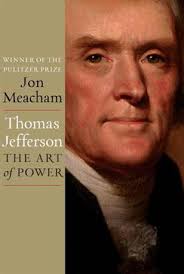
Thomas Jefferson by Jon Meacham (Presidential Bio Series)

jefferson

This fine biography by Pulitzer-Prize winning author Jon Meacham draws a vivid picture of Jefferson. Mr. Meacham clearly admires Jefferson, but as the subtitle “The Art of Power” shows, he was not blind to his weaknesses. Jefferson was charming, yet he knew how to manipulate situations to stay in control. He was never satisfied unless in control and was exceptionally good at gaining it. His compensating trait was that he genuinely liked people and beyond control he really wished no harm.

Many consider him the most intelligent President we have ever had, and that could likely be the case. He was brilliant, a voracious reader, a student, a thinker, and had a naturally inquiring mind. Despite wanting to be liked by people, he was ever true to himself. Give him a chance at personal contact and he could disarm most critics, except, of course, Alexander Hamilton. As you read you will discover a man you can’t help but like despite his bewildering moral inconsistencies.

Jefferson was the most articulate spokesman of the liberties that were the battle cry of the Founders. His writing of the Declaration of Independence was epic, though he wrote little else besides personal letters the rest of his days. He was in Paris when the Constitution was drafted, yet his influence was there in the person of his protegee, James Madison.

He served in Washington’s administration, but that was often difficult as he ever battled Hamilton. The parties of Federalist (Hamilton) and Republican (Jefferson) developed in spite of Washington’s disdain of them. Washington sided more often with the Federalists as that matched his thinking. He still respected Jefferson and always listened to what he had to say. I was saddened to see that though Jefferson respected Washington in many ways, he did not love him and was rather happy when he retired. Maybe that control thing blinded him.

After Adams term and the straining of that friendship, Jefferson finally got the control he wished in his two terms as President. He actually kicked off the Virginia Dynasty where his protegees followed him for the longest run in American politics (24 years). His term in office was a success. The Louisiana Purchase was a masterstroke.

Despite these successes, there was his lifelong approval of slavery. I fully understand that he was a product of his times and surroundings (Virginia), but for someone to so clearly see the value of liberty and freedom how did he justify it in his time? Perhaps he knew it wouldn’t last, but that it wouldn’t go away in his lifetime, so he just enjoyed things as they were. Washington was at least haunted by it while we find nothing to prove it upset Jefferson.

Then there is Sally Hemmings. Meacham is convinced that Jefferson fathered children with this slave. It was complicated in that she was actually his deceased wife’s half sister. It seems his father-in-law was a bad boy too. They say she looked a lot like her sister, whom Jefferson adored. Her death was one of the dark spots of his life. There has been long debate about this with many saying Jefferson is innocent. DNA tests prove that a Jefferson got into the Hemmings family, but there is no way to prove it was Thomas Jefferson. My own thoughts are that it is likely true. Human nature being what it is, and having the power a master has over a slave, it was bound to happen in many cases in a setting of slavery. If it is true, that Jefferson would allow his own children to be slaves in his lifetime would have to be the darkest stain on his life.

The Meacham volume is good reading and truly brings Jefferson alive. It is a winner.

Find all articles in the series here.

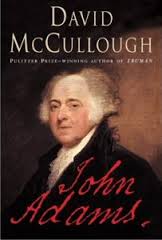
John Adams by David McCullough (Presidential Bio Series)

adams MMC

Here is a superb presidential biography by master writer David McCullough. Mr. McCullough could not be dull if he tried and this is one of his most popular books. This volume brought him his second Pulitzer Prize and I can see why. This biography has the distinction of rescuing a stalwart founding father from the oblivion he was sinking into. It was an undeserved retreat, which McCullough likely realized, and Adams has a 200-year history of competing with Jefferson and coming up a little short. It took McCullough to put Jefferson on the defense!

McCullough did not create something from nothing. Adams is the real deal. He is no Washington, but who is? He need not feel inferior to any other of our Founders. Perhaps a better Founder than a President, but he did as well as any one could following Washington. He had a few blunders, but some successes too.

He could be quite crusty, but he had an honest foundation that never let him down. He was far more moral in his private life than Jefferson. He was not into intrigue or political maneuvers, even to the detriment of his career, but I found myself appreciating it as I read. He wouldn’t just lie when he hit a rough spot either. That it is not to say he didn’t have his flaws. Vanity, and at times ambition, damaged his career. In his defense he realized it to some degree and even made a few attempts to improve.

This volume does a particularly good job at tracing the ups and downs of his relationship with Jefferson. As you read, you will actually rejoice to see the two improve the relationship in old age.

This volume also well explains that the seeds of the Civil War were sown at the very beginning. Adams hated slavery.

It is clear too that Adams was a believing Christian. He is not one of the Founders like Jefferson or Franklin who can be put in the Deist camp. Seeing him as a father was instructive too. Two of his children did not turn out well and his neglect was probably a contributing factor. He put much more input into John Quincy Adams’ life to better results.

This book is simply one of the great ones.

Find all articles in the series here.

The Printer And The Preacher by Randy Petersen

printer preacher

Here is the merging of two categories of reading that, if you are like me, you enjoy–Christian biography and Colonial America. You get in this volume two prominent characters in those categories–George Whitefield and Ben Franklin. It is a pleasing, somewhat stretched, and breezy read.

His premise that the friendship of these two men “invented” America failed, but the book did not. These two men made distinct contributions to what became America, and they even had some sort of friendship, but the friendship itself had nothing to with anything in forging of our nation. In fact, the friendship was much ado about nothing as he failed to uncover just how deep the friendship was. I suspect it was not that deep and we will never know for sure beyond that.

Why I will still recommend the book is that these two men with their different lives did have such an impact. The similarities and differences in the two men are fascinating and how people took to them is something Petersen did capture. He succeeded in bringing Franklin alive more than he did Whitefield in my opinion. Part of the reason, I imagine, is that he too followed the oft-discredited study of Harry Stout.

Still, with the above caveats in mind, it remains enjoyable reading.

I received this book free from the publisher. I was not required to write a positive review. The opinions I have expressed are my own. I am disclosing this in accordance with the Federal Trade Commission’s 16 CFR, Part 255.