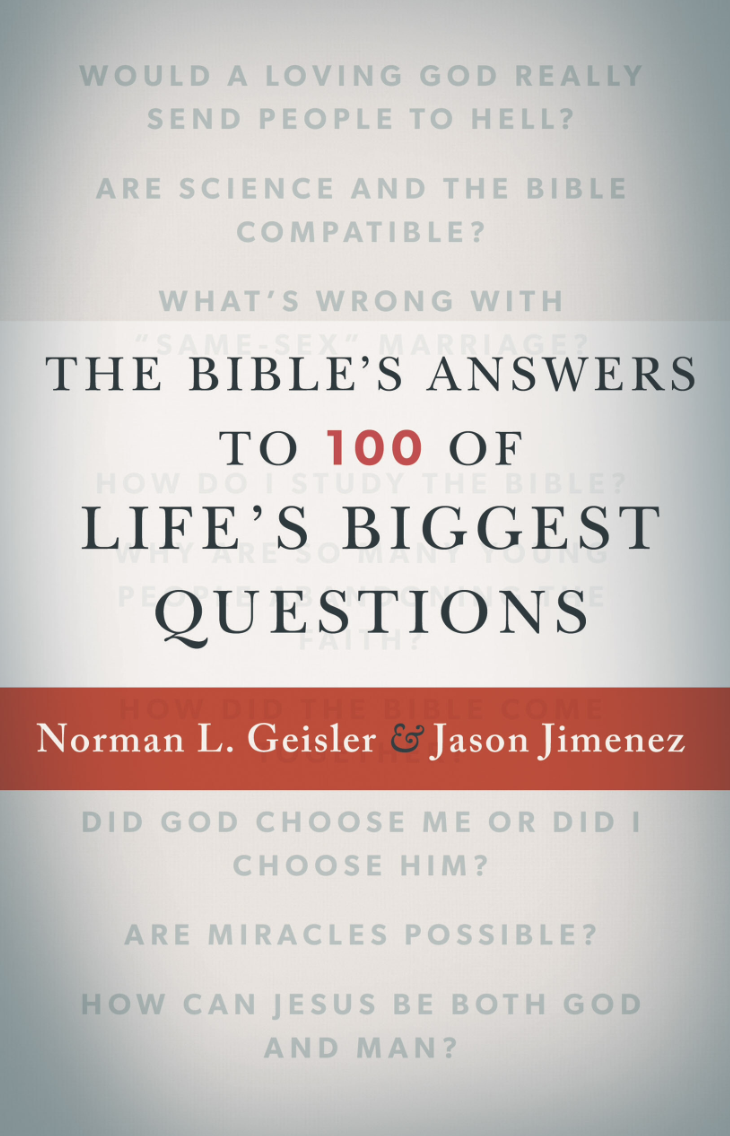
The Bible’s Answer To 100 Of Life’s Biggest Questions by Geisler & Jimenez

Looking for a book that would help newer Christians, or those seeking to get more up to speed as a believer? Here in a book with an ideal format of questions and answers, this volume by Norman Geisler, famed apologist, and Jason Jimenez, published by Baker, will be an asset to you.

The first 18 questions are superb in their succinct guidance on things like, “Who made God?”, or “If God, why evil?”, or even “What happened to the dinosaurs?” The answers sparkle with the kinds of things we need in this rough-and-tumble world. Think confronting the tough questions of others as a Christian.

Parts three through seven (questions 19-59) cover basic doctrine in areas of Christology, the Holy Spirit, sin, salvation, Heaven, Hell, angels and demons, the Church, and end times. Basic truths are given at a level essay to grasp, and though we might quibble over some statement, most pastors would be thrilled at folks learning these basics.

Next we have questions for the Christian life. A few are so basic, but still just perfect for a new Christian. Then in questions 71-78 help for difficult social issues are given. Part 11 on world religions, again Mr. Geisler’s specialty, could hardly be better. It is not an attack on them, just explaining where there are fundamentally opposite of, and incompatible with, Christianity.

The last questions on the family seem a little trite, but the book, for what it attempts to be, is a winner!

I received this book free from the publisher. I was not required to write a positive review. The opinions I have expressed are my own. I am disclosing this in accordance with the Federal Trade Commission’s 16 CFR, Part 255.

D
IMG_2336

Have You Left Doctrine? (IBTR #56)

Have you ever had the charge that you have left doctrine? Of course, some have left doctrine to even take up with another gospel. In such a case, that is a fair assessment. But what about receiving that charge for something of lesser magnitude? Perhaps a temptation to all Christians, and certainly a common one in the Independent Baptist world, proclaiming one has left true doctrine simply simply because he or she disagreed with you is an all-too-common occurrence.

Some say that very thing when one takes a different opinion on dress standards, or music preferences, etc. That is a flawed, illogical charge because it assumes that all issues are equal. We break fellowship over changing the plan of salvation, but we also do over a change of standard. In both cases it is charged that there is a change of doctrine. There may be a change, but it is not necessarily one of doctrine.

Those who make the charge flirt with hypocrisy for the simple reason that neither they, nor anyone else, really believes that all issues are equal. I have seen cases where one breaks with someone because they changed a dress standard, but went and preached for a friend whose music is different and conveniently looked the other way. Or other cases where the music standard was held absolute, and they overlooked some other loudly-professed belief–like eating at a restaurant that serves alcohol. The examples are endless.

It is true that “doctrine” refers to “teachings”, or particularly, the content of teaching. Still, it does not follow that all are of the same magnitude. I know people have given their lives for the Gospel, but I can’t remember someone doing it over the issue of attending a movie theater or not. Again, no one really believes it is so.

If a person believed it were so they quite logically would be required to leave off every person who held a difference of opinion on any issue. That is to say, they must on EVERY issue. I have never yet seen any person, even the most militant, ever do that. Their actions, then, prove that they believe value judgments must be made.

Once your actions prove you believe value judgments can be made, then we must agree that our only real argument is what those value judgments are. Without some measure of charity, that argument becomes only that my value judgements are better than yours. The exceptions I make are acceptable, but yours are not.

Then, you could only say they left your opinion. You could not say they left doctrine. That is why sensible Christians have always realized those things that make up essential doctrine. Perhaps they called the fundamentals of the faith, or irreducible truths, but they were the things that held up Christianity. Without them there could be no Christianity as described in the Bible.

None of this is to say that I shouldn’t try to arrive at certain Biblical opinions, and when I to the best of my ability determine it, then I should live it as well. Still, I will not label differences on non-essentials as leaving doctrine. I will not be so sure of myself to dare do that!

Find all articles in the series here.

IMG_2319

Cookie Cutter Christians (IBTR #55)

It is easy, so easy, to mix up the true goal of Christian discipleship. If the goal is missed, apparent success is worthless. I speak of Cookie Cutter Christians. Perhaps every group in Christianity struggles here, and Independent Baptists are, perhaps, masters of the art.

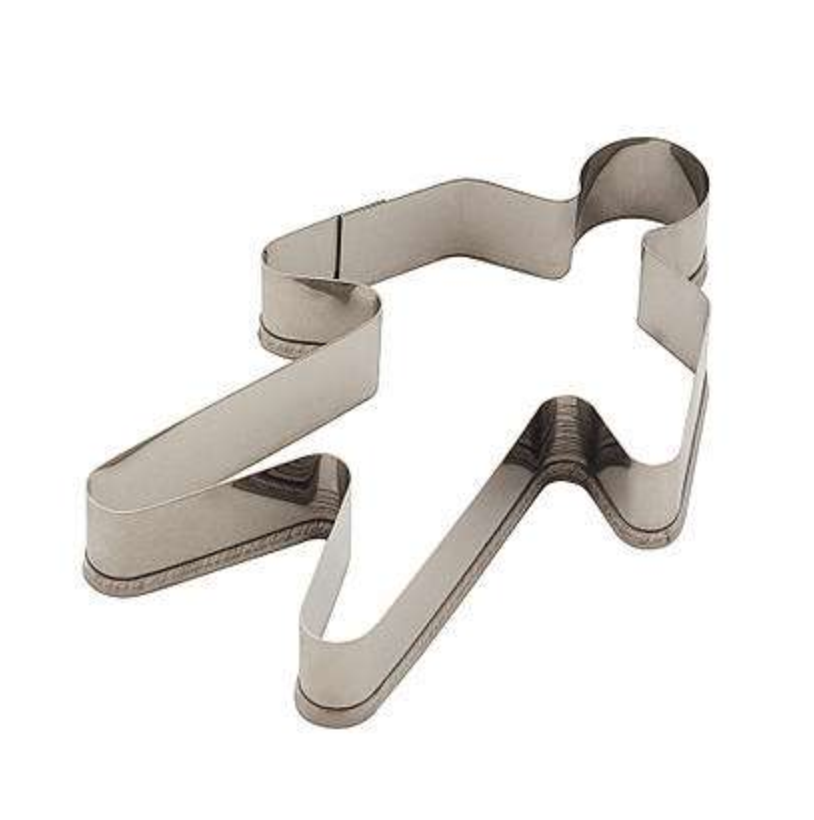
Perhaps you have taken part in a cookie making event. As a father of six, I have had at least a few Christmas opportunities (though I could in no way walk in the kitchen at this moment and make a batch of cookies). The first thing you will notice is how much they all look alike as you use you little cookie cutter.

Strangely, that is how some view disciplining new Christians. The great doctrines that define Christianity are mentioned to some degree, but no more than how we ought to look, exactly how a worship service should look, and what we are allowed to do or not do. Some of those discipled are shocked to learn later, if they actually become Bible students, that the emphasis does not match what the pages of Scripture show. If they never do, they will more likely become what their trainers hope they will.

It is not if they have a theological grasp on salvation by grace, but that they commit to memory all standards and never slip on any of them. It is not if they have the big picture comprehended, but if they have the rules down. If you doubt this to be the case, just let the Christian in question miss the doctrinal point (real doctrine) or miss the standard. Watch what happens, and you will see for yourself.

The other thing about making cookies is that if I remove the cookie cutter and some part of the little snowman falls off, I grab it and roll it back into the batter. That cookie doesn’t make it.

So it is for some new Christians. They get a little time to conform, but then they better get with the program; or else. I have seen more than one broke little Christian thrown back into the batter.

Perhaps if we saw the goal as Christians being conformed into the image of Christ, we would not be so concerned if they were not conformed into the image of us!

2015/01/img_2277.png

The Inverted Spiritual Gift Of Griping (IBTR #53)

Sometimes the most trumpeted spiritual gifts are the ones that are not spiritual at all. One example is the snooping around done that leads to griping. We sit there griping about someone as if the words out of our mouths were new nuggets in our accumulating treasure in Heaven.

We read articles to see who has messed up. We ask around for the juiciest gossip of who has fallen just so we can wax eloquent on how upset we are about it. Strangely, it is not common to be really upset about what you go seeking to find. Usually, that is a source of joy. Could that be the case here? You can answer for you, but I must ask: O Lord, help me.

Sometimes we are looking for lesser things than someone falling. We scan Facebook newsfeeds with squinting eyes asking our spouse: does she have on pants? We have an in-depth conversation at church about whether so-and-so went to the movies. And on and on.

If that wasn’t bizarre enough behavior, we then talk about that person as if he or she has apostatized. We say, “Isn’t that so sad?” Now the emotion shown looks like something other than sadness. Gloating is, perhaps, a little more accurate. Then we gripe and gripe: “What is this world coming to?” “Isn’t there anyone left who loves and follows The Lord?”

There are people, I believe, who never have a week go by without engaging in this aberrant behavior. It is done with the pretense of spirituality, but how does The Lord view it?

On several occasions such people showed up to check on Jesus. Can you believe He eats with sinners? He ignores the Sabbath–He doesn’t love God. They would come finding what they were looking for and just gripe incessantly. What does Jesus think of that attitude?

Well, once John the Baptist answered the question. Matthew 3:7 says:
But when he saw many of the Pharisees and Sadducees come to his baptism, he said unto them, O generation of vipers, who hath warned you to flee from the wrath to come?

Read on–his words only got stronger!

It might be time to put this supposed spiritual gift on the shelf where it belongs much as you would poison when making a nutritious dish. We need no such spiritual griping.

Read all articles in the series here.

IMG_2207.PNG

Straining At Gnats and Swallowing Camels (IBTR #52)

There are things that go on in religion as if perfectly normal, rational, and spiritual that are, to Christ’s eyes, the most ludicrous of actions. Whether it be the Pharisees of Jesus’s day, or the super spiritual ones of Independent Baptists or any current group of Christians today, the perverse lunacy is the same.

When Jesus preached His most scathing recorded sermon, to whom was it addressed? The Pharisees, or the spiritual forebears of those who trouble us today. That sermon in Matthew 23 is scorching. Jesus spoke so lovingly to adulterers and thieves, but blasted those who claimed a spiritual authority that they used to manipulate and abuse.

In Matthew 23:23 Jesus laid bare the unacceptable dichotomy that had developed among the Pharisees:

Woe unto you, scribes and Pharisees, hypocrites! for ye pay tithe of mint and anise and cummin, and have omitted the weightier matters of the law, judgment, mercy, and faith: these ought ye to have done, and not to leave the other undone.

Well, you could not accuse our Savior of mincing words! They had inverted priorities and missed by miles what was really important to the God they professed to love. The excelled where it was meaningless and grossly failed where it really mattered. That is not the life I want to live, how about you?

Then with an almost comic flair our Lord drew an unforgettable word picture. If you really can get the image in your mind, you will never forget it. In Matthew 23:24 He said:

Ye blind guides, which strain at a gnat, and swallow a camel.

If the thought of a blind guide wasn’t shocking enough (it is odd, you know, when one blind feels competent to lead you over the rough terrain of life), then He gave us a scene of one easily swallowing a camel but choking on a gnat! Stop and visualize that….it is quite amusing and, of course, ludicrous.

Camels are bigger than you and swallowing is out of the question for sane people. At the same time, no one likes a gnat, but you will survive swallowing them with relative ease, unless, again you are not sane. We have never actually seen this attempted. I guess we are all at least that intelligent, but in spiritual matters there are things Christ finds just as ludicrous.

What does our Lord think when He sees us hammering some poor believer over some little standard while His proscribed call for love is completely absent? Hey look, they have camels and gnats mixed up again!

It is just as crazy in us as that mental picture Jesus drew. I say let’s give up straining at gnats and swallowing camels.

Find all articles in the series here.

IMG_2166-0.PNG

The Greatest Motivation To Be A Pharisee (IBTR# 51)

They were an ugly group. They fought Jesus at every turn. Their hearts had run so amok that Christ reserved the harshest words He ever spoke for them. Strangely enough, they thought they followed God better than anyone ever did. The irony that they thought God’s Own Son was a devil jumps off page after page of the Gospel records. As you might imagine, to be called a Pharisee for anyone who thinks themselves a solid Christian will arouse a blood-boiling reaction. Though this pharisaical attitude rears its hideous head in all corners of Christianity, and although I know there is a little Pharisee in both you and me, I call on those in the Independent Baptist world to give careful thought to just how much the spirit of Pharisaism is entrenched in some places.

Don’t make the error of thinking that Pharisees sprang from evil and only ever had bad motives. Just because Jesus called them hypocrites, don’t assume there was never any sincerity. After the Captivity and its corresponding trials rendered its chastening to the point that it became difficult to reboot and sustain their OT worship, it appeared to some well-meaning believers that something ought to be done. In that idolatry was at the core of the offense that brought on the agonizing judgments, it seemed, quite reasonably, that steps ought to be taken that it never happen again. From those ashes rose a patriotic, zealous group of sincere men who made their lives about restoring what they thought they lost from God.

So it wasn’t the original aims or goals that were a problem. No, these “separated ones” likely were as sincere as any believers have ever been. I have no reason whatsoever to believe that they did what they did for any other motivation than love of God. Still, I must know well the one I love for my love to accomplish an end worthy of love.

With a zeal that puts our halfhearted efforts to shame they went relentlessly after their goals. As time went along, it occurred to them that fences were the only safety net to avoid another round of horrors as they had experienced in the bondage of oppression. So they took the things God had said and added many regulations to it to ensure that they did not stumble across the line God had drawn. They saw breaking God’s Law as the cliff and so they built fences father and farther back until they were hundreds of feet away. By Christ’s day they were so far back that they could not even see the cliff. And they felt really good about it.

What never occurred to them was that in backing away from the cliff they had somehow backed far away from God Himself. They were too far away to hear His voice, but in the cacophony of their own voices they did not even notice. Hearing your own voice standing in the place of the Lord’s, however, will do a number on you, especially if you have convinced yourself that you did it for Him!

Plus when you only know someone from a distance you tend to get a warped view of who they really are. They knew about the fear of the Lord. They did not just know it, they lived it. That the fear of the Lord might be more appropriate when we are purposely running from Him, not when we are treading watchfully, never crossed their minds. That the fear of the Lord when we are in an appropriate relationship with Him might have more to do with reverential awe never occurred to them either. Had they taken the time to actually listen to Jesus they might have learned what intimate fellowship our Lord has in mind for us.

Is it clear to you now what was the great motivation to be a Pharisee? Fear. It was then and it is now. Never mind that Jesus told us that He had not given us the spirit of fear; some still design their entire Christian experience on it. Sadly, it will make a Pharisee of you every time. Fear is the basis of idolatrous religions and has no place in Christianity. Our God in not a pagan god to be feared and appeased, but a real God to be known and loved. In that light you can see that a Pharisee is the last thing you would ever want to be.

Find all articles in the series here.

IMG_2145-0.PNG

The Radical Disciple by John Stott

I love a simple, yet profound, challenge for my Christian life. I love a devotional work with enough bite to deliver that challenge. John Stott’s final volume is just such a work.

He covers eight areas that he feels are “some neglected aspects of our calling”. Short, sweet, and inspiring, these chapters carry more punch than their size suggested.

His first chapter entitled “Noncormity” was extraordinary. In only eleven pages he wove the ideas of escapism and conformism being forbidden, the failure of pluralism, materialism, and relativism, and ugliness of narcissism in a meaningful way. He explained how self-love is a sign of the last days. The next chapter on Christlikeness was moving in that he wrote from the perspective that “God wants his people to become like Christ, for Christlikeness is the will of God for the people of God.

In the chapter on maturity he answers the question about what is the best description of Christianity today. What is that answer? “Growth without depth.” Wow! Could it be better stated? That whole chapter was memorable.

I really couldn’t connect on the next two chapters, but the rest of the chapter more than compensated for the two I felt of little worth. After these two, he got back on track.

The final two on dependence and death were as compelling as any I have read. Dependence, even in a declining health situation, can be a good thing. His own suffering punctuated the words that made sense even if we must begrudgingly admit it. His chapter on death would not have meant as much written by a young man. He would die within two years of writing this chapter. He stared down death as one safe in Jesus and I was moved as I read it.

Reasonably priced, not too long, but a real spiritual treat–I recommend this as a treasure.

I received this book free from the publisher. I was not required to write a positive review. The opinions I have expressed are my own. I am disclosing this in accordance with the Federal Trade Commission’s 16 CFR, Part 255.

Urban Legends (IBTR #46)

It dawned on me that we sometimes have some serious urban legends in Christianity. My familiarity with Independent Baptist has made me aware of several in our ranks. When I looked the definition up to make sure my terminology was accurate, I laughed. Wikipedia defines urban legends as “a form of modern folklore consisting of stories that may or may not have been believed by their tellers to be true, and often possess horror implications that are believable to their audience.” The story is often “the Bible teaches …”, when of course it does not!

My thinking went this direction from a letter a fine Christian lady wrote me. She had been lambasted for an opinion that she could not believe that 1 Corinthians 7:1 (“Now concerning the things whereof ye wrote unto me: It is good for a man not to touch a woman.”) meant that a male could not hug a female who was merely a friend goodby.

This lady, obviously one who has become a Bible student, said that verse meant ” ‘to touch a woman’ is a euphemism for sexual intercourse”. It is very good to not fornicate, the verse is saying. Her exegesis was quite good as she shared her conclusions about the first seven verses.

The strange thing was how it came to mean that touching the opposite sex would always lead to instant fornication. That urban legend is so strongly believed by some and thundered out as if disaster was certain. Of course there is a touching that could lead to danger, but that does not mean every innocent touch is the same thing.

Urban legends can be easily fixed. Just check out the facts. It is amazing how simple it is.

In Bible matters, just check out what the Bible really says. Look at the appropriate passages in context and define the words carefully. Bible urban legends die a quick death in the hands of one careful with his or her Bible.

You feel pretty silly for believing an urban legend after you find out what it really was. For sure, don’t let that happen in God’s Word.

Find all articles in the series here.

IMG_2108.PNG

Faulty Measurements And Misunderstood Results

Christians do it all the time. Pastors are the very worst. It can lead to great discouragement and pain. What am I talking about? Attempting to measure the results of our efforts for Christ when we know not how to measure, nor what success really is.

I guess in the end we worry more about the results of what we planned to do rather than being simple servants of Jesus Christ.
His plan, not fully even understood by us, is not enough for us. We live for what we might do for Him rather than what He might do through us. We carelessly blur the line till we are living for what we want to do and consider ourselves a failure when it doesn’t all work out as we planned. May I encourage both you and I to think about this from a different angle?

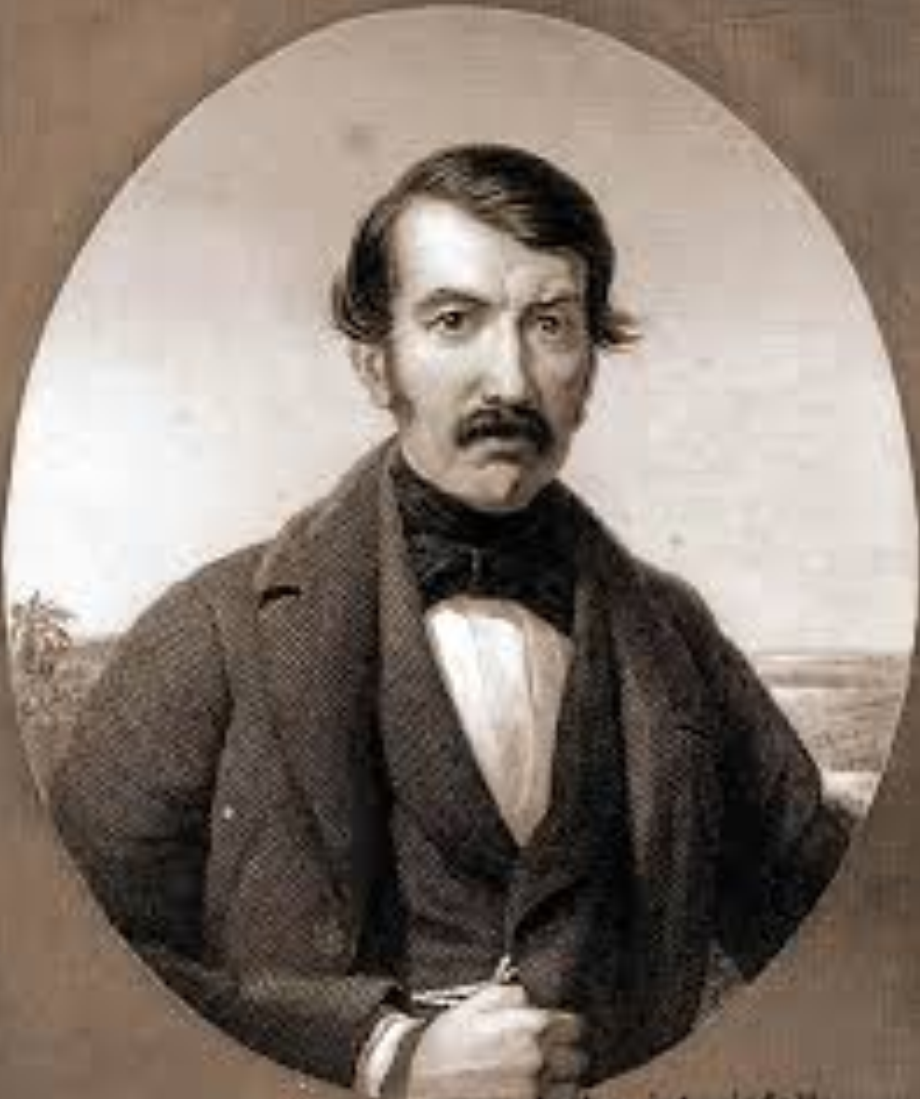
I read and reviewed a moving book about David Livingstone (link to review below). If you are like me, you count him as a hero and are inspired by his life for Christ. He was just a man. Perhaps he got a little sidetracked on exploring at the expense of his missionary efforts at times. He could be a little tough on those who worked under him in the harsh conditions of Africa and a few relationships were severed along the way. I am sure he was filled with regrets over the way he treated his wife and children. Still, he gave his life to the work he believed Christ gave him to do until that life was gone.

He clearly was led by God to see that exploring Africa would make a way for the Gospel. If the rivers could be mapped properly, missionaries could be brought in. He came to learn, quite accurately, that slavery would be a complete barrier to bringing the Gospel as no African would know the difference between a white slavetrader and a white missionary. So he went relentlessly.

In his later years he dealt with the discouragement of his results. One of his main expeditions was an embarrassing failure that haunted him his last years. Critics came out to agree with the worst thoughts his censuring mind could conjure up. The book I read showed these things really bothered him. His wife died just like her parents predicted she would if he took her to Africa. He mistakenly made finding the headwaters of the Nile his key exploration goal and he never found it. He exerted what influence he could in Africa and through letters to Europe to fight the slave trade. From his perspective, it was as ugly and bloody the day he died as ever.

He loved His Lord. On his last expedition he surely knew he was dying. He knew that meant his life would end with another failed exploration. Missions were not thriving in Africa and the slave trade marched on. I imagine he was a broken man, in body and spirit, as he knelt by his bed in prayer and then closed his eyes in death.

But Livingston was wrong. He measured his life by only what he could see. He forgot the very thing you and I so often do–what God is doing. As the book I read so magnificently showed, God was doing mighty things. He had no idea that the Lord was using his letters in Britain to kill the salve trade. He had no idea it would that the main slave market in Zanzibar would close within a month of his death. He had no idea that that army of missionaries that he dreamed of would in fact flood the African continent on the trail he blazed. He died thinking he was a failure and all lovers of Christian biography have David Livingstone volumes on their shelves. He was dead wrong.

I realize that after death we may not have the reputation Livingstone had, but it likely will not be the dark conclusions we imagine either if we have truly given our lives to serve Him. Our Lord feels no obligation to reveal all He is doing on a schedule that will massage our egos. In Heaven we can connect all the dots, but now are the days of simple service. Avoid measuring eternal results with instruments calibrated for time. Give Livingstone credit. He may have played some of the mind games of measuring results, but he never stopped serving his Savior. Right up to that day deep in Africa when he went home to look upon his Savior’s face. Let us follow his example there.

Book review:
The Daring Heart of David Livingstone

IMG_2106.PNG

Spiritual Profiling (IBTR #45)

How fast can you size up someone as a dedicated Christian or not? Can you do it with a mere glance? If so, you may have a problem that pervades all of Christianity. It really thrives in the Independent Baptist world too. We too often become expert spiritual profilers!

Strangely, the idea for this post came from a family discussion we had in the van driving along. My son remembered an episode a few years back where we once just saw some people and said they must be Christians. It was based on how they were dressed. Then we saw them do something and said that we must have been wrong. My son remembered that episode and thought how silly we were. He was right!

We never spoke to them, nor really knew anything about them, but felt qualified to label them as sincere Christians. Then in a knee-jerk reaction, a few moments later, we felt equally capable of labeling them the opposite on the flimsiest of evidence. We have probably been more guilty of what I write of here than anything else, though we have dabbled in many of them.

It happens so often. Our pride convinces us we can tell with a glance, though somewhere deep inside we know better.

People are outraged when the police profile. As it usually goes, those who get profiled get far more angry than those who have the look the profiler finds acceptable. I could see the sense of it in radical cases (someone with a quintessential jihadist look in an airport), but beyond that it is only an inaccurate exercise at best.

In spiritual matters profiling is doomed from the start. It arrives at its conclusions with the wrong criteria. It’s like trying to add without arithmetic! Two people could walk by and one be dressed far more conservatively than the other, but how could that one thing prove which one is truly the dedicated Christian? The less conservative one may have prayed sincerely or just witnessed to someone while the more conservative one may have just yelled at some helpless sales clerk. I am not saying that one could not dress in a truly immodest way, nor am I suggesting profiling in the other direction either.

No, I am suggesting that we stop profiling all together. Jesus actually spoke of it in other terms. He said, “Judge not lest ye be judged.” He was not saying that you could not call something sinful that was biblically defined as such, but that you must not size people up by outward appearances. You do not know someone’s heart, and the things we often use to try are all the wrong things!

How do you think spiritual profiling would have gone had you tried it with the Pharisee and the Publican? Probably not a good idea, is it?

Find all articles in the series here.


IMG_2089.PNG