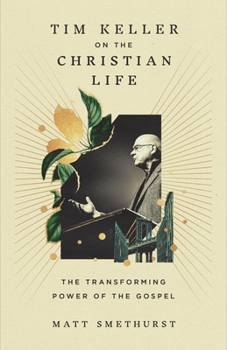
Tim Keller on the Christian Life by Matt Smethurst

This book will make a lot of people happy. People who love Tim Keller are going to see this summary of his salient teachings as an addendum to his biography, especially if they read those copious endnotes, and be happy. Those looking for some rich devotional writing with the best theological precision will be happy. You’re probably catching on, but this book makes me happy.

I admire Keller, but for some weird reason I’ve listened to many of his sermons online while not getting around to reading his works. After reading this book, that process was certainly a mistake. What was I thinking? This work convinced me that I will read him going forward. Each chapter, as best as I can tell, synthesizes his most beloved books. These chapters leave you clamoring for more. I guess this book makes the publishers of Keller’s books happy too.

This book is well written. It doesn’t only propel you to Keller’s books, but says much itself. These chapters stirred me. I prayed some prayers of repentance for the challenge and conviction I encountered (sans the guilt that you know this moralism-hater was incapable of throwing) after several chapters.

I can’t tell you which chapters were the weakest as I found none I didn’t love. I can’t tell you which chapter I love most as I loved so many of them immensely. I can tell, though, that most of them found this reviewer wanting. If I were forced to list its worst feature I guess I’d say endnotes are annoying to keep flipping to when they are so many and too delicious to miss.

Rarely does a book so gallantly reach its aims, but here’s one that did.

I received this book free from the publisher. I was not required to write a positive review. The opinions I have expressed are my own. I am disclosing this in accordance with the Federal Trade Commission’s 16 CFR, Part 255.
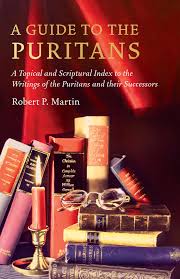
A Guide to the Puritans by Robert P. Martin

Here is a beautiful resource. It’s strikes me as both one of a kind and all you would need of its kind. The Puritans are quite a resource, but I’m in that number of those who wouldn’t know exactly where to turn to tap it. Now I have it!

The first two sections make up the bulk of the book. The first, topical index, shows what workers those Puritans were. I can hardly find a subject they didn’t cover (except some unneeded modern junk). This is a treasure trove. The second, the Scripture index, opens up the Puritans for sermon prep as well.

The ten other shorter sections are simply fun. They are for when your interest grows and you want to get to know the Puritans.

I can’t imagine the amount of labor Mr. Martin put into this resource, but we are all richer for. Tracking down just one thing that would only take a few seconds to find in this book that would have taken you hours shows you just what a treat we have here. We need this one. And then for icing on the cake, we have it in this beautiful hardback edition.

received this book free from the publisher. I was not required to write a positive review. The opinions I have expressed are my own. I am disclosing this in accordance with the Federal Trade Commission’s 16 CFR, Part 255.
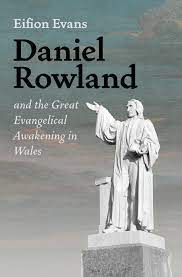
Daniel Rowland by Eifion Evans

Here’s another offering in the long line of biographies of Christian heroes by Banner of Truth of men who are, sadly, far too little known. They seem to especially mine Welsh preachers, not because Wales is better than anyplace else, but because of the landmark revival experienced there. The Great Evangelical Awakening there had less of the excesses of some revivals, which, perhaps, partially corresponds to the main players in it. They were dedicated, magnetic while maintaining humility, doctrinally consistent, and zealous. In what stands out from the pack, their zealousness was fully for Christ rather than an unholy mixture of carrying the Gospel and self promotion. Daniel Rowland is a good fit in this string of biographies.

Eifion Evans has written previously on Revival as it was clearly his niche. The full title is “Daniel Rowland and the Great Evangelical Awakening in Wales.” In my opinion, this book succeeds more on the history than on pure biography of Rowland. I suspect a lack of source materials is the culprit. The trail of humble men doesn’t often lead back to themselves.

Still, Rowland was an incredible man worthy of our revisiting his life. He was, as you will see in this biography, far more stable than Howel Harris. In my view, Rowland was on the right side of the divide with Harris.

There’s plenty of exciting revival described here. To the author’s credit, the bumps along the way were given too. The division that popped up didn’t diminish the beauty of the revival as I read as it only reminded me that we have a wickedly diligent enemy that probably hates revival as much as anything. You could also see the enemy could not ultimately prevail.

Beautiful book. Beautiful cover. Beautiful read. What more could you want?

I received this book free from the publisher. I was not required to write a positive review. The opinions I have expressed are my own. I am disclosing this in accordance with the Federal Trade Commission’s 16 CFR, Part 255.
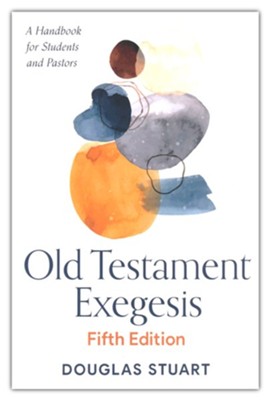
Old Testament Exegesis (Fifth Edition) by Douglas Stuart

With this Fifth Edition, the abiding value of this book is beyond question. Were it not so it would have fallen off the radar by now. I’m guessing it lives on in classrooms for the most part, but I feel it’s a title new pastors should take in tow. Perhaps your style will differ from his, but it’s good to know how OT exegesis is being taught these days and at least consider if you’re reasonably on track even with differences. Additionally, he suggests a lot of tools that will help you weight purchasing choices as such reference tools are quite, and in some cases excessively, expensive.

I’ve had some of the earlier editions, but they are in storage at the moment so I must compare from memory. He says in the preface that this work is substantially revised, but it seems to me to be primarily in book or reference recommendations. That is nothing to sneeze at with all the changing options. While there are other changes, I do not think the overall approach has. I suppose some tweaking has come about as he has continued to interact with students. Students will need the new edition, and newer pastors will want this one as well. More experienced pastors might get by with the previous edition unless they are really considering to expand their reference titles since Stuart’s recommendations carry as much weight as any OT scholar today.

All the superlatives of the previous edition remain, so this title is one I still recommend.

I received this book free from the publisher. I was not required to write a positive review. The opinions I have expressed are my own. I am disclosing this in accordance with the Federal Trade Commission’s 16 CFR, Part 255.
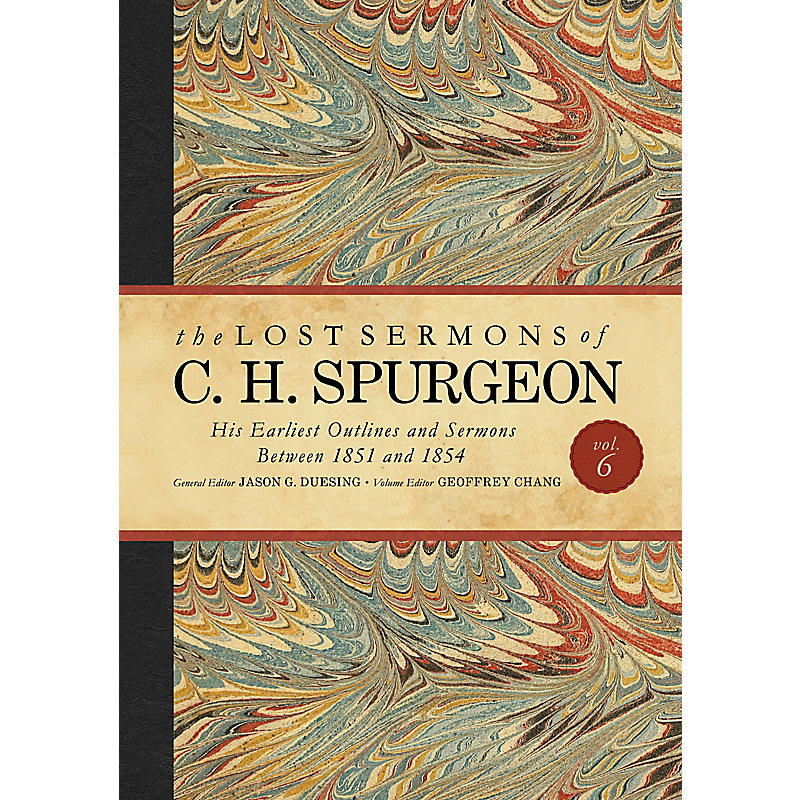
The Lost Sermons of Spurgeon (Collector’s Edition) Volume 6

This beautiful set of Spurgeon’s early sermons continues in this volume 6. The spine of this collector’s edition is green but the exquisite look remains. What a set this is turning out to be!

The Foreward this time is by Mark Dever and focuses on Spurgeon and the art of preaching. He discusses the calling and what it entailed according to Spurgeon. From there, he discusses Spurgeon’s advice on preaching. All good stuff!

After reprinting the Introduction from previous volumes, and a few pictures of Spurgeon’s notes, the sermons begin with the first one a lovely one on Immanuel. I love how the notes always tell us if he had a later sermon on the text and whether there are similarities. I remember the later one on Jehovah Jireh but the one here really isn’t the same. The other notes are fascinating as well.

The sermons are awesome again. Anyone who loves Spurgeon needs these volumes! Anyone who loves preaching needs them too. I give it the highest possible recommendation!

I received this book free from the publisher. I was not required to write a positive review. The opinions I have expressed are my own. I am disclosing this in accordance with the Federal Trade Commission’s 16 CFR, Part 255.
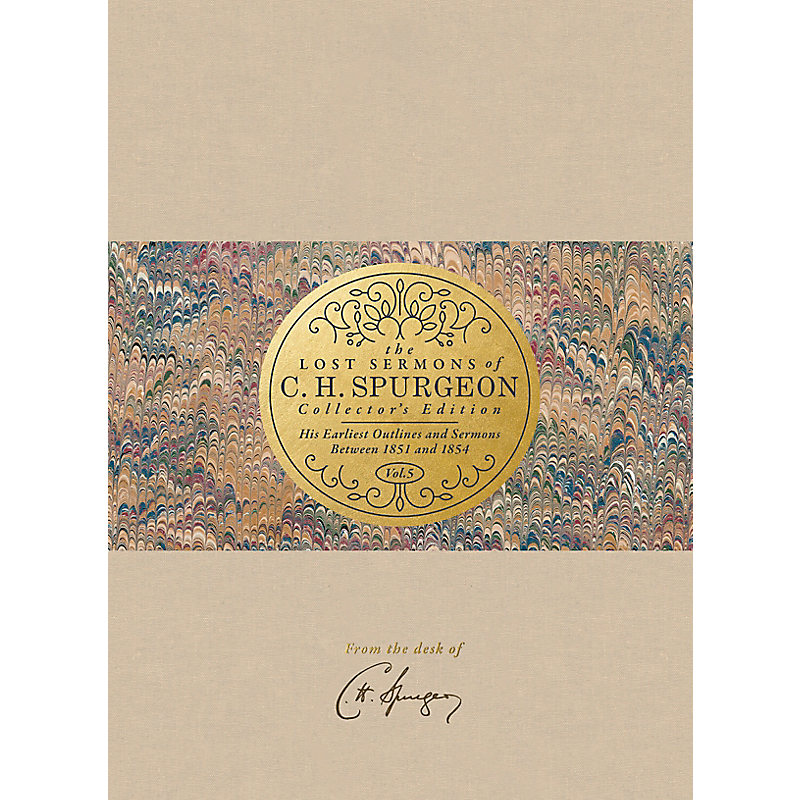
The Lost Sermons of Spurgeon: Volume 5 (Collector’s Edition)

Volume 5 continues this set of exquisite volumes of Spurgeon’s early, previously unreleased sermon notes. Though there is a more economical release of this book, I personally love these collector’s editions. If you love an heirloom volume, you will love this volume with its beautiful cover with marbled paper.

Don’t miss the Introduction that answers the question, who is Charles Spurgeon? Really it tells the story in a few pages leading up to the story of the notebooks where these sermons were found.

Beyond the lovely volume are the sermon notes themselves. Spurgeon had a gift, a gift directly from the Lord. He could stretch the text or spiritualize it on occasion but the warmth is always there. The Gospel always soars in his stuff as well. When he speaks of the Lord he speaks of a friend he knows and adores. His sermons could easily be identified among others. They are different, but good and often profound.

When you see these notes you will immediately be amazed that his gift came at a young age. Maybe they were better later, but they are excellent even here. He even tackles Ezekiel 1 here! As always, his texts are from all of Scripture. I especially enjoyed his take on a favorite of mine, Ezekiel 47. I’m fact, his sermons from the prophets are the best in this particular volume.

It’s hard to find words for how wonderful this book truly is!

I received this book free from the publisher. I was not required to write a positive review. The opinions I have expressed are my own. I am disclosing this in accordance with the Federal Trade Commission’s 16 CFR, Part 255.
The Care of Souls by Senkbeil (Books on Ministry #26)

book care souls

This book surprised me. The advertisements for it looked intriguing, but we are blessed to have many wonderful volumes about the work of a pastor. The author, Harold L. Senkbeil, is a long-time Lutheran pastor. Since I am not a Lutheran, I wondered if I might diverge from him on many points. To be sure, he would sometimes talk about the sacraments or baptism in a way that is totally foreign to my thinking, but I loved his book nonetheless. I could easily roll over those sacramental comments because what he had to say about God, His Word, and the ministry struck me directly in the heart. He wrote in so many ways about the pastor I want to be and showed me the way to get there.

He had a knack for working in his life experiences without ever making it about him. He would mention what he learned growing up on a farm many times but I assure you it was never trite nor meaningless. In fact, every facet of farming that he ties to the ministry will be so clear that you will wonder why you hadn’t thought of it before. He gives a wonderful description of what a pastor even is. He will explain both the care and the cure of souls and define a pastoral “habitus” along the way. Even if you’ve never heard the term before, you will be glad to make its acquaintance. There’s an extraordinary chapter on how the word of God is our source for ministry. His description of part of pastoring being the work of diagnosis and a work on the soul covers more in one chapter than some such books do in their entirety. His chapter on treatment of what is diagnosed makes it all practical. Other chapters that tie everything to Christ are extraordinary. He relates theologically how to talk about sin and justification and what shame and guilt are in a way that will minister to your soul as he’s trying to tell you how to help others! Be sure to check out his sexual case study, which again is written for you to help others, in a chapter that is as good as I’ve ever read on that subject.

I have underlined many sentences in my copy. In addition to the wonderful material, the author is an extraordinary, captivating writer. I was unable to read this book fast. In fact, I could never read more than one chapter at a sitting because it would give me so much to dwell on. That means it may take you a few days to read it, but they will be days well spent. This publisher has had a legacy year in writing about pastoring as they’ve already released one of the best volumes on preaching (The Heart of the Preacher) that I have seen in a long time. This book is worthy of the highest possible recommendation!

I received this book free from the publisher. I was not required to write a positive review. The opinions I have expressed are my own. I am disclosing this in accordance with the Federal Trade Commission’s 16 CFR, Part 255.
The Heart of the Preacher (Books on Ministry #25)

book heart preach.jpg

This book for the preacher is one of the best I’ve seen come along in a long time. Rick Reed from his own preaching experience and that of teaching homiletics knows precisely the path to the heart of the preacher as well as the deadends away from it. His mantra of the preacher preparing his soul is no hyperbole. This isn’t self-help pointers but vital issues that throb the preacher’s heart. Mr. Reed does something for preachers today that Ralph Turnbull did for others in previous generations in his A Minister’s Obstacles. Some of those obstacles are exactly the same while others are peculiar to our day and Mr. Reed knows the difference.

The book is divided into two parts, which he defines as the testing and the strengthening of the preacher’s heart, that could just as easily be called the negative and positive heart issues preacher’s face. After Brian Chapell’s foreword that is itself worth reading, Mr. Reed gives a clear introduction to what he is attempting to do. Some of the chapters include key subjects like ambition, comparison, insignificance, laziness (one of the best and not at all what you expect), fear, criticism, failure, and pain (another jewel). Part two continues at the high level he began by explaining personal soul care, championing expository preaching, developing internal security, doing the work of an evangelist, and in a timely chapter on taking care of yourself that he creatively calls “don’t kill the horse”. There wasn’t a dud in any of these 25 chapters and everything he discussed made you want to re-dedicate your efforts to the work of preaching for the glory of Jesus Christ.

Mr. Reed wrote with the humbleness that pushed his material deeper into your heart. He was never afraid to say that he struggled in some of these areas. You felt like you were listening to a brother in arms! The book is easy-to-read but never shallow. Every preacher ought to read it. I’m glad I did.

I received this book free from the publisher. I was not required to write a positive review. The opinions I have expressed are my own. I am disclosing this in accordance with the Federal Trade Commission’s 16 CFR, Part 255.
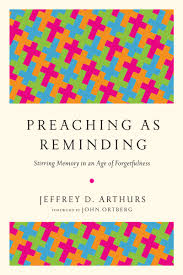
Preaching As Reminding by Jeffrey Arthurs (Books on Ministry #24)

book preach remin

We’ve been blessed with many fine books on preaching. There are classics from previous centuries as well as winners from our day. I should know as I’ve been blessed by many of them. On the other hand, because it’s such a popular subject the inundation of titles has led to a few dull books that say nothing new at all. Fortunately, Jeffrey Arthurs stepped into a niche that I don’t feel other authors have properly addressed and has given us something beautiful to help us as we preach God’s word. Since we live in an age of rampant forgetfulness, his work is extremely timely as well.

The help he gives has been meticulously studied out and thoughtfully presented. He makes a powerful case for his premise that preaching is an act of helping people remember before he jumps into practical guidance for preaching itself. He traces both remembering and forgetting through Scripture and proves its prominence. He even handles the science behind memory adeptly though I imagine that is not his normal field of work as a professor of preaching and communication. You will likely so agree with his reasoning that you will find him a trusted guide by the time he gets around to telling you how to improve your preaching.

There is no letdown at all when he transitions to practical help in preaching. Beginning in chapter 4 when he discusses style as a tool for stirring memory, he explains how style is a tool of persuasion and how each preacher needs his own style as well as to improve that style. He gives wonderful suggestions to that end. Next, he reminds us that story or narrative is especially effective in helping people remember. His chapter on delivery is a great reminder for us all as he digs into the details including the important nonverbal signals that we send.

If I were assembling a list of the key books on preaching, I would have to include this perceptive volume. I’m thoroughly impressed with what Mr. Arthurs had to say between these covers.

I received this book free from the publisher. I was not required to write a positive review. The opinions I have expressed are my own. I am disclosing this in accordance with the Federal Trade Commission’s 16 CFR, Part 255.

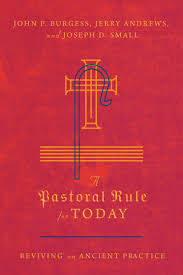
A Pastoral Rule for Today by Burgess, Andrews, and Small

book pastoral rule.jpg

This book is designed to bring pastors back to our core work. A trio of authors, John Burgess, Jerry Andrews, and Joseph Small, take seven historical characters to remind us of what ministry is supposed to look like. This work was an initiative by the Presbyterian Church (USA) and certainly has the flavor of that body throughout the book. Since I’m not a Presbyterian, I found myself at odds with the authors on some of their conclusions. On a more important note, however, I did pause to reflect on some areas of my own ministry that I feel was truly profitable for me. The biographical section on the historical theological figures was enjoyable as were several of the ultimate admonitions for those in ministry. Sometimes the path by which they reached those admonitions was something not particularly scriptural to my mind. Further, the authors seem to have an overblown reverence for the monastic lifestyle. While taking the time to truly meditate on God’s word and remove yourself from the hustle of life is of the utmost value, monastic life has not led to a superior spirituality in many documented cases. It is, then, with a caveat that I recommend this book.

The historical figures used to illustrate what the authors call pastoral “rule” were Augustine, Benedict, Gregory the Great, John Calvin (no surprise), John Wesley (a little bit of a surprise), John Henry Newman (a questionable choice for some of us), and Dietrich Bonhoeffer (one of the best chapters in the book). The introductory chapter on why pastors need a “rule” was intriguing. Augustine was used to describe that monastic life while Benedict was used to illustrate obedience “in the context of community”. That obedience as well as what was shown in the life of John Calvin turned out to be the most overtly Presbyterian chapters in the book as it pushed a church hierarchy that fits well with their system. As I read it, I couldn’t help but think of its lack of scriptural support. Gregory the Great was mined to show the importance of disciplined prayer. The chapter on John Wesley was extremely timely for our generation as it showed the importance of choosing your words carefully. While I’m not a big fan of John Henry Newman, the principal shared about the need for serious study of the Scripture was well taken. The chapter on Bonhoeffer, who wrote Life Together, had the best insights on community in the book. The concluding chapter on making a contemporary pastoral rule had many helpful insights.

As I said above, this book did get me to thinking about some things that needed addressing in my own life and ministry. You can add a star if you are Presbyterian or hold to the author’s overall views about ministry. Worth pondering!

I received this book free from the publisher. I was not required to write a positive review. The opinions I have expressed are my own. I am disclosing this in accordance with the Federal Trade Commission’s 16 CFR, Part 255.