Becoming Dallas Willard: The Formation of a Philosopher, Teacher, and Christ Follower by Gary Moon


book dallas

This biography is a joy. It has both an interesting subject and a skilled examination of the person that creates life upon the pages. If you’re tempted to think a biography of a man who is a philosopher and a college professor is too dull for pleasant reading, I challenge you to prove yourself wrong by reading this book. Dallas Willard’s life never allows the reader to become complacent. His journey twists and turns and yet follows an upward trajectory. As a reviewer, I probably come from a different vantage point than most in that as much as I love to read I’ve still never read any of Dallas Willard’s works. I suppose many readers are drawn to this biography because they love his writings, but you may be like me and have this biography entice you toward his writings.

Part one covers the first 30 years of his life in seven chapters. His Missouri upbringing deeply influenced him. His mother’s death and other family situations that required his moving around were expertly probed without resorting to psychoanalysis. As a reader, you will be emotionally attached to Mr. Willard by the end of this rendition of his first 30 years.

Part two looks at the middle part of his life. There was always some sort of gravitational pull toward the Lord and the ministry in Mr. Willard’s life. Earlier, he went to Tennessee Temple University under the direction of Dr. Lee Roberson, which was also the place he met his wife, and loved many aspects including their zeal and revival emphasis but grew to have a problem with the “view of salvation that is complete when one has publicly professed (put forward an understanding of) the gospel and which only has a past tense.” It was that middle section of his life where he developed his much-appreciated thoughts on communion with God.

The latter part of the book gave much detail on how each of his books came together. Believe it or not, that was interesting and shed more light on who he was as a person. I could not agree with every conclusion that Mr. Willard came to hold, but I found him to be genuine, sincere, and a person who would be interesting to either talk to or pray with. This biography didn’t obscure his weaker traits, whether it be his nomadic nature or his family struggles, but a man who loves the Lord shone through. I really can’t imagine how Mr. Moon could’ve made this biography any better.

I received this book free from the publisher. I was not required to write a positive review. The opinions I have expressed are my own. I am disclosing this in accordance with the Federal Trade Commission’s 16 CFR, Part 255.
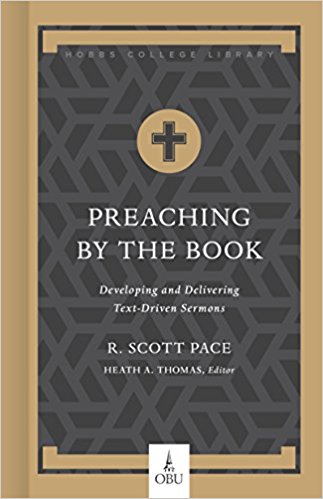
Preaching by the Book: Developing and Delivering Text-Driven Sermons (Hobbs College Library)

book preah pace

Here in the second installment of the Hobbs College Library series aimed at those in the ministry we have help with developing and delivering text-driven sermons. It’s another small, attractive hardback of quite-manageable length that is well done. It gives a grand overview that covers preaching from picking the text to giving the invitation.

As I read, it struck me that this book would especially appeal to two groups: 1) those starting out in the ministry, and 2) bi-vocational pastors. Still, even as one who has been a pastor for several years, I would catch myself thinking as I read– I need to remind myself to quit being sloppy here!

The book begins with a great chapter on inspiration for preaching and what preaching really is, as well as why textual preaching is so valuable. The next chapter shows a process of sermon development that begins with prayer and the first work of study. Part II includes chapters 3 and 4 on the framework that includes how to study and draw out what’s needed for the sermon from the text. Part III gives four chapters on what he calls the finishing touches. These touches include the importance of a good introduction to draw people in, the effective use of illustrations to captivate attention, and the crucial aspect of giving a good invitation. There’s a short, challenging conclusion to conclude the book.

If this book is an indication of what’s to come in this series, we have a tool to look forward to. This book is helpful, encouraging in the places where it’s most needed, and should be a boon for preaching to those who read it.

I received this book free from the publisher. I was not required to write a positive review. The opinions I have expressed are my own. I am disclosing this in accordance with the Federal Trade Commission’s 16 CFR, Part 255.

Portraits of a Pastor (Books on Ministry #21)


book pas

Pastors, we need this book! The nine key roles of our work are beautifully discussed in this outstanding volume. By taking these nine traits we can re-calibrate to what the Lord intended us to be. All the things that are not on the list are almost as instructive as the nine that are. Pastors who have a different nine main spheres of work need to do some soul-searching. If that happens to be the case, this is the perfect book for you. Even if you already agree that these are the main nine areas of the ministry that God has given you, you have here the reminder you may be needing as well as the cheerleading to pick up the mantle of God’s design in a world of contrary voices.

Jason Allen is both the editor and one of the contributors. Danny Akin, Jason Duesing, Ronnie Floyd, Christian George, Owen Strachan, Don Whitney, Jared Wilson, and John Mark Yeats round out the list of contributors. Sometimes a book seems cobbled together when it is a group production. In this case, the work has been so beautifully edited that every chapter seamlessly connects with the others. My guess is that Mr. Allen pulled this off by assigning each contributor to his most passionate area. I repeatedly forgot as I read that the author of the chapter I was in was not the author of the chapter before.

Mr. Allen gives a brief introduction that describes the almost maddening situation that most pastors are thrown into. In other words, they are to fulfill more roles than any human being could. It’s that very same cauldron that pulls them away from doing what they’re supposed to do.

I loved how chapter 1 that described a pastor as shepherd gave this simple outline of our work: 1) shepherds feed the sheep, 2) shepherds love the Lamb, and 3) shepherds trust the Good Shepherd.  Wow! The next chapter discussed the pastor as husband and father. Many pastors fail in this area and this chapter was a superb antidote. Chapter 3 discussed the pastor as preacher and described our primary work as preaching. There was a strong plea for expository preaching here.

The next chapter was on the pastor as theologian. It looked back and reminded us of the place pastors once held in society, and even if that is no longer true it is still our task to be theologians. The next chapter was on the pastor as church historian and I assure you it will make sense once you read it. The following chapter on the pastor as evangelist powerfully challenged us to remember our obligation to the lost. There was a chapter on the pastor as missionary that reminds us of our need to help missionary efforts around the globe. You would expect the chapter on the pastor as a leader, as was the subject of the next chapter, but it was not the self-help type material that has flooded the market for the last 40 years. No, it looked at the need for us to lead in living out the Christian life. The final chapter on the pastor as the man of God, which is a term that has fallen out of use for some but will be appreciated in the context given here, again calls us to personal holiness and is a reminder of the big picture of what we do. Mr. Allen gives a fine conclusion that further ties together what we have just read.

This book is less than 200 pages, is easy-to-read, but don’t let that fool you. It packs quite a punch! Every pastor would do well to grab and read this book.

I received this book free from the publisher. I was not required to write a positive review. The opinions I have expressed are my own. I am disclosing this in accordance with the Federal Trade Commission’s 16 CFR, Part 255. 
Some Pastors and Teachers by Sinclair Ferguson (Books on Ministry #20)

book p t

This book is not at all what I expected when I first picked it up and began reading. In fact, I felt at times that the title did not match the contents. On most occasions, when a book does not live up to its title or the expectation the title produced, it fails. In this case, I may surprise you by saying that this book is Five-Star plus!

It turns out that it’s actually a compilation of many articles that Sinclair Ferguson has written over his long pastoral career. That approach often lands with a thud in many books that I’ve seen, but somehow those articles again made a magical whole here. Mr. Ferguson brings three incredible traits to the table that make this book a success: he’s an astute historian, a probing theologian, and an engaging writer. I offer that praise even though I don’t always agree with his theological conclusions. A book that can get me thinking as deeply as this one does is my friend.

The first 18 chapters are primarily a deep dive into three of Mr. Ferguson’s heroes: John Calvin, John Owen, and John Murray (I guess only those named John need apply!) In each of these three pastor/theologian’s cases he highlights their passion for preaching and pastoring coupled with an explanation of their theology. The theology never bogs down what is quite interesting biographical writing.

Chapters 19-31 are deep theology. Though he uses some of the explanations of his heroes mentioned above, Mr. Ferguson often wrote with more clarity, verve, and accessibility than they did. Again, I didn’t agree with all of his conclusions as I am not a reformed Presbyterian as he is, but with great warmth he laid the issues clearly on the table.

The final section is a bit more of a hodgepodge, but is in the category the book’s title led you to believe the whole book is about. He covers exegetical preaching, preaching Christ from the Old Testament, the preacher as a theologian, preaching the atonement, preaching to the heart, preaching and the Reformed theological tradition, followed by a preacher’s Decalogue, which was a very interesting list of things that he wishes he had heard earlier in his ministry. Only in his epilogue did the author leave off the emphasis on Christ and replace it with his own passion for reformed theology.

When you finally finish this book, you will then realize why perhaps the author felt comfortable with his title after all. Quite frankly, he thinks a pastor is not worth his salt who can’t ply theology. After I’ve thought about it, he’s correct.

This book is best done as a slow read. It’s thick and so will take an investment of time. Take it. You won’t regret it.

I received this book free from the publisher. I was not required to write a positive review. The opinions I have expressed are my own. I am disclosing this in accordance with the Federal Trade Commission’s 16 CFR, Part 255.
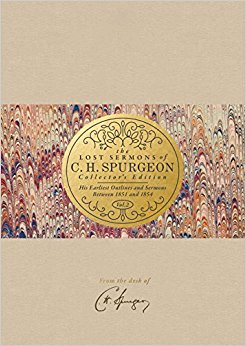
The Lost Sermons of C. H. Spurgeon: Volume 1–Collector’s Edition

book spu 1

I love this Collector’s Edition! This book is a call for celebration for any Spurgeon lovers or any who appreciate great preaching in general. If you are like me, you already read often from the pool of sermons available in either the New Park Street Pulpit or the Metropolitan Tabernacle Pulpit sermon sets. Perhaps you would agree with me as well in saying that Spurgeon is one of the greatest preachers who ever lived. This gorgeous volume is the first in what will be an indispensable set.

Spurgeon himself meant to publish these sermons from his earliest ministry, but it never worked out. His notes have languished in storage for these many years. Now Christian T. George has rescued the sermons and B & H Publishing has blessed us all by committing to print them in quality, beautiful editions. What will be obvious the minute you pick up these volumes is that both Mr. George and the publishers have treated the sermons as a labor of love.

Once you open this beautiful volume you will find a treasure trove. You will read a history of how the project came together, an interesting timeline that puts Spurgeon in historical context, and introduction, two interesting essays on Spurgeon, and an essay about the sermons themselves. Mr. George then describes his sources and methods and even gives a sermon analysis that reviews the number of words in his sermon notes and other interesting facts. I must confess that I found every page of the introductory material to be interesting reading. Don’t miss the incredible amount of information in the footnotes as well.

Then there’s the sermons. Many of them are only an outline, but Mr. George has put such incredible research of interesting tidbits both historical and personal that are loads of fun for Spurgeon fans. Who would’ve thought that Spurgeon’s first outline mostly came from John Gill! As I read the sermon outlines, I could tell that these were, perhaps, before Spurgeon completely hit his stride, but they still showed the homiletic genius that he was. It also demonstrated how Spurgeon can teach us all to find great sermons in unlikely texts.

This Collector’s Edition contains the same content as the regular volume as you will see when comparing each Table of Contents, but is still worthwhile to check out. I suspect many Spurgeon fans will prefer it. ( I do!)  It has the look and feel of those heirloom volumes that existed in Spurgeon’s day and have lasted until ours. It comes in a slipcover box and is a cloth over boards volume with leather spine binding. In addition, there’s genuine gold foil on the spine as well as gilded page edges. I’m a book lover and own many, but this collector’s edition is easily the best I’ve seen published these days. Don’t miss the incredible pictures either that have been added in unnumbered pages at this end of this book–they aren’t found in the other edition.

I look forward to getting each volume as they come out and can’t wait to have the set completed. If you are a book lover, this is the release of the year. I pray this series has great success and mark me down as its first admirer.

I received this book free from the publisher. I was not required to write a positive review. The opinions I have expressed are my own. I am disclosing this in accordance with the Federal Trade Commission’s 16 CFR, Part 255.
The Lost Sermons of Spurgeon: Vol. 2 [Collector’s Edition]

book spurgeon 2 coll

It’s thrilling to see this second volume roll out in this exciting series of the lost sermons of Charles Spurgeon from the earliest days of his ministry (1851-1854). I fell in love with the first volume, and this one continues all the interesting features and beauty of the first. I noticed the sermons are little more developed here than those in volume 1 as well.

This Collector’s Edition contains the same content as the regular volume as you will see when comparing each Table of Contents, but is still worthwhile to check out. I suspect many Spurgeon fans will prefer it. ( I do!)  It has the look and feel of those heirloom volumes that existed in Spurgeon’s day and have lasted until ours. It comes in a slipcover box and is a cloth over boards volume with leather spine binding. In addition, there’s genuine gold foil on the spine as well as gilded page edges. I’m a book lover and own many, but this collector’s edition is easily the best I’ve seen published these days. Don’t miss the incredible pictures either that have been added in unnumbered pages at this end of this book–they aren’t found in the other edition.

The forward and editor’s preface are the same as in Volume 1, but the introduction is specific to the sermons in Volume 2. Editor Christian George continues his painstaking research to uncover an incredible amount of detailed information on the sermons. As we saw in Volume 1, he shows that Charles Spurgeon did little borrowing in the early days of his ministry from preachers like John Bunyan, Charles Simeon, and Thomas Manton. To my ear, they still came out sounding like Spurgeon himself. As is always the case when he preaches, they are full of the gospel.

Spurgeon had such an eye for texts. In fact, when I look through this work the idea would often strike me that I should preach on some of these texts someday. (I promise I won’t steal Spurgeon’s sermons!) It’s no understatement to say he was a master preacher.

This volume includes #78-134 of his sermons, including the famous sermon entitled “The Curse and the Blessing” that he preached from Proverbs 3:33 when the horrific accident at the Surrey Garden Music Hall in London happened where seven were killed and others were injured in a stampede. Be sure to read the footnote that describes how Spurgeon was so affected by that tragedy that the mere mention of the text would precipitate a reaction from him. For that matter, all the footnotes in this book are incredible. I can’t fathom the number of hours involved to assemble all this information.

This set will be a treasure when completed. Either set is superb, but the Collector’s Edition is extraordinary. I imagine many are collecting them one at a time as they are released and joyously anticipating the next release. If you have an appreciation for the greatest preaching from history, you can’t overlook Spurgeon or this set. I commend the publisher for undertaking the task of producing this treasure for us. We are all indebted to them. I give this book the highest possible recommendation!

I received this book free from the publisher. I was not required to write a positive review. The opinions I have expressed are my own. I am disclosing this in accordance with the Federal Trade Commission’s 16 CFR, Part 255.
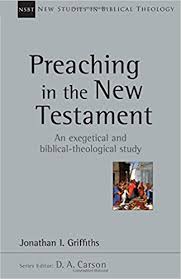
Preaching in the New Testament (NSBT) by Jonathan Griffiths

book preaching NSBT

This recent release in the New Studies in Biblical Theology (NSBT) series, written by Jonathan I. Griffiths and edited by D. A. Carson, is a winner! It matches the depth of the series that is respected all around while having something to say about preaching that will be meaningful to every preacher. While I have read and enjoyed many volumes on the subject of preaching in the New Testament, this one is different and lives up to its subtitle in that it goes hard after being an exegetical and biblical-theological study. In other words, it’s less a motivational approach and more of a declaration of what the New Testament specifically says about preaching. By the end of the volume, you will have no doubt that the task of the preacher, or “authoritative public proclamation”, is the design of the Lord revealed in the New Testament.

After a brief Introduction explaining the purpose of this book, the author tackles in Part 1 what he calls foundational matters. He will explain in three chapters the basis of the Word of God in biblical theology as well as the key Greek words for “preaching” in the New Testament. That chapter on those keywords is fascinating (don’t miss the fine charts) and really proves the authors premise by its end. This section is followed by an excursus on who the preachers are in Philippians chapter 1.

Part 2 covering chapters 4 through 9 exegetes six key passages where preaching is discussed in the New Testament. 2 Timothy 3-4, Romans 10, 1 Corinthians, 2 Corinthians 2-6, 1 Thessalonians 1-2, and Hebrews are all superbly covered. In some cases, the focus is on a few chapters while others trace words for “preaching” throughout an entire New Testament book. The author succeeds in both of these approaches, and again, in my opinion, proves the place of preaching in the New Testament beyond doubt.

Chapter 10 shares a summary and conclusions. He gives a summary of exegetical findings, followed by his biblical–theological conclusions. I found it easy to agree with every one of his conclusions made here after reading this book. In a day when preaching is held in less repute than former days, this book is just what we need. I’m glad it’s been written and glad to recommend it.

I received this book free from the publisher. I was not required to write a positive review. The opinions I have expressed are my own. I am disclosing this in accordance with the Federal Trade Commission’s 16 CFR, Part 255.
Spiritual Leadership by J. Oswald Sanders (Books on the Ministry #19)

book spiritual leadership

There’s good books and there’s books you simply must have. While every Christian can glean so much spiritual help from this fine book, it would almost be a crime for a pastor to not own and carefully read this book by J. Oswald Sanders. Originally written in the late 1960s, this million-seller finds a new life in this stunning paperback edition by Moody. I’m not sure how to describe the material the cover was made from, but it’s the best paperback cover I’ve ever seen.

I don’t think this classic became so popular through a savvy marketing campaign, but simply by the fact that it is so captivating. It covers leadership as the title suggests, and though there is some overlap with the modern subject of leadership that floods the book market, you also see that spiritual leadership is worlds apart from modern leadership. The book is true to the Bible, and you will find yourself saying over and over again “that’s so true”, even if what you just read nailed your hide to the wall.

The book begins by explaining how ambition fits into the picture and goes on to opine the lack of leaders today. As you would imagine, by chapter 3 you read of Jesus Christ’s master principle – the principle that leadership is servanthood. Later chapters will discuss how to become a leader even if you are not naturally one, insights that you can gain from Paul and Peter’s leadership, as well as essential qualities of leadership.

Later in the book we are told that spiritual leadership requires spirit-filled people. We are admonished how we can never be a leader in God’s work without being a leader in prayer. There’s suggestions on how to make use of time and how to incorporate the highly valuable act of reading.

Later chapters become even more soul-searching. There’s discussion of improving leadership, the cost of leadership, the responsibilities of leadership, the test of leadership, and the art of delegation. We are told of the necessity of replacing and reproducing leaders as well. Finally, in the most probing pages of the book, he reviews the perils of leadership. We should read that section repeatedly! He ends with a short chapter on Nehemiah, followed up by a short conclusion chapter.

Make this book one of the first five or six you buy if you are going into the ministry and read it carefully. It’s one of the great ones and its manifold impact on many Christian leaders over the last 50 years is its greatest recommendation.

I received this book free from the publisher. I was not required to write a positive review. The opinions I have expressed are my own. I am disclosing this in accordance with the Federal Trade Commission’s 16 CFR, Part 255.
The Expositor’s Bible Commentary (Rev. Ed.)- Volume 9: Matthew-Mark

book ebc 9

Volume 9 of the Expositor’s Bible Commentary (revised edition) covers only the Gospels of Matthew and Mark. Fortunately, that means that Matthew, one of the most important books of the Bible, gets a great deal of extra space in the series. D.A. Carson, one of the most respected scholars of our day, handles Matthew in this volume. It seems to me that Carson’s Matthew is the most heralded volume in either the old set, or this new revised series of the Expositor’s Bible Commentary.

Although the rewrite was not substantial, Carson’s Matthew still holds its place among the commentaries on Matthew available today. Carson wrote a substantial Introduction. He begins discussing the criticism of Matthew, or in other words, how critical scholars have debated the book of Matthew. Considering Carson’s reputation in conservative circles, his credence of the opinion of some of the more critical scholars is somewhat surprising. Still, his work is outstanding. He addresses history and theology, as well as the synoptic problem, and again entertains more than I could. In any event, I can hardly imagine a better overview. When he discusses authorship, he is tentatively agreeable to the historic position of Matthew being the author. On subjects like occasion, purpose, and structure, he begs for restraint. His discussion of themes and special problems was well done. While the text of the Introduction was not altered greatly from the original volume, I noticed the footnotes and bibliography were updated a great deal.

The commentary on Matthew would just what you’d expect from Carson – detailed, careful, cautious, thoughtful, and with skilled scholarship. He is occasionally harsh, but this is one of the most important commentaries on the Gospel of Matthew available today.

The Gospel of Mark received a more substantial rewrite. The work of the late Walter Wessel, much appreciated by pastors in the old set, was thoroughly updated by scholar Mark Strauss. The Introduction was also updated a great deal, I noticed, when I laid the old and new volumes side by side. The upgrade was a success. The new work covers in its Introduction the place of Mark’s gospel in biblical studies, genre, authorship, origin and destination, date, occasion and purpose, literary features, and ends with a bibliography and outline. The commentary itself was also effectively updated.

The 2-for-1 nature of this volume, along with the fact that the Matthew portion is considered one of the premier commentaries on Matthew, means you can’t go wrong in adding this book to your library. It’s a good deal and I highly recommend it.

I received this book free from the publisher. I was not required to write a positive review. The opinions I have expressed are my own. I am disclosing this in accordance with the Federal Trade Commission’s 16 CFR, Part 255.

40 Questions About Church Membership and Discipline by Kimble

book 40 questions

This book provides a unique format to get you thinking deeply about church membership and discipline. You can read through the table of contents for a specific question on the subject, or you can as I did, read through the entire book and be blessed to think through the issues from a variety of vantage points. Mr. Kimble has provided a nice resource here. Though there are many new titles in the area of church membership and discipline published recently, this book carves out its own niche and will be appreciated by readers everywhere.

The author divides the questions into four main parts. Part One defines terms and gets us thinking in the right direction for the questions that follow. Part Two contains general questions about church membership. These questions cover theology, ministry, and practicality. I can’t think of a question he left out, nor of a question he answered carelessly.

Part Three contains general questions about church discipline. If anything, the subject of church discipline is even more bewildering to most Christians than that of the little-discussed subject of church membership. The author again divides the questions into theological, ministry, and practical questions. Part Four asked two concluding questions about the significance of these two interrelated subjects.

As a Baptist pastor, I find this volume biblical, well-written, and helpful. Its design makes it the ideal volume to have on the shelf to pull down when a question comes to mind. Even if you squabble about some conclusion the author makes, he writes succinctly and carefully lays the issue out for you. The reader cannot help but be blessed by this volume. I highly recommend it!

I received this book free from the publisher. I was not required to write a positive review. The opinions I have expressed are my own. I am disclosing this in accordance with the Federal Trade Commission’s 16 CFR, Part 255.