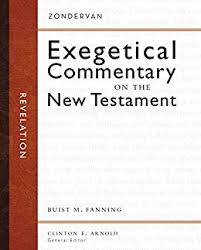
Revelation (ZECNT) by Buist Fanning

book rev zec

This latest release of the ZECNT Is a fine exegetical commentary on the highly-debatable Book of Revelation. Personally, I always give commentators a little slack because this book manages to trip them coming out of the gate in almost every instance. In other words, the reader is going to approach both the book and the commentary with his or her own theological system. For that reason, no matter what the perspective of the commentator happens to be, he or she is going to start out with a much higher group of detractors than if, say, they had written on the Gospels or one of the Epistles. Fanning has done the best that could be done. He has tried to write a commentary that would be helpful to the widest number of readers without rigidly lobbing off whole swaths of them. He does, however, lean toward positions that would be labeled futurist as opposed to historist. Still, he is fair to all. More importantly, the exegesis and examination of structure are both rock solid. No, I don’t agree with every interpretive point he makes, but what commentator on Revelation could hope for that from any of us? The point that must not be lost is that this commentary can help you as you wrestle with this challenging book of the Bible.

I thought the introduction was exceptional. Throughout, he both lays out varying opinions and respectfully submits his own. He begins by talking about authorship and really does not land on one outlook himself in this case since he doesn’t find it critical to the overall interpretation of the book. He discusses date and setting, genre with an emphasis on prophecy, imagery and symbols, all before he addresses the thorny subject of hermeneutical approaches. He explains both the importance and the specifics of the use of the Old Testament in this book and how to view prophecy and typology. I thought his discussion of topology was particularly apropos. He discusses text, language and style, before he dives into structure and outline which is an emphasis of this series. He gives a lot of outstanding insights before he provides his own outline. There is a select bibliography given as well.

The commentary proper follows the typical style of this series and is quite helpful. There were just a few places I wish he had said a little more. Still, when you talk about what you really need to learn in an exegetical commentary you will find it all here in spades. The end of the book gives a nice summary of the theology of Revelation too.

He probably does for a futurist position what Beale does for the modern fad of an eclectic position. You’ll need both. Therefore, you should probably put this in the must-get category.

I received this book free from the publisher. I was not required to write a positive review. The opinions I have expressed are my own. I am disclosing this in accordance with the Federal Trade Commission’s 16 CFR, Part 255.
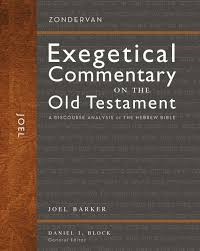
Joel (ZECOT) by Joel Barker

book joel zec

I have really enjoyed these early volumes in the ZECOT series and this new title is no exception. Joel Barker provides another competent exegetical commentary with an emphasis on discourse analysis this time on the Book of Joel. Unlike other mostly unprofitable types of criticism, discourse analysis renders real insights into the text. If you are looking for a standalone commentary on the Book of Joel, this volume will definitely meet your needs.

After he offers his own translation of Joel he jumps into an effective introduction to the Book of Joel. By the first few paragraphs, you can tell that the author enjoys Joel. To be sure, that always makes a commentary better. He offers six theories for the historical context of Joel. He lays them out clearly and makes it easy for one to evaluate. I might not agree with his final conclusion, but I appreciate his defining the issues. He makes a wonderful case for the literary integrity of Joel. I tend to find that with every book of the Bible, but I appreciate his compelling case that should answer any critic. He looks at Joel’s place among the Minor Prophets as well as describing Joel from the perspective of rhetorical discourse. He proves here that he is up to speed on those issues as you would expect for this series. I really appreciated his thoughts about the structure of Joel as well.

The commentary proper follows the usual ZECOT pattern. He does an outstanding job here. My only caveat to that statement is his discussion of 2:28-32. I know we have to first place these scriptures in the context of the prophet’s time, but I just felt he was a little brief on the importance of this passage in the New Testament. Still, this is first-rate commentary on a book of the Bible where you’re likely to need it. I’d rank this commentary a winner!

I received this book free from the publisher. I was not required to write a positive review. The opinions I have expressed are my own. I am disclosing this in accordance with the Federal Trade Commission’s 16 CFR, Part 255.

Spiritual Warfare in the Storyline of Scripture by Cook & Lawless

book sp war

I’ve never seen a book that approaches spiritual warfare in a better, more grounded way. William Cook and Chuck Lawless team to provide a work that avoids the excesses of most volumes on the subject of spiritual warfare.

It’s almost like they provide us two books in one. The first half of the book approaches the Bible from Genesis to Revelation and traces spiritual warfare as the subject is biblically developed. Really, what could be a better approach to grasping a biblical subject? Further, this half of the book could almost be used as a reference book as well as reading it straight through to develop the concept of spiritual warfare.

The second half of the book approaches the subject from a practical standpoint. Here its balance was even more dramatic. They followed the good advice they gave in telling us to study God rather than studying Satan to understand spiritual warfare. In fact, the usual suspects of such a book are refreshingly absent. No spooky stuff about demons, but rather practical discussion of how Satan works in our lives. What this volume lacks in shock it more than makes up in spiritual value. Five chapters are included in this second section of practical application and covers spiritual warfare in the local church, evangelism, missions, the family, and in leaders. It was so at once convicting and helpful. I’m convinced that this is exactly the sort of thing the Lord intended we dwell on as we process the concept of spiritual warfare.

The authors highlight so effectively the danger of looking into ourselves or our own strength as the open door to Satan entering and establishing a foothold. I needed what I read here!

I received this book free from the publisher. I was not required to write a positive review. The opinions I have expressed are my own. I am disclosing this in accordance with the Federal Trade Commission’s 16 CFR, Part 255.
Why Church? by Scott Sunquist

book why church

It’s good to see a book championing the church. There has been a radical shift in how the world views local churches both culturally and in terms of impact. Scott Sunquist tackles this important subject both historically and biblically and with an eye to the future. He has written it in such a way that it’s not specific to a certain denomination, but looks rather at the core function of the local church.

He comes back to basics in chapter 1 and explains that the two purposes of the church are worship and mission. Chapter 2 is a fine survey of church history from the time of Jesus to the current environment of Post-Chrisendom. We may not be happy about the trends, but he lays them out for us to ponder.

The next five chapters make up his main premise by using five words to describe what a church is supposed to be doing. These words are come, stand, kneel, sit, and go. When he speaks of coming to the church, he is speaking of coming to Jesus in conversion, coming to the body of Christ for community, and finding our identity in the worship of Jesus Christ. His discussion of standing is a call to praise God. He may be less concerned about worship styles than you are, but I do think you will likely agree with his emphasis on the necessity of praise. As you probably guessed, the chapter on kneeling is about worship. He doesn’t approach worship as some touchy-feely, nebulous experience, but rather coming before God in confession and repentance. It’s a good approach I think. The chapter on sitting describes the great importance of sitting still to receive the Word of God. I found it to be quite helpful despite a few possible rabbit trails. The final chapter on going is about taking the church outside of its building and carrying out the mission of Jesus Christ.

There is a later chapter that he calls “healthy body movement”. Here he wrestles with the implementation of all he has discussed with a balancing of his five key elements. Don’t read that as if he has all the answers, but read it as taking suggestion on what you ought to consider as you work through that same dilemma. The epilogue mentions a few things that he did not write about in the book, but should be considered.

I just happened to be doing this review while churches around the world are quiet in the buildings with most services held online during the Covid-19 crisis. It strikes me that perhaps we haven’t given thought to how incredibly powerful and wonderful the local church is in our lives. Maybe this book can help us reflect and plunge forward.

I received this book free from the publisher. I was not required to write a positive review. The opinions I have expressed are my own. I am disclosing this in accordance with the Federal Trade Commission’s 16 CFR, Part 255.
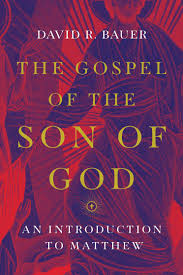
The Gospel of the Son of God by David Bauer

book gospel son god.jpg

David Bauer is the right person to write this academic introduction to the Gospel of Matthew. I’ve known for years that Mr. Bauer has followed in the footsteps of Jack Dean Kingsbury. Kingsbury’s writings on Matthew first fascinated me well over a decade ago. In fact, this volume divides the book of Matthew in the same three places that Kingsbury first did. I find that division to be quite helpful and accurate. Bauer takes the best of Kingsbury and expands it to all that we have learned since and offering his own additional conclusions.

Part one called an orientation covers form and genre, approach and method, circumstances of composition, and shape of composition in four chapters. I got the least out of this section especially as the theories of composition don’t do much for me. Academic tops will still likely work through it.

Part two is where the book starts to shine offering an interpretation in three chapters along the lines of the aforementioned division of Matthew’s gospel. There is brilliant insight to be found here.

Part three entitled reflection gives us 5 chapters looking at the Christological titles of Jesus, additional aspects of christology, God, salvation history and eschatology, and discipleship. You will find outstanding nuggets along the way even if there are occasional statements that you find totally subversive to your thinking. Take the book as one requiring a little digging to remove its treasure with a little junk to move out of the way and the gospel of Matthew will come alive to you in a whole new way.

I see this book as the pinnacle of a key interpretive arc of Matthew’s gospel. In that sense, it will be an indispensable volume.

I received this book free from the publisher. I was not required to write a positive review. The opinions I have expressed are my own. I am disclosing this in accordance with the Federal Trade Commission’s 16 CFR, Part 255.
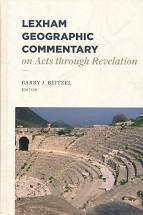
Lexham Geographic Commentary on Acts through Revelation

book lexham comm

If you happened to have the Lexham Geographic Commentary on the Gospels, You will be glad to see this wonderful volume that finishes the New Testament from Acts through Revelation. The quality and depth of geographic information and how it plays into the story on the page remains just as high. Maybe you are like me and you are not as up to speed on the geography outside of Israel as you are that of Israel itself. If that be true for you as it is for me, then perhaps this volume will be even more important than the first one.

The quality of writing by a group of top-notch scholars, the appropriateness of pictures and illustrations, and the usefulness of maps make this an incredible resource. Mark this down as one of the greatest Bible study needs you have that you weren’t even aware of. My only small complaint is that the size of the font and particularly of maps is smaller than ideal. My guess is that the smaller font became necessary because of the incredible amount of information they are giving us. It would have been much more expensive but I wonder if this might have been better as two volumes than one. In any event, it is an extraordinary resource that could be a blessing to anyone at any level from Bible student to scholar. I give this attractive hardback volume the highest possible recommendation.

I received this book free from the publisher. I was not required to write a positive review. The opinions I have expressed are my own. I am disclosing this in accordance with the Federal Trade Commission’s 16 CFR, Part 255.
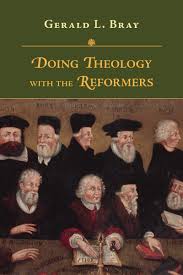
Doing Theology with the Reformers by Gerald Bray

book doing theo.jpg

This book by Gerald L. Bray, a known Reformation expert, isn’t exactly what I expected—it’s better. For some reason, I imagined something of a brief systematic theology cast in the History of the Reformation. There is some of that, to be sure, but much more. It wasn’t until the mid-point of chapter 3 (nearly 100 pages in) before the book really mentioned some of those subjects. My favorite part was those first 100 pages! Mr. Bray writes history with verve. I found the pages turned quite easily. I got more out of it than some far lengthier books for sure.

Whether he talked about Bible interpretation, the Covenants, reformed theology, he always infused it with clear historical context. That he could write so thoroughly and yet so winningly suggests his profound knowledge of his subject. To me, he could sift through reams of data and clearly distinguish what was most significant.

The look of this book might tip you off that it is a companion to the larger Reformation Commentary on Scripture (RCS) series before you even read that it is. There is that distinctive green. More importantly, there is that same labor of love behind its careful scholarship.

You don’t have to follow reformed theology to benefit from this book. It will lead you to clear historical context of a pivotal moment of church history.

I received this book free from the publisher. I was not required to write a positive review. The opinions I have expressed are my own. I am disclosing this in accordance with the Federal Trade Commission’s 16 CFR, Part 255.
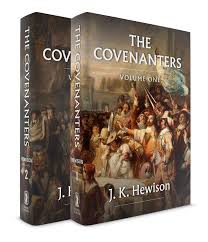
The Covenanters–A Beautiful New 2-Volume Release!

book cov.jpg

If you are familiar with Church history, then you are likely aware of the spectacular period of Scottish church history beginning at the Reformation and extending throughout the 1600s. Besides some incredible believers and servants of Christ that we can be challenged by, there are all the thrills that any historical reader craves. Religion, palace intrigue, bloodshed, and rousing courage combined to make those costly days to follow Christ.

Banner of Truth dominates the market for this kind of history. They do it right as well. These two volumes by J.K. Hewison would catch your eye on any shelf among other books. The artwork on each volume is the best of any book I’ve seen this year. The binding is durable to last for years to come too. The word “heirloom” comes to mind. (Would make an exceptionally nice gift).

What is between the covers is captivating as well. It would be hard to fail as a writer with that kind of material to work with, but Hewison totally succeeded. He struck the right balance between a truly scholarly work and an enjoyable read. He was fair and didn’t sugarcoat the lives of believers either. Occasionally pictures are even provided.

This book can be used either as a reference to study persons or events or as a fine read with equal parts history and devotion. You will likely have your own favorite episodes as you read. For some reason, Mary, Queen of Scots, grabbed my attention.

If I were forced to only have one title on those magnificent Scottish Christians, this two-volume set would be my choice hands down!

I received this book free from the publisher. I was not required to write a positive review. The opinions I have expressed are my own. I am disclosing this in accordance with the Federal Trade Commission’s 16 CFR, Part 255.
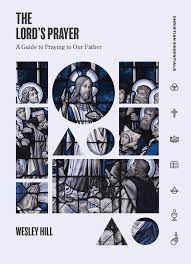
The Lord’s Prayer by Wesley Hill

book lord pr.jpg

This short volume on the Lord’s Prayer by Wesley Hill is designed to shake off the dust and routine that many on us have covering that model prayer Christ shared. The subtitle “a guide to praying to our Father” is wisely kept prominent throughout. Hill leads us on a thoughtful journey through every phrase of that prayer.

To be sure, there were times I didn’t line up theologically with Hill, nor would I agree with every capitulation to modern times I felt he made, but this book led me deeper into the Lord’s Prayer. It replaced staleness with vibrancy on several occasions. He gives clear evidence of unrushed thinking and the results often gratify.

Lexham Press has started a series of “Christian Essentials” which includes this title. If this is what we can expect, I predict the series might be quite popular.

This book draws you back to the Lord’s Prayer as if it were a neglected friend. What better measure of success could this little book have?

I received this book free from the publisher. I was not required to write a positive review. The opinions I have expressed are my own. I am disclosing this in accordance with the Federal Trade Commission’s 16 CFR, Part 255.

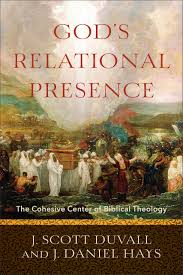
God’s Relational Presence by Duvall and Hays

book gods relational.jpg

There are getting to be quite a few large volumes on biblical theology available to Christian readers today. Many of them are scholarly and well done. They may focus the work along different lines – redemption, love, forgiveness, or the kingdom – but don’t dare think of this volume by J. Scott Duvall and J. Daniel Hays as an anomaly. This focus on God’s relational presence as the cohesive center of biblical theology makes perfect sense. It will not replace those others described above but it will complement them well. Our God is about relationship and as the authors scan Genesis to Revelation they will prove to you how prevalent it is. Mark me down as at first surprised and then convinced!

This author combination has already proven to work well before in the well-received title Grasping God’s Word and several other projects. Duvall is the New Testament scholar who balances out Hays the Old Testament scholar. Together they have learned how to communicate across the Canon.

I saw no signs of haste. The theme is well carried out while the detail is well fleshed out. In every part of Scripture, they find evidence of this controlling theme or overarching storyline of Scripture and show it to you. Don’t miss the introduction where in the very first paragraph they lay out their basic thesis and explain what they are trying to do to perfection. It well makes you know what to expect across the thorough volume.

Unlike many such books they didn’t just ask us to believe them, they showed us. So many biblical texts are pulled in while the expansive bibliography shows the breadth of scholarship as well. There’s even an occasional chart or graph that is quite instructive.

I found this book more successful in its presentation than some others of its kind and give it the highest recommendation!

I received this book free from the publisher. I was not required to write a positive review. The opinions I have expressed are my own. I am disclosing this in accordance with the Federal Trade Commission’s 16 CFR, Part 255.