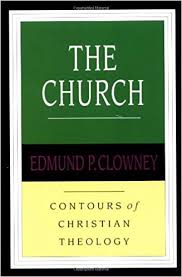
The Church (Contours of Christian Theology) by Edmund Clowney

book the church

By this point, I have used almost every volume in the Contours of Christian Theology series. All these volumes have run between good and great. They all are books to ponder after you’ve already consulted your systematic theologies. None of them are for shallow readers but are for those who are interested in really digging in the theology. This volume on the church by Edmund P. Clowney is one of those that fall on the “great” end of the scale. He has such probing, interesting things to say about the church and handles beautifully where ecclesiology touches on any of the other main doctrines.

There are 18 chapters that cover the church from every conceivable angle and address every theological issue I can imagine on ecclesiology. While I might not agree with a few statements here and there, this volume definitely leans to the conservative point of view. Just check his references and endnotes and see who he quotes. That will make it clear where his perspective comes from.

The beauty of the book was how he took very familiar concepts, exactly those concepts you would imagine you’d find in a book about the church, and said them in new ways that stretched your thinking. He wrote a book of scholarly depth and theological precision without sacrificing clear, persuasive writing. Concepts within ecclesiology are highly debated and rigidly held so there’s little hope that he will fall exactly where every reader does but don’t let that keep you at bay. You will work through all these issues in a much more thorough fashion with far more satisfying results if this book is one you carefully use. A well-done volume!

I received this book free from the publisher. I was not required to write a positive review. The opinions I have expressed are my own. I am disclosing this in accordance with the Federal Trade Commission’s 16 CFR, Part 255.
Check Out The New “Best of Christianity Today” Series!

book CT

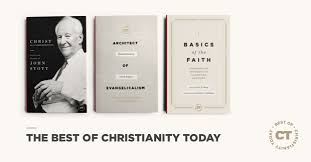
Two out of the three new releases in the Best of Christianity Today (CT) series published by Lexham Press have come across my desk:

Christ the Cornerstone: Collected Essays of John Stott

John Stott is a writer who always says something I find worth listening to. It doesn’t matter if I even agree with him on the point in question or not, as he speaks to me deeply with any words he has ever penned. To be honest, I wasn’t even aware that he had written a series of penetrating articles for Christianity Today between 1977 and 1981. This lovely hardback volume with its attractive dust jacket includes a short introduction that explains these essays and the type of writing Stott does in them. Though he wrote the articles randomly to speak to readers then, this volume collects them in six categories: Scripture and theology, the Christian disciple, the mission of the church, the church around the world, church challenges, and social concerns.

While some of these articles are more theologically probing than others, they teach us many things. Some of the articles are specific to a specific condition of those years that might not be exactly the same in our day but the value of the essays is in how to biblically think about the world and what’s going on. To be sure, there may be places where you might completely disagree with some political observation he makes. Ignore that as you read because the real issue is what spiritual concerns are involved. One of the reasons Stott is so helpful is that he makes you a better thinker. He never seems in-your-face but rather a gentle, kind man with a keen mind who would love to talk to you about issues with the Bible open. He strikes me as the man who would have no problem with you disagreeing with him on some issue as long as spiritual concerns were kept front and center.

This book is a gem!

I received this book free from the publisher. I was not required to write a positive review. The opinions I have expressed are my own. I am disclosing this in accordance with the Federal Trade Commission’s 16 CFR, Part 255.

Architect of Evangelicalism: Essential Essays of Carl F. H. Henry

To go along with the new volume of John Stott’s essays is this equally attractive collection of Christianity Today articles by Carl F. H. Henry. Henry writes with a stronger tone than Stott and his articles cover a larger swath of years, but he also had something powerful to say to readers in those days that can be gleaned by us today. In some ways, issues only present themselves again in different garb but they are the same issues. Maybe Stott could write a little better to the common person, but Henry knew how to get his point across as well.

This volume also contains a little introduction to explain how the articles came about and the type of writing that Henry does. Once again, the essays are categorized for us this time as: defining evangelicalism, evangelicals and modern theology, evangelicals and education, and evangelicals and society. The words that come to mind when I see his essays are fearless and theological. Again, you will like some of these articles better than others, but you will find them all together making a captivating collection.

We need some of the things said in this volume trumpeted throughout the land again!

I received this book free from the publisher. I was not required to write a positive review. The opinions I have expressed are my own. I am disclosing this in accordance with the Federal Trade Commission’s 16 CFR, Part 255.


Thessalonians, Timothy, Titus, Philemon (RCS), edited by Gatiss and Green

book RSC XII.jpg

This latest entry in the Reformation Commentary on Scripture (RCS) series covers six small Pauline epistles (1-2 Thessalonians, 1-2 Timothy, Titus, and Philemon). Though these letters of Paul are not quite as pivotal as recent releases in the series on Romans in understanding the Reformation, they still give great insight into both Paul and key Reformation thinking. Two scholars, Lee Gatiss and Bradley G. Green, combine forces to provide us this helpful volume in a series that makes a unique contribution to our studies.

There is the usual general introduction that adorns every volume in this series which lays out how this series is put together and what it hopes to accomplish before we receive an introduction to the six letters. This introduction begins by stating how the Reformation seized on Paul in laser-like fashion. I was almost surprised at how often the authors acknowledge the New Perspective on Paul. It almost seems that they assume it might be guiding reader’s opinions and must be often taken into account. To my mind, the NPP didn’t exist in the Reformation and doesn’t have the credence in many of our minds that some may think today and so might not need much discussion in a commentary like this one. Still, I don’t think these acknowledgments really detract from the commentary overall. More to the point, they did a great job of addressing how each of these letters was received in the Reformation. In another capitulation to modern times, they cited the few writings that were positive about women in the ministry. Whatever your view on that subject, there is no denying how few believed in that possibility prior to the last century.

I found the same strengths and weaknesses as with other volumes in the series. To be fair, the weaknesses can’t be helped as citations in the commentary are of necessity arbitrary. Someone must make the call for which writings to use in the commentary from the plethora of primary sources to choose from. The strengths are from the same area in that the authors have chosen well and given wonderful food for thought. They are wonderfully fair to a variety of teaching within and near the Reformation as well.

This series is far enough along to have earned a high rating and this volume clearly upholds the standard we have come to expect.

I received this book free from the publisher. I was not required to write a positive review. The opinions I have expressed are my own. I am disclosing this in accordance with the Federal Trade Commission’s 16 CFR, Part 255.
Master Robert Bruce–A Nice New Biography!

book ro bruce.jpg

A Banner of Truth biography simply stands out in our day. In one way, you can wonder how they are so popular? They publish as many on people you’ve never heard of as they do on those you have. Let me give you a hint that I’ve picked up on: make a special effort to grab these beautiful biographies of those you don’t know as quickly as those abounding with fame. Take for instance this book on Master Robert Bruce. I’ll confess upfront that I had never heard of this Scottish preacher of yesteryear. I’ll also confess this: a book about an unheard-of pastor like this can sometimes encourage me more than those of the well-known heroes. In the back of my mind, I often think of those heroes as far beyond my league, but in biographies like this one, we get to watch a pastor with all the ups and downs of a ministry be faithful to Christ. That’s a bona fide challenge for me!

Even though this book was first published several years ago, the author, D. C. Macnicol, writes well. His style is not exactly that of modern biographers, but that may be to advantage in this case. The book seems to transport you back to those days. That is not to say the book is hard to read, however, because the writing still flows beautifully.

I love the rawness of the book. There are a few instances in his life that you might wonder if he exactly made the right decision. But that is life and ministry, isn’t it? Events don’t unfold with perfect dimensions and easy answers. Even if you wonder if he could have chosen a different solution at some point, you will never doubt his faithfulness as you read. If he was slightly emotional at times, you will never doubt his fidelity to our Savior. Why the book is so challenging is that we know we will not get through the ministry with perfection, but can our lives be evaluated as faithful?

Let’s not forget the quality binding and beautiful dust jacket that will look so attractive on the shelf that now adorns all modern printings of hardbacks by Banner of Truth. You will enjoy this biography and so would your pastor!

I received this book free from the publisher. I was not required to write a positive review. The opinions I have expressed are my own. I am disclosing this in accordance with the Federal Trade Commission’s 16 CFR, Part 255.
Amos, Jonah & Micah (EEC) by Hoyt

book eec jonah

Every new release of the Evangelical Exegetical Commentary (EEC) series that I come across reinforces my thoughts that this series has something special brewing. It’s almost like when this series releases a new volume it immediately becomes the go-to exegetical commentary, especially for pastors who want a truly scholarly work. This latest volume covering Amos, Jonah, and Micah by Joanna Hoyt lives up to the lofty standards this series has already established. This volume is easily one of the best on either of these three prophets and you are blessed to have all three of them covered in this large (800+ pages) impressive volume.

For this review, I gave the most attention to Jonah because so many scholars today seemingly fall off the cliff when they get to Jonah. Delightfully, I found a commentary here that is not ashamed of Jonah, does not laugh off his historicity, or roll its proverbial eye at his grand message. Pastors will get solid help here. Scholars, though so many of them run left of the line found here, will find this an incredibly detailed scholarly look at the prophet. It seems no stone is unturned. In fact, the weakest area of contribution would be on structure, but the volume is still too wonderfully thorough to criticize.

I’m not saying that I agree with every sentence the author writes in this volume, only that everything is so well explained and in such depth that I have a thorough grasp of the issues involved to make my own decision. That is always what I’m looking for in an exegetical commentary.

To be sure, Amos and Micah are as well handled as Jonah in this book. The introductions to each are ideal and the things that scholars need beyond what pastors are looking for can all be found as well. Every passage bears traces of painstaking care and work. There are no signs of haste. From what I’ve read, Hoyt is a young scholar who strikes me as making quite a splash here. I’ll be using this book for years to come!

I received this book free from the publisher. I was not required to write a positive review. The opinions I have expressed are my own. I am disclosing this in accordance with the Federal Trade Commission’s 16 CFR, Part 255.

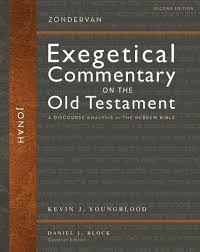
Jonah (ZECOT) [Second Edition] by Youngblood

book jonah 2

When I reviewed the original volume of this work just a few years ago, I was thoroughly impressed with it and gave it the highest rating. Quite simply, it was one of the best exegetical commentaries I had ever seen on Jonah. As it turns out, this Second Edition is very little changed from the earlier one. Nevertheless, my opinion has not changed either. There’s a new EEC volume that covers Jonah with two other prophets. It would be fair to say that these two volumes supersede all exegetical commentaries in print today on Jonah.

I love the approach of a ZECOT volume. Modern scholarship has had many developments that are of no detectable value for pastors, but discourse analysis really opens up the understanding of a passage. Youngblood is outstanding in handling the discourse analysis and gives dependable, conservative help throughout.

As I said for the first edition, Mr. Youngblood’s Introduction to the book of Jonah struck me as being of the perfect length and depth. He discussed the usual suspects – placement in the Canon, historical context, literary context, and an outline – with verve. Much of the information was of the kind that really aids one preaching on Jonah. He beautifully wove in his discourse analysis as well throughout the entire work.

The commentary itself is superb. Again, he always keeps us grounded in the context at large. Still, he draws out the needed background, word meanings, and other important detail. At the end of every periscope, there is fine theological reflection too.

You may not need to replace your first edition, but this is a commentary that you cannot do without!

I received this book free from the publisher. I was not required to write a positive review. The opinions I have expressed are my own. I am disclosing this in accordance with the Federal Trade Commission’s 16 CFR, Part 255.
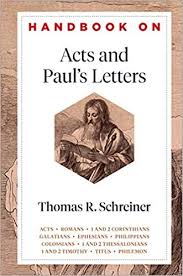
Handbook on Acts and Paul’s Letters by Thomas Schreiner

book handbook acts ept

If you use modern scholarly works, you already know Thomas R. Schreiner. He has written a multitude of well-received, highly helpful books including major exegetical commentaries. Now he tackles a handbook on Acts and the Epistles of Paul. Fortunately, when we say the Epistles of Paul, Schreiner means all 13 of them! That alone was totally refreshing. Schreiner is simply more conservative than several other major scholars of our day. For that reason alone, any work he writes is worth checking out.

I would label this volume a content survey. Those can be quite tricky to produce and some such volumes have almost no value. Rather than giving an overview, they provide so little depth that they add nothing. In this case, however, Schreiner has succeeded. You can truly follow the flow of the book you’re studying and have a real understanding of what’s going on. Think big picture rather than minutia, but a real drawing out of the theme of what that book is trying to say to us.

Perhaps I liked a few of the introductions better than others. In some cases like the one on Acts, he added a few helpful charts that just brought it alive in the opening statements that discussed structure and themes. In fact, that would be my only minor fault of the book is that a few of the books of the Bible covered do not have that material with the helpful charts. In any event, I feel he totally succeeded both in the broad introduction and the overview of the content. This volume is a total winner on providing what I would want in a handbook on these New Testament books. I don’t see how you could go wrong in using it!

I received this book free from the publisher. I was not required to write a positive review. The opinions I have expressed are my own. I am disclosing this in accordance with the Federal Trade Commission’s 16 CFR, Part 255.
Exegetical Lectures and Sermons on Hebrews by Charles Hodge

book hebrews hodge

What pastor hasn’t heard of Charles Hodge? You will often see his commentaries in worn condition in used bookstores because generations of pastors have used his works. For some years now, Banner of Truth has become THE publisher of his works and fortunately are keeping them in print in far better quality volumes than used to be the case. What we have here, however, is something the older pastors have never had: Charles Hodge on Hebrews.

If you get this lovely hardback edition, be sure to take the time to read the introduction that was prepared by William Vandoodewaard. He provides a brief biographical overview of Hodge’s life before he explains how this Hebrew volume came about. In short, it took some work on his behalf to gather and edit Hodge’s material into what became this new commentary!

The commentary, of course, is not as full as his other commentaries, but you will enjoy having it on hand to study. The first section contains exegetical lectures that though briefer are in the Hodge style that we are familiar with. He even has comments on the Greek interspersed throughout his perceptive comments. The next section is called sermons and outlines. They are mostly sermons rather than outlines and are hit or miss in terms of texts addressed. Still, they cover some of the most important texts in Hebrews in quality sermons, again though shorter, that may be quite helpful in suggesting approaches to preaching these texts. In addition, they will make fine devotional reading.

You know you can count on Banner to create a volume that will last for years to come and I highly recommend this latest volume!

I received this book free from the publisher. I was not required to write a positive review. The opinions I have expressed are my own. I am disclosing this in accordance with the Federal Trade Commission’s 16 CFR, Part 255.

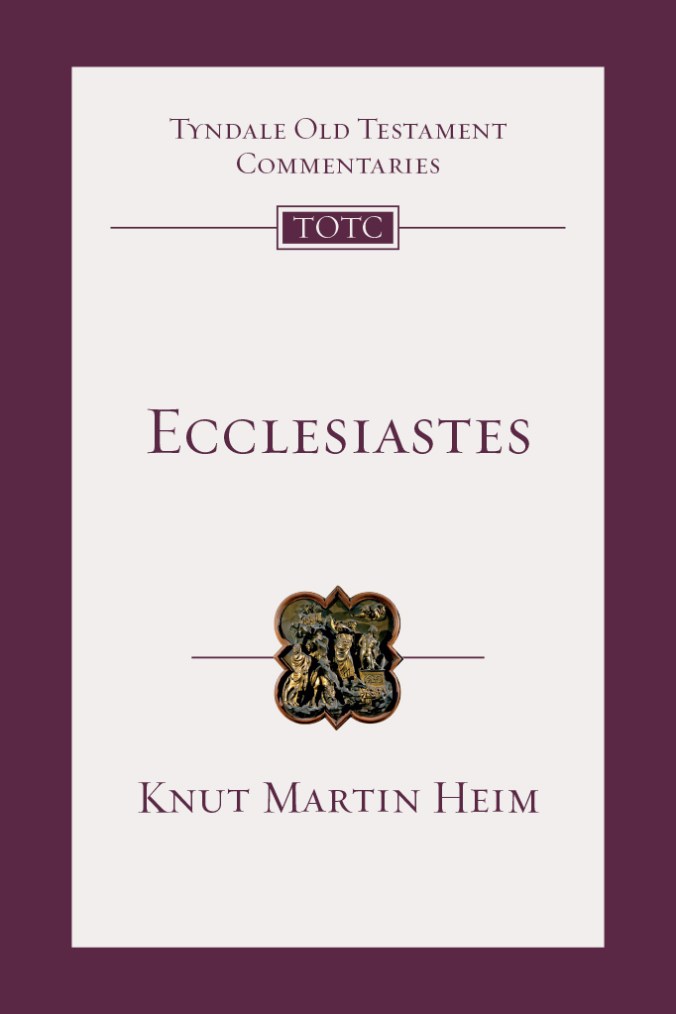
Ecclesiates (TOTC) by Heim

book ecc totc.jpg

The Tyndale Old Testament Commentary (TOTC) series keeps turning out these replacement volumes at a rate that would be a model for other series. The series retains its status as the best shorter commentary series that still has real depth with each of these new releases that I have seen. Knut Martin Heim upholds the standards that we have come to expect from the series. As a matter of personal taste, I may not have liked this volume as much of some of the other recent releases, but that probably has as much to do with the uniqueness of Ecclesiastes as anything else. In other words, scholarship on Ecclesiastes has gone a direction that some of us feel only gets us farther from its truth. Perhaps I’m a little too much of the old school to follow his theory about Qoheleth rather than Solomon, but I must confess he’s in line with the majority of what’s being written today. I can’t quite swallow that the writer of Ecclesiastes is mostly being sarcastic either. On a more positive note, the writing and scholarship in this volume are impeccable. He clearly communicates what he thinks and is adept at succinctly presenting current scholarly thinking.

The Introduction is crystal clear in explaining his viewpoint. While he has trouble with Solomon as the author, he highlights inter-textual issues, Canon, date and historical context, language and genre, as well as the theological and practical message of the book. I found him easy to follow. There’s a good select bibliography and analysis outline as well as his own translation. The commentary proper is never trite or simplistic and whether you agree with what he says or not you will appreciate gaining so much information in a short compass.

I’m an advocate of having all these TOTC volumes in one’s library and so I recommend this new release on Ecclesiastes as well.

I received this book free from the publisher. I was not required to write a positive review. The opinions I have expressed are my own. I am disclosing this in accordance with the Federal Trade Commission’s 16 CFR, Part 255.

Daniel (WBC) [Revisied Edition] by Goldingay

book WBC Daniel

John Goldingay is a big name in the scholarly world, and I can understand why the editors of the Word Biblical Commentary (WBC) series would ask him to revise his popular volume rather than replace it. It’s also good to see this revision since we haven’t seen many new releases from this series in quite a while. A page near the beginning shows that several volumes are now in revision or are forthcoming. Likely you are aware of how highly rated this book is to scholars while in many cases it might not be as well-loved by conservative pastors. In short, the author has not changed his overall conclusions on the Book of Daniel, but he has expanded his explanations in several cases. The page count has grown by nearly 300 pages! I’ll make it easy for you to rate this volume if you’re already familiar with the one that has been around since 1989. The perspective has not moved to the right, but the scholarly contribution has been successfully updated to the point that I see this volume holding its lofty status for several more decades to come.

I compared his Introduction in the original volume since I had it on hand and have used it several times. I do not personally endorse his viewpoint, but I felt he explained it well and, in many cases, took on more introductory issues that were even found in the original volume. He even followed the reception of Daniel through the New Testament and into later history all the way to the current time. That is a fascinating contribution, to say the least. I thought his conclusion after studying Daniel scholarship in the 20th century was that nothing changed at all during that time was quite surprising.

For you scholarly types, the bibliography has also significantly grown. He knows how to operate in the unique WBC format and his notes for scholars in every passage are extensive. He looks at structure more than some of these volumes do and the part that pastors would find most interesting still remains in the Explanation section. Sometimes his conclusion about the text or historicity leads him to places where I would strongly disagree. I don’t think this revision will majorly raise perceptions that pastors hold about this volume, but scholars are likely to give it the highest rating. Even if you don’t subscribe to all the author’s viewpoints, the book is simply too significant not to have access to for any kind of study or research on Daniel.

I received this book free from the publisher. I was not required to write a positive review. The opinions I have expressed are my own. I am disclosing this in accordance with the Federal Trade Commission’s 16 CFR, Part 255.