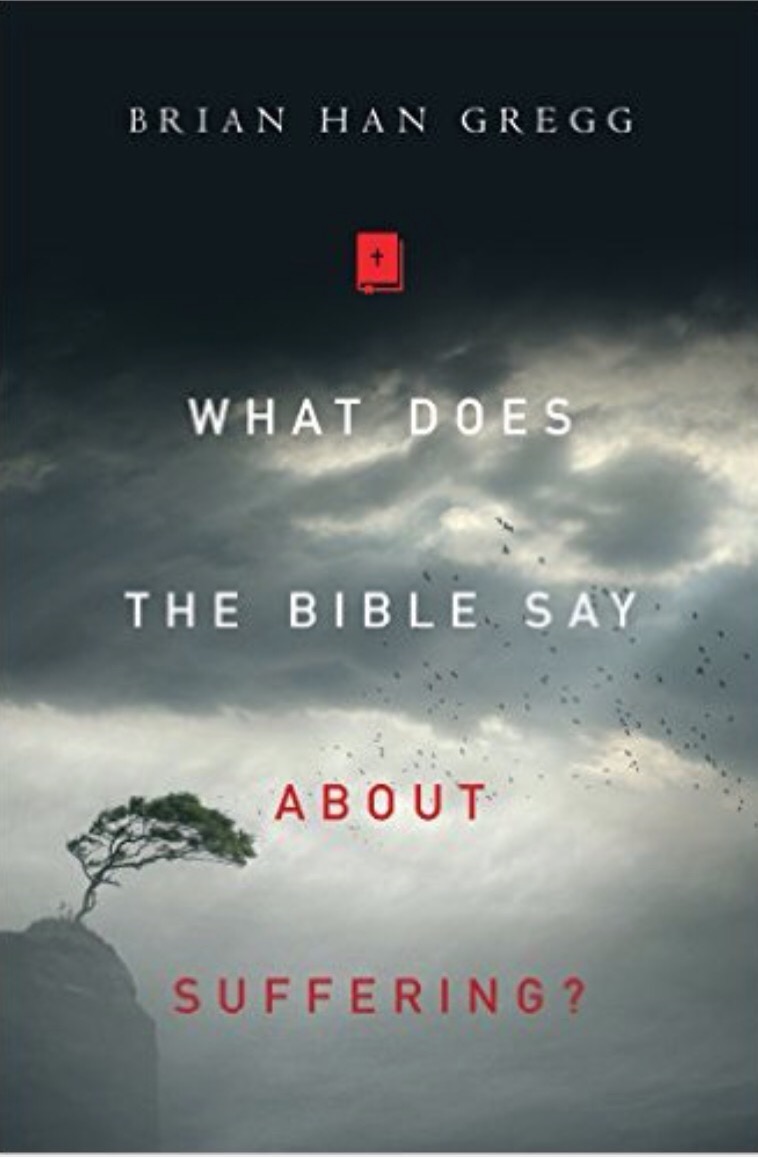
What Does The Bible Say About Suffering by Brian Han Gregg

Suffering is one of the most difficult theological concepts to get a handle on. Not only in a world that finds it easy to get angry at God, but even among Christians the pain of suffering leads to many struggles. Mr. Gregg enters this tender territory to try and corral what the Bible says about suffering.

While he focuses on the complexity, or even the mystery of suffering, he reminds us that no simple answers will be found. He seems dedicated to teaching others to not oversimplify to some sort of formula. While you can see what he is trying to say, I was even more amazed at how he extracts from the pages of Scripture all the components of suffering that is revealed to us. He does an extraordinary job at finding in the text what we actually can know about suffering.

I found this volume highly stimulating to meditate on suffering. I’ll remember his warning about oversimplifying, but I’ll also use this book as a starting place when I wrestle with this age-old subject. I warmly recommend this book.

I received this book free from the publisher. I was not required to write a positive review. The opinions I have expressed are my own. I am disclosing this in accordance with the Federal Trade Commission’s 16 CFR, Part 255.
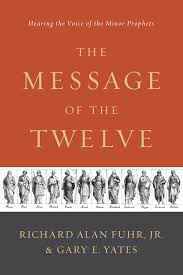
The Message of the Twelve by Fuhr and Yates

book twelve

Perhaps you especially enjoy the Minor Prophets as I do, then you are really going to savor this volume by Richard Alan Fuhr, Jr. and Gary E. Yates. The Minor Prophets make up one of the least well-known sections of the Bible, so the help this type of volume can provide is greatly needed.

The authors begin the volume proving the book’s worth immediately with a chapter on the historical background of the tumultuous times of these prophets. Though I might quibble on some details,  the chapter was outstanding at putting these twelve prophets into perspective. The next two chapters discussed what the prophets were accomplishing in their writings and the literary genres and rhetorical devices involved. Finding ten literary subgenres might be stretching it a bit, but that would match modern scholarly opinion. 

Chapter 4 was one of my favorites as it made a case for canonical unity of these twelve Minor Prophets. While they all stand quite well individually, I believe looking at them as a unit also yields tremendous insights.

As you might imagine, chapters  5-16 cover the Twelve individually. I appreciate the way the authors present these individual evaluations. Background, structure, overview, and theological leave you with a good idea of what’s going on in each of these books. Only some comments on Jonah’s historicity were subpar.

A few helpful charts, maps, and pictures round out this useful volume. Still, unlike some modern volumes, this book aims at providing its help by words rather than just a visual presentation.

This book is 5-star all the way.

I received this book free from the publisher. I was not required to write a positive review. The opinions I have expressed are my own. I am disclosing this in accordance with the Federal Trade Commission’s 16 CFR, Part 255.
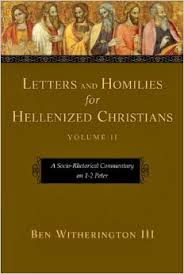
Letters and Homilies for Hellenized Christians Volume 2

book peter

This volume carries on the same valuable commentary that was found in Volume 1 that covered the Pastoral Epistles and the Epistles of John. In Volume 2 he finishes the letters he feels were especially for Hellenized Christians by giving us this full commentary on I and II Peter. I always marvel at his output as a writer of commentaries and here is another 400+ page commentary.

I must confess that I find myself even in less agreement with him than with Volume 1, and it seems he started in the middle with the Introduction of I Peter. Still, that same good, easy-to-follow writing was present that makes commentary reading more enjoyable.

Conclusions about authorship I found particularly hard to follow, but he continues to present his opinions well and share scholarly thinking up to the present. He continues to see the”household code” just as he did in the Pastorals. His comments on the text still make for lively reading even where one must disagree. Agreement is not essential to gain from a commentary and I’m glad to have this one to use.

All in all, this is a solid commentary.

I received this book free from the publisher. I was not required to write a positive review. The opinions I have expressed are my own. I am disclosing this in accordance with the Federal Trade Commission’s 16 CFR, Part 255.
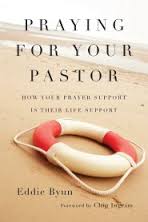
Praying For Your Pastor by Eddie Byun

book praying

As a pastor, I would love people to read this book and take its recommendations to heart. Mr. Byun is not exaggerating what is going on among pastors in our generation, though it likely will seem that way to readers. To a pastor this will seem like a condensed book of things we need to take seriously, but the target audience is to those we pastor. The subtitle (“How your prayer support is their life support”) suggests exactly what he stayed on subject about throughout. 

As a pastor himself he understands the pitfalls, the glass house our families endure, and the physical and spiritual challenges we face. He strengthens his case with timely statistics in a variety of places in his book and they are in many cases shocking. Though some of his suggestions confess we pastor’s own frailties and failures, I feel he has perfectly found the things we most need prayers for.

He suffered some indignities at the hands of some in his last pastorate, but only occasionally fell into self-justification mode. He situation did actually illustrate his point. He accepts the idea of female pastors, which the more conservative of us cannot agree with, but it did not affect the overall tenor of this fine book. 

Concise enough to encourage wide readership, this volume strikes at a real need. My prayer is that it will accomplish its goals.

I received this book free from the publisher. I was not required to write a positive review. The opinions I have expressed are my own. I am disclosing this in accordance with the Federal Trade Commission’s 16 CFR, Part 255.
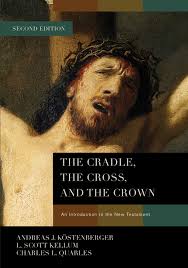
The Cradle, the Cross, and the Crown (2nd Edition)

book cradle

I love this book! After having seen and used several New Testament Introductions, this volume strikes me as ideal. It’s clearly designed for advanced studies, yet is so well written and accessible that it will not bore the reader as some advanced studies do. I have never had access to the first edition and so am not sure the level of updating in this second edition, but this is an outstanding book.

Be sure to read the Preface to the Second Edition to see clearly the conservative outlook of Andreas Kostenberger, L. Scott Kellum, and Charles Quarles, and design of the volume. On both counts, it is exactly what I would be looking for in this type volume. Chapter 1 speaks of issues of canonicity and even inerrancy. They well outline the twists and turns of scholarship while not allowing it to make them lose perspective. The chapter on the political and religious background is finely executed.

Chapter 3 expertly introduces the Gospels with a chapter following on each Gospel. Next we have a chapter on Acts, then one on Paul, followed by each of the rest of the books of the New Testament. An ending chapter and an epilogue well round out the volume.

Each of the chapters covering the perspective book is the greatest asset on the volume. Real background, scholarly thought, literary designs, theology, and contents of the book are all enlightening. Fine charts and maps only make the content better.

Again, I give this the highest possible ratings among Introductions of the New Testament.

I received this book free from the publisher. I was not required to write a positive review. The opinions I have expressed are my own. I am disclosing this in accordance with the Federal Trade Commission’s 16 CFR, Part 255.
The Thiselton Companion to Christian Theology

book thiselton

What is called a theological companion turns out to be an astute theological dictionary from a seasoned theologian. The scope of this fine volume is so massive that it is hard to believe that one writer gave us the entire volume. Most dictionaries are compiled by a host of scholars who can even contradict themselves across entries, but here we have a unified approach to all things theological.

The book begins with a timeline of theologians to help you place the many theologians that will receive a biographic entry in the volume. That is a great help in seeing who was contemporary with each other. Next, there is a list of entries which is much easier than flipping through the large volume itself. Still, the majority of the book is a-to-z entries.

In addition to influential theologians, he gives almost every theological word imaginable whether common like “justification”, or biblical like “abba”, or of a modern scholarly bend like “open theism”, or even esoteric like “womanism.” Exhaustive is a fair description.

The articles are of various lengths following a logical approach to their complexity and importance. You might occasionally disagree with his choice, or find something missing like the “New Perspective on Paul”, but it is broad enough to cover most everything you might need in such a volume. You might even disagree on a theological conclusion, but you will never find him careless, naive, or harshly dogmatic. His lifetime in theology is apparent.

Quite simply, I must rate this a winner and consider it a jewel to have on your shelves.

I received this book free from the publisher. I was not required to write a positive review. The opinions I have expressed are my own. I am disclosing this in accordance with the Federal Trade Commission’s 16 CFR, Part 255.
Unchanging Witness–A Book For Our Day

book

This issue of homosexuality is the roaring issue on the doorstep of Christianity. That the world is embroiled in it is no surprise, but that some corners of Christendom are bowled over by it is.  The biggest shock of all is what is proclaimed to be biblical and historic in Christianity on the subject. That is why this new book by S. Donald Fortson III and Rollin G. Grams is so timely, helpful, and important.

The task these scholars tackle with such aplomb is showing that homosexuality has always been biblically and historically wrong  in our Christian faith. They show in one succinct chapter how the gay movement has proceeded since it embarked upon a political path in the 1960s. Then the next 6 chapters show what all parts of Christianity has believed on the subject since the beginning with plenty of direct historical quotation and analysis. They may provide more than you will feel you need, but you will appreciate their careful labor.

The balance of the book examines the biblical passages mentioning homosexuality. They spend time mentioning every argument presented by pro-homosexual scholars. You see these other scholars have been incredibly unscholarly, careless, and even dishonest. Some may not like all that scholarly interaction, but this is a case where it’s needed appreciated.

A person can say they think homosexuality is acceptable because they choose not to accept the truthfulness of Scripture, but one cannot logically or honestly say the Bible supports homosexuality. These authors have put any Christians who study this subject in a great debt by so ably providing that proof.

I received this book free from the publisher. I was not required to write a positive review. The opinions I have expressed are my own. I am disclosing this in accordance with the Federal Trade Commission’s 16 CFR, Part 255.
Introduction to World Christian History by Derek Cooper

book chr history

This book serves as a short introduction to Christian history and actually covers that territory in 250 pages. It’s other unique feature is the extent it goes to prove that Christianity has a global rather than a western history.

The volume was successful in proving what we often forget–Christianity has had peak periods all over the world. I personally wasn’t aware how some areas, like, for example, the Far East, had periods of flourishing in Christianity. The history is presented in broad sweeps, but you could easily get the big picture and know where to pursue other studies.

Reading a broad introduction also made it easy to notice trends. I was amazed how getting close to any government often spelled a sudden destruction of Christianity. There was proof given too of how European countries that once were highly Christian are now  mostly secular.

The downside of the book is that it makes no distinction of anything ever called Christian. It passes no judgment except where western excesses were presented, or so it seemed to me. In an effort to make a global case, it was too threadbare in presenting American Christianity.

Still, it is a great book for a broad perspective and a global emphasis.

I received this book free from the publisher. I was not required to write a positive review. The opinions I have expressed are my own. I am disclosing this in accordance with the Federal Trade Commission’s 16 CFR, Part 255.

The Enduring Authority of the Christian Scriptures–An Important New Book

book authority

Likely the most important book of its kind for this generation, this massive volume covers the doctrine of Scripture from every conceivable vantage point. Edited by the redoubtable D. A. Carson, this book maintains a consistently high level of scholarship. Though I did not read every page (I wanted to provide somewhat of a timely review),  I read much and was impressed throughout.

The volume begins with a spectacular introductory essay by Carson that was fascinating. He at once laid bare the lines of debate and an outline of the history. Starting a trend that carried through the book, he named names. He was never ugly, but he put people with positions and then evaluated positions in this successful romp through the issues.

Next comes nine chapters on historical topics. There might be more information than you feel the need to know, but in any future historical questions you will likely find your answers here.

The heart of the book was chapters 11-24 on biblical and theological topics. These articles were excellent even if certain parts were somewhat esoteric. Still, the great subjects were fully addressed. The next section on philosophical and epistemological topics carried the theological discussion forward. The section on comparative religion topics was much less interesting to me, but that is likely a matter of taste. The book ends with Daniel Doriani encouraging us to think holistically and then some FAQ by Carson.

This book is a major publishing event. Pastors will find some that is helpful clarification, but some that is needless complication. We must remember, though, that the book is dedicated to scholarly concerns in addition to what is helpful to us. There were statements that I could not agree with in these pages, but this book is a presentation of the conservative position. To that end, it was just what was needed in our complicated days.

I received this book free from the publisher. I was not required to write a positive review. The opinions I have expressed are my own. I am disclosing this in accordance with the Federal Trade Commission’s 16 CFR, Part 255.

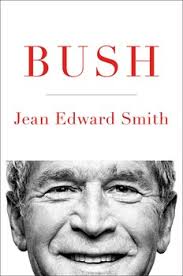
Bush by Jean Edward Smith (Presidential Bio Series)

bush

Here’s the first stab at a definitive biography of George W. Bush by a major biographer. I don’t think it will hold that title long if another famous biographer tries his hand, but it is first in that sense. It’s hard for me to classify this biography. On the one hand, the skilled hand of Mr. Smith is ever present, yet he makes blunders as well. I could hardly put the book down, yet I disagreed often and picked up on clear bias.

There is plenty of research, no character discussed is ever wooden, and you learn much about Mr. Bush’s personality. Still, Smith paints in broad strokes. He equates Bush’s distinct Christianity with a lack of sophistication, his penchant for “deciding” as reckless and brash, and his outlook, particularly on Iraq, a general naivety that continually led him astray.

Smith failed to see that perhaps that Christianity gave him a moral grounding that is often tragically missing in Washington. Right or wrong, he really meant well. His “deciding” was surely better than indecisiveness in horrific events. ( 911, Katrina, the Great Recession–Bush wasn’t a lucky man).When Smith outlined what Bush should have done, he at times looked like the naive one when he seemed to feel that his ideas would have flawlessly followed the script. No matter the plan, the players in Iraq and surrounding areas were the equivalent to having a tiger by the tail. We all learned that together.

When he suggests that Bush overreacted to 911, he doesn’t connect the dots to what he told us in this book–we all wanted to go fight somebody! The Democrats were ready too. A few started disagreeing when Iraq was brought up, but very few at the beginning.Even in this harsh assessment too, there is no doubt that Bush believed there were weapons of mass destruction. If you sincerely believed that to be true, what else could you have done? He writes as if 20/20 hindsight was at Bush’s disposal beforehand.

There’s criticism of his managing of his staff. What president didn’t have staff issues, or been guilty of listening too much to the most agreeable staff members. That’s the human element that always complicates management.

Bush had some failures for sure. Like most of us, often our greatest strengths and greatest weaknesses come from the same component of our personality. It was likely true for Bush too. Amazingly, he quotes Bush admitting, to some degree, many of the very things Smith perhaps overemphasizes. I actually grew to appreciate Bush in places I had not before, especially in things like his handling of the mortgage crisis. We teetered on the edge of a crisis to rival the Great Depression and it called for measures that we might most of the time strongly disagree with. It’s almost 8 years later and Bush clearly got that one right.

As for the book, Smith tells us he thinks Bush is a horrible disaster in the first paragraph. (Was the editor asleep?) Forget building a case and convincing the audience over the course of the book. That crazy method put him on trial as much as Bush page by page.

So is this a great book? I closed it at the end more confident that Bush was a genuinely good man who gave it his all. I was further convinced that Bush would be a guy quite enjoyable to spend a day with. He’d defend his overall approach as it was a matter of principle to him, yet he would readily admit his mistakes, and he’d be a gracious host whether you agreed with him or not. I found that refreshing here in July 2016 as this book hits the shelves and we are in more danger than in Bush’s days and miss his magnanimous ways.

So I reached those conclusions and grew in appreciation of Bush while this book I couldn’t put down tried to convince me that he was a failure. Does that make it a five-star wonder or a one-star dud? I have no idea. I’ll be gracious like George W. Bush and give it 4 stars.

I received this book free from the publisher. I was not required to write a positive review. The opinions I have expressed are my own. I am disclosing this in accordance with the Federal Trade Commission’s 16 CFR, Part 255.