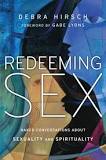
Redeeming Sex by Debra Hirsch

hirsch

Well, Hirsch is certainly tackling the hot issue of our day. While she addresses the big perspective of sex in all our lives, she ultimately writes to confront how Christians and churches interact with the LGBT community. Having been deeply involved in the LGBT lifestyle herself, she writes as a believer now. While some of her insights were profound, I felt she often gave away the farm in an effort to plant the seeds of reaching them.

She did well when she explained that in many such things we are attempting in a flawed way to reach the God we desperately need. When she talked of the brokenness in many lives before and during their LGBT days, she was spot on. When she explained that we have been failing as Christians to reach that group, she often pegged our failures clearly.

The problem with the book is the solutions she presents. I felt that being a celibate gay was enough for her. I don’t know how that position could be maintained biblically, and she made little attempts to do so. She pointed out that we view a man leaving his wife for another woman differently than for another man as if to prove we are unfair. What she fails to see is that there is a possible holy relationship between a man and a woman that could never be true of a man and a man. Suggesting that cultural factors might weaken the force of what she admits are all negative biblical passages is a poor argument too.

She at least seemed sincere and caring as she wrote, but she did not, in my view, strike the right balance between holding to truth and not being overly judgmental. Some will love it, but I cannot give a high recommendation to it.

I received this book free from the publisher. I was not required to write a positive review. The opinions I have expressed are my own. I am disclosing this in accordance with the Federal Trade Commission’s 16 CFR, Part 255.
Disaster Ministry Handbook by Aten and Boan

disaster

Have you ever wondered how to respond to crisis or disaster as a church? The volume will provide all the detail you could ever need on the subject. The Introduction tells the interesting way the authors developed their passion for this ministry and explains why few have ever thought more deeply about the subject than they have.

I felt chapter two on disaster basics was enlightening. Especially things like disaster phases gave insight into what needs really are present over time, even beyond the initial crisis.

Chapter three was the weakest as it used trendy terms to discuss Christian obligation. I believe a better theological presentation could have been given. The rest of the book is the nuts and bolts of disaster ministry including excellent forms to carry out their recommendations. That could hardly be better.

Few might read it through as it has more of a manual feel, but I doubt any one attempting to implement a large disaster ministry, or write about it, will be able to ignore this volume going forward. My only criticism is that I don’t see how smaller churches could implement it. Still, I recommend it for all those interested in disaster ministry.

I received this book free from the publisher. I was not required to write a positive review. The opinions I have expressed are my own. I am disclosing this in accordance with the Federal Trade Commission’s 16 CFR, Part 255.
The New Testament: Its Background and Message (2nd ed) by Lea and Black

nt 2

Are you looking for a fine, conservative New Testament background for your studies? This volume appears to me to be aimed more at pastors and Bible students than scholars, though you will be made familiar with more important scholarly questions.

Part One was exceptional in the big picture background of the NT. The history from the end of the OT to the beginning of the NT well sets the stage. Daily life and the unique religious background of the times are carefully explained. The chapter on the text illumined canonicity in a small compass.

Part Two combines a study of the background of Jesus’ ministry and of the Gospels themselves. The four chapters on Jesus’s ministry and its changing geographical emphasis are essential to properly understanding the New Testament.

The balance of the book covers Paul and the Epistles. It ends with a chapter on Revelation where various viewpoints are covered. Each NT book has its contents, unique features, themes, and an outline given.

There are helpful charts interspersed throughout the text. One of the best traits of this volume that is often missing in such volumes is that it reads well. I recommend it.

I received this book free from the publisher. I was not required to write a positive review. The opinions I have expressed are my own. I am disclosing this in accordance with the Federal Trade Commission’s 16 CFR, Part 255.
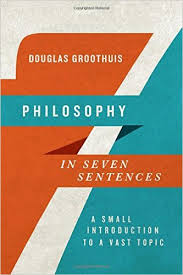
Philosophy In Seven Sentences by Groothuis

philosophy

This book is an experience. It takes an impenetrable subject for many and makes it fascinating. I found this volume far superior to a semester-long undergraduate class I took years ago. He makes it relevant, interesting, and all with a Christian guide to take you along. The writing style is engaging, enjoyable, and captivating. I only use the cliche “I couldn’t put it down” because I never dreamed that would be the case.

Taking seven great philosophers along with their most famous statements was a masterstroke in giving an introduction to philosophy in a small compass. Again, I opened the book thinking that would never work, only to discover it did.

He begins with Protagoras, who I knew nothing about, and taught me about using a measurement outside ourselves. He taught something about today. When he used a statement that many agree with,  including his students,  and then shocked us with the knowledge that it was a philosophy statement of a serial killer, you knew he had something worthwhile to say.

He brought Socrates to life. In fact, I feel I never knew him at all until this book. I learned too how we hear more of a caricature of these philosophers rather than what they really believed. It’s the same with Aristotle. We learn too that if we ignore the basic Law of Noncontradiction we give up everything we could ever know.

He well explained Augustine from a philosophic viewpoint while in no way damaging his theology. He made plain Descartes and Pascal too. He made me realize I had Kierkegard all wrong in that superb chapter.

All in all, this is a masterpiece.
 

I received this book free from the publisher. I was not required to write a positive review. The opinions I have expressed are my own. I am disclosing this in accordance with the Federal Trade Commission’s 16 CFR, Part 255.
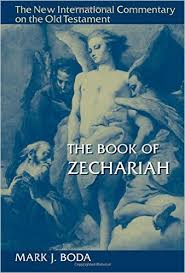
Zechariah by Mark Boda (NICOT)

zech

This is what an exhaustive commentary looks like. This commentary on the Minor Prophet of Zechariah is almost as large as the one on Psalms in this same New International Commentary series. I am not suggesting it is exhausting though. A judicious use of footnotes has made for a volume at once effective for scholarly pastors and academia. I can’t imagine the hours Boda must have put in here.

You would expect the Introduction to be massive in a volume so large, yet it is a manageable 45 pages. That means the bulk of the book is actual commentary on the text.

The Introduction contains a textual history as well as a competent historical background. A section called “Compositional History” overlapped with structure and was worthwhile. I couldn’t personally agree with some of his other conclusions on how the composition came together, but he still trusts the text. His section on the message of Zechariah was good as far as it went.

Again, it’s the actual commentary that will make this volume important for the next 50 years. It seems most every angle is discussed and it is almost encyclopedic. Still, as most will read it one text at a time, the depth will be appreciated. For that reason, I must give a strong recommendation.

I received this book free from the publisher. I was not required to write a positive review. The opinions I have expressed are my own. I am disclosing this in accordance with the Federal Trade Commission’s 16 CFR, Part 255.
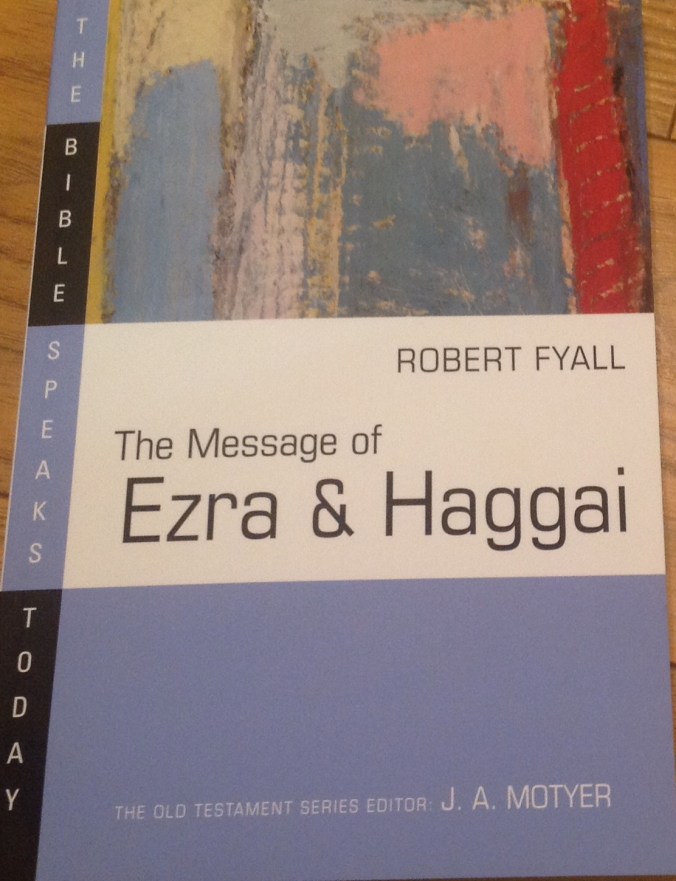
The Message of Ezra & Haggai (BST) by Fyall

ezra

This is a helpful commentary on two books of the Bible that are not only less studied than others, but rarely seen packaged in one commentary. That is not to say that the combination doesn’t make sense; it does. As Robert Fyall explains, Ezra gives the exciting history while Haggai gives the prophetic voice.

The Introduction is a little longer for Ezra than Haggai, but that is partly because the historical setting is the same and needs no repeating. Particularly, his discussion on the structure of Ezra was fascinating. His selections for the leading themes of Ezra (God, worship of God, the people of God, Scripture and prayer) were well discussed and seemed spot on.

The shorter Introduction on Haggai still sufficiently covered similar territory. Again, the approach was well thought out.

The commentary proper was outstanding in the BST style that we have come to love and expect. In the Preface he pays homage to Derek Kidner’s fine volume on Ezra, but this is clearly a worthy companion to it. I’m sure glad to have it on my shelves when studying these two books, and I highly recommend it.

I received this book free from the publisher. I was not required to write a positive review. The opinions I have expressed are my own. I am disclosing this in accordance with the Federal Trade Commission’s 16 CFR, Part 255.
From The Pen of Pastor Paul by Daniel Hyde

paul

This new volume gives help for studying I & II Thessalonians. The style is sermonic rather than a regular commentary style. Whether reading for study purposes, or just for devotional reasons, you will likely enjoy it.

The approach may vary from one text to another, and it may not cover all that could be said, but what is said is of value. You do sense a pastor at work and that the approach was first to address his own congregation. You also pick up on his closely following the thinking of his denomination–the Reformed Church.

The book’s greatest feature is Hyde’s ability to trace Pastor Paul in the two letters. It strikes me that he may he on to something that I will want to think about in my own future studies of Thessalonians. Those sermons that highlighted the ministry were the most penetrating in this volume.

There is some repetition from one sermon to another as might happen in a preaching series, but this is a solid volume to pick up for your studies.

I received this book free from the publisher. I was not required to write a positive review. The opinions I have expressed are my own. I am disclosing this in accordance with the Federal Trade Commission’s 16 CFR, Part 255.
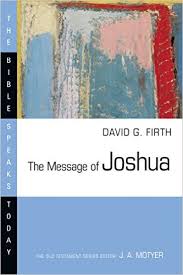
The Message of Joshua (BST) by Firth

joshua

It’s finally complete! Now every book of the Bible is represented in the BST series. It’s strange that Joshua would be the last to get coverage in the series, but it is an outstanding volume in any event. David Firth, the contributor of this volume, has shown in recent years his mettle as a commentator on the historical books of the Old Testament. His superb quality is upheld here.

The Introduction is unique, and yet a joy. The typical elements of an Introduction, which are of varying worth to readers, were skipped to focus on what he felt was the biggest issue in studying Joshua–the violence in Joshua. Since that violence is often parlayed into an attack on God, and a reason to completely discount Joshua, his approach has merit.

His conclusions are interesting. He argues that the violence is not as widespread as it sounded, and that the line was not as racial as imagined. Rahab and others seem to prove his point. Even his explanation that the land is owned by Jehovah as the overriding justification is helpful. This novel approach to Introduction is, in my judgement, a success.

The commentary proper exhibits those qualities you love when studying a text. Great insights and good theology abound. For example, read all he explains on the story of Rahab and see what I mean. He addresses the violence all through the text as well.

This is a fine commentary and I highly recommend it.

I received this book free from the publisher. I was not required to write a positive review. The opinions I have expressed are my own. I am disclosing this in accordance with the Federal Trade Commission’s 16 CFR, Part 255.
I Will by Thom Rainer

iwill

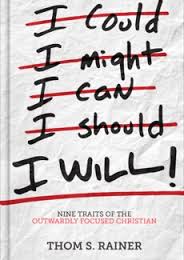
Here’s a needed book for pastors and church members alike. Pastors need to know what church members are really thinking these days. At the same time, church members would do well to recognize how the culture has affected us all and turned us into church consumers who only view church in terms of what benefits it can give. Lost in the shuffle is service, which clearly is a bedrock of Christianity.

Rainer is the perfect author for this subject. He’s been studying churches and pastors for years. He challenges us to break out of the straitjacket of an inward focus. It is, as he writes here, a matter of the will.

As we have shifted to a preference-driven mentality, he diagnoses our real problem: the focus of our worship is not on God. He encourages us to say “I will” to corporate worship. He also encourages us to grow together with others rather than in isolation. His chapters on serving and going would likely revitalize any church whose members put it in practice. He wonderfully discussed the oft avoided subject of giving too.

The final three chapters on determining not to be a church dropout, avoiding the traps of churchianity, and deciding to make a difference are a challenge to every individual Christian. As a pastor, I wish  church members everywhere would read it.

I received this book free from the publisher. I was not required to write a positive review. The opinions I have expressed are my own. I am disclosing this in accordance with the Federal Trade Commission’s 16 CFR, Part 255 .

Ready To Return by Ken Ham

return

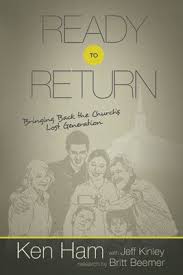
Ken Ham returns to a subject that he has written on before–our losing the younger generation from the faith. As you would expect from this famous creationist, he sees the denial of the historicity of the Genesis account as part of it. Still, he and co-author Jeff Kinley, assisted by researcher Britt Beemer, probe deeper to all aspects of moral relativism and an insufficient view of God’s Word that have brought on this problem.

The research is at once fascinating and heartbreaking. His assessments of why we are where we are seem spot on. When he shares that children being raised in Sunday School are leaving churches and the faith at a higher rate than those who weren’t, we get the greatest shock of all. His explanation that how we teach Bible “stories” is adding to the problem gets one thinking.

The book is excellent, the analysis keen. The only downside is there is a bit of repetition at times. Still, he looked at issues from several vantage points. Public school was shown to statistically predict a bad turnout for children. He well showed differences in only borrowing someone else’s faith. The chart on page 99 showing “renters” versus “owners” well illustrated the problem.

Chapter 9 was the best as he gave a plan that used the Bible as the basis for our raising our kids with results different than these dismal statistics he shared. His analysis of current trends nationally shared in appendixes was helpful. This book is a fine resource!

I received this book free from the publisher. I was not required to write a positive review. The opinions I have expressed are my own. I am disclosing this in accordance with the Federal Trade Commission’s 16 CFR, Part 255 .