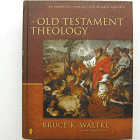
An Old Testament Theology by Waltke

book ot theo

That Bruce Waltke is revered in Old Testament scholarship is beyond dispute. His works on some OT books are the highest rated commentaries we have on them (particularly Proverbs and Micah). He’s written on most every section and genre of the OT and even contributed on Hebrew syntax. It comes as no surprise that Waltke would be chosen to deliver a comprehensive OT theology with those credentials. As he has done before, he even credits an associate who helped, in this case, Charles Yu, as a contributing author–but make no mistake—this is a Waltke work.

He gives 6 chapters of thorough explanation on what bible theology is as well as the importance of OT theology. By the time he’s done with this introduction, which compares to many a whole book on the market today, we are 170 pages deep.

Part Two covers chapters 7-28 and is labeled “Primary History”. It’s not just a chapter on every book or a combination of books of the Old Testament, yet every book that includes a historical element is covered. He lingers over the foundational Book of Genesis in covering the Cosmos, man, the Bride, the Fall, and the Noahic and Abrahamic Covenants. He follows a theological interpretation of Creation that doesn’t demand a literal creation, which is less than I would believe. Still, he was more conservative in places that I anticipated, and as works are graded these days, he would be labeled “conservative”.

Part Three covers chapters 29-35, is called “other writings” and addresses Wisdom Literature. As you probably know, that is one of Waltke’s specialties. The final 70 pages of this fine volume are made up of helpful indexes.

To my mind, this volume is one of the three most important OT Theologies on the market today. Because of the cruciality of OT Theology, and because of the three distinct approaches, I recommend having this Waltke volume along with Paul House and Eugene Merrill. If one is all you want, this book gives you the most material.

I received this book free from the publisher. I was not required to write a positive review. The opinions I have expressed are my own. I am disclosing this in accordance with the Federal Trade Commission’s 16 CFR, Part 255.
 

Here in Spirit by Jonathan Dodson

book here spirit

This book has a wonderful approach to the study of the Holy Spirit. Most such books run straight to controversy as if the Spirit was nothing more than an academic question or a “spirited” debate. The better ones remind us that the Spirit is a Person. This one by Jonathan Dodson goes one better by stressing that He desires relationship—a relationship that is not merely representative of the Father and the Son, but personal to Himself. The author went so far in that vein that repentance was required in his life for what was rank neglect of the Spirit on his part. Perhaps like me, you aren’t far behind him!

Dodson knows how to connect with this generation. I’m not sure the word “hip” is still in currency as I don’t have a hip bone in my body, but he knew how to pull in a great deal of popular culture. For the record, I don’t think I had ever seen even one movie he referenced, but he told enough of the plot that I could connect the dots easily. What won the day for me was his prevalent sincerity and contributive content.

He didn’t drown in tongues, or gifts, or other strange favorites, but he displayed a clear understanding that preferred to stay on task for a relationship with the Spirit. My strongest recommendation for this book is the positive conviction it brought to me. In short, I prayed differently this morning. In a book aimed at Christians at all points of our journey, what could be a better endorsement?

I received this book free from the publisher. I was not required to write a positive review. The opinions I have expressed are my own. I am disclosing this in accordance with the Federal Trade Commission’s 16 CFR, Part 255.

Modern Technology and the Human Future: A Christian Appraisal

book mod tech.jpg

We must have discussions like this one. A couple of decades pass and our very world has changed with smartphones and other electronic devices. It has affected Christians along with everyone else. We are finally pausing to search out the implications of this seismic shift. Several practical Christian books have probed how we might deal with a world that has changed and is not going back. (One by Tony Reinke lies on my desk). In this volume by Craig Gay, however, the broader theological implications are mined. This book is less of how you ought to alter your life in the days to come and more of what does it even mean. Both types of books are needed and I’m rooting for their success.

The author writes with balance. He neither denies his own use of the technology he writes about nor encourages its complete rejection. In fact, his analysis seems to embrace its good at least to the extent of sharing the Gospel and other wholesome features while exercising caution on the other end. Our society has changed. To what extent should a Christian change with it?

To bulk up his premise, the author surveys other paradigm-shifting technological advances from the plow to automated manufacturing. He traces how economic concerns are usually the driving force. He turns his discussion toward theology by considering “ordinary embodied human existence” with the background of the Incarnation of Christ and God’s mission for us.

The book is deep reading. If you find that kind of theological reading difficult, this book will be a challenge. Theological junkies will find it the perfect discussion of an all-encompassing subject. If you can handle academic reading, and enjoy well thought out analysis, this is the book for you.

I received this book free from the publisher. I was not required to write a positive review. The opinions I have expressed are my own. I am disclosing this in accordance with the Federal Trade Commission’s 16 CFR, Part 255.

The Christian Doctrine of Humanity (Crisp and Sanders, Editors)

book chr doc humanity.jpg

This collection of cutting-edge essays on the doctrine of humanity is the sixth installment in a series entitled “Explorations in Constructive Dogmatics”.  They proceed from the Los Angeles Theology Conference hosted by Fuller Theological Seminary. Previous entries addressed Christology, Trinitarian Theology, the Atonement, the Word of God, and the task of dogmatics. A wide-ranging group of specialists is assembled in each case and this time includes Marc Cortez, Hans Madueme, Ian McFarland, Richard Mouw, Lucy Peppiatt, and Frances Young, and total 12 contributors that look at humanity from many vantage points.

Let’s be clear. There’s no shallow wading here. Though these essays are not geared toward a popular audience, they are well written, There’s a good chance, however, that they will go deeper than you get in most volumes. If you’re game, then, this book is an important, challenging read. As I read, it struck me that many of these essays were in the realm where the doctrine of humanity bumps against the other major doctrines—Christology, Eschatology, Pneumatology, among others. Along the way, you will get a clear overview of where scholars are still debating this key doctrine. You will notice as well that current events are bearing on these theological issues as questions of how we personally identify ourselves is addressed as well, yet with a warmness toward biblical clarity and longstanding Christian belief.

All 12 essays were well done. My favorites were Marc Cortez’s look at “Nature, Grace, and the Christological Ground of Humanity”, Hans Madueme’s “From Sin to the Soul: a Dogmatic Argument for Dualism”, and  Lucy Peppiatt’s “Life in the Spirit: Christ’s and Ours”. I took something that helped me from each of them.

I imagine this will be a much-cited and influential book for some time to come as it fully succeeds in what it sets out to do.

I received this book free from the publisher. I was not required to write a positive review. The opinions I have expressed are my own. I am disclosing this in accordance with the Federal Trade Commission’s 16 CFR, Part 255.
A Gracious and Compassionate God (NSBT) by Timmer


book jon nsbt.jpg

The New Studies in Biblical Theology (NSBT) tackles the beloved Book of Jonah in this entry by Daniel Timmer. There’s really not a dud that I’ve seen in this series. Many attribute this consistent quality to the editorship of revered scholar D. A. Carson. I suspect that along with careful selection of contributors is responsible for the prestige of the series. If you value D. A. Carson as many do, you should know that he calls this volume by Timmer “a book to cherish”.

The subtitle accurately outlines what you will find between these covers: “mission, salvation, and spirituality in the book of Jonah”. In fact, chapters one and two take mission and conversion/spirituality in Jonah and relates it to the entire biblical corpus.

Chapters 3-6 take Jonah chapter by chapter drawing out its theology and again tracing the themes mentioned earlier. At times, the author is quite strict about the theology that can legitimately be mined here, perhaps overly so. Still, there are loads of great theological introspection for this familiar story. The concluding chapter effectively ties it all together.

Mark this down as another entry in this winning series!

I received this book free from the publisher. I was not required to write a positive review. The opinions I have expressed are my own. I am disclosing this in accordance with the Federal Trade Commission’s 16 CFR, Part 255.
Finding Favour in the Sight of God (NSBT) by Belcher

book fin nsbt.jpg

This latest entry in the New Studies In Biblical Theology (NSBT) by Richard Belcher and edited by D. A. Carson presents a theology of wisdom literature. Since this series has already provided Hear My Son by Daniel Estes and Five Festal Garments by Barry Webb, I opened this volume with something of a here-we-go-again attitude. I was in that fog for a few pages before I realized that this book was a really good one. Think of a field laden with nuggets. Often, I would catch myself saying, yes, that is what that wisdom book is about!

Proverbs, Job, and Ecclesiastes make up the bulk of this volume. Since they each provide their own difficulties, help is appreciated. Theology and structural concerns shine throughout this volume.

The opening chapter explains why wisdom literature is such a challenge in the formulation of Old Testament theology. Making Creation its foundation was a reasonable hermeneutic. Chapter 2 discusses the theology of Proverbs 1-9. The structure outlined made sense to me. That’s followed by a brief chapter on the hermeneutics of Proverbs. Chapter 4 rounds out the study of Proverbs by concluding its main theological themes.

The next three chapters look at Job. For my money, this section is the richest in the book. In these chapters, I was amazed at how much he could impart to us. The chapters divide the Book of Job into three parts, but it’s so much more than that! The speeches, the structure, the theology–all so perceptive!

Ecclesiastes gets three chapters as well. If they aren’t quite as good as the ones on Job, they still are fine specimens of drawing theology out of a wisdom book. The final chapter on Jesus and wisdom makes the perfect conclusion to this book.

This book provides perfectly what you would want in this type of volume. Let’s rate it highly recommended.

I received this book free from the publisher. I was not required to write a positive review. The opinions I have expressed are my own. I am disclosing this in accordance with the Federal Trade Commission’s 16 CFR, Part 255.

Reading Mark’s Christology Under Caesar by Winn

book read mark

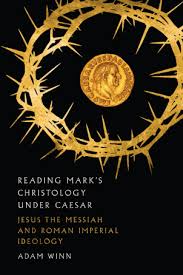
Mark’s Gospel has intrigued scholars for years. Or maybe it has confounded them. There’s a general consensus that Jesus is Messiah and that Mark is written against a Roman backdrop, but paths diverge from there. Adam Winn takes a stab at it arguing that Jesus as Lord directly counters Roman propaganda. He further posits that Christians would have read it as such in those days. Winn explains in his acknowledgments that this is his second pass on this subject. He wrote on the Christology of Mark in his doctoral dissertation and has since imbibed the contributions of his critics. To me, this work benefits from that mature reflection.

The Introduction possesses great value as a reflection on what’s been believed along with a perceptive analysis of trends found in the text of Mark itself. The secrecy motive, redaction studies, and other criticisms good and bad are well explained too. Fortunately, he unpacks his own approach, which gives you a good basis to take in what he will share over the course of the book.

In chapter one, he reconstructs the historical setting. That analysis is foundational as he sees Roman influence as a driving force in Mark. Chapter two develops the equally essential element of his approach as he explains Christological titles in Mark. You don’t have to agree with his conclusions about the individual titles to glean from the chapter.

The next two chapters trace this theme through the traditional lens of the powerful Jesus in Mark 1-8:21 and the suffering Jesus in Mark 8:22-10:52. In chapter five he returns to the secrecy motif through his Roman lens followed by one on Christology.

If you are familiar with volumes that attempt to provide a thematic analysis of a biblical book, you will find this book to be a good representative of the type. It may be a specialized subject, but it is one well done.

I received this book free from the publisher. I was not required to write a positive review. The opinions I have expressed are my own. I am disclosing this in accordance with the Federal Trade Commission’s 16 CFR, Part 255.
The Message of the Living God (BST) by Peter Lewis

book liv gos bst

Peter Lewis contributes this book in the Bible Speaks Today (BST) series. In addition to all the fine commentaries covering all the books of the Bible, there are several like this one that covers biblical themes. The approach to explaining these themes is still one of examining Bible passages. If you happen to be studying the doctrine of God, you might find this volume along with The Message of Creation by David Wilkinson and The Message of the Trinity by Brian Edgar to form quite a trilogy. In any event, this book on the Living God covers several key passages effectively.

The book is divided into three parts: God and His world with all Genesis passages, God and His people with passages over the rest of the Old Testament, and God in Three Persons with all New Testament passages. Believe it or not, that division is not stretched.

There are many outstanding expositions here, but I found the one entitled “Genesis for today” on Genesis 1 to be particularly perceptive. Several attributes of God are brought alive here. You’ll find many underlined sentences in my copy!

This book has great value because most volumes on this subject approach it in a systematic theology fashion. We sometimes need reminding that good systematic theology should come from Bible passages first.

I’m a fan of all the books in this series and mark this down as another title well worth your time.

I received this book free from the publisher. I was not required to write a positive review. The opinions I have expressed are my own. I am disclosing this in accordance with the Federal Trade Commission’s 16 CFR, Part 255.
Spirit-Led Preaching (Revised Edition) by Greg Heisler

book sp led pre

Most books on preaching, and I’ve read a lot of them, only give a cursory mention of the Spirit’s role in preaching. The better ones sometimes give a chapter. Besides a book by Tony Sargent on the preaching of Martyn Lloyd-Jones, I’m not aware of any book like this helpful volume by Greg Heisler that probes the Spirit’s role in preaching. Even the Sargent book, as awesome as it is, doesn’t guide us through the whole sermon preparation process step by step with an eye on the Spirit as does this book. I somehow missed the first edition of this work, but this revised edition was a blessing and a reminder to me.

Chapter 1 challenges us to see that the most vital element, the Spirit’s help, may be missing in our preaching. What’s worse is that we may not have even felt the loss! Chapter 2 probes exactly what Spirit-filled preaching is. That aforementioned loss may mushroom for you in this chapter. If you somehow slip through without concern through chapters 1 and 2, chapter 3 will bring you before the tribunal. Jesus, the Prophets, and Paul all clearly highlight the essentialness of the Spirit in preaching. That must be the standard for us as well. Since there’s little doubt of being all in at that point, chapter 4 works through the doctrine of illumination. Here the nuts and bolts meet the Spirit. We who love the Word, and the exposition of it, find how complimentary Word and Spirit are to each other in chapter 5.

Chapter 6 looks at the Spirit and sanctification. Here the preacher himself and the Spirit are in view. The next chapter takes the preacher again through the sermon preparation process from text selection to ready to preach again with the Spirit. Chapter 8 glides into sermon delivery with the Spirit. Chapter 9 is a breath of fresh air as it takes the Spirit to the congregation. The value of listening is even probed. Chapter 10 is something of a challenging summary.

I’m impressed with this book. Its contents are desperately needed in our day of programmed, sterilized preaching that would rather give pointers for self-improvement than deliver the Word of God that throbs with life and has the power of the Spirit to bring it to life for you. Every preacher needs a library of key books on the ministry. Make sure this book is in yours.

I received this book free from the publisher. I was not required to write a positive review. The opinions I have expressed are my own. I am disclosing this in accordance with the Federal Trade Commission’s 16 CFR, Part 255.

Delighting in the Trinity by Michael Reeves

book del trin.jpg

Mark this down as one of the best books around on the Trinity. Don’t let the fact that it’s written in a popular style cause you to believe that it’s inferior to more scholarly volumes either. Michael Reeves has put the Doctrine of the Trinity on the high perch it deserves and uses it as a springboard to comprehend our faith. If you don’t go into the reading of this book with Mr. Reeves’ conclusions, you will likely leave it that way. Along with all that academic value, you will have your heart warmed too. This book succeeds at every level.

Instead of giving a chapter-by-chapter overview, let me tell you some of the things that jumped off the page for me. He reminded me how persuasive the concept of God as Father is all across Scripture. He demonstrated that because the Father loved the Son, creation is about Him sharing His love! He explained how our triune God “is the sort of God who will make room for another to have real existence”. That observation even explains the presence of evil in our world.

There’s more! He reveled in the explanation of grace being more than God giving out of what He had—He gives Himself. The Lord created familial relationships, he said, to extend the fellowship He loves. Isn’t this enough to hook you? If not, check out his discussion of holiness. I saw in the Trinity more than ever that God loves me.

If I could only have one book to explain the importance and practicality of the Trinity, this book would be it. Call it indispensable!

I received this book free from the publisher. I was not required to write a positive review. The opinions I have expressed are my own. I am disclosing this in accordance with the Federal Trade Commission’s 16 CFR, Part 255.