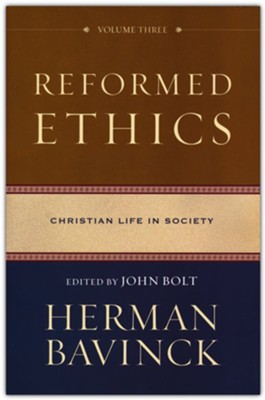
Reformed Ethics (Volume 3) by Bavinck

Fascinating! I’ve just never read anything before on the material covered here. I’ve read Bavinck, of course, but here he digs in with that penetrating style of his in a place I need led by the hand.

Somehow I missed the publishing event of this three-volume set and make my introduction through this volume 3. When it arrived, I laid other things aside and jumped in. You probably wouldn’t normally label an ethics book captivating. As good as Bavinck is, you might not call him captivating usually either as he is quite exacting in his approach. His gift is depth of content. What a mind he possessed and to read him makes you a learner. Still, I can’t believe how quickly I went through this work.

The bulk of the book is on “The Life Spheres in Which the Moral Life Must Manifest Itself”. As heady as that title is, the material distills a mountain of study and lays it at your feet in around 200 pages. Along the way, he covers family, the “duty” to marry (hadn’t thought of that), qualifications for marriage (who you can marry), betrothal and wedding, essence of marriage, and divorce.

Here’s why the book is so fascinating. He gathers all the Bible says and on some points the Bible says little specifically. He covers what Christian groups have thought from the most to least known. What you will discover is the lack of consistency among Christians. He is not so “dogmatic” except where he feels the evidence warrants it. He is honest enough not to just trumpet his opinion. He also shows how these ethics have often showed up in laws. It’s a bit tilted towards Dutch law, but that’s understandable as he ministered there. You will at least leave this book knowing what questions you must ask yourself.

The last third of the book changes direction. It addresses philosophical ethics first. I thought he was good at probing the subject, putting it in perspective, and making sure to not allow it to plow over the gospel. In the last part, contemporary morality is covered. You can decide for yourself how contemporary it is. In my view, we must at least wrestle with some of the things he brings up.

I want to consult Bavinck on any subject he covers. I may not agree, but I know I’ll be richer for reading it. Here he plows fields off the beaten trail, and I highly recommend it. 

I received this book free from the publisher. I was not required to write a positive review. The opinions I have expressed are my own. I am disclosing this in accordance with the Federal Trade Commission’s 16 CFR, Part 255.

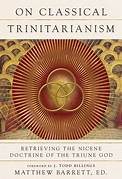
On Classical Trinitarianism–Edited by Matthew Barrett

The subtitle “Retrieving the Nicene Doctrine of the Triune God” tells what we have here. Forty authors giving forty articles covers that subject from every vantage point imaginable. The list of authors is something of a who’s-who as well. Still, it’s a book more likely to have one pick and choose which articles to read rather than reading cover to cover. It’s an incredibly learned resource.

It’s something of a polemic too. These authors are passionate for Nicene Doctrine, perhaps to a fault. I say that because you’d think that it would moor itself to Scripture first and then show how Nicene doctrine is true to Scripture. You would also think it would call for allegiance to Scripture rather than the writings of the Nicene Council. I think the case could probably be made, so why not make it? Here it was just assumed. Still, some of us feel that there are times that Greek philosophy has too much influence, and that viewpoint would never be accepted in this book.

Along the same lines, deep doctrinal understanding is assumed. A newer Christian trying to learn doctrine would not need to begin here. This book is for those already a bit seasoned in theology.

After those caveats, this book is a tremendous resource. There are so many articles that give such opportunity to wrestle with these great things. Several I read had some things that I would not fully agree with, but they gave excellent opportunity to hone my thinking. There were several articles that really interested me, and were quite helpful to me, addressing what has become the battle between classical trinitarianism and social trinitarianism. For the record, I would lean toward classical trinitarianism.

This book will be quoted for years. I simply can’t think of another book on trinitarianism that comes close to this volume in depth. It is a treasure trove of learning. If you can’t learn from this book, you aren’t even trying.

I received this book free from the publisher. I was not required to write a positive review. The opinions I have expressed are my own. I am disclosing this in accordance with the Federal Trade Commission’s 16 CFR, Part 255.
The Return of the Kingdom (ESBT) by Stephen Dempster

Here’s the latest in this delightful series on biblical theology. Several of the volumes take the same subject—the sweep of the biblical story—and tell it from a unique vantage point. So it’s Genesis to Revelation again, as always in this series it is in chunks, this time told from the standpoint of kingdom.

Perhaps more than other title in the series it tells the broader story more, and perhaps better, than that of its perspective—kingdom in this case. The book had so many interesting tidbits and theological nuggets with even a dash of helpful exegetical hints. In this volume, I’d especially glance at the footnotes if I were you.

On kingdom it was helpful. Many passages you’d expect are covered. I figured the messianic Psalms would get great coverage, but he clearly didn’t see them as essential to his discussion. Where, in the most critical omission, was Psalm 110? It seemed to me he presented more depth up to David, but was more streamlined thereafter. He saw Matthew as having its obvious importance in his theme, but could have developed it more.

He didn’t really touch Israel versus either the church or whether it was substituted, etc.. That’s a battleground for dispensationalists and covenant theologians. Most books written on kingdom would pick a hill to die on, but that wasn’t an intense theme for him. It’s obvious to me which side he is on, but he wasn’t as explicit as some in this series either. On the plus side, he was never condescending either.

I hope I haven’t made it sound like I dislike this book, or that it is a failure. It’s still a very pleasant and helpful read. It will give you a lot to chew on about biblical theology, even if I wouldn’t call it the most important book on the theme of Kingdom itself.

I don’t line up exactly where the writers of this series do theologically, but every book in the series, including this one, has been a great blessing to me.

I received this book free from the publisher. I was not required to write a positive review. The opinions I have expressed are my own. I am disclosing this in accordance with the Federal Trade Commission’s 16 CFR, Part 255.
God Dwells Among Us (ESBT) by Beale and Kim

This is an awesome series, but mark this one with the Edward Klink volume as my favorites. In the old battle of the trees versus the forest this one pulls off a coup by taking the trees to construct a grand forest. And oak trees at that.

Strangely enough, I almost thought it might be a dud. I mean where a new author (Mitchell Kim) takes the work of an old author ( G. K. Beale) and makes a new book from the old book just didn’t sound like a winning proposition to me. Why not just get the old book? After reading this work, I’m of a different mind. Either get both books, or get this one, but I’d recommend not getting the old book over the new one.

The old book (The Temple and the Church’s Mission: A Biblical Theology of the Dwelling Place of God) is a masterwork of its kind, but this one reads better…a lot better. Mr. Kim is not just riding the coattails of a seminal work, but he took the vitamin-filled book and made it tasty to the palate. At times, it even had its devotional moments. I learned AND I enjoyed it.

So the theme of Creation, or Eden, as the first Temple is quite familiar to me, but the connections made here were the most compelling I’ve seen. As the book traveled through the Tabernacle and Temple it revealed threads that I had frankly missed. The book reached a profound level for me when it got to Jesus. Especially the statements Jesus made about the Temple were far more packed with meaning that I realized. The final chapter on the New Jerusalem as the Temple was, without hyperbole, thrilling for me.

Only the chapter on Eden’s ministry fell flat for me. The interpretation for Revelation 11 just didn’t seem plausible to me. As with every title in this series, the authors swear by Covenant Theology. I don’t fully subscribe to that viewpoint, but some of these larger concepts transcend our typical divisions. We view from the mountain tops here.

Beale is a genius. Kim has the winsome writing down. Together they made this one is a gem!

I received this book free from the publisher. I was not required to write a positive review. The opinions I have expressed are my own. I am disclosing this in accordance with the Federal Trade Commission’s 16 CFR, Part 255.
The Giver of Life (WB) by J.V. Fesko

This second volume in the We Believe (WB) holds up the high expectations established by the first one on Christology. Most major Christian publishers have a series of this sort covering various doctrines that together form a systematic theology and this one so far is standing out in a crowded field.

This volume gets two of the key topics of such systematic theologies—salvation and the Holy Spirit. I judge it far more passionate on the subject of salvation than that of the Spirit. My guess is that the author gets consumed with the Spirit carrying out the application of salvation and that swallows the discussion at large. The discussion on the Trinity and, for example, the gifts, almost seemed tacked on to get to the heart of what he really wanted to talk about—salvation.

On other quick caveat is that this book is overtly reformed. I could almost jokingly say that it is more reformed than it is Christian, but not everyone might appreciate my humor.

With that out of the way, that passion he has that I spoke of is quite beneficial and enjoyable in studying salvation in all its glorious beauty. Mr. Fesko comes across as a captivating teacher. You of necessity will learn. Isn’t that the target we’re aiming for in this type of series? You will often love what he’s saying too, and when you occasionally disagree, you’ll at least have the consolation that he’s having a good time.

I have a system of jotting brief notes and page numbers in the front cover of books where what’s being written really resonates with me. I have 17 such notations in this one of things that really rang the bell for me. In case you’re wondering, that means this one ranks high for me. I’ll consult it again too—that’s another dead giveaway for me that we have a winner here. I wouldn’t make him your only guide, but this author is a teacher at whose feet you should spend some time.

I received this book free from the publisher. I was not required to write a positive review. The opinions I have expressed are my own. I am disclosing this in accordance with the Federal Trade Commission’s 16 CFR, Part 255.
Answering the Psalmist’s Perplexity (NSBT) by James Hely Hutchinson

Though the topics can be narrowly constructed, I’ve thoroughly enjoyed the NSBT series. Can you believe this volume is #62 in the series? Regarding narrowly defined subjects, perhaps this one is even more so. Because of that, this book may not find as big a round of acceptance as the others. When you are sixty-two titles deep into a project, you clearly have a homogeneous audience that can be easily described. So why do I feel perhaps that mutual admiration society might not hold up in this case? Well, it’s more, to be sure, the fault of the subject than the author.

He’s jumping into the covenant theology- dispensational theology divide. But he dives deeper still using a 7-model spectrum running from Westminster Covenantalism to Classical Dispensationalism. Though Models 1-5 are more on the Covenant Theology side and 6-7 on the Dispensational Theology side, you are still going to make six out of seven groups at least marginally unhappy.

Let’s give credit where credit is due—he lays out well the seven groups and is fair minded to those even farthest from him. He makes clear the whole Continuity versus Discontinuity that is the trendy way to lay out the issue. Continuity is God’s people (Israel and the Church) are mostly the same ties to Covenant Theology while Discontinuity separates them in distinct ways and ties to Dispensationalism.

Instead of stating Hutchinson’s viewpoint or my own, I’d rather mention the larger problem. His approach reminds me of walking into an opulent room and focusing on one immaculate lamp. It is a nice lamp, but what about that gorgeous mahogany desk? Must the room forever be oriented to the lamp? You mean I can’t talk about the couch or the ceiling tiles unless I speak in terms of the lamp? That’s the problem to my mind with either Covenant Theology or Dispensationalism. They are asked to explain more than they can. Their adherents see them as more a throne in a throne room, but I say they’re still a lamp. Nice lamps, ok, but not strong enough to bear the weight of the room. They explain something, but no where near everything. Less esoteric, less enticing to scholarly vanity, and more accessible to the common Bible believer, are ideas like Jesus, or say relationship between the Trinity and us. Make these ideas (I’ve learned much from all seven of the viewpoints while having some clear opinions on some of those issues) the condiments and Jesus the meal and what a feast we can have.

Let’s move on before someone gags on my review. The richness of this volume is to take the Scripture Index and use with all the texts he uses in Psalms. He can help with exegesis.

He’s a clear writer too. Surely we can do better than the term “New-Covenant Newness”, but he communicates his line effectively.

Agree with Hutchinson and you’ll love the book; not fully agree and you’ll see the boundaries more carefully; agree or not and use the exegesis for Psalms and you’ll be helped at least.

I received this book free from the publisher. I was not required to write a positive review. The opinions I have expressed are my own. I am disclosing this in accordance with the Federal Trade Commission’s 16 CFR, Part 255.
Creator by Peter Leithart

Wow! What a book! It was fascinating, enlightening, challenging, and it taught me. I must admit there were times I struggled. There were times I had to lay it aside and come back later. A few times I wondered if I were too dense and were in over my head. But I kept coming back and I am so glad did.

Where I kept running into problems was when I needed a bit more philosophy background than I had. If that describes you, do as I did and persevere. He’s going somewhere and will get back to the more comfortable surroundings of theology soon enough. If you will hang on, he will show that we have had a bit too much Greek influence on our theology and that has put us in scriptural quandaries. I was convinced.

Before I say more, I must admit Leithart is a brilliant writer. I do feel he pitched this volume to professional theologians (untranslated words are a dead giveaway). I wish he had veered toward about 20% more popular in writing style (I mean, how many professional theologians are there?), but the denseness was worth it still. I’ve read some of his more popular works and he is great whether you agree or not. He has original thinking in his works and he is profoundly and pleasingly provocative.

I’m not going to rehash the book here. Just experience it. For me, he tweaked my thinking on some of the attributes, particularly accommodation. Further, he opened my eyes to how crucial the idea of Creator is and made me understand my God even more. Finally, he blew me away in his discussion of time.

I tend to be a bit liberal with praise in my book reviews, but there’s no grading on a curve here. This is a great one.

I received this book free from the publisher. I was not required to write a positive review. The opinions I have expressed are my own. I am disclosing this in accordance with the Federal Trade Commission’s 16 CFR, Part 255.
The Hope of Life After Death (ESBT) by Jeff Brannon

This series is exciting! Had I been planning this series I might have overlooked resurrection getting one of the slots in it, but after seeing this title it makes perfect sense. Brannon makes his case for Resurrection being one of the “essential” themes of biblical theology. His fleshing out the link to Creation and Redemption only strengthen his case.

The book is clear and clear-headed. He is quite convincing in driving home his premise. Besides his love of quoting obscure lyrics of (popular?…I guess) music, he succeeds across the board.

To grasp resurrection he grapples with life and death. Relating that to Creation and the Fall was the proper foundation while building with redemption (New Creation) and Resurrection (Eternal Life) was the right edifice to build upon it. A lot has been written on these themes but his niche is a clarity that comes from a careful presentation.

He also traces his theme to good effect in biblical order. Watching a doctrine develop progressively is one of the best ways to take it in.

As you can imagine, he address Christ’s resurrection and does so by building into his rich tapestry. From there he weaves in the church before reaching our final resurrection.

What’s amazing in a book like this is taking one doctrine to examine them all. Biblical theology is really rocking when that really happens. It happens here.

I received this book free from the publisher. I was not required to write a positive review. The opinions I have expressed are my own. I am disclosing this in accordance with the Federal Trade Commission’s 16 CFR, Part 255.
Treasuring the Psalms by Vaillancourt

A treasure itself! Vaillancount is expert in biblical theology and the Psalms are indeed rich in that way. For some reason, I see this as a fine addendum to James Hamilton’s fine commentary on the Psalms in the EBTC series.

His Introduction whets the appetite for more and more is what we get. His chapters on reading Psalms canonically, as are what follows, are outstanding as they abound in both Structure and Theology. Throughout the text, specific psalms pop up and though he writes on a perceptible track you might not anticipate which psalm comes next. Fortunately, the scriptural index at the back of the book opens up this work to a whole additional approach. There’s good exegesis wherever he comments. You just can’t lose here.

Really, he opens up many pathways that you can begin and go even farther. When I do deep study on the Psalms, in addition to some favorite commentaries, I assure you this book will be in my “special” pile. This is the kind of book you don’t want to be without.

I received this book free from the publisher. I was not required to write a positive review. The opinions I have expressed are my own. I am disclosing this in accordance with the Federal Trade Commission’s 16 CFR, Part 255.

Holiness: A Biblical, Historical, and Systematic Theology

This book was not what I expected. Let’s just say that it isn’t J. C. Ryle 2.0 for sure. No, it was something else. Since I already own Ryle, though, maybe that’s a good thing. To be fair, I just didn’t read the blurbs carefully enough because it was exactly what it professed to be. It’s holiness from the Wesleyan tradition. Since Wesley’s day they’ve been joined at the hip with their teaching on holiness. To be sure, these authors have laid out a cogent case for their perspective. Agree, or like me, not, you will learn much in this passionate, yet respectful work.

There’s a bonus here as well. I love big picture biblical theology. The first chapter was incredible and could hold its own with any biblical theology works (and I’ve read a lot of them). Since the Pentateuch is so foundational to biblical theology, this chapter is key. Holiness is covered, but there’s so much more. Two more chapters finish the Old Testament.

Part Two covers the New Testament and as you probably can guess Paul’s writings are where they make the heart of their case. Here many will disagree, but at least they so clearly make their case.

Part Three takes holiness through church history. You can decide for yourself if it’s on target or skewed.

The final section traces holiness through the whole of systematic theology before turning practical in “the when and how of holiness”. I find the most sympathy with “the longer way”. Taking the whole as a call to maturity means the work is even not bereft of devotional value.

To those who follow the Wesleyan tradition, this must be a jewel. To rest of us it’s a window to look in. Perhaps we do not agree, but we must tip our hats. This is a good book.

I received this book free from the publisher. I was not required to write a positive review. The opinions I have expressed are my own. I am disclosing this in accordance with the Federal Trade Commission’s 16 CFR, Part 255.