Wonder what they will say? That was my first thought when I saw this title by Christopher Morgan and Robert Peterson in the NSBT series. The glory of God is a concept that you think is self-apparent, at least until you try to express it. Then circular definitions and hollow platitudes roll off your lips. To be truthful, this title upon hearing of it didn’t excite me as some in this series, but equally in truth, I am excited to think upon what it showed me. The glory of God is a subject, as shown here, that pervades Scripture and clearly must be crucial to understanding our God.
The first two chapters take you to school on the glory of God. The various ways scholars define it is brought out, not just to ascribe scholarly labels, but to reason through to real understanding. Explaining God’s glory as being both intrinsic and extrinsic was the apex for taking the reader to mastery of the subject. This section was so worthwhile and revealing.
The reason the title of the book adds “and Paul” is because in the subsequent chapters the concept of the glory of God is fleshed out in the epistles of Paul. The theology and the exegesis of specific passages seemed spot on.
The variety and quality of this series always impresses as is certainly the case here!
I received this book free from the publisher. I was not required to write a positive review. The opinions I have expressed are my own. I am disclosing this in accordance with the Federal Trade Commission’s 16 CFR, Part 255.
The NSBT series marches on with this interesting look at the significance and theology of Ezra and Nehemiah. The NSBT series is truly a random series, but the volumes are often fascinating. We never know what is coming next in the series, but we’d be remiss not to find out. Dean Ulrich does good work here.
The title Now and Not Yet suggests the track the book will run. That thought that is found in many prophetic writings here tells of a new chapter for God’s people that will more fully climax in Christ. Many are reluctant to develop that line of thinking in the scholarly world, so we appreciate the openness here to embrace it.
Throughout this book we are confronted with Ezra-Nehemiah as if it were one book rather than two. He makes a good case and at the least it does no harm to study with that design. Though I enjoyed what he gave us, I wish he had developed the structure even more.
Chapter two well explained the big picture of biblical theology. Chapter three explained the history of the return from exile but the nuggets were all in the theology developed.
In a creative turn, the next three chapters address rebuilding the temple, rebuilding the people, and rebuilding the wall. That told the story in a framework that allowed the theology to bud. Chapter 7 shows what worked and what fell short. There his now-and-not-yet theme fully bloomed.
Isn’t it wonderful that these NSBT volumes keep coming along? I want them all, don’t you? This one is a sample of why.
I received this book free from the publisher. I was not required to write a positive review. The opinions I have expressed are my own. I am disclosing this in accordance with the Federal Trade Commission’s 16 CFR, Part 255.
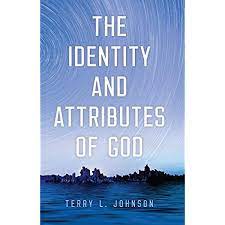
I must best describe this book as pure joy. I’d heard good things about it, but had been warned that it is heavily imbibed with quotations. To my mind, that usually doesn’t work. In those cases the author seems more of a compiler than a writer. I wondered going in if this would be more of a good reference than a good read. The more I read, the more my weak expectations were proven wrong.
The book is full of quotations, so how did the author pull it off? By picking the very best quotes, by seamlessly weaving them into the work, and by then writing thoughtfully around them. In the end, you get rich theology for your mind and warmth for soul. This is not a compilation. This is a book!
This book doesn’t address ever attribute, but covers some of the most important ones to ingest. After a discussion of God, the Trinity, and what the incommunicable attributes are, those of God as Creator and of His providence are brought to light. One of the best sections was holiness. Another favorite was goodness. I gained so much from it. The one on love started slower but really pierced my heart by end.
The book ends abruptly, but the author has delivered another volume on other attributes from another publisher.
You’ll see a pastor’s heart and a theologian’s precision throughout your read of this precious book. If this book doesn’t help you, I doubt you’re even trying.
I received this book free from the publisher. I was not required to write a positive review. The opinions I have expressed are my own. I am disclosing this in accordance with the Federal Trade Commission’s 16 CFR, Part 255.
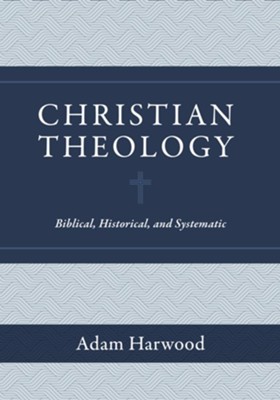
Here’s a new Systematic Theology that fulfills a distinct need on two fronts. First, it’s a bit more manageable than most systematic theologies without sacrificing the needed depth. Second, it’s from a distinctly Baptist perspective. In that vein, it doesn’t follow the Calvinistic approach that clearly dominates the systematic theology market. That difference means you get more perspective as several other popular volumes are so closely aligned as to render some redundant.
There’s also a unique presentation here that allows one new avenues of thinking. As I was reading, I was struck with how this material was obviously honed through years of interacting with students. Every section was quite approachable and useful. Only in the section on Last Things did I feel he left some questions unanswered, or at least gave a briefer treatment.
Who would benefit most from this book? Pastors will appreciate it for sure. It would also be a boon to one embarking on their first attempt at a really deep, thorough study. Several other such volumes might sink your studies by their opaque style, but that is not the case here. Even if you can handle those volumes, this one still gives a different perspective like I mentioned before that makes it still particularly valuable.
I keep a stack of 3-4 systematic theologies always close by. This one will join them on that often-used pile.
I received this book free from the publisher. I was not required to write a positive review. The opinions I have expressed are my own. I am disclosing this in accordance with the Federal Trade Commission’s 16 CFR, Part 255.
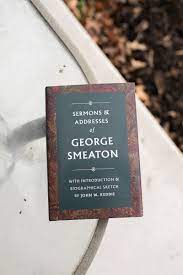
Here’s an attractive new volume by popular older theological writer George Smeaton. You probably are aware of his influential writings on the Holy Spirit and the Atonement that have been around for 140 years. In this new release sermons and addresses are collected and presented to us in one book.
The book begins with a fine biographical sketch by John Keddie. This is particularly valuable since there has been so little written on Smeaton. Since there’s so little for Keddie to draw from, there’s much more on his career than his personal life. His ministry and theological writing are well described as well as several theological controversies of his time that he was involved in. Next, the Introduction gives a few details on these sermons and addresses. What is unique about these addresses are how they really add to a biographical understanding of Smeaton themselves.
The first five are excellent sermons that have both an exceptional theological basis and a clearly experiential side. The next two look at the profound revival of his time. The one “The Improvement of a Revival Time” makes you pine for what we know so little of. The last several are excellent yet give good historical background and strong encouragement particularly for preachers.
This beautiful hardback is the perfect setting for these writings. I think you’ll like them.
I received this book free from the publisher. I was not required to write a positive review. The opinions I have expressed are my own. I am disclosing this in accordance with the Federal Trade Commission’s 16 CFR, Part 255.
Linking the Transfiguration of Christ to our transformation as believers in Christ is intriguing to say the least. I’ll confess that I never thought of the connection before I came across this book. The connection isn’t fabricated as both spring from the same word in the New Testament.
In a Preface entitled “A Biblical ‘Metamorphosis’”, Jones takes the time to prove linguistic connection and explains why it might be a rich vein to mine. Then the book divides into two main parts taking the Transfiguration and our transformation in turn. At first, I thought his presentation of the Transfiguration began slowly. As I came to realize, he was laying a solid foundation. Perhaps some issues he addresses are not ones you’d ever be concerned with, but he seems determined to counter all criticisms and restore what should have always been a lofty status. As he proceeds, the discussion grows much richer.
When he switches to transformation, rather than addressing critical challenges he reorients to theological challenges. Again he builds his foundation slowly, but really builds on the framework of regeneration, sanctification, and glorification. Whether you’d agree with his theological viewpoint or not, it’s the discussion of individual passages that address transformation that renders the most aid to our contemplation of transformation.
This book addresses more scholarly concerns than I am used to seeing in a BOT volume, but it is an interesting study. I always appreciate someone who can open the Bible and show me something I have never put together before. That is what happens here.
I received this book free from the publisher. I was not required to write a positive review. The opinions I have expressed are my own. I am disclosing this in accordance with the Federal Trade Commission’s 16 CFR, Part 255.
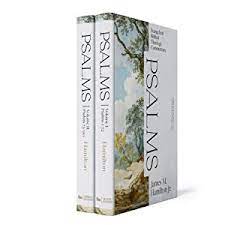
Mark down these two volumes on Psalms by James Hamilton Jr. as my new favorite in this newer Evangelical Biblical Theology Commentary (EBTC) series. Strangely enough, in this series that emphasizes theology it isn’t the theology that makes me rate it so highly (though the theology is excellent), but the overall approach to the Psalms themselves. In short, he sees an overarching structure and unity that presents a purposeful, carefully planned presentation rather than a loose collection with no more interconnection than a hymn book. You know how a hymn book works—each new edition drops a few songs while adding others with no loss other than if the changes involved your favorite song or not. There’s no overall theme to affect. Hamilton doesn’t want us to see the Psalms that way. I’m convinced he’s right.
More than the proclamation that the Psalms are a unity and interconnected, the details that Hamilton marshals and presents are profound. As you read, you catch yourself saying, of course that’s right! You might might disagree on a few details but there are too many to dodge. I’ve always felt this must be true of the Psalms and how I enjoyed reading the labor shown here to work it out.
There’s a second reason to love this commentary. It stands above the pack in an even more fundamentally important category. I’ve had the privilege to review many commentaries and have had occasional opportunity to declare that a particular commentary presents well-argued conservative conclusions. On a high level that’s true here too, but there’s more. I can’t recall ever reading such an impassioned exhibition in a major commentary series for the necessity of seeing Scripture as the inspired Word of God. Scholarship frowns too often on childlike faith and so even many scholars who possess such faith write as if they hear the eggshells breaking under their feet. They write in a subdued manner as if someone might show up and make them sit in the corner, or worse, call them out as not a REAL scholar. Hamilton didn’t take that defensive position. Let’s just say he was on offense and turned the discussion on its head so much so that it’s those other scholars who can take their place in the corner. What a breath of fresh air! He wasn’t brash, but he just brought the discussion back into the light of day. We hold a book in our hands that is a production of the Almighty. How can we believe less than what he shared here? How did scholarship lose sight of the big picture? I have the highest admiration for what I read here.
Everything else was on target in this commentary. The exegetical depth of the comments are as far as the parameters of the series allows and give real help. Why should I say more? You can already tell these two volumes are 5 star all the way to me.
I received this book free from the publisher. I was not required to write a positive review. The opinions I have expressed are my own. I am disclosing this in accordance with the Federal Trade Commission’s 16 CFR, Part 255.
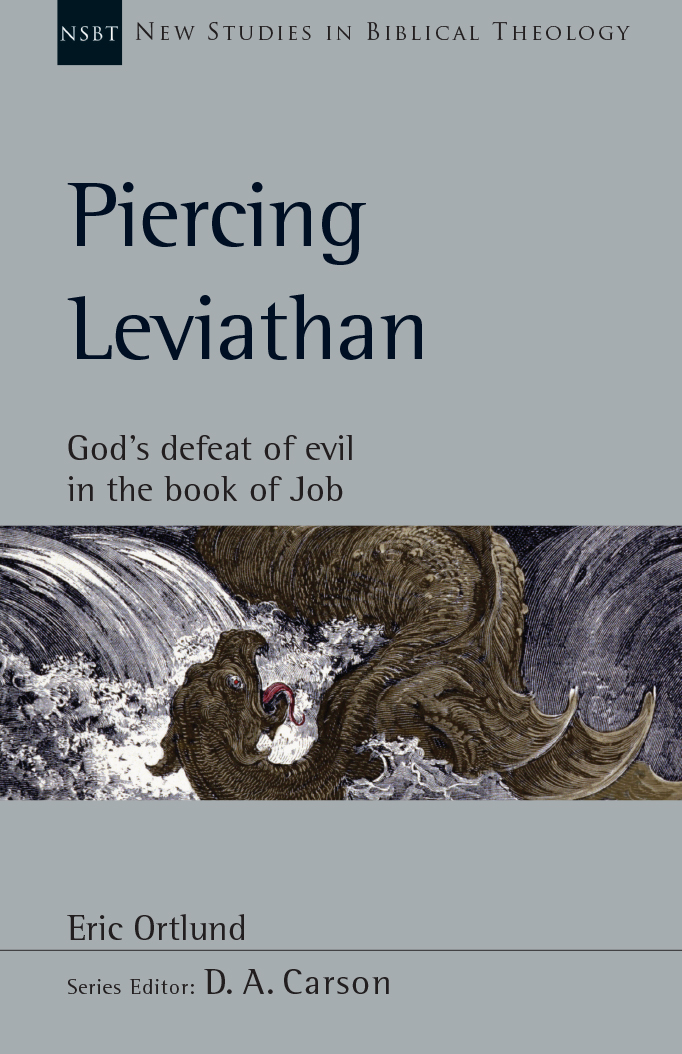
It is often said to not judge a book by its cover, but in the case of this new volume in the NSBT series, I suggest you not judge it by its size either. It’s worth many books five times its size! It has something to say and it says it well about the enigmatic character of Job. Our reactions to the story of Job fluctuate between fascination and fear. The book of Job asks the questions we have all wanted to ask, and yet we’re almost afraid of the answers. Especially if the answer is not in the form that we want it. And especially not if some of the mystery remains after the Lord reveals what He is willing to share. Because of the uniqueness of the book of Job, many people interpret it any way they like as long as they acknowledge that some mystery remains. The book of Job pushes us to the edge of these deepest questions until we finally grapple with how there is evil and suffering in a world formed and controlled by our God.
Before I attempt to describe the contents of this book, I must offer an admission that the author did not answer all the questions about suffering and evil. The book did, however, tell me more about my God and made me feel better, even hopeful. I remain baffled about some of the suffering in my own life, but I feel more at peace reading this book. You never expected I would say that about a book written in a scholarly series, did you?
Just because I found such personal value in this book, don’t think for a moment that is not written with top-notch scholarship. The scholarship is present, but the stiltedness is not. I don’t think you’ll ever drift off to sleep reading this book and yet you will learn just as much as you will learn in any other scholarly effort. The contents of the book proceed chronologically through the book of Job making many observations and conclusions before a grand theological conclusion is drawn at the end.
In fact, this book succeeds in two different categories. You could place this book with your commentaries on the book of Job and you could easily follow the line of thinking of the book and have a much better chance at arriving at proper interpretation. Additionally, as you might imagine in a series of this sort, you could put this book with your theology books as it does have something to contribute to these dogged questions of theodicy.
I almost feel like if I said more about what you learn in this book I would have to put out a spoiler alert. You will learn about Behemoth and Leviathan, and the often-accepted descriptions of hippopotamus and crocodile, but you will learn of cosmic chaos and evil as well. Perhaps you will be like me and when you finish this book you will say to yourself, now that is what the book of Job is really saying.
This erudite work trades in profundity and joy. That is not easy to do, so you should treat yourself to secure this book today.
I received this book free from the publisher. I was not required to write a positive review. The opinions I have expressed are my own. I am disclosing this in accordance with the Federal Trade Commission’s 16 CFR, Part 255.
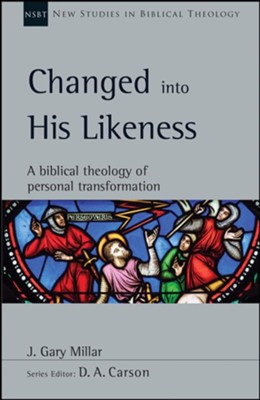
This new release in the New Studies in Biblical Theology (NSBT) stands out among the other volumes in the series that I have reviewed. There is still much scholarly research as well as a host of biblical passages exegeted that I’ve come to expect in this series, but the scope of the subject isn’t as narrow as that found in most volumes. Most surprisingly, too, there is at times what could be used devotionally to be found. Not at the expense of scholarship, but in addition to it. In that sense, it’s quite rich. Maybe this isn’t so surprising after all, as how can you study personal transformation biblically without it turning personal?
The introductory chapter examines what we mean by transformation by looking even at prevailing trends in psychology regarding it. That discussion was nothing short of fascinating and reinforced why we’d better turn to the Bible to see what it has to say on the subject. The next chapter turns to biblical anthropology regarding personal transformation and defines key terms like “heart”, “mind”, “soul “, etc. I was impressed again.
The third chapter scans the Old Testament for personal transformation. The approach mostly takes key characters and states (overstates?) his appraisal of the biblical data. The level of digging into these beloved figures was in no way shallow, even incredibly perceptive at times, but was almost depressing as he was trying to make his case that there was little personal transformation there. He moved my thinking a little but I believe a much stronger positive case could be made than his gloomy analysis. In the next chapter, as he surveys the New Testament, he goes the other way and becomes especially positive on personal transformation and perhaps overlooks a few hiccups in those characters lives. I wonder if his covenantal theology guided him overmuch. Please don’t think I’m downgrading the overall depth and quality of his work, but let’s just say that he is not one of those scholars who’s afraid to persuasively present his conclusions!
Chapter 5 was a masterpiece. He took theology as expressed by key theologians and crafted an exquisite theology of personal transformation. You would never guess in the chapter’s opening paragraphs when he tells you of three broad groups (inner life/ Augustine & Edwards, Christology/ Calvin, piety/Owen) what a profound reading journey you are about to take. Other theologians are mentioned, but the synthesis and collation of theology are where he soars. As I read, I was finding myself agreeing in many ways with all three positions. So did he. My only criticism, and a mild one at that, is that he sometimes switched from biblical theology to trying to ascertain the official Reformed position as if it never crossed his mind that anyone outside a reformed persuasion would read his work.
The book concludes by drawing out the biblical conclusions articulated by some master theologians and reflecting on key biblical passages. His conclusions all make sense to me—as a Bible student and a Christian sometimes sad my transformation hasn’t been more profound. Personal transformation, even biblically, is complicated, but maybe less so after reading this book. Without doubt, this one is a keeper!
I received this book free from the publisher. I was not required to write a positive review. The opinions I have expressed are my own. I am disclosing this in accordance with the Federal Trade Commission’s 16 CFR, Part 255.
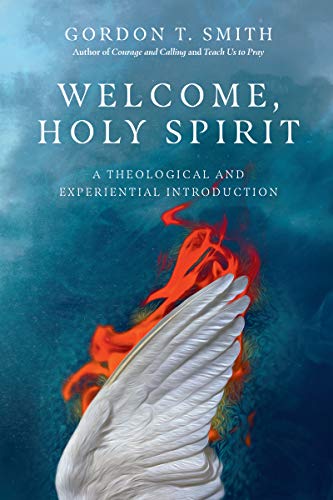
Hardly any theological subject has such diverse writings than those addressing the Holy Spirit. Pick up the first five or six books on the Holy Spirit that you come across and as you peruse them you may wonder if they are even talking about the same subject! Who the Holy Spirit is, what His importance is, how we should view Him, how we might imbibe Him into our lives, apparently, finds little agreement among Christian people. If nothing else, that suggests that there is need of thoughtful works on the Holy Spirit. Enter here Gordon T. Smith as he throws his hat into the ring.
To be honest, I had more trouble than usual in deciding how to rate this book. My trouble is that on some pages there is the most remarkable theological insight while on others I found myself asking the question, are you kidding? Though I had trouble, I think I might suggest how you can know in advance whether you will like this book or not. I’ll assume that you want good theology, so the whole thing hinges on how ecumenical you are. Are you convinced that being ecumenical is the most important thing in this day? You will love this book. If you are skeptical of being too ecumenical, then, perhaps, not so much.
I wasn’t very far into the book as I was enjoying some of his theological insights before I was thinking in the back of my mind, wow, this guy is really ecumenical. To be honest, he went fullbore in the last two chapters. Let me give an example. In the last chapter he commends the Presbyterian Church of Canada for coming up with “an extensive theological framework for engaging expressions of aboriginal spirituality including especially those that were typically of indigenous prairie belief systems.” He listed things like “the pipe ceremony, the sun dance, the powwow, the sweat lodge, the medicine wheel, and the smudge ceremony.” A little later on he made a wonderful statement that, “we must, of course, be radically Christocentric and orthodox – intentionally Trinitarian.” I love that last statement! But how could the earlier statement not be a direct contradiction to it? To be fair, he gives a detailed explanation of his reasoning. It didn’t add up to me. In my view, he went a field too far, or maybe two or three fields too far. Again, if you think being broadly ecumenical is the best way to advance the gospel in our day, you may find this riveting.
To try to give the full picture, he does write with an engaging style and comes across as likable. He doesn’t overly talk about himself, but there are a few clues that give you insight to him as a person. He grew up in a charismatic setting. He currently is part of the Christian Missionary Alliance. Along the way, he came to value liturgy too. Maybe that explains why he has more than average desire for everyone to respect each other, but I diverge with him when he says to fit their practices into orthodoxy. Respect is one thing. Syncretism is another.
Though his ecumenicalism was a glaring fault in my view that even weakened the book, I must admit still enjoying some of his theological observations. I usually read with a pencil in my hand and in the front of the book I will write the page number of special pages that really spoke to me. I just checked and I had 14 such pages notated and that is a little above average for an 180-page book. The aforementioned faults notwithstanding, this isn’t the usual fluff that clutters bookstore shelves on the Holy Spirit.
I received this book free from the publisher. I was not required to write a positive review. The opinions I have expressed are my own. I am disclosing this in accordance with the Federal Trade Commission’s 16 CFR, Part 255.



 The Reagan Review