Searching For Tom Sawyer–Help Keeping Boys In Church

“How parents and congregations can stop the exodus of boys from church” reads the subtitle and sums quite nicely the theme of “Searching For Tom Sawyer” by Tim Wright and published West Bow Press. You read much these days about how men are shunning the church, and even some about what we might do to make our churches more palpable to men. This volume looks to solving the problem before it begins–with boys.

Mr. Wright begins by presenting a solid case for males and females having distinct differences designed by the Lord, even though both are of equal worth to Him. He repines our culture’s mistaken emphasis on sameness at the expense of differences. These differences must be considered if we are to have a church that reaches men and women.

He even digs into the differences in how our minds are wired. Boys develop a little slower than girls and most Sunday School classes are geared more toward girls. Girls begin reading earlier so boys naturally don’t like getting called on to read and be embarrassed in front of those same girls. As time goes by, boys are by their Creator’s design likely to squirm and hate being forced to sit still. Again, we often set things up this way. So, boys start hating church at a very young age. The author makes some suggestions about setting things up differently. Whether we would exactly follow his instructions or not, these are issues worthy of much thought.

I appreciate that in his recommendations he discusses lower-cost ideas for those of us who don’t have massive budgets. The model of mega-wow factor simply won’t work for us all. The book ends with a few sample lessons designed to appeal to boys.

Our culture almost seems embarrassed by manhood. No amount of indoctrination, however, will ever remove how God made us. It is particularly ridiculous to organize church against what we know to be true! This is a helpful book that we should consider carefully.

I received this book free from the publisher. I was not required to write a positive review. The opinions I have expressed are my own. I am disclosing this in accordance with the Federal Trade Commission’s 16 CFR, Part 255 .

Related Post:
Why Men Hate Going To Church why men hate going to church

20130817-184134.jpg

Coffee With Jesus–A Book Review

Here is a book to aid with your devotions. It is written by Lucinda Berry Hill and published by West Bow Press. It is designed to be used over the course of 52 weeks. You have an original poem by Mrs. Hill and a corresponding Scripture. Obviously, this isn’t made to be the whole of your devotions, but a supplement to it. She wants to bring inspiration to your devotions.

Not every one gets into poetry I know. Others find great inspiration in it and have favorites from the years. If you enjoy poetry at all, I recommend this book to you. I met Mrs. Hill on social media and she is always a kind, encouraging person there. The book comes with scriptural and topical indexes as well to help you find something for the occasion. She has been writing poetry for years that has been read on special occasions and even run in the newspaper.

20130804-094317.jpg

House Church?

Over the last few years we have seen a trend of more people having what they call a “house church”. I’m not referring to what is referred to in Romans 16:5:

Likewise greet the church that is in their house. Salute my well-beloved Epaenetus, who is the firstfruits of Achaia unto Christ.

In that case they had church in the only place they could meet and it happened to be a house.

No, I’m talking about this idea that I can’t find any church pure enough for me and mine, so my house is my church. That would have its perks—scheduling family and church activities would be rather easy when the only schedule I would have to consult is my own. If I didn’t finish preparing my message and it is only my family, how easy would it be to watch “The Andy Griffith Show”. (Perhaps some episodes of that show would be better than some of the messages I’ve preached, but that is beside the point).

What is lost in this discussion is the idea of corporate worship. The Lord did not intend that everything in your life in regards to Him be in private. That’s a modern invention. Here’s a Scripture that might have escaped your notice. Deuteronomy 12: 17-18 says

Thou mayest not eat within thy gates the tithe of thy corn, or of thy wine, or of thy oil, or the firstlings of thy herds or of thy flock, nor any of thy vows which thou vowest, nor thy freewill offerings, or heave offering of thine hand: But thou must eat them before the Lord thy God in the place which the Lord thy God shall choose, thou, and thy son, and thy daughter, and thy manservant, and thy maidservant, and the Levite that is within thy gates: and thou shalt rejoice before the Lord thy God in all that thou puttest thine hands unto.

The phrase “within thy gates” means at your house. There are some activities that should take place at God’s House. No amount of verbal acrobatics will nullify what the Lord says.

This is nothing more than a repackaging of the old I’ll-have-church-in-nature routine. You know, I worshipped the Lord Sunday morning at the fishing hole. How does that work? Is there some spiritual way to hold the pole or bait the hook? I think of the Lord when out in nature too, but does that replace His call to corporate worship?

This all springs from a misunderstanding of all the Lord had in mind when He gave us the local church. Part of the idea was that there should be other Christians in it besides me and my family. Hopefully my family is already encouraging me and surely they are praying for me. I need more prayers, more encouragement, more of the Word than I can have at my house alone. Then there is giving and reaching out and the local church is what the Lord has designed for this very thing.

It’s not about that building, but we need that body of people in our lives. We need a local church.

20130729-111633.jpg

A Forgotten Regulation

It’s one we don’t think about. I imagine you haven’t heard a sermon on it in a long time, if ever. It first came up in Deuteronomy and was re-emphasized a few times in the New Testament. More importantly, it has incredible potential to keep you and me out of deep messes. We can hardly imagine why it is important at all, but it got enough mileage in Scripture to show us the Lord thought it a worthy concept.

What is this mysterious and forgotten regulation? The requirement that we have two or three witnesses to establish the validity of a word or matter (Deut. 19:15) is the one that needs to make a comeback in our generation. Think of how we establish a matter. We accept a whisper, we seize a rumor, and the worse the report the sooner we believe it. We so believe it that we feel it such an established fact that we have the right to tell it far and wide. Such is the genesis of broken friendships, wounded hearts, assassinated reputations, and of course, a sin itself. This doesn’t even cover the fact that it is blatantly unchristian and repeatedly forbidden.

The Lord knew what He was doing when He gave us this regulation. He knew conflict would arise among us and He knew we might not always play fair. So He took precautions for us. It protects us from both directions. On the one hand, it’s so easy for someone to make up a charge in a moment of vindictiveness, or at least so exaggerate the situation that it no longer resembles what actually happened. If there’s a requirement of two or three witnesses, unless they conspire together, it will rule that out. At the very least, it will greatly lower the chances of a false accusation getting through. This makes a great principle obvious. Don’t form opinions by the word of one person, even if a good one, because you never know what complications in life may color his or her judgment. Also, we should check our own conclusions by those of others because it’s so cheap and easy to form a harsh opinion. You can check and see if others you respect have the same opinion.

Secondly, this can lead us through church troubles. Such crises usually denigrate into who can garner the most support as if it were but a popularity contest. But, praise the Lord, we don’t have to settle matters that way. I look for two or three witnesses, and if they are not available, I turn it over to God. Isn’t this what Matthew 18:15-20 is all about? Then personalities are irrelevant and we have a clear path through the mess.

There’s something to this two-or-three-witnesses thing. Do you suppose it has something to with why we are sent out two-by-two to witness of our Lord?

There is a lot of junk in this sin-cursed world. Perhaps, though, there wouldn’t be quite as much if we would but remember a carefully-defined, yet mostly-forgotten, regulation our Lord gave us long ago.

I first posted this on Partners For The Gospel

20130726-173459.jpg

Did The Devil Make Me Do It? –A Book Review

How would you like a down-to-earth volume that would make sense of the Devil and demons? One without bizarre extremes but still fully believed in demonic reality? Then you need this volume by Mike McKinley and published by The Good Book Company in its Questions Christians Ask series.

He gives background on the issue and even tells how African Christians laugh at Westerners who disbelieve the reality of demons. He strikes the right balance between understanding what we need to know about such things without getting obsessive or too deep into it. He respects that The Lord has told us what we need to know and asks us to be simple concerning evil beyond that.

He tells us of the origin of Satan and explains the names of Satan. He describes him as trying to destroy God’s creation as his vigilant motivation. He outlines the tactics Satan uses against us while remembering that the Devil is not all-knowing.

He talks about what he feels demon possession really is, and he distinguishes it from mental illness. Demonic strongholds are discussed without them seeming as insurmountable as some present them. He offers sane advise if you feel you come in contact with demonic activity.

The book is helpful and aimed at laymen. I might disagree on a few small points, like his
explanation of Isaiah 14, but I still recommend this volume.

I received this book free from the publisher. I was not required to write a positive review. The opinions I have expressed are my own. I am disclosing this in accordance with the Federal Trade Commission’s 16 CFR, Part 255 .

20130714-220138.jpg

Books On The Ministry #5

photo (3)

While so many older books offer classic, timeless help for those in the ministry, that in no way precludes the fact that some homerun volumes are still coming out today. I would like to share three that I have read recently plus two from last year:

1. Under The Predictable Plant by Eugene Peterson

His subtitle “An Exploration in Vocational Holiness” tells us where he is going in this incredible book. He uses the story of Jonah to chart a course for us where Jonah’s struggles show us the pitfalls before us today. He guides us to see that we have a well-defined vocation if we could cast off the fog of the world that would re-define it if we would allow. In a majority of pastors, sadly, this switch has already robbed us of our calling.

He nails it when he tells us our marketing mindset has run off the spiritual. We attempt a spiritual vocation without the spiritual and we were doomed from the start! Following modern trends he equates to idolatry. He says, “Our actual work takes shape under the pressure of the marketplace, not the truth of theology or the wisdom of spirituality.”

He takes needed shots at performance-based ministry. There he says, “The taste for God is debased into greed to be God. Being loved by God is twisted into a lust to God-performance.”

I love how he relates flashy Tarshish to the ministry of today as many perceive it. But he explains: “ …pastoral vocation is not glamorous vocation and that tarshish is a lie.” If this gets out, many may leave the ministry if they can’t squeeze glamour out of it! In fact, in every place possible he reminds us of how human congregations really are.

There is so much more and he relates how he learned some of this the hard way in his own pastorate. I plan on getting other Peterson books on the ministry!

  • 2. The Sacred Wilderness of Pastoral Ministry by David Rohrer

Here is a book that seeks to remind us what the pastorate is really all about as we live in a world where pastors have lost their way. As he says, “We have a gospel to preach.” He uses John the Baptist to share these concepts with us. He places an emphasis where it should be: we are “preparing a people for the presence of the Lord.”

He warns against turning into a pretender. He says, “… we occasionally fall prey to those insecure moments when we allow the approval and disdain of our congregations to define us. When this happens, our goal in ministry degrades into making people happy or avoiding their wrath.”

When he writes about conflict, he gives great help. He shows that we often blow it because we see the conflict as against us personally and not against the Lord. That error will greatly raise your stress level.

He ends asking us if we can be like John and let it be only about Christ. This is likely the worst mistake we could make to fail here. He also says, “Yet humility allows us to acknowledge that neither the complimentary accolades nor the derisive criticisms are ever the final evaluations of our ministry.”

This is a great book!

3. The Six Deadly Sins of Preaching by Robert Reid and Lucy Hogan

I’m amazed this book is so good. I imagine I would disagree with the theology of these two writers on many points. Still, it holds we who preach to account and is incredibly convicting.

It will be enough to entice you for me to list these six sins:

The Pretender (The Problem on In-Authenticity)

The Egoist (The Problem of Self-Absorption)

The Manipulator (The Problem of Greediness)

The Panderer (The Problem of Trendiness)

The Demagogue (The Problem of Exploitation)

The Despot (The Problem of Self-Righteousness)

The sad part was that I felt traces of myself in almost every one of these! I suspect churchgoers would love for all of we pastors to read this volume!

4. Dangerous Calling by Paul Tripp

Every pastor needs to read this book. He pierces us until he gets our hearts. This book brought major conviction to my life.

Read here for a fuller, earlier review I did.

5. Leading On Empty by Wayne Cordeiro

Here was another book that met a personal need for me. Read it to be prepared for burnout that may come, or run and buy it if you already feel it.

Again, read here for an earlier review.

More in Series:
You can find all posts and books reviewed in this series in the Introductory Post.
<a title="Books On The Ministry #1" href="http://reaganreview.wordpress
.com/2013/06/20/books-on-the-ministry-1/” target=”_blank”>Introductory Post

Previous Post

Next Post

The Two Main Paths of Temptation – Idolatry and Legalism

Temptation

The written record we have makes it clear. Our life experiences confirm it in every instance. We are swept from God’s way at any given point from one of two streams of thinking. We either are bewitched into idolatry by our desires or we are escorted into legalism by our pride.

I realize sins themselves can be categorized into sins of the flesh or of the spirit, but I refer to where these sins come from. Whether idolatry or legalism, sins of the flesh and of the spirit easily emerge. Before this discussion becomes academic exercise for Christian readers, I, too, want to add that the subject is not any more geared to unbelievers than it is to believers. In that the flesh remains, idolatry and legalism find fertile ground to thrive in any of us. (Since I have swan in the putrid waters of idolatry and of legalism, as well as committed a wide variety of sins of the flesh and of the spirit, I find myself unusually qualified to speak).

If you think about it, you find the story of the Old Testament as it traces Israel from its infancy to the threshold of its Messiah tells this very thing. For centuries Israel fell into idolatry at every turn. Whether she ran after the false gods of Canaan, or wanted a king over the King of Kings, she was never far from idolatry till she watched herself ruined and carried away into the Babylonian Captivity.

After she endured that painful captivity she shook off idolatry once and for all, but replaced it with a more subtle type of sin—legalism. The key difference in the two is that when you fall into idolatry you tend to know it. You and the Lord are not on good terms and it is as obvious to you as anyone. On the other hand, when you are drowning in legalism, you  are usually the last to know it. You and the Lord are still not on good terms, but you are convinced He sits on the throne giving you regular rounds of applause.

To understand sin, you must begin with God. It is not only that sin is an affront to God, but that every sin is personally against Him. Every sin we commit is then connected to Him in the sense that it springs from what we think about Him. That thought horrifies me as much as anyone, but it is true.

In idolatry I want something other than Him. Any one of a thousand things will do; it just can’t be Him. I want to distance myself from Him, from His way cramping my style. Like the idol of stone, the quieter the better. I will be God for a while.

In legalism, I don’t necessarily want Him because I am so sure I already have Him. I get to thinking I have earned God and that blinds me in the ugliest ways. I make myself pleasing to Him and that builds up a reserve that covers an indiscretion here and there, even if that indiscretion is actually horrendous. In a way not so obvious, I will be God for a while.

I am sure the Pharisee of Jesus’ day was embarrassed by the idolatry of his fathers while he lived in his legalism. Well, it was embarrassing. Still, there were plenty of Pharisees in the crowd ready to stone the woman taken in adultery when Jesus stopped it.

The point is not that legalism is that much worse than idolatry. When Israel was in idolatry, however, she did bring reproach on His Name; and when she was in legalism, she nailed Him to a cross. Still, both are bad and I do no favors to attack one at the expense of the other.

That is, though, the heart of the problem. We are usually blind to one or the other. If I am in idolatry, I can spot the ugly pride inherent in legalism a mile away. If I am in legalism, I can find the reprobates all around me so easily. The issue becomes which road temptation will travel to get to me. As you can see, it will either be the road of idolatry or of legalism, and it will depend on what I think of the Lord at the time. Looking down one road or the other, temptation will sneak up on me from the other direction. I guess that explains how I have been blindsided so many times!

Books on the Ministry #4

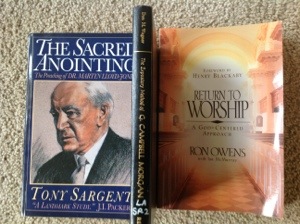
ministry books 4Here are 3 more classic books on the ministry.

1. The Cure of Souls by John Watson (Ian Maclaren)

This Scottish preacher wrote under the pen name John Watson and published several volumes of his sermons. He could be a little sloppy doctrinally, but his viewpoint on preaching was spot on. I can just hear his Scottish brogue as I read. This was the 1896 Yale Lecture.

“Cure” sounds like thick Scottish for “Care” ( I read it is actually Latin) and so he writes about the ministry. He begins with forming sermons and he gives good guidance. He explains how when we preach about everything, we really preach about nothing. He says these casual sermons come either from slackness or laziness.

Chapters 4 and 5 drag, but be sure to read on as chapters 6 through 9 are exceptionally good. You will smile as he tells about church members who are dissatisfied with everything. He calls them “mutineers” and says “…a ship may weather many storms from without, but mutiny among the crew is destruction.” His solution? Every church should refuse them and they could all get together and make their own church! Since no one would want to pastor them, a pastor who has wrecked two churches “by bad temper and overbearing conduct” could be sought for them. See why these old books can still be so valuable because so much of the ministry never changes!

When he speaks of being a prophet versus being an organizer, he sounds like he writes today. He respects and shows the value of small works too. Many ministry books today write that off as failure in these success-mad days we live in.

Whether it is call for confidentiality, or the egotism he hears in some public prayers, or the description of the good side of ministry, every preacher should read it.

2. The Ministry of the Word by G. Campbell Morgan

Here is master preacher who gives us his thoughts on the ministry. He discusses the man in the “ministry of the word.” He begins by digging out the meaning of “ministry” and the “word” and describes them as the fundamental conceptions.

Then in 4 chapters he compares and contrasts the Apostle, Prophet, Evangelist, and Pastor/Teacher. He sees them as different gifts among those who preach, though there are no more Apostles today. He fills like no one will be gifted in all these areas. He does argue persuasively that pastor and teacher are the same office.

In the final four chapters he deals with modern application for these roles he dug out. They are really good. He says that he never asks someone to enter the ministry as the Lord calls Who He wills. Though that call appears different in different personalities, the call is there none the less. He feels the clearest evidence of a call is the gift for it. A Pastor, for example, should have a clear gift for teaching.

His epilogue on prayer keeps the true source of power before us. What a gifted preacher he was and it is worth hearing what he has to say.

Read more on Morgan here.

3. Ministerial Life and Work by W. H. Griffith Thomas

This title isn’t as known as some, but it should be. This is an abridgment of his The Work of the Ministry, but likely all we need is here. He was a popular author who had a profitable ministry.

He has six good chapters on we men in the ministry by reviewing the ministry of the prophets, the Twelve, Paul, and as described by certain epistles. It is well done.

In the second half of the book he writes about the work itself. It is very detailed on certain aspects of the ministry like worship, preaching, visiting, Sunday School, and even prayer meetings.

This is a very good volume.

More in this series on the ministry books:
You can find all posts and books in this series reviewed in the Introductory Post.
Introductory Post

Previous Post

Next Post

Books On The Ministry #3

ministry books 3

From the treasure trove of great books on ministry, we review three more classics.

1. The Pastor-Preacher by William Quayle

It is hard to relate how good this book really is. It is provocative in its description of the ministry. Every chapter is outstanding and many sentences make memorable quotes. When he first describes the preacher, you will be hooked. He says, “It takes more courage to be a preacher than to be a gladiator, or a stormer of fortresses, because the preacher’s battle is ever on, never ceases, and lacks the tonic of visible conquest.”

How about this perspective? “We are come to give ourselves. A preacher is to give himself…A man is an estate; and at death should any of that estate be left in hand the man is by so much a failure…Jesus had nothing left. Empty as a drained cask; that is Christ’s new program for life.” Or this of the preacher: “ He is not the trumpet, but the trumpeter; not the sword, but the soldier.”

This he says of what we preach: “So the preacher must know the way to the Hidden Source. He must trail tendencies. He must keep to the main stream; and the rivulets he must pass only giving them a glance….” How that would revolutionize preaching today!

He challenges us to be men of prayer or not be a man of God. He also explains that we must be a mystic. We must hear things from above. We must have wonder and imagination. He tells us be but not be consumed with the age we live in, but the ages.

He is as powerful in presenting our work with people as equal to our work in preaching. He ends with practical help with various types of visits.

This book should be on every pastor’s shelf.

2. Heralds of God by James Stewart

Mr. Stewart ministered in Scotland. This volume was originally a Warrick Lecture and is organized around five subjects for the preacher: his world, theme, study, technique, and inner life.

We are in this world as a herald of God to people who are disillusioned confused and need to hear of our Lord. We are to smash that disillusionment, he says, with the Cross of Christ.

He reminds us to be sure we worship as we lead worship. He is one of the best I have read in describing how the sermon itself is a key component or worship. That is so often forgotten today. He speaks to what I’ve heard many preachers talk about–running out of fresh ideas for sermons. He proclaims: “The longest ministry is too short by far to exhaust the treasures of the Word of God.”

He makes it beautifully clear that Christ must be our theme. We must be careful not to be swallowed by side issues.

When he speaks of our study, he encourages us to throw our all into it because of the importance of the message we have to preach. We work with treasure. To better know how to preach to men, better know God. He also makes a powerful plea for expository preaching. As he says, “Let the Bible speak for itself.” He says it will deliver us from monotony. He is right!

After giving practical advice on technique, he launches into our inner life. He argues that we must take heed to ourselves before we do so for the flock.

This is another winner!

3. The Christian Pastor’s Manual, compiled by John Brown

This is a reprint originally published in 1826. Soli Deo Gloria and Solid Ground have reprinted this fine volume. Every chapter is written by a different preacher of that era. Some are better than others, but all are good. The chapters may read slightly slower being from that period, but are worth the time. You might enjoy reading one chapter a day and then mulling it over.

I especially recommend the chapter on “Pastoral Cautions” by Abraham Booth. These and other chapters remind us again how so many facets of ministry never change through the centuries.

Young or old, you should ponder the chapter by Isaac Watts called “Questions Proper for Young Ministers Frequently to Put to Themselves.” I finished it only to pray: “Help me Lord.”

Hope you can get these great volumes.

MORE IN THIS SERIES ON MINISTRY BOOKS:
You can find all posts and books reviewed in this series in the Introductory Post.
Introductory Post

Previous Post

Next Post

Books On The Ministry #2

ministry books 2

Here are three jewels on the ministry. Some are more well known than others, but all are 5-star volumes. Several of these were reprinted by Baker in a series called “Notable Books On Preaching.” If you ever see one of them at a used book sale, by all means pick it up.

1. The Preacher: His Life And Work by J.H. Jowett

Jowett was an incredible preacher and this volume made up one of the famous Yale Lectures On Preaching (1911). When I first read this over 10 years ago, the realization came to me just how truly the ministry was work. Particularly, he laid bare the vital truth that preaching is work. Sermon preparation should be intense work. Anything less is unbecoming our great task.

His opening chapter puts the importance of our calling in its proper place. Next, he tackles the perils of the preacher. Listen carefully as he speaks of “deadening familiarity with the sublime.” I personally believe this is one of our greatest dangers. In the next chapter on “The Preacher’s Themes” with its emphasis on “feed my sheep”, he points out that we are both responsible and accountable for this very thing. How honest and careful we must be in this task.

When he discusses “The Preacher In His Study” he said things like: “We must make the businessman in our congregation feel that we are his peer in labor.” He in no way meant that in show, but in reality. When he gets done you want to roll up your sleeves and run into your study and get going.

He goes on to cover our work in the pulpit itself as well as in the homes of our people. When you read these classic volumes on the ministry, you will find an emphasis on being in the homes and lives of the people you pastor. The idea that all visiting should be about getting new people in the church would horrify the old masters who took seriously their role as shepherd.

This is a must-have volume!

2. A Minister’s Obstacles by Ralph Turnbull

This volume is a perfect follow-up to Jowett’s The Preacher: His Life And Work. Mr. Turnbull wrote this book in 1964 and it was incredibly influential and for good reason. You will notice how widely read he was in the great books on preaching before him. It is no surprise that he edited Baker’s “Notable Books On Preaching” series.

His chapter titles alone will grab you. Consider “The Specter of Professionalism”, “The Vice of Sloth”, “The Dry Rot of Covetousness”, “The Bane of Jealousy”, and “The Paralysis of Pride” among others. The contents are as convicting as the titles.

He had so many great things to say. I marked in my copy how he even broached the subject of moodiness in preachers and how we must guard against it.

This is a great volume!

3. A Minister’s Opportunites by Ralph Turnbull

A worthy sequel to his A Minister’s Obstacles. It is set up the same way, but in positive terms. The titles are as riveting and the subject matter needed. He begins with “The Certitude of Vocation.” Again, he wants us to see the task before us. I love what he said here: “If the ministry degenerates to a ‘job’ with demands of monetary returns for services rendered and a tendency to unionize conditions and terms, then the peril of being the hireling and not the shepherd is obvious.” That still speaks to our day.

When he addresses “The Stewardship of Time”, he distinguishes the Father’s business and busyness. He challenges us to self discipline and hard work. I love his discussion of study and books, though not everyone gets into that subject as I do.

His chapter on “The Power of Ambition” is worth the price of the book. He coaches us to avoid “dreams of grandeur and aggrandizement.” He cautions against being “content with externals and to be careful as “success is a catchword of our secular age.” Thirty years has only deepened the problem.

Not quite as influential or good as his earlier volume, but it is worthy acquisition.

Happy hunting on the used book sites!

MORE IN THIS SERIES ON MINISTRY BOOKS:
You can find all posts and books reviewed in this series in the Introductory Post.
Introductory Post

Next Post