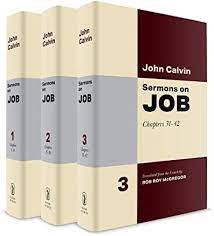
Sermons on Job (3 volumes) by John Calvin

This is a publishing event! Fortunately for us, Banner is the publisher, and as you likely know, still puts effort into publishing beautiful, quality books that will last. Beyond acing the eye test, what we get between the covers of these three volumes is even more exquisite. These sermons on Job have long been considered among his finest. I’ve often told people not to think of him in terms of the theological system that bears his name, but as either a commentator or expositor. People across the theological spectrum can learn from him both content and the art of how it’s done. You don’t have to agree with every word he says, but you’ll be all the better for wrestling with them.

Since Calvin wrote in French, most of us need a helper to get at his sermons. Rob Roy McGregor, in my view, has excelled in translating and updating these sermons with words that flow beautifully. In fact, you can be reading these sermons and totally forget the centuries that have passed since they were preached. They could easily have come from our day in terms of readability.

While you’d be crazy to preach 159 sermons on Job, you’d be wise to read these 159 sermons on Job to prepare to teach or preach Job. So often, I’ve read later works on Job and found Calvin quoted. That’s not an accident. Sometimes he squeezes more out of a verse than I think is legitimately there, but the interaction will help you arrive at the heart of the passage. Plus, if you’re studying just one passage in Job, the corresponding sermon in this set will be a boon to you.

I have not, of course, read all of the sermons yet. But I have read in different parts of the set to get the flavor of the fruit that is provided here. It is ripe and tasty. In the first sermon alone, he explained how Job made a bad case of a good cause with his friends made a good case of a bad cause! Now that’s what I call insight!

Be sure to check out the Translator’s Preface and the Introduction. You wonder if Calvin’s prolific physical suffering (he suffered severe health problems for years) made Job a personal favorite or even a needed friend.

What an awesome set to get! ( Now if we could only convince Mr. McGregor to tackle Calvin’s Jonah sermons next!) This set is a treasure that has not been available to us before and how blessed we are to get it.

I received this book free from the publisher. I was not required to write a positive review. The opinions I have expressed are my own. I am disclosing this in accordance with the Federal Trade Commission’s 16 CFR, Part 255.
Now and Not Yet (NSBT) by Dean Ulrich

The NSBT series marches on with this interesting look at the significance and theology of Ezra and Nehemiah. The NSBT series is truly a random series, but the volumes are often fascinating. We never know what is coming next in the series, but we’d be remiss not to find out. Dean Ulrich does good work here.

The title Now and Not Yet suggests the track the book will run. That thought that is found in many prophetic writings here tells of a new chapter for God’s people that will more fully climax in Christ. Many are reluctant to develop that line of thinking in the scholarly world, so we appreciate the openness here to embrace it.

Throughout this book we are confronted with Ezra-Nehemiah as if it were one book rather than two. He makes a good case and at the least it does no harm to study with that design. Though I enjoyed what he gave us, I wish he had developed the structure even more.

Chapter two well explained the big picture of biblical theology. Chapter three explained the history of the return from exile but the nuggets were all in the theology developed.

In a creative turn, the next three chapters address rebuilding the temple, rebuilding the people, and rebuilding the wall. That told the story in a framework that allowed the theology to bud. Chapter 7 shows what worked and what fell short. There his now-and-not-yet theme fully bloomed.

Isn’t it wonderful that these NSBT volumes keep coming along? I want them all, don’t you? This one is a sample of why.

I received this book free from the publisher. I was not required to write a positive review. The opinions I have expressed are my own. I am disclosing this in accordance with the Federal Trade Commission’s 16 CFR, Part 255.

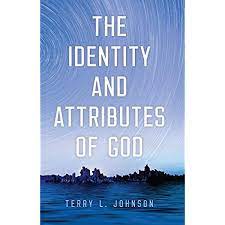
The Identity and Attributes of God by Terry Johnson

I must best describe this book as pure joy. I’d heard good things about it, but had been warned that it is heavily imbibed with quotations. To my mind, that usually doesn’t work. In those cases the author seems more of a compiler than a writer. I wondered going in if this would be more of a good reference than a good read. The more I read, the more my weak expectations were proven wrong.

The book is full of quotations, so how did the author pull it off? By picking the very best quotes, by seamlessly weaving them into the work, and by then writing thoughtfully around them. In the end, you get rich theology for your mind and warmth for soul. This is not a compilation. This is a book!

This book doesn’t address ever attribute, but covers some of the most important ones to ingest. After a discussion of God, the Trinity, and what the incommunicable attributes are, those of God as Creator and of His providence are brought to light. One of the best sections was holiness. Another favorite was goodness. I gained so much from it. The one on love started slower but really pierced my heart by end.

The book ends abruptly, but the author has delivered another volume on other attributes from another publisher.

You’ll see a pastor’s heart and a theologian’s precision throughout your read of this precious book. If this book doesn’t help you, I doubt you’re even trying.

I received this book free from the publisher. I was not required to write a positive review. The opinions I have expressed are my own. I am disclosing this in accordance with the Federal Trade Commission’s 16 CFR, Part 255.
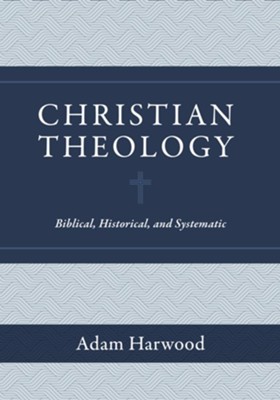
Christian Theology by Adam Harwood

Here’s a new Systematic Theology that fulfills a distinct need on two fronts. First, it’s a bit more manageable than most systematic theologies without sacrificing the needed depth. Second, it’s from a distinctly Baptist perspective. In that vein, it doesn’t follow the Calvinistic approach that clearly dominates the systematic theology market. That difference means you get more perspective as several other popular volumes are so closely aligned as to render some redundant.

There’s also a unique presentation here that allows one new avenues of thinking. As I was reading, I was struck with how this material was obviously honed through years of interacting with students. Every section was quite approachable and useful. Only in the section on Last Things did I feel he left some questions unanswered, or at least gave a briefer treatment.

Who would benefit most from this book? Pastors will appreciate it for sure. It would also be a boon to one embarking on their first attempt at a really deep, thorough study. Several other such volumes might sink your studies by their opaque style, but that is not the case here. Even if you can handle those volumes, this one still gives a different perspective like I mentioned before that makes it still particularly valuable.

I keep a stack of 3-4 systematic theologies always close by. This one will join them on that often-used pile.

I received this book free from the publisher. I was not required to write a positive review. The opinions I have expressed are my own. I am disclosing this in accordance with the Federal Trade Commission’s 16 CFR, Part 255.

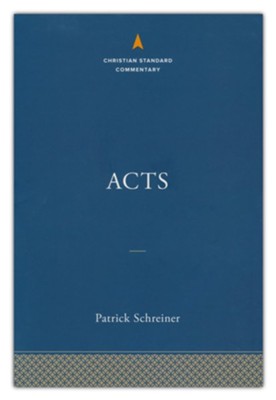
Acts (CSC) by Patrick Schreiner

This latest release in the Christian Standard Commentary (CSC) series is the first to replace an author from the NAC that the CSC is replacing. To be honest, I was surprised to see the John Pohill work replaced as I had enjoyed using it in the past. In the author’s preface where he mentioned the type of commentary Pohill and others had written, he laid out his desire to especially focus on “the narritival and theological content of Acts with an eye toward the ecclesial.” I only had to start reading before I realized that he was on to something.

He begins the introduction by telling us of the main proposals for the “theological heart” of Acts. From there he develops quite convincingly this theme as our Triune God sharing with us. He traces the big picture through the Father, the Son, the Spirit, the Word, salvation, the church, and witnessing. Now that’s what I call getting the big picture. The Trinitarian perspective is brilliant and undoubtedly correct.

Next, he takes on narrative, genre, Lucan concerns, and structure and imparts much meaningful material along the way. There are even some helpful graphs provided. He ends with traditional introductory issues and has conservative conclusions.

The commentary proper is at once well researched and well written. Despite the expertise, I think pastors and Bible students can score a winner in this volume.

Count be as won over! This is a real treat.

I received this book free from the publisher. I was not required to write a positive review. The opinions I have expressed are my own. I am disclosing this in accordance with the Federal Trade Commission’s 16 CFR, Part 255.
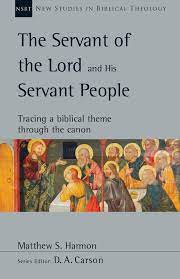
The Servant of the Lord and His Servant People (NSBT) by Matthew Harmon

Here’s another interesting title in the the NSBT series that is a series with some of the most incredible variety of any that I know. Though there are several books on slavery in biblical times and ones on the Suffering Servant in Isaiah, and though there are many devotional titles on being a servant, this theological treatise carves out its own niche.

It has an interesting introduction that looks at the words in Hebrew and Greek that can be translated as either slave or servant. It well explains what a challenge it can be and how it all depends on the context as the words have quite a range of meanings.

In chapters 2-5 Harmon explores four key OT characters as servants. Adam, Moses, Joshua, and David are quite effectively presented as servants though not rigidly in the same way. Good stuff!

The next two chapters cover the Isaianic servant and Jesus the servant par excellence in turn. From there a group, the apostles, are covered including Paul, Peter, and others. Finally, the church in each part of the NT is presented as a servant people.

In addition to the interesting theme, every passage used has carefully done exegesis for you. That has its own distinct value and can be used in study of the passages themselves.

This volume joins other recent releases in the series as a winner. I’m not surprised!

I received this book free from the publisher. I was not required to write a positive review. The opinions I have expressed are my own. I am disclosing this in accordance with the Federal Trade Commission’s 16 CFR, Part 255.
Ezra-Nehemiah (ZECOT) by Gary V. Smith

I’ve loved all the ZECOT volumes releases to date, but this latest entry by Gary Smith deserves special commendation. Perhaps he has grasped the format of the ZECOT the best I’ve seen so far. His work is good; his presentation is near perfect. I even enjoyed it more than his widely-received work on Isaiah (NAC/CSC). In that vein, I liked it more than a recent release on Ezra and Nehemiah in the NICOT series as well.

After a bibliography and translation, he dives into a strong Introduction. He begins with a clear presentation of historical background. It’s spruced up with some pictures and graphs that were particularly effective. His conclusions are conservative here as well as the following section on date and authorship. The concluding work on literary features is his best work here and, of course, matches the distinctive contribution of the ZECOT series.

The commentary proper is even better and continues the use of timely charts. Every section gives a main idea, the literary context, structure and literary form (rich), explanation of text ( what most are looking for), and canonical and theological significance (perceptive).

This is one to get!

I received this book free from the publisher. I was not required to write a positive review. The opinions I have expressed are my own. I am disclosing this in accordance with the Federal Trade Commission’s 16 CFR, Part 255.
Sermons and Addresses of George Smeaton

Here’s an attractive new volume by popular older theological writer George Smeaton. You probably are aware of his influential writings on the Holy Spirit and the Atonement that have been around for 140 years. In this new release sermons and addresses are collected and presented to us in one book.

The book begins with a fine biographical sketch by John Keddie. This is particularly valuable since there has been so little written on Smeaton. Since there’s so little for Keddie to draw from, there’s much more on his career than his personal life. His ministry and theological writing are well described as well as several theological controversies of his time that he was involved in. Next, the Introduction gives a few details on these sermons and addresses. What is unique about these addresses are how they really add to a biographical understanding of Smeaton themselves.

The first five are excellent sermons that have both an exceptional theological basis and a clearly experiential side. The next two look at the profound revival of his time. The one “The Improvement of a Revival Time” makes you pine for what we know so little of. The last several are excellent yet give good historical background and strong encouragement particularly for preachers.

This beautiful hardback is the perfect setting for these writings. I think you’ll like them.

I received this book free from the publisher. I was not required to write a positive review. The opinions I have expressed are my own. I am disclosing this in accordance with the Federal Trade Commission’s 16 CFR, Part 255.
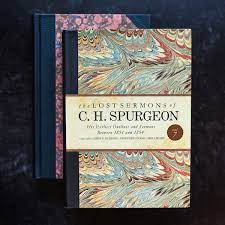
The Lost Sermons of Spurgeon (Collector’s Edition) Volume 6

This beautiful set of Spurgeon’s early sermons continues in this volume 6. The spine of this collector’s edition is green but the exquisite look remains. What a set this is turning out to be!

The Foreward this time is by Mark Dever and focuses on Spurgeon and the art of preaching. He discusses the calling and what it entailed according to Spurgeon. From there, he discusses Spurgeon’s advice on preaching. All good stuff!

After reprinting the Introduction from previous volumes, and a few pictures of Spurgeon’s notes, the sermons begin with the first one a lovely one on Immanuel. I love how the notes always tell us if he had a later sermon on the text and whether there are similarities. I remember the later one on Jehovah Jireh but the one here really isn’t the same. The other notes are fascinating as well.

The sermons are awesome again. Anyone who loves Spurgeon needs these volumes! Anyone who loves preaching needs them too. I give it the highest possible recommendation!

I received this book free from the publisher. I was not required to write a positive review. The opinions I have expressed are my own. I am disclosing this in accordance with the Federal Trade Commission’s 16 CFR, Part 255.

Philippians (TNTC) by Jeannine Brown

Philippians is the latest new release in the rapidly unfolding complete revision of the time-honored Tyndale New Testament Commentary series. Brown replaces the somewhat controversial Ralph Martin volume that was itself a revision of his earlier work. Without doubt, that Martin volume took the most criticism in the series. For that reason, this is a welcome replacement.

This work, fortunately, is not going to be as controversial. I wouldn’t call this book riveting as it aims slightly more toward scholars than is typical of this series. At times, what Bible students or pastors would want takes a back seat to more scholarly interests. The author seemed quite knowledgeable, but took, perhaps, too academic an outlook for this series.

I also saw something, too, in this volume that I had not seen in any other I could remember. When I said it had an academic tone, it seemed as though she wrote for younger seminary students. She would explain what she was talking about as if it were the reader’s first encounter with the subject. For example, when discussing reconstructing the situation of the Philippians she had two full paragraphs on how to have a balanced approach in historical reconstruction. That would be helpful to a new student but perhaps others wouldn’t like it. She sounded like a professor teaching at many points.

I’m not suggesting this is a bad commentary just that it might not be for all tastes. She is an accomplished scholar and has written and edited major works. Perhaps that is more her forte than a work for Bible students and pastors or the typical TNTC user.

Still, she handled Philippians 2 far better than Martin did and has for sure superseded his work. I wouldn’t want this volume to be my only one for Philippians, but it one be fine as one of a few I’d consult.

I received this book free from the publisher. I was not required to write a positive review. The opinions I have expressed are my own. I am disclosing this in accordance with the Federal Trade Commission’s 16 CFR, Part 255.