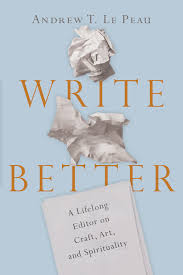
Write Better by Andrew T. Le Peau

book how write

When I heard this book was coming out, I was immediately intrigued. There’s plenty of places where you can read about how to write better, but when someone whose life work is editing Christian titles, some of which I’ve read myself, decides to tell me how to write better I’m ready to listen. Andrew Le Peau gave 40 years to editing IVP titles. Along the way, he wrote a commentary on Mark’s gospel that I found fascinating before I even realized he was an editor of other books I had read. Since I knew I would be writing a review before I cracked open this book, I found something of a perverse grin come across my face as I thought I would have to examine his writing as he was telling me how to write better!

Let me, then, dispense with the question of whether this book that offers to be my guide was itself well written. It was. Strangely enough, imagine how easy it would be to fall into a dry writing style to explain something as technical as writing. He wrote so well, in fact, that now I’m going to always wonder if IVP publishes great writers or if editors like Mr. Le Peau just make them appear so. In any event, I’d be happy to write at the level of Mr. Le Peau and so am happy to consider all suggestions he makes for the craft of writing.

He divides his book into three parts: the craft of writing, the art of writing, and the spirituality of writing. He covers everything. Whether it be big picture ideas like knowing your audience or understanding persuasion or whether it be the smaller details like grammatical rules, he guides us with a deft hand. Every suggestion he offers made sense to me. He not only tells you the what but provides the why. Further, he is keenly aware of what’s important if you are writing a spiritual work.

This book manages to accomplish two feats: how to write better and how to publish. That is not to say that the book is in any way unfocused, just that the two are closely tied together and he knows the ropes for both. Still, if you had no intention of publishing and only wanted to write better for a blog or some other project, this book will be a magnificent help to you.

It would be unhelpful for me to drop more details from the book into this review, but I can say it’s the best book on writing that I’ve come across in more than 20 years. If this book can’t help you be a better writer, you must not be trying.

I received this book free from the publisher. I was not required to write a positive review. The opinions I have expressed are my own. I am disclosing this in accordance with the Federal Trade Commission’s 16 CFR, Part 255.
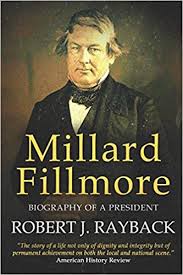
Millard Fillmore by Robert Rayback (Presidential Bio. Series)

book fillmore

Millard Fillmore is usually relegated to a dusty list of our forgotten presidents. Admittedly, most are hard-pressed to name any of our presidents between Jackson and Lincoln (well, maybe Polk has a few fans). To make it worse, Fillmore has been summarily dismissed as the ultimate underachiever. After reading this biography by Robert Rayback, I’m wondering if historians have been a little too unkind to Fillmore. While it’s true that Rayback greatly admired Fillmore and perhaps cast events in the best light possible, I did feel that many of the facts were on Rayback’s side.

While I have no illusions that Fillmore was one of our presidential greats, he does appear to be a likable person, especially when compared to one of his irascible predecessors, John Tyler. He held principles on several occasions where personalities involved caused him to want to go another direction. He was an effective legislator before he became president and was perhaps more suited to that role. He was more adept at compromise and order than he was at either possessing or casting vision. Any record of the short-lived Whig party cannot deny his importance to its history. Somehow, he came through successfully the rough-and-tumble backroom battles of his party without being as cutthroat as many of his colleagues.

Most negative modern analysis of Fillmore stems from his part in the Compromise of 1850. That is somewhat unfair on two fronts: a desire to solve the slavery question without war was obviously appealing at the time and the reading of the convictions of our day onto the past without regard for the context of those times. Since war came a decade later anyway and destroyed slavery in the process, it knocks the luster off what many across the spectrum thought worthwhile at the time. Did, however, the nation progress in that decade to be more able to accept the demise of slavery? Since we can be sure of completely different leadership on both the Union and Confederate sides in this prior decade, are we confident that we would’ve had the same result had it burst out in 1850? Maybe I put more stock in the providence of God than most readers, but it appears to me that the vastly different events of 1850 and 1861 were ultimately for the best.

In reading these presidential biographies, I’ve made a point to check out the religious background of these men. I’m aware that the outlook of the biographer can add an unfortunate layer to what I find. Rayback explains how Fillmore joined the Unitarian church prior to becoming president. He further explains that although Fillmore did not appear to attend church much before this move to the Unitarian church, he became quite faithful afterward. It does appear to me that the author has made a mistake in describing Unitarians more as they are today than they were in Fillmore’s time. Some other American characters widely known for their Christianity were, in fact, Unitarians in those days. Mrs. Fillmore was the daughter of a Baptist pastor and was raised in the Baptist Church. The author is probably correct in explaining that Fillmore did not join the Methodist Church, which was quite zealous in those days, even though he had family members in it. The Unitarian church probably matched his more genteel ways, but it seems altogether possible that Fillmore was a Christian. We may never know for sure.

Since this biography was written 60 years ago, I dreaded a dry writing style. Since presidential biographies have attracted some of the best writers of our day in the last few decades, it’s easy to become spoiled. To be sure, Rayback is no McCullough or Chernow, but I thought his pages flowed easily and were pleasant to read. Even though the book was well written and Fillmore was likely a better president that he’s often given credit for, I’m still of the opinion that 250 pages would have likely been enough for his life. Since I’ve heard that the volume in The American Presidents series is a complete disaster, I’m glad I read Rayback’s take on Fillmore.

For more in this series, look here.

Preaching As Reminding by Jeffrey Arthurs (Books on Ministry #24)

book preach remin

We’ve been blessed with many fine books on preaching. There are classics from previous centuries as well as winners from our day. I should know as I’ve been blessed by many of them. On the other hand, because it’s such a popular subject the inundation of titles has led to a few dull books that say nothing new at all. Fortunately, Jeffrey Arthurs stepped into a niche that I don’t feel other authors have properly addressed and has given us something beautiful to help us as we preach God’s word. Since we live in an age of rampant forgetfulness, his work is extremely timely as well.

The help he gives has been meticulously studied out and thoughtfully presented. He makes a powerful case for his premise that preaching is an act of helping people remember before he jumps into practical guidance for preaching itself. He traces both remembering and forgetting through Scripture and proves its prominence. He even handles the science behind memory adeptly though I imagine that is not his normal field of work as a professor of preaching and communication. You will likely so agree with his reasoning that you will find him a trusted guide by the time he gets around to telling you how to improve your preaching.

There is no letdown at all when he transitions to practical help in preaching. Beginning in chapter 4 when he discusses style as a tool for stirring memory, he explains how style is a tool of persuasion and how each preacher needs his own style as well as to improve that style. He gives wonderful suggestions to that end. Next, he reminds us that story or narrative is especially effective in helping people remember. His chapter on delivery is a great reminder for us all as he digs into the details including the important nonverbal signals that we send.

If I were assembling a list of the key books on preaching, I would have to include this perceptive volume. I’m thoroughly impressed with what Mr. Arthurs had to say between these covers.

I received this book free from the publisher. I was not required to write a positive review. The opinions I have expressed are my own. I am disclosing this in accordance with the Federal Trade Commission’s 16 CFR, Part 255.
Ephesians (TNTC) by Bock

book eph tntc

This latest release in the Tyndale New Testament Commentary (TNTC) series has snagged yet another top-flight scholar. Darrell Bock tackles Ephesians here after his major works on Luke, Acts, and the historical Jesus. In case you weren’t aware, his two-volume commentary on Luke in the BECNT series is often rated as the best exegetical work we have on that book. Though he branches away from his normal work in this effort to grapple with a Pauline epistle, his credentials are clearly up to the mark. TNTC targets an audience below those major exegetical works though its scholarship is always top-notch. It seems to me that Mr. Bock understood the aims of the TNTC series and brought us an excellent work within those parameters.

After a select bibliography of a few pages, Bock jumps into his introduction. He begins with explaining the importance of Ephesians which many find to be a mountain peak within Pauline writings. He goes on to explain destinations of the letter with plenty of background on the city of Ephesus before he gets into several issues involving authorship. When he enters a more formal discussion of authorship and date, he explains vocabulary and style and theological issues within Ephesians. He doesn’t find enough evidence to deny Paul authorship.

After a brief outline, Bock enters the commentary section that makes up the bulk of the book. For each passage, he gives context, before entering into commentary itself for each verse. There’s also a paragraph or so on the theology of the passage. In my estimation, he makes the reader fully aware of the issues and what the passage is trying to say to us. For example, I thought he handled the Household Code with skill and grace. He stayed true to the text concluding a conservative position yet wrote in a way that would not be overly antagonistic to someone of a different persuasion. The quality of commentary remained throughout.

Pastors, teachers, and Bible students will appreciate the fine help this commentary provides. I recommend it.

I received this book free from the publisher. I was not required to write a positive review. The opinions I have expressed are my own. I am disclosing this in accordance with the Federal Trade Commission’s 16 CFR, Part 255.
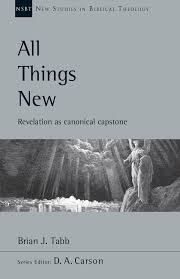
All Things New (NSBT) by Brian J. Tabb

book all th new.jpg

If you are like me, you know what to expect when you pick up the latest entry in the New Studies in Biblical Theology (NSBT): perceptive theology, careful scholarship, in-depth coverage that even exceeds many commentary introductions, and a work that goes beyond anything you already have on your shelves. That consistency is as steady as the unchanging gray covers that adorn every volume. On the one hand, some credit must go to D. A. Carson for his editorial work. On the other hand, somebody must have done their homework in choosing authors as well.

This latest release by Brian J. A Tabb looks at the book of Revelation “as canonical capstone”. As heady as that sounds, the author knew how to make a strong case for his thesis. As I read, I thought this author is great at digging. He brought out so many things that are easily missed and made so many connections between Scriptures that we rarely see. Mr. Tabb takes an “eclectic” approach to Revelation. In fact, he much reminds me of Gregory Beale. (He cited 19 of Beale’s works in his bibliography!) Still, it’s clear he did his own work and made his own conclusions. Further, as one who is a futurist rather than following his eclectic approach, I felt he was gracious throughout. Even better, the type of information he mined for us can be taken and shone back into Revelation no matter which approach to prophecy you take.

His introduction was outstanding and contained all kinds of wonderful information. I did much underlining there. From there he divides his book into four parts: the triune God, worship and witness, judgment, salvation and restoration, and the word of God. Part one contained, you guessed it, three chapters on the Sovereign on the throne, Jesus as the Lion and the Lamb, and the Spirit of prophecy. These were some of my favorite chapters in the book with particular success in the chapter on the Holy Spirit. Part two looked at followers of the Lamb and discussed things like a priestly kingdom and a new Israel while another chapter talked about the battle for universal worship. I felt that viewpoint was well worth digging into. Part three considered the wrath of the Lamb and made several insights on things like the seven seals, the seven trumpets, and the seven bowls of wrath, as well as a new Exodus. There was a chapter on Babylon the harlot and Jerusalem the bride as well as another on all things new. Part four only had one chapter on the Word of God but it was well done and followed by a conclusion for the book. There’s a lengthy bibliography for those wanting further study.

This book even contains some charts that summarize important information for the reader and that I was blessed by. This book is fully up to the high standards set by the NSBT series and I recommend it.

I received this book free from the publisher. I was not required to write a positive review. The opinions I have expressed are my own. I am disclosing this in accordance with the Federal Trade Commission’s 16 CFR, Part 255.
A Pastoral Rule for Today by Burgess, Andrews, and Small

book pastoral rule.jpg

This book is designed to bring pastors back to our core work. A trio of authors, John Burgess, Jerry Andrews, and Joseph Small, take seven historical characters to remind us of what ministry is supposed to look like. This work was an initiative by the Presbyterian Church (USA) and certainly has the flavor of that body throughout the book. Since I’m not a Presbyterian, I found myself at odds with the authors on some of their conclusions. On a more important note, however, I did pause to reflect on some areas of my own ministry that I feel was truly profitable for me. The biographical section on the historical theological figures was enjoyable as were several of the ultimate admonitions for those in ministry. Sometimes the path by which they reached those admonitions was something not particularly scriptural to my mind. Further, the authors seem to have an overblown reverence for the monastic lifestyle. While taking the time to truly meditate on God’s word and remove yourself from the hustle of life is of the utmost value, monastic life has not led to a superior spirituality in many documented cases. It is, then, with a caveat that I recommend this book.

The historical figures used to illustrate what the authors call pastoral “rule” were Augustine, Benedict, Gregory the Great, John Calvin (no surprise), John Wesley (a little bit of a surprise), John Henry Newman (a questionable choice for some of us), and Dietrich Bonhoeffer (one of the best chapters in the book). The introductory chapter on why pastors need a “rule” was intriguing. Augustine was used to describe that monastic life while Benedict was used to illustrate obedience “in the context of community”. That obedience as well as what was shown in the life of John Calvin turned out to be the most overtly Presbyterian chapters in the book as it pushed a church hierarchy that fits well with their system. As I read it, I couldn’t help but think of its lack of scriptural support. Gregory the Great was mined to show the importance of disciplined prayer. The chapter on John Wesley was extremely timely for our generation as it showed the importance of choosing your words carefully. While I’m not a big fan of John Henry Newman, the principal shared about the need for serious study of the Scripture was well taken. The chapter on Bonhoeffer, who wrote Life Together, had the best insights on community in the book. The concluding chapter on making a contemporary pastoral rule had many helpful insights.

As I said above, this book did get me to thinking about some things that needed addressing in my own life and ministry. You can add a star if you are Presbyterian or hold to the author’s overall views about ministry. Worth pondering!

I received this book free from the publisher. I was not required to write a positive review. The opinions I have expressed are my own. I am disclosing this in accordance with the Federal Trade Commission’s 16 CFR, Part 255.
Walking the Ancient Paths: A Commentary on Jeremiah by Kaiser and Rata

book walk ancient.jpg

I’ve been using the works of Walter Kaiser for several years, so when I saw that he was coming out with a new work on Jeremiah I was instantly intrigued. Now that I’ve had a chance to get into this commentary, I can confess that it did live up to my high expectations. As something of a commentary junkie, I’ve had the privilege to review all types of commentaries all the way up to the massive tomes that cover every conceivable issue. As much as I enjoy using all of them, if I were forced to choose, this type of commentary prepared by Kaiser and his colleague Tiberius Rata is the most ideal for pastors. It has more depth than the TOTC series and is pretty close to the NAC in its scope. If you can imagine that style of commentary, then you will know how to gauge this work that is a model volume of its class. Further, in these days of prolific commentary production, I would argue that Jeremiah would be one of the books most in need of a new commentary of this type.

The introduction is not massive, but it gets to the heart of what most Bible students and pastors are looking for. There is background on Jeremiah and his times. There’s a brief mention of compositional issues because the scholarly world is so enamored with them. You will find conservative conclusions here. There is a discussion of Jeremiah’s relation to Deuteronomy as well as the text of Jeremiah. The section on theological emphases could probably have been expanded but was accurate as far as it went. The authors give us an extensive outline of Jeremiah along with a brief bibliography at the end of the introduction. (There’s a lengthy bibliography at the end of the book).

As for me, I enjoyed the commentary itself even more than the introduction. What you received in every passage was clear guidance on understanding the text. If scholarly side issues were mentioned, they never dominated the discussion. I don’t see how this book could not help someone wrestling with the challenging book of Jeremiah. Let’s label this book a necessity!

I received this book free from the publisher. I was not required to write a positive review. The opinions I have expressed are my own. I am disclosing this in accordance with the Federal Trade Commission’s 16 CFR, Part 255.
The Old Testament in 7 Sentences by Christopher Wright

book ot 7 sen

When Christopher J.H. Wright produces a book, it will be worth checking out. Every book of his that I’ve read, whether it be a commentary or theological work, is simply above average. I think the reason he so often succeeds is that his scholarship on any issue involving the Old Testament can stand up against any other scholar’s work, yet his works possess a spirituality that few of them can match. Every time I read one of his works, I’m reminded of how much he possesses the flavor of his mentor, John Stott. Not that he just repackages Stott’s work, but he has that special gift to blend scholarship and spirituality that is too often lacking these days.

This work is a little different. Not in quality, but in what he usually writes. IVP has started publishing these books (I enjoyed the one on philosophy) and I assume a series may follow. As you can imagine, these books are more of a survey. In this case, we are getting our overview from seven key texts of the Old Testament. Both the number seven and the choice of texts are arbitrary, or at least debatable, but Mr. Wright has chosen as well as anyone could. What he did accomplish, though, is using these texts to cover more ground. For example, when he chose, “the Lord is my shepherd”, he covered what all the Psalms and wisdom writings are attempting to accomplish in the Old Testament. In other words, he pulled off this difficult writing assignment.

His choices were creation with Genesis 1:1, Abraham with Genesis 12:3, Exodus with Exodus 20:2, David with I Samuel 13:14, the prophets with Micah 6:8, gospel with Isaiah 52:7, and Psalms and wisdom with Psalm 23:1. As I said above, he covers much more ground than those texts suggest. To my mind, he chose these texts to unlock the larger narrative of each section of Scripture.

This book would be ideal for a Bible student’s first pass at surveying the Old Testament. Pastors might not need this book as much as others he has written but would probably be happy to put it in the hands of their people. Still, even the most seasoned Christian will find nuggets along the way in this winning volume.

I received this book free from the publisher. I was not required to write a positive review. The opinions I have expressed are my own. I am disclosing this in accordance with the Federal Trade Commission’s 16 CFR, Part 255.

The Message of Discipleship (BST) by Peter Morden

book mess disc.jpg

This latest release in the Bible Speaks Today (BST) series explains the topic of discipleship by careful exposition of key texts. If you are familiar with this series, you know that that is how these volumes on Bible themes work. Peter Morden appears quite comfortable in this format. Personally, I wondered what would be the best texts to consider, and I found that I pretty much agreed with what Mr. Morton has chosen. Partially because of the subject matter, I found this volume to be one of the most devotional that I have read in the series. Mr. Morton comes across as equally adept at handling the devotional aspect. The only tiny criticism that I could find in the volume is that he, perhaps, quoted others a bit much. To be fair, I didn’t actually verify that with the other volumes, but that was my impression as I read. At least, he chose wonderful works to quote, and some you don’t normally see quoted in one of these types of works too.

The 17 chapters, or expositions, are divided into three parts: the foundations of discipleship with four chapters, the resources for discipleship with four chapters, and the practice of discipleship with nine chapters. The chapters on the foundations of discipleship look closely at the ministry of Christ and the call he put on us. The chapter on Isaiah 6 was an excellent addition here as well. In part two there were fine chapters on prayer and the church regarding discipleship, but my personal favorite was a gem of a chapter on discipleship and the Holy Spirit. Part three dug deep into our personal walk with Christ and included the resurrection, holiness, a needy world, daily work, finance, living in dark times, the key of love, making disciples in our world, and a concluding exposition on finishing the course.

Though this book has quality scholarship, I would deem it to be helpful to any Christian reader. The writing is accessible and the message is warm. Mr. Morton is a pastor in addition to being a scholar and it shows throughout.

I received this book free from the publisher. I was not required to write a positive review. The opinions I have expressed are my own. I am disclosing this in accordance with the Federal Trade Commission’s 16 CFR, Part 255.
Paul and Union with Christ by Constantine Campbell

book paul union christ.jpg

Wow! I knew this book was highly regarded on the influential subject of union with Christ. I’ve seen Constantine Campbell’s name show up all over this issue as well. What surprised me, though, is this book’s laudable design. I cannot think of a more ideal way to examine Paul’s relationship to the theological subject of union with Christ than to simply exegete every passage in the epistles of Paul that touch on the subject. Along the way, Campbell tackles “in Christ”, “through Christ”, “into Christ”, as well as every other conceivable expression on the subject. In addition to exegeting each passage, he outlines the possible uses of the word and categorizes each passage as to its likely usage.

Before all those passages are exegeted, there are two chapters that cover introductory matters and a history of the issue seen through the eyes of the major theological players that have most contributed to how the debate has gone. There’s a lot to evaluate there as Campbell does a fine job explaining the strengths and weaknesses of each theologian. After chapters 3 through 7 exegete all those passages, there are several chapters of theological study. More terms are defined and exegeted as well as major concepts of participation like the body of Christ, Temple and building, marriage, dying and rising with Christ, and the new Adam being explained. There’s one chapter that well explains Trinitarian issues and another that tackles the often-debated relationship of union with Christ and justification. The twelveth chapter defines union with Christ with all the information we gained throughout the book and there’s one final chapter on implications and future directions that will really appeal to scholars. Fortunately, there’s a scriptural index that will make this volume as wonderful a reference as it is a theological read.

To my mind, this volume is without peer for the needs of Bible students and pastors on union with Christ. Without a doubt, it will be my go-to volume.

I received this book free from the publisher. I was not required to write a positive review. The opinions I have expressed are my own. I am disclosing this in accordance with the Federal Trade Commission’s 16 CFR, Part 255.