Colossians and Philemon (ZECNT) by David Pao

book colossians

The Zondervan Exegetical Commentary on the New Testament (ZECNT) series rings the bell again with this fine volume on Colossians and Philemon by David Pao. The more volumes in this series I peruse, the more I like the ZECNT format. The scholarship is conservative and the outlook warmly in sympathy with the biblical text. Pao holds his own with the other great scholarly writers in the series.

The Introduction to Colossians is ideal. He argues beautifully for traditional conclusions while succinctly sharing various viewpoints. Still, he doesn’t let this volume drown in the weirder scholarly drama that we sometimes find in modern exegetical commentaries. He agrees with the long-accepted conclusion that Paul is the author and feels that Rome is the most likely location of the letter’s origin. He describes well the audience in Colossae and explains the circumstances behind the text. He sees both a Jewish legalism and syncretism at play in Colossians. He provides a helpful outline and bibliography.

The commentary on Colossians follows the usual format of discussing literary context, offering up the main idea, diagramming the text, discussing the structure, providing an exegetical outline, followed by substantial commentary on the text along with a section on theology in application. This format really serves up exactly what the pastor needs and is helpful throughout. I found his comments perceptive.

Philemon is given a similar Introduction followed by the same type of commentary format. Though I do not really agree with his rejection of seeing Onesimus as a runaway slave, it’s all still very helpful. I’m more in sympathy with his conclusions on Colossians, but this is still a superb choice for Philemon.

This commentary ranks up there with Douglas Moo  and Peter O’Brien and is newer than either of them. Add to its high rating its economical price and you have a winner here. I highly recommend it!

I received this book free from the publisher. I was not required to write a positive review. The opinions I have expressed are my own. I am disclosing this in accordance with the Federal Trade Commission’s 16 CFR, Part 255.
The First Letter to the Corinthians (Pillar)

book 1 cor

Roy Ciampa and Brian Rosner team up to provide this commentary on First Corinthians in the highly respected, conservative Pillar Commentary series edited by D. A. Carson. At this point, I’ve used most of the volumes in this series, and even reviewed several of them, and can’t deny that this series is one of the premier ones on the New Testament. Many of us look forward to when the entire New Testament is covered.

This volume on First Corinthians is huge, at just under 900 pages, on this one of the more challenging books of the New Testament. After a lengthy bibliography, the authors dive into an Introduction. With a confession that First Corinthians is one of Paul’s most difficult letters, they then jump into a discussion of the background of the church in Corinth. That section is quite well done. Next, they examine the identity and aims of the apostle Paul. They conclude that “Paul’s aim, then, is to bring about true worship and obedience among the Gentiles, to the glory of God”.

In the discussion about the interpretation of the book, they outline the structure of First Corinthians. They feel “the four main elements of 1 Corinthians are (in order) wisdom, sexuality, worship, and resurrection/consummation”. A section that was a bit harder to follow was the biblical theological framework of First Corinthians. They pull in many parallels from the Old Testament. They discuss verbal aspect and finally conclude that a “biblical/Jewish approach provides a solid basis for appreciating the structure and coherence of Paul’s response to Corinthian problems and also does greater justice to the fundamentally Jewish character of Paul’s response to the Corinthians”. You will have to decide for yourself if you see the depths of the Jewish character that they do.

The commentary itself is outstanding and of the high-caliber writing that we are used to finding in the Pillar commentary series. When checking several of the more notorious problem passages, you will find the authors arguing clearly and helpfully. I really liked what they had to say! I’m sure scholars will love this detailed volume. On the other hand, this volume is likely the top exegetical commentary on First Corinthians available to pastors today.

I received this book free from the publisher. I was not required to write a positive review. The opinions I have expressed are my own. I am disclosing this in accordance with the Federal Trade Commission’s 16 CFR, Part 255.
Biblical Theology for Christian Proclaimation: 1-2 Timothy and Titus

book pastorals

 This second release in the Biblical Theology for Christian Proclamation (BTCP) series by B & H Publishing is a home run. Andreas Kostenberger has produced a conservative, thoughtful, and winning commentary on the Pastoral Epistles. I anticipated a good volume based on what he has written and edited on the highly-debated passages of these books in the past, and if anything, this volume exceeds my expectations. You have to love a book that holds to biblical inerrancy, has a complementarian viewpoint, and does not run off the rails with esoteric or pointless scholarly misconceptions.

His Introduction covers much of the typical information that you would find in any substantial commentary on the Pastoral Epistles, which he prefers to call LTT, or Paul’s letters to Timothy and Titus. Authorship, date, relation between the three letters, and the roles of Timothy and Titus (he sees them as apostolic delegates rather than pastors). He further discusses canonicity, authenticity (which he fully accepts), chronology, and historical context. He has an interesting section on literary analysis and structure as well.

Still, the commentary proper is what I loved. Even better, he always did his best work in the harder passages. Passages on pastoral qualifications, women in ministry, and household code were handled with aplomb. As is an aim of the series, he beautifully draws out theology too. Can you tell I’m really high on this commentary? I couldn’t imagine not using it in any future study in the Pastoral Epistles.

I received this book free from the publisher. I was not required to write a positive review. The opinions I have expressed are my own. I am disclosing this in accordance with the Federal Trade Commission’s 16 CFR, Part 255.
Jeremiah (OTL) by Leslie Allen

book jeremiah

Leslie Allen is a veteran commentator who has contributed commentaries in several important series. Here in the Old Testament Library (OTL) Allen has replaced an earlier weak volume in the series with this widely-recognized contribution on the Book of Jeremiah. Having used some of his other commentaries, I found here the same quality of efforts as I saw in earlier projects. The book is even considered more conservative than several in this series.

After a nice bibliography, Mr. Allen begins a rather brief Introduction for this commentary. I appreciated his sharing his six guiding principles of approach to this commentary. I wish all commentators would so succinctly tell us up front the approach they’re going to take. He gets into translation and text and then quickly moves to the genre. He feels that “oracles of disaster constitute a backbone for the book”. He discusses the quotation formulas that you will encounter in Jeremiah. He barely addresses style before he jumps into literary development. Though I could not agree with his conclusions about the LXX and MT, he did carefully state his reasons. His comments on structure were helpful, and then he ends the Introduction with a discussion of purpose in the complex Book of Jeremiah. He remarks that the “purposeful trajectory of overriding grace that stretches over the book like a rainbow” is key.

The commentary was superior to the Introduction. In each passage, he gave the text with exegetical notes, followed by a paragraph on the passage as a whole, and then with more comments on individual verses. Though I could not always agree with his conclusions, you could tell that Mr. Allen was a season scholar with a full grasp of all the issues.

I found this book to be one of the more important in the OTL series, and as I said before, more conservative than some of them. Anyone trying to secure the most important commentaries on Jeremiah for a first-class library, simply must add this volume. I recommend it.

I received this book free from the publisher. I was not required to write a positive review. The opinions I have expressed are my own. I am disclosing this in accordance with the Federal Trade Commission’s 16 CFR, Part 255.
Interpreting the Psalms by Mark Futato

book psalms

In the series “Handbooks for Old Testament Exegesis” that teaches us how to interpret the different genres of the Old Testament, the Book of Psalms is rightfully seen as so important as to receive its own volume in the series. This book will complement “Interpreting Poetry”, which can also be found in this series by Kregel.

Chapter 1 discusses appreciating poetry and seeks to differentiate Hebrew poetry from what is common in our culture. For one thing, rhyming is not important in Hebrew poetry. This chapter also serves to define all the terms like line, colon, by-colon, strophe, stanza, and correspondence. The chapter also seeks to explain imagery and patterns. As you will find throughout the book, many examples are pulled from the Book of Psalms to make his point.

The next chapter on “Viewing the Whole” was one of the best in the entire book. The author gave much discussion on the purpose and message of the Psalms where he found the theme of the book to be the kingship of God and the eschatological hope that our King is coming.

Chapter 3 is about preparing for interpretation. In this chapter, we learn to ascertain the historical setting of a Psalm, to see the timelessness of the Psalms, and how to do text criticism. This chapter ends with bibliographic suggestions for further study. Chapter 4 is about interpreting the categories, or as we might normally express it, the genres. He explains how these things guide our expectations and give another level of context to help us. Chapter 5 moves us on to the sermon and putting into practice what we’ve learned in the book. The book is concluded with a helpful glossary.

This book by Mr. Futato, and edited by David Howard, is a worthy addition to this series. It stacks up well with the others that I have had the chance to use. It gives hermeneutic help in the narrow, but vitally important, Book of Psalms. I highly recommend it.

I received this book free from the publisher. I was not required to write a positive review. The opinions I have expressed are my own. I am disclosing this in accordance with the Federal Trade Commission’s 16 CFR, Part 255.
Micah (OTL) by Smith-Christopher

book micah otl

This commentary on the Book of Micah is one of the latest entries in the Old Testament Library (OTL) series. A reviewer that I respect said he found this book to be “rich”, so I was anxious to dig into it. Daniel L. Smith-Christopher has produced this provocative commentary from the critical side of scholarship and “rich” is a fair assessment. Though I found many points at which I would disagree with the author, it’s the quality of writing that makes me rank this volume highly.

Mr. Smith-Christopher provides an introduction that is longer than some of those I have found this series. After a substantial bibliography, he dives into the introduction saying that he proposes “reading the book of Micah as an ancient Israelite ‘critical populist’, whose attitudes were fueled partially by his location as a ‘lowlander’”. Though at times he stretches the politics too far and reads too much of a modern take on Micah’s day, he does discuss issues that could have been in play in Micah’s day that other scholars overlook. His own background with Quakers and Mennonites, and their corresponding hatred of war, contribute to his outlook. Still, he pulls out insights that we can use in developing our own thoughts.

A strength of this commentary is how well he paints the picture of the historical context of Micah’s day. Those were turbulent times, and he captures how events help guide the struggle. He does well in viewing history internationally, regionally, and locally. His political take is best described as populism. Again, though that is overdone, some elements of what we call populism may have been in play then. These discussions take up the majority of the introduction. He does end with a discussion of the literary observations of the book of Micah including versions of the text, organization of the book including Micah’s coherence, and guiding principles in reading Micah. He summarizes what several other scholars say on those subjects. The last page of the introduction is his warning to remember how trauma affected the people of Micah’s day.

The commentary proper is in the OTL style. That includes a translation with plenty of technical discussion and commentary verse by verse. The textual help is first rate. The commentary soars and lags depending on where you are. In Micah 5:2 he never even mentions the possibility of it being a prophecy of Jesus Christ! In other places like the famous Micah 6:8 he was much more helpful. There are also eight excursuses of unexpected subjects along the way.

I consider this one of the best commentaries to own from the critical camp on the book of Micah. Even where you don’t agree, you will be challenged. I recommend this volume.

I received this book free from the publisher. I was not required to write a positive review. The opinions I have expressed are my own. I am disclosing this in accordance with the Federal Trade Commission’s 16 CFR, Part 255.
Isaiah (OTL) by Childs

book isaiah otl

This volume by Brevard Childs replaced three volumes by Otto Kaiser and Claus Westermann in the popular Old Testament Library (OTL) series. It was written in the twilight of his career after his highly-regarded commentary on the Book of Exodus in the same series. Most reviews I’ve seen feel Mr. Childs is the best commentator on Isaiah that we have from the critical camp. After reviewing this book myself, I can see how that came to be believed by many.

In what seems to be a unique approach, Mr. Childs gives an introduction to the Book of Isaiah as a whole, followed by the introduction to Isaiah 1-39. Then he gives an introduction to Isaiah 1-12. That’s followed by commentary on that section and in chapter 16 we have an introduction to Isaiah 13-23. That pattern is continued with separate introductions to Isaiah 24-27, 28-35, 36-39, 40-55, and 56-66 followed by commentary on that section. I’m used to seeing Isaiah chopped in either two or three parts by the critical side, but this was rather unique. Don’t worry, though, following the commentary is still straightforward.

Mr. Childs did not stick to a canonical approach as much as he did in his commentary on Exodus, and gets more into sources and other redactional critical ideas. In his introduction to the whole book, he discusses the approach that he will take. More than in many commentaries I’ve read, I think it’s highly important that you allow him to explain for himself the track he will follow.

In the commentary itself, you will find much of what you might have come to expect with Mr. Childs. There’s still redactional discussions, but real exegetical help and textual insights abound throughout. The commentary is not as long as you might expect for a book the scope of Isaiah, but it still offers the reflections of a season scholar at the end of his career.

We can’t deny that this volume is an important one on the Book of Isaiah today. Though I follow a more conservative path than Mr. Childs does, I still find value in this book and look forward to interacting with him in future studies I do in the Book of Isaiah. It’s worth checking out.

I received this book free from the publisher. I was not required to write a positive review. The opinions I have expressed are my own. I am disclosing this in accordance with the Federal Trade Commission’s 16 CFR, Part 255.
The Historical Reliability of John’s Gospel by Blomberg

book john reliab

This book by reputed scholar Craig Blomberg has become the leader in the field in the unique category of the historical reliability of John’s Gospel. Haven already written “The Historical Reliability of the Gospels”, Mr. Blomberg was right at home in digging deeper into the much beloved Gospel of John.

Part one covering through page 68 is what he calls introductory considerations. It includes topics such as you would find in a traditional Introduction of a major commentary, yet always with an eye to his subject of historical reliability. A skepticism in the matter of historical reliability mars many works in print on the Gospel of John today. It’s wonderful to see a book that upholds that reliability when he discusses authorship, date and provenance, sources, the relationship between John and the Synoptic Gospels, literary genre, and audience and purposes. The final part of this section discusses where he feels the burden of proof lies in what the criteria of authenticity ought to be followed by his sensible suggestion for the way forward.

Part two is a commentary of over 200 pages on the Gospel of John with a focus in every text on the historical data and why it is reliable. To my mind, that makes this short commentary a jewel. It’s a subject that might be ignored in several texts in even major commentaries on the Book of John. In our skeptical age, this commentary helps in an area of one of the strongest onslaughts against the Book of John that we face. Frankly, the value of this commentary exceeds its size.

The commentary is followed by an incredibly detailed bibliography of near 35 pages. All in all, this volume’s attractive cover and economical price makes it an all-around winner.

I received this book free from the publisher. I was not required to write a positive review. The opinions I have expressed are my own. I am disclosing this in accordance with the Federal Trade Commission’s 16 CFR, Part 255.
Interpreting the New Testament:Essays on Methods and Issues

book interpreting

Here’s a collection of 22 essays on issues involved in New Testament interpretation. This collection boasts a host of highly-respected scholars including Peter Davids, David Dockery, Darrell Bock, Grant Osborne, George Guthrie, Craig Blomberg, Robert Stein, Gary Burge, John Polhill, Thomas Schreiner, and several others. I view this book as a superb secondary text on New Testament hermeneutics. Keep this book nearby to your chosen hermeneutics textbook and you will find the extra help that you need.

Part one is an introduction that contains the first two essays. The first one on authority, hermeneutics, and criticism by Peter Davids is quite provocative. Though I cannot agree with every statement he made, I couldn’t help being instructed by what he shared. The second chapter provides a fine historical survey of New Testament interpretation.

Part two contains essays 3-8 covering the basic methods in New Testament interpretation. All told, textual, source, form, redaction, literary, and sociological criticism are all covered in turn. Though I am skeptical of the value several of these critical methods, I find these essays outstanding in explaining what each of these criticisms are. Whether we agree or not, these critical methods play such a part in the modern scholarly world that we must at least grasp what they mean. Though these authors may find more value here than I do, they still write in a conservative vein.

Part three is the largest section and contains essays 9-22. Highlights include an explanation of the use of the Old Testament in the New Testament and another chapter on discourse analysis. Beginning in essay 13 several of the following chapters cover the literary genres of the Scripture. To my mind, these are some of the most difficult elements of hermeneutics and are a place where we can use help. I appreciated the final essay on New Testament interpretation and preaching by Richard Wells that reminds us that the task of interpretation is to lead us to the sermon.

Again, I feel this book quite valuable to have in your hermeneutic library. As I said before, I do not see it as a first choice for a hermeneutics textbook, but as an outstanding aid for extra reading in areas we find difficult to understand. It’s refreshing to have a conservative resource for such help. I think you ought to check out this book.

I received this book free from the publisher. I was not required to write a positive review. The opinions I have expressed are my own. I am disclosing this in accordance with the Federal Trade Commission’s 16 CFR, Part 255.

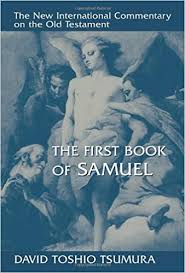
First Samuel (NICOT) by Tsumura

book sam 1

This volume is the first of a planned two-volume set covering the Books of Samuel. It’s part of the highly respected New International Commentary on the Old Testament (NICOT) series published by Eerdmans. This series never had a volume on the Books of Samuel until this volume by scholar David Toshio Tsumura came along and we eagerly await the volume on II Samuel. Though some reviews I’ve read do not give this volume as high marks as others in the series, my own review finds this volume to be underrated.

Even those who are slightly critical of it must confess that Mr. Tsumura  is expert on philological and grammatical matters. Scholarly students will especially appreciate its depth in the different critical approaches all the way down to the current hot topic of discourse analysis. Though he agrees with some things in critical areas that I could not, his approach would be considered quite conservative by most standards.

His Introduction begins with a basic explanation of the title of the book and then launches into a discussion of the text itself. He is quite positive about the value of the Masoretic text and compares it to the LXX and Dead Sea Scrolls. He confesses that we cannot know who wrote the books of Samuel since Samuel died in I Samuel. Though he agrees with more than I could, he still finds many of the theories of redaction in the text to be based on questionable assumptions. He digs deep into the historicity of the Books of Samuel and feels confident about most of it. He gives good background material on the Philistines, the Canaanites and all their influence including the gods of the area, and the prevalence of necromancy.

From there he goes into grammar/syntax and discourse analysis and shows us his specialty. He even addresses the poetry that can be found in the Books of Samuel. The section on literary structure and themes was well done as was the brief section on the theology of Samuel. The introduction ends with a detailed outline and a select detailed bibliography.

The commentary proper is quite full and a real help to those studying this book. There is more of an emphasis on philological matters than theology or application, but as I said before, the book is better than some people give it credit for being. It actually stands up well with other volumes in the NICOT series and I recommend it.

I received this book free from the publisher. I was not required to write a positive review. The opinions I have expressed are my own. I am disclosing this in accordance with the Federal Trade Commission’s 16 CFR, Part 255.