The Message of Daniel (BST) by Dale Ralph Davis

Here is a fine volume on Daniel by Dale Ralph Davis, who is simply one of the best writers today on any Old Testament historical portion, in the Bible Speaks Today series. Helpful in the ways usually found in this series, this volume is also particularly so for preachers. It delivers at a level we have come to expect from Mr. Davis too.

The Introduction is short, but powerful in its easy repudiation of critical theories and dating. I would even call that section fun to read. I found myself agreeing with much of what he wrote.

Again, the history was superb here. Background on Babylon and the Jews in Babylon was illuminating. From thoughts on the diet put before Daniel and his friends to Nebuchadnezzar’s mindset or dream the reader gains much and through the more famous stories as well. He brings out the information and insights most needed

Since I have a different perspective than him on prophecy, I could not agree him on passages like, say, Daniel 9:25-27. Still, he was kind in presenting his amillennial case, and the other historical sections are well worth the price of the book. I would already label this my favorite from that prophetic viewpoint though I hold to a different one.

The book is enriching and I highly recommend it.

I received this book free from the publisher. I was not required to write a positive review. The opinions I have expressed are my own. I am disclosing this in accordance with the Federal Trade Commission’s 16 CFR, Part 255.

danielbst

Return To Me by Mark Boda

return

Here is a volume the New Studies In Biblical Theology (NSBT) series that tackles the theological hot-potato issue of repentance. Author Mark Boda strives to give us “a biblical theology of repentance” with this volume in the series edited by the well-known D.A. Carson.

The most valuable feature of this book is the in-depth tracing of repentance in every part of Scripture. He divides the Old Testament in the Jewish way as he feels that is more sensible for following repentance through the Bible. He has strong convictions about the Word of God, which I appreciate. He feels the typical approach of viewing the subject through the definitions of the words involved is insufficient. Following that theory, he traces more of the big picture of repentance. Repentance is more in some parts of the Bible than others, but he succeeds in finding what degree repentance is there. He is thorough.

It was surprising that the book is 80% Old Testament, but perhaps that is only because the New Testament talks much less of it. I found it easy to agree with many things he said. It seemed a little much to say repentance was a big theme of John when the word is only mentioned once. Still, you felt in the hands of a capable scholar as you read.

He references the theological battles involving repentance, but really does not address them. He seemed to want to lay the data out there so others could take it into the battle and think for themselves. I can not imagine anyone writing on this subject again without consulting this volume. For this volume set out to do, it succeeded all the way.

I received this book free from the publisher. I was not required to write a positive review. The opinions I have expressed are my own. I am disclosing this in accordance with the Federal Trade Commission’s 16 CFR, Part 255.

Perspectives On Israel And The Church: 4 Views by Brand

israel church                                                                                                                                                 Here is another fine volume in B & H Academic’s Perspectives series. This volume tackles viewpoints on Israel and the Church, which means a debate between dispensational and covenantal thought. This volume, edited by Chad Brand, discusses the four most prominent views though there is even more variety out there. You will read on the traditional covenantal view (Robert Reymond), the traditional dispensational view (Robert L. Thomas), the progressive dispensational view (Robert Saucy), and the progressive covenantal view (Tom Pratt Jr.). The editor Chad Brand assists on the progressive covenantal view as well.

All the authors are scholars and some have been well known in this subject for years. Each was fairly dogmatic, as you would expect in such a series. Only Mr. Reymond seemed to go too far in harshness. While I must disclose that I do not agree with his position, I even wonder if those who hold that position would think he had a good approach. He also used extreme examples like quoting John Hagee as if he were the best representative for dispensational thinking.

All of the other three wrote more respectively and gave much food for thought. It seems issues on election, the Millennium, and other topics intersected strongly with this subject, but the authors did a good job only referencing the points that made sense to the Israel/ Church issue.

This volume did not change my mind, but it did suggest points that I needed to think through. What more could you ask for in a series like this? I recommend it.

I received this book free from the publisher. I was not required to write a positive review. The opinions I have expressed are my own. I am disclosing this in accordance with the Federal Trade Commission’s 16 CFR, Part 255.

I Don’t Know A Thing About Revival

revival

I really don’t know anything about revival. Very few people could actually say that they have ever seen a real revival, but perhaps you are like me and sure would love to see one. I could say I have always been fascinated by it, and have read of it on several occasions. While I don’t know anything personally about a real breath from Heaven that sweeps through an area in a miraculous way, I would like to point out a few things that I have noticed from those who have experienced and written about it.

Let’s be sure on the front end that we are on the same page in what we mean by revival. I am not speaking of personal revival, or one of those special times in our Christian life. I am not talking about a time where evangelism was highly effective. I refer to a miraculous moving of the Spirit of God that must be traced to the mercy of God.

I think a study of revival from historical sources would bear out these things:

  • Revival is preceded by intense prayer.

Pick up any record of real revival and you will see a pattern of prayer. Usually it involves many praying, but not always. It is a time of serious prayer as opposed to the careless prayer you and I so often get caught up in. Months of praying, nights of prayer with forfeited sleep, intense praying—this is the prayer you find preceding a revival. While God gives revival, He is apparently willing to be asked for it.

  • Revival will first show up in confession of sin.

You will be amazed as you read of God’s people confessing their sins as being the tipping point for revival to break out. There are so many little hurts and hard feelings between us and these are quite obviously a great hindrance to revival. You might say a key to revival is removing hindrances. Apparently, the Lord finds us not too interested in revival as long is sin is unconfessed and grievances unfixed. Many remembrances of revival will point out that people’s sin became almost overwhelming in their minds, but led them to seek the Lord in a way they never had before.

  • Revival will come on the Lord’s terms.

Some who taught that a formula could be followed that would guarantee revival have been proven wrong. Charles Finney sometimes taught that, but his own life disproves it. His great revivals dried up while his formula kept right on going.

  • Revival does not fit our preconceived boundaries.

Of course not every claim of revival has been real, but revival has not stayed within the boundaries we would prefer it would either. Every denomination that held to the Gospel, had a strong Christology, loved the cross, and professed the Bible to be true has had great revivals in the past. Baptists, Presbyterians, Methodists, and on and on have been blessed with glorious revivals, but not one of those groups has really outdone the others in seeing great Revivals. Secondary issues have often even been laid aside in revivals. Not that each involved did not have strong feelings about those issues, but revival is not the time to battle them. Mode of baptism, Calvinistic debates, church government—I have never read of a revival where these things were strongly debated.

For example, Charles Finney and Jonathan Edwards were both instruments in God’s hands in revival. Strangely enough, both men have fans today who strongly criticize the other. Charles Finney was wrong about original sin, but he is more strongly criticized for originating altar calls, or invitations. Others today would strongly criticize the followers of Edwards for never using altar calls. Both sides have a problem—God blessed Finney and Edwards. There is no problem in our deciding which man was more theologically correct, but we are less than honest if we claim God did not use either one of them. Some books have been written, particularly against Finney, which skew the facts. There were abiding results following the revivals both were involved in. There were also anomalies in both revivals. Edwards did a great job in reporting those he knew of. Actually, every real revival seems to have some of those. Apparently, the Lord is not concerned with massaging our egos about the supposed superiority of the group we are in.

  • Revival is local.

For my whole life I am always hearing that we should pray for revival in America. If history is any judge, it will not start on a nationwide level if it comes. Likely our dreamy fascination that some great politician is going to come along and deliver us confuses our thinking. Revival starts somewhere, and at best, grows from there. We would be better served to beg God to send revival to our congregation, or our community, and see where He takes it from there.

Please join me in praying for revival!

Here are some book suggestions that I have read (most of them lately).

  1. Handbook Of Revivals by H.C. Fish

The chapters give history and teaching on revival from first-hand witnesses. The chapters are not of equal value, but the book is worthwhile.

  1. When The Fire Fell by George T.B. Davis

A little book with some great history of various revivals.

  1. By My Spirit by Jonathan Goforth

A gem! Confession really played a role in the revivals he was part of in China and Korea.

  1. Power From On High by John Greenfield

This little volume is a history of the great Moravian Revival of 1727. Gets sidetracked promoting the Moravians at times, but a good read still.

  1. Revivals of Religion by Charles Finney

A very popular title where if you ignore his thoughts that certain steps guarantee revival the rest of the book is quite helpful.

I plan to review others in the future. God bless!

Do We Need The New Testament? By John Goldingay


We must applaud volumes that encourage us to see the Old Testament in all its splendor. Too many push it back to secondary status. Enter Old Testament scholar John Goldingay who makes his attempt to shake up our thinking on the subject. His aim is ” letting the Old Testament speak for itself.”

There are pluses and minuses in this volume for sure. The author writes well, knows the scholarly issues out there,  and can be quite thought provoking. His chapter on “The Costly Loss Of First Testament Spirituality”, for example, covered several trains on thought that I had never thought of, particularly on the Psalms and worship.

There were also chapters, like chapter four on Grand and a Middle Narratives, that I simply could not get on with. Perhaps that says more about me as a reviewer than him as a writer–I am not sure.

I imagine some will love this book and rate it highly, but for me it was marred by his suppositions that led him far afield. He has so little regard for the historicity of the Bible, thinks books like Jonah and Ruth must be fictional, and his claims of their abiding value are undermined by his view of dating.  His ideas of memory may be a trendy, new scholarly view, but it seems bizarre to me.

His last chapter fails completely in how it deals with Christology in the Old Testament, and I believe a majority of Christianity would think so. I will be curious to read future reviews. I will be curious, too, with his being such an influential scholar what will come of his discussion. He did at least succeed in making you feel he loved the Old Testament. You will have to check this one out and decide for yourself.

 I received this book free from the publisher. I was not required to write a positive review. The opinions I have expressed are my own. I am disclosing this in accordance with the Federal Trade Commission’s 16 CFR, Part 255.

Haggai, Zechariah & Malachi (Apollos Commentary) by Petterson

The latest offering in the Apollos Old Testament Commentary series, published by IVP, covers the last three of the Minor Prophets where most pastors and Bible students are a little less savvy. If this volume is a precursor of what is to come in this series, it is going to be incredible.

Mr. Petterson was an unknown scholar to me, but writes as well any I have seen. His judgments are conservative, logical, and mature. He brings these three prophets to life in a way that will be a help to those who teach or preach God’s Word.

He gives us a General Introduction for the three prophets in the first 40 pages. The section on Historical Context was superb and really made clear how the times fit in to these prophet’s messages. He also gave us an overview of the methodical approaches to the prophets without dragging us into glassy-eyed boredom. Ever better, he easily dispatched some of the lunacy that somehow often derails the scholarly world.

After that Introduction, each prophet is tackled individually with its own Introduction and thorough commentary. After his own translation, he gives us notes on the text, form and structure, and comment. I found the comments very helpful. I felt I had a much better understanding of these three prophets after reading in this volume.

This commentary is a clear winner and I hope Mr. Petterson gets future commentary assignments as well.

I received this book free from the publisher. I was not required to write a positive review. The opinions I have expressed are my own. I am disclosing this in accordance with the Federal Trade Commission’s 16 CFR, Part 255.

The Hiding Place by Corrie ten Boom

What a joy to see Hendrickson Publishers select this title for their new Classic Biography series in lovely bindings. The series aims to reprint the greatest biographies and this title qualifies as, perhaps, the best of its kind. I am at a loss to tell you just how extraordinary The Hiding Place really is. Beyond the timeless story, the book is well written and designed for easy reading. Teenagers to the aged need this book.

To think of a simple, God-fearing family of watchmakers in the Netherlands and then watch this same family rise to the heights of faith and action when the Nazis overran their simple existence is a spiritual journey for every reader.

After the background of their lives is vividly set in an economy of words, the story of their work in the Underground to rescue persecuted Jews with all its twists is given. Had the story ended there it would have been a testament of love, sacrifice, and dedication.

But the story did not end there. They were arrested. The father died. The first prison seemed terrible until you read of the next one. This is when faith and a growing closeness to Christ really rose and becomes a challenge for every Christian reader.

The last prison was a city of horrors, but they found a way to trust the Lord and serve Him in an amazing way. The also saw the Lord do things that were truly miraculous in the midst of their incredible suffering. Getting the Word in each prison shows how the Lord reaches out to those who turn to Him. That Word sustained them just as the Lord promises it would.

They learned how to see the Lord’s hand and be thankful for it, all the way down to the fleas (read it, you will see). The sickly, broken Betsy faced death as the victor that in Christ she truly was.

This story is not merely moving biography, nor even inspiration. No, it is one of the greatest challenges of faith you will ever lay your hands on. Truly, one of the greatest Christian books of all time!

I received this book free from the publisher. I was not required to write a positive review. The opinions I have expressed are my own. I am disclosing this in accordance with the Federal Trade Commission’s 16 CFR, Part 255.

hiding place

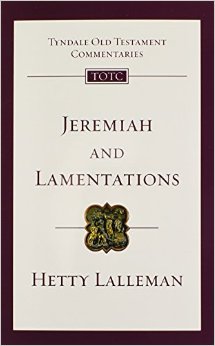
Jeremiah and Lamentations (TOTC) by Lalleman

The Tyndale Commentary series, published by IVP, continues its revision in this successful replacement volume for Jeremiah and Lamentations. In fact, this volume is superior to the R. K. Harrison volume it replaces–if for no other reason, it gives us 373 pages to 240. The longest of the Prophets needed those extra pages for sure.

There are fine, succinct Introductions for both Jeremiah and Lamentations. The section on historical background was well done and fits Jeremiah into Israel’s history, as well as international influences. His life and ministry covered the final dark days of a people who had little time left for the Lord all the way through their overthrow and subsequent captivity. This history explains the hard words we often find here and makes more poignant the promises of restoration.

Their is only a little talk of redaction as the author lands on the text as we have it for commentary purposes. This is far superior and spares us the endless speculation some commentaries are compelled to encumber us with. There are other helpful discussions: the key word “turn”, how “falsehood” in false prophets is a recurring theme, and suffering which hits prophet and people alike. Finally, the New Covenant and Jeremiah in the New Testament finish out the helpful introduction.

The commentary proper offers thoughtful help. Perhaps you will still find some passages with less commentary than you wished, but that is likely only because Jeremiah is so long. Still, you will find it worth consulting.

In my opinion, this commentary is not quite as good as another commentary published by IVP and aimed at a similar audience, “The Message of Jeremiah” by Christopher Wright. Still, multiple helps on Jeremiah are so beneficial, and at this price how could you go wrong? I recommend it!

I received this book free from the publisher. I was not required to write a positive review. The opinions I have expressed are my own. I am disclosing this in accordance with the Federal Trade Commission’s 16 CFR, Part 255.

jeremiah totc

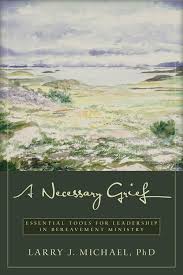
A Necessary Grief by Larry Michael

As pastors we certainly need guidance in helping our folks as they go through bereavement. This book, subtitled “Essential Tools For Leadership In Bereavement Ministry”, certainly provides that help. It helps get inside the thinking bereaving ones are going through more effectively than most such volumes that I have seen.

The author defines grief and how it impacts people differently. He covers the many emotions that may arise, yet he warns us that thinking of it as a process may cause us to misunderstand those grieving. “Steps” may not be in order, nor may every one show up in every person.

He well presents many fallacies where we may be giving unhelpful advice. He also teaches us to avoid the clichés that we so often use because most are actually shallow and make us seem not to care. That is followed by helpful things to say and do. The book finally transition to expanding our help to full-blown bereavement ministries. It is all well done. The appendixes add even more value.

As I read this book, it seemed to be an updating for our generation for what Wiesbe’s “Comforting The Bereaved” said a generation ago, and Blackwood’s “The Funeral” did for the generation before that. All three books would likely cover that subject quite well in your library. This volume is a success in speaking to our day and I recommend it.

I received this book free from the publisher. I was not required to write a positive review. The opinions I have expressed are my own. I am disclosing this in accordance with the Federal Trade Commission’s 16 CFR, Part 255.

grief

A Truth We Baptists Should Never Forget (IBTR #68)

Sometimes in a series like this we discuss denominational pride, or in our case, believing that Independent Baptists are the only ones who are serving the Lord in an effective way. In recent articles we mentioned the extreme Baptist Brider position and its more common counterpart, the belief that we must separate from any who are not Independent Baptists. As you would imagine, once you start down that road the next step becomes separating from Independent Baptist who are not Independent Baptist enough.

I am on record as an Independent Baptist who finds that wrong, an example of misguided thinking and unbridled pride. Instead of exposing that as pride in this article, however, I would like to offer a fact that should be faced in any discussion on this subject. Maybe I should put it as a question.

How do you explain the mighty things God has done in other Christian groups? Further, how do you explain the incredible faith, love of Christ, and wonderful service of individuals in other Christian groups?

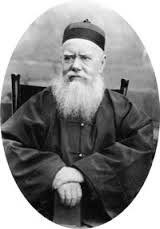
How do you explain Hudson Taylor, or George Mueller, or Jonathan Edwards, or George Whitefield, or John Wesley? These Christians were men of faith, but not Baptists. Human? Yes, but they are some of the choicest servants of Christ ever and only a twisting of the facts could state otherwise.

I began thinking of these questions as I was reading and reviewing The Korean Pentecost this week. It is the story of Presbyterians, some men I had never heard of, who took the Gospel to Korea. In 1865 Robert Taylor took passage on a boat up into Korea to take Bibles and be one of the first missionaries there. After being able to give out Bibles at a few stops, rumors took fire that this boat crew came to rob the Koreans. Long story short, when the boat grounded and was set on fire by the Koreans, the crew took its only chance and charged the shore with weapons. They all died. It wasn’t until missionaries returned years later that it was discovered what happened. They were told the story and how all the crew were killed. They recounted, though, that one man came ashore without weapons but arms filled with Bibles where he handed out all he could before he died.

The other extraordinary thing about that story was that the missionaries discovered many pockets of believers where that man handed out the Bibles. Who could deny that God’s hand was incredibly upon that man who gave his life for his Savior? As that Presbyterian work continued through the years, an incredible revival came, which was followed by persecution where many other bold believers gave their lives for Christ.

So back to our question. If God’s hand is only upon we Independent Baptists, how can this and the many stories like it be explained? God has blessed the work of Baptists. He has blessed the work of others. The Lord has sent revival to Baptists. He has sent revival to others. Baptists have given their lives for Christ. So have others. We have an incredible heritage, but so do others.

We can, of course, disagree on a few points in our efforts to be true to Scripture as best we understand it. In the case of those Presbyterians, we would differ from them on Baptism, church polity, and a few other things, but that in no way proves our superiority over them. Again, that tracing of God’s hand in both groups makes that an opinion that cannot be logically held.

So we must humble ourselves and drop a belief that cannot possibly be true. This is a truth we Baptists should never forget.

Find all articles in the series here.

J.-Hudson-Taylor