A Minister’s Obstacles–An Awesome Reprint

book turnbull

I’m excited to see this superb book reprinted. I found an old copy of this book early in my ministry and it made quite an impact on me. It’s crazy that it went out of print. It’s truly one of the great titles on the ministry that has been written. In fact, when I started a series a few years ago on the best books for ministry, I recommended this book. (Read me earlier review here).

The story behind this reprint is touching. Marty Moon fell in love with this book and was saddened to realize that preachers today did not have it available to glean from. He also wanted to give a gift to his pastor, Bill Lytell of Gospel Baptist Church, on the occasion of his 25th anniversary as pastor. On March 5, 2017 Pastor Lytell was presented with a copy of this book reprinted in his honor. Clearly, Mr. Moon saw in Pastor Lytell the great traits exemplified in this book.

Your pastor would likely be blessed by a copy too.

Click here to find on Amazon.

Luke (ZECNT) by David Garland

book-luke-zec

With every new title in this Zondervan Exegetical Commentary on the New Testament series that I delve into, I find my appreciation growing. This series is well conceived and this entry by seasoned-commentator David Garland adds to the laurels of the series. In addition to commentaries on a few New Testament epistles, Mr. Garland has already produced a volume on Mark in the NIVAC series. He is equally at ease in either the Gospels or the epistles.

In his Introduction to Luke, Mr. Garland discusses the authorship of Luke and Acts. In accepting Luke as the author, he strives to dig a little deeper into who Luke actually is. He keeps his discussion of Luke’s sources mercifully brief and jumps on into the genre of Luke and Acts. He sees Luke as both an historian and apologist. The next section is called “date, provenance, and the readers of Luke-Acts”. Unlike some other commentaries I’ve read, he discusses those three issues together rather than separately. There’s even in that section some great information that some others might put in the category of structure. He makes some nice, valid points about Luke’s purpose in writing this gospel. The only disappointment in the Introduction is that his section on structure is only an outline.

I found the commentary proper of even more value. That’s not to say I didn’t disagree with him on some points. For example, the meaning of the word “inn” in the birth of Christ is much more conducive to the traditional meaning that Mr. Garland seems to believe. Most other commentators would not agree with him on that one either. Still, the commentary is of extraordinary value. Every passage I surveyed offered the kind of things I’m looking for in a commentary.

Mr. Garland appears comfortable with the ZECNT format. In each passage, he discussed the literary context, stated the main idea, offered his own translation, explain the structure and literary form, and gave an exegetical outline before launching into a detailed explanation of the text. That is followed by a theology in application section that helps preachers bridge the gap between exegetical information and the sermon.

Having reviewed the volumes on Mark and John, and now reviewing this volume on Luke, I’m amazed at the quality this series has given us on these three Gospels. This volume is ideal for pastors. Think of it as being helpful like the NAC series with a little more depth. I warmly recommend it.

I received this book free from the publisher. I was not required to write a positive review. The opinions I have expressed are my own. I am disclosing this in accordance with the Federal Trade Commission’s 16 CFR, Part 255.

Luke (NAC) by Robert Stein

book-nac-mark

Robert Stein has written a quality volume for the New American Commentary series. I have long felt that the NAC series is a top choice for pastors in terms of content and price. Though the volumes are slightly shorter than some of the other exegetical commentary series, the help these volumes provide is still top-notch. This volume on Luke is one of the better volumes in the series.

The Introduction is succinct, power packed, and covers an amazing amount of information in its pages. In just a few pages he covers the authorship of Luke by examining internal evidence, church tradition, and the “we” sections and, to my mind, unanswerably proves that Luke was the author. He surveys well the various opinions on the date of Luke. He reminds us that Acts was never intended to be either Paul or Peter’s biography, but sought to tell the story of taking the gospel to the world. Though such things are highly suspect to me, he covers scholarly opinion on the sources of Luke. Though he finds outlines rather arbitrary, he provided a good one.

I fully agree with his conclusion that the purposes of Luke ought not be pigeonholed into a single purpose. He explains what he believes to be the four main purposes of Luke and provides a great deal of detail in explaining his case. I thought it was effective. His section on the theological emphases in Luke was also highly suggestive. By the time you get to the fine map that ends the Introduction, you may feel as I did that it was the kind of Introduction that really helps a pastor.

I found help in the many passages I reviewed in this volume. He was never trite, and he provides real assistance to one who preaches the Gospel of Luke. I highly recommend this volume to all my fellow pastors out there. You won’t be disappointed.

I received this book free from the publisher. I was not required to write a positive review. The opinions I have expressed are my own. I am disclosing this in accordance with the Federal Trade Commission’s 16 CFR, Part 255.
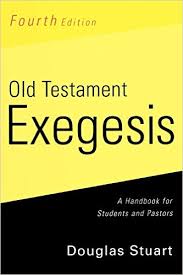
Old Testament Exegesis by Douglas Stuart (4th edition)

book-ot-exegesis

Subtitled “a handbook for students and pastors”, this volume has been a standard in the field for many years. Now in its fourth edition, it is poised to continue its usefulness for many more years. Mr. Stuart is a highly-respected Bible scholar, who has written several outstanding commentaries. I’ve enjoyed using several of them myself. In this volume, he goes through his process of performing exegesis on Old Testament passages. This book is especially valuable for those new to exegesis.

The structure of the book, with every section and subsection numbered, makes using it as a reference at any point of the exegetical process very efficient. After you work through the volume initially, you will find it easy to go back and check certain elements where you may be confused. There’s even a handy analytical table of contents at the beginning to help you zip to the needed location. While you might not have his exact method, you must think of everything he addresses at some point in the exegetical process. I don’t personally do everything in the exact order he says, but I found him to be engaging and suggestive. It even struck me as I read that there were some elements of the exegetical process that I could improve.

Chapters 1 and 2 are aimed more at students doing exegetical papers in seminary. Not only does he explain the process well, but he also illustrates his point with scriptural passages on several occasions. Chapter 3 shortens the process for pastors creating sermons. He takes the process even through application and sermon. Chapter 4 is a fine bibliographic chapter suggesting books for each phase. The suggestions are quite extensive.

The only downsides I could see in the book is that it reduced the process to such a science that the art was lost. Further, some of the language work he suggested is realistically not going to be done by pastors. Finally, if the student or pastor is just beginning, it would take years to build the library he recommends. In his defense, I’m sure he was suggesting buying one good book in each category.

You might want to check out a similar volume on the New Testament from the same publisher. Don’t miss the list of common Old Testament exegesis terms and the list of frequent hermeneutical errors in the back of the book. As a guide or refresher, I recommend this book.

I received this book free from the publisher. I was not required to write a positive review. The opinions I have expressed are my own. I am disclosing this in accordance with the Federal Trade Commission’s 16 CFR, Part 255.