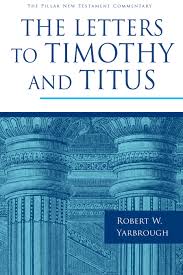
The Letters to Timothy and Titus (PNTC) by Yarbrough

book pntc pe

This commentary by Robert Yarbrough will become, I predict, a top-rated volume on the Pastoral Epistles. These epistles are ideal for the style of commentary we find in the Pillar New Testament Commentary (PNTC) series. As respected and valuable as the NICNT volumes by the same publisher are, these Pillar volumes are simply more valuable. They have a better center of focus, are more consistently conservative, and have more value for pastors without sacrificing scholarship. This volume succeeds in reaching that standard too. As you might have guessed, the editorship of D. A. Carson likely keeps this series moored to that lofty perch. BTW, don’t miss the editor’s preface where Carson fawns over Yarbrough’s work here.

I was in love with this commentary within a few pages of its fine Introduction. So many commentators lose their way in the Pastoral Epistles. I have long suspected that it has far more to do with the authors dislike of what these epistles say rather than any actual problem found within them. Yarbrough is not sucked into the irrational fear of using the term “pastoral epistles” as so many are today either. It’s a breath of fresh air.

He opens the Introduction with eight theses on pastoral heritage in these epistles. To my mind, that was a great way to present introductory issues. Next, he does a section each on Father, Son, and Spirit respectively in the Pastoral Epistles (PE). He was particularly perceptive in discussing Paul as a working pastor, even dispensing some silly critical theories along the way. He then tackles in turn geography, people, and key terms. He ends with a section on authorship and other usual introductory matters and masterfully reaches conservative conclusions.

The commentary itself was even better! The phrase “real help” comes to mind. He showed off his skill, for example, in the perpetual battlefield of Titus 2. He gently yet surefootedly takes us where that disliked passage goes. He’s kind to dissenters, careful in scholarship, but not afraid to reach a conclusion. I don’t know about you, but that’s how I like my commentaries. 5 stars all the way!

I received this book free from the publisher. I was not required to write a positive review. The opinions I have expressed are my own. I am disclosing this in accordance with the Federal Trade Commission’s 16 CFR, Part 255. 

1 Corinthians (TNTC) by Thomas Schreiner

book 1 cor tntc.jpg

Thomas Schreiner provides us an ideal commentary of the type aimed at pastors or Bible students rather than scholars. It’s part of the celebrated Tyndale New Testament Commentary (TNTC) series that’s been a favorite for decades. In fact, the value of this series becomes especially apparent when Schreiner confesses that it was a distinct help in his younger days. Talk about coming full circle!

His task, however, was daunting as he gets to replace the redoubtable editor and writer Leon Morris. Morris was exceptionally gifted for these type of commentaries, so I can see why the current editors went after a heavy hitter like Schreiner. For my money, Schreiner, who had already proven adept with major exegetical works, scored a home run here. (That’s high praise from one who will never part with Morris!)

After a nice bibliography, Schreiner turns out a thoughtful, well-constructed Introduction. He surveys the city of Corinth, Paul’s ministry there, and the occasion of the epistle. His description of the letter’s occasion was perceptive and was strengthened by several appropriate tables. Next, he delves into the nature of the letter, which is a sane look at the letter’s unity. In the section on major theological themes, he begins with the Trinity and spreads to the church. Other themes include salvation, resurrection, the Christian life, food offered to idols, and spiritual gifts. He ends with a nice outline.

The commentary itself is outstanding. If you want to see the quality of his work, look at a controversial passage like, say, I Corinthians 7 on marriage issues. Words like gentle and gracious come to mind. On the other hand, words like brave and certain come to mind as well. In other words, you will get the kind of things you are looking for when you pick up one of this kind of commentary.

This commentary is a winner all around. It’s inexpensive too. What more could you ask for?

I received this book free from the publisher. I was not required to write a positive review. The opinions I have expressed are my own. I am disclosing this in accordance with the Federal Trade Commission’s 16 CFR, Part 255. 

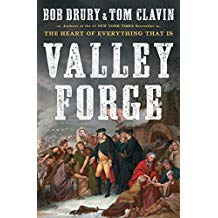
Valley Forge by Bob Drury & Tom Clavin

book valley forge.jpg

Valley Forge. Now that’s a subject worthy of its own book. If nothing else, there’s George Washington. Washington attracts great writers you know. Ron Chernow was compelled to give us a life of Washington while David McCullough gave us 1776, so it’s no surprise to me that the bestselling author team of Bob Drury and Tom Clavin were pulled to Valley Forge. Valley Forge made for one of the greatest chapters of Washington’s celebrated life and contributed immensely to his mystique. Drury and Clavin give it the treatment it deserves in this fine book.

The authors struck the right balance in setting up the famous winter in Valley Forge, telling its story, and describing what followed along with its significance. Part 1 tells us of a series of failures that led into the dismal winter. Wait till you read of Brandywine. That this book ends in great victory makes the whole story something of a microcosm of Washington’s amazing life. He had more losses than most any famous general, yet he always preserved to ultimate victory. Defeat never crushed him, the odds never defied him, and he is the poster child of fearlessness in battle. He could rally men that seemed beyond it. All in all, he makes for thrilling reading as this book turns out to be.

It would be unfair, though, to call this only a biography of an episode of Washington’s life. There are all kinds of heroes and villains to be found. For example, you will despise Charles Lee by book’s end. There’s plenty more across the field among the Redcoats too.

The famous winter is great drama as well. The suffering was real—so real that the victories in the following spring seemed unreal. My only complaint with this book is that the authors were perhaps more skeptical of some of the Christian elements than seemed necessary. I know legends always have a potential of growing, but the evidence of Washington’s genuine Christianity is greater than what’s found here.

If you love either Washington or the Revolutionary War, or for that matter any well-written slice of history, you will thoroughly enjoy this book.

I received this book free from the publisher. I was not required to write a positive review. The opinions I have expressed are my own. I am disclosing this in accordance with the Federal Trade Commission’s 16 CFR, Part 255. 

Galatians (NICNT) by DeSilva

book gal nic

David DeSilva has wonderfully replaced the volume on Galatians by Ronald Fung in the long-lived, much loved New International Commentary on the New Testament (NICOT) series. This new volume is little like its predecessor.  That volume was old enough to be written in a more expositional way than is found in the major scholarly works the series turns out today. DeSilva is fully in line with what the series has been turning out in recent years. Without a doubt, he brings many of his own specialties and a somewhat more lively writing style as well. He always has a few detractors for his strong emphasis, and to some minds overemphasis, on rhetoric, but I predict this commentary will be well received. It’s pretty conservative too.

There’s a major, thorough Introduction of over 100 pages after a substantial bibliography. First, he addresses the Pauline authorship. From there, he delves into Paul’s ministry in Galatia and the pastoral challenges he faced there. That requires a careful rendering of the false teachers there. It was an explosive battle among Paul and the false teachers and DeSilva well described it. Next, geographic issues (he favors the South Galatian view) and chronology are surveyed. Acts is consulted and a conservative chronology is pieced together over several pages.

As you would expect with this author, he dives deep into rhetorical issues. There are 40 pages on it! I don’t find that as interesting as some do but he examines it with the best scholarly standards. He ends with structure and the overall effectiveness of the letter.

Next, you get 400 pages of commentary on the epistle itself. I found it thorough, done with careful exegesis, and with a healthy coverage of issues scholars love along with some timely excursuses. Pastors will benefit from this commentary too. All in all, a fine work.

I received this book free from the publisher. I was not required to write a positive review. The opinions I have expressed are my own. I am disclosing this in accordance with the Federal Trade Commission’s 16 CFR, Part 255.

Hosea (Apollos Old Testament Commentary) by Joshua Moon

book hosea apo

The Apollos Old Testament Commentary series is starting to get out enough titles to see that we are going to have a major series on our hands. They run from conservative to moderately critical and are far more conservative overall than, say, the Word Biblical Commentary series. This latest release is a helpful volume on one of the Minor Prophets, Hosea. I enjoy having individual commentaries on even the smaller books, and this is one of the few major ones on Hosea. Only Dearman in NICOT comes to mind, yet their strengths are different enough to make both worthwhile. Both have impeccable scholarship, yet I suspect pastors might favor this one while scholars will go with Dearman. I’m glad to have both within reach. Joshua Moon is the younger scholar, and perhaps like me, you hadn’t heard of him before. I suspect a productive career for him after writing this quality commentary on Hosea. He seemed adept at commentary writing as he pitched this book perfectly for both scope and length.

The Introduction begins with an overview of Hosea’s historical backdrop. He holds to a conservative chronology. From there, he broadens his purview to Hosea’s place among the prophets. The next section looks at Hosea from a writing perspective. He says, “As will be amply demonstrated, no part of the text requires a date earlier or later than the era stated in the superscription”. He does discuss editing which always strikes me as fanciful. The sections on text and structure are a little too brief, but the one viewing Hosea in light of the Covenant was well done. Theology could have used more space too, but I suppose he saved it for the commentary itself.

The commentary is truly helpful. It’s presented in the usual Apollos style: translation, notes on the text, form and structure, comment, and explanation. I liked what I found here.

The Apollos series has another quality title here and I warmly recommend it.

I received this book free from the publisher. I was not required to write a positive review. The opinions I have expressed are my own. I am disclosing this in accordance with the Federal Trade Commission’s 16 CFR, Part 255.

The Message of the Living God (BST) by Peter Lewis

book liv gos bst

Peter Lewis contributes this book in the Bible Speaks Today (BST) series. In addition to all the fine commentaries covering all the books of the Bible, there are several like this one that covers biblical themes. The approach to explaining these themes is still one of examining Bible passages. If you happen to be studying the doctrine of God, you might find this volume along with The Message of Creation by David Wilkinson and The Message of the Trinity by Brian Edgar to form quite a trilogy. In any event, this book on the Living God covers several key passages effectively.

The book is divided into three parts: God and His world with all Genesis passages, God and His people with passages over the rest of the Old Testament, and God in Three Persons with all New Testament passages. Believe it or not, that division is not stretched.

There are many outstanding expositions here, but I found the one entitled “Genesis for today” on Genesis 1 to be particularly perceptive. Several attributes of God are brought alive here. You’ll find many underlined sentences in my copy!

This book has great value because most volumes on this subject approach it in a systematic theology fashion. We sometimes need reminding that good systematic theology should come from Bible passages first.

I’m a fan of all the books in this series and mark this down as another title well worth your time.

I received this book free from the publisher. I was not required to write a positive review. The opinions I have expressed are my own. I am disclosing this in accordance with the Federal Trade Commission’s 16 CFR, Part 255.

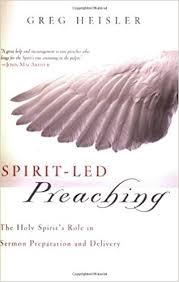
Spirit-Led Preaching (Revised Edition) by Greg Heisler

book sp led pre

Most books on preaching, and I’ve read a lot of them, only give a cursory mention of the Spirit’s role in preaching. The better ones sometimes give a chapter. Besides a book by Tony Sargent on the preaching of Martyn Lloyd-Jones, I’m not aware of any book like this helpful volume by Greg Heisler that probes the Spirit’s role in preaching. Even the Sargent book, as awesome as it is, doesn’t guide us through the whole sermon preparation process step by step with an eye on the Spirit as does this book. I somehow missed the first edition of this work, but this revised edition was a blessing and a reminder to me.

Chapter 1 challenges us to see that the most vital element, the Spirit’s help, may be missing in our preaching. What’s worse is that we may not have even felt the loss! Chapter 2 probes exactly what Spirit-filled preaching is. That aforementioned loss may mushroom for you in this chapter. If you somehow slip through without concern through chapters 1 and 2, chapter 3 will bring you before the tribunal. Jesus, the Prophets, and Paul all clearly highlight the essentialness of the Spirit in preaching. That must be the standard for us as well. Since there’s little doubt of being all in at that point, chapter 4 works through the doctrine of illumination. Here the nuts and bolts meet the Spirit. We who love the Word, and the exposition of it, find how complimentary Word and Spirit are to each other in chapter 5.

Chapter 6 looks at the Spirit and sanctification. Here the preacher himself and the Spirit are in view. The next chapter takes the preacher again through the sermon preparation process from text selection to ready to preach again with the Spirit. Chapter 8 glides into sermon delivery with the Spirit. Chapter 9 is a breath of fresh air as it takes the Spirit to the congregation. The value of listening is even probed. Chapter 10 is something of a challenging summary.

I’m impressed with this book. Its contents are desperately needed in our day of programmed, sterilized preaching that would rather give pointers for self-improvement than deliver the Word of God that throbs with life and has the power of the Spirit to bring it to life for you. Every preacher needs a library of key books on the ministry. Make sure this book is in yours.

I received this book free from the publisher. I was not required to write a positive review. The opinions I have expressed are my own. I am disclosing this in accordance with the Federal Trade Commission’s 16 CFR, Part 255.