Books on the Ministry #4

ministry books 4Here are 3 more classic books on the ministry.

1. The Cure of Souls by John Watson (Ian Maclaren)

This Scottish preacher wrote under the pen name John Watson and published several volumes of his sermons. He could be a little sloppy doctrinally, but his viewpoint on preaching was spot on. I can just hear his Scottish brogue as I read. This was the 1896 Yale Lecture.

“Cure” sounds like thick Scottish for “Care” ( I read it is actually Latin) and so he writes about the ministry. He begins with forming sermons and he gives good guidance. He explains how when we preach about everything, we really preach about nothing. He says these casual sermons come either from slackness or laziness.

Chapters 4 and 5 drag, but be sure to read on as chapters 6 through 9 are exceptionally good. You will smile as he tells about church members who are dissatisfied with everything. He calls them “mutineers” and says “…a ship may weather many storms from without, but mutiny among the crew is destruction.” His solution? Every church should refuse them and they could all get together and make their own church! Since no one would want to pastor them, a pastor who has wrecked two churches “by bad temper and overbearing conduct” could be sought for them. See why these old books can still be so valuable because so much of the ministry never changes!

When he speaks of being a prophet versus being an organizer, he sounds like he writes today. He respects and shows the value of small works too. Many ministry books today write that off as failure in these success-mad days we live in.

Whether it is call for confidentiality, or the egotism he hears in some public prayers, or the description of the good side of ministry, every preacher should read it.

2. The Ministry of the Word by G. Campbell Morgan

Here is master preacher who gives us his thoughts on the ministry. He discusses the man in the “ministry of the word.” He begins by digging out the meaning of “ministry” and the “word” and describes them as the fundamental conceptions.

Then in 4 chapters he compares and contrasts the Apostle, Prophet, Evangelist, and Pastor/Teacher. He sees them as different gifts among those who preach, though there are no more Apostles today. He fills like no one will be gifted in all these areas. He does argue persuasively that pastor and teacher are the same office.

In the final four chapters he deals with modern application for these roles he dug out. They are really good. He says that he never asks someone to enter the ministry as the Lord calls Who He wills. Though that call appears different in different personalities, the call is there none the less. He feels the clearest evidence of a call is the gift for it. A Pastor, for example, should have a clear gift for teaching.

His epilogue on prayer keeps the true source of power before us. What a gifted preacher he was and it is worth hearing what he has to say.

Read more on Morgan here.

3. Ministerial Life and Work by W. H. Griffith Thomas

This title isn’t as known as some, but it should be. This is an abridgment of his The Work of the Ministry, but likely all we need is here. He was a popular author who had a profitable ministry.

He has six good chapters on we men in the ministry by reviewing the ministry of the prophets, the Twelve, Paul, and as described by certain epistles. It is well done.

In the second half of the book he writes about the work itself. It is very detailed on certain aspects of the ministry like worship, preaching, visiting, Sunday School, and even prayer meetings.

This is a very good volume.

More in this series on the ministry books:
You can find all posts and books in this series reviewed in the Introductory Post.
Introductory Post

Previous Post

Next Post

Books On The Ministry #3

ministry books 3

From the treasure trove of great books on ministry, we review three more classics.

1. The Pastor-Preacher by William Quayle

It is hard to relate how good this book really is. It is provocative in its description of the ministry. Every chapter is outstanding and many sentences make memorable quotes. When he first describes the preacher, you will be hooked. He says, “It takes more courage to be a preacher than to be a gladiator, or a stormer of fortresses, because the preacher’s battle is ever on, never ceases, and lacks the tonic of visible conquest.”

How about this perspective? “We are come to give ourselves. A preacher is to give himself…A man is an estate; and at death should any of that estate be left in hand the man is by so much a failure…Jesus had nothing left. Empty as a drained cask; that is Christ’s new program for life.” Or this of the preacher: “ He is not the trumpet, but the trumpeter; not the sword, but the soldier.”

This he says of what we preach: “So the preacher must know the way to the Hidden Source. He must trail tendencies. He must keep to the main stream; and the rivulets he must pass only giving them a glance….” How that would revolutionize preaching today!

He challenges us to be men of prayer or not be a man of God. He also explains that we must be a mystic. We must hear things from above. We must have wonder and imagination. He tells us be but not be consumed with the age we live in, but the ages.

He is as powerful in presenting our work with people as equal to our work in preaching. He ends with practical help with various types of visits.

This book should be on every pastor’s shelf.

2. Heralds of God by James Stewart

Mr. Stewart ministered in Scotland. This volume was originally a Warrick Lecture and is organized around five subjects for the preacher: his world, theme, study, technique, and inner life.

We are in this world as a herald of God to people who are disillusioned confused and need to hear of our Lord. We are to smash that disillusionment, he says, with the Cross of Christ.

He reminds us to be sure we worship as we lead worship. He is one of the best I have read in describing how the sermon itself is a key component or worship. That is so often forgotten today. He speaks to what I’ve heard many preachers talk about–running out of fresh ideas for sermons. He proclaims: “The longest ministry is too short by far to exhaust the treasures of the Word of God.”

He makes it beautifully clear that Christ must be our theme. We must be careful not to be swallowed by side issues.

When he speaks of our study, he encourages us to throw our all into it because of the importance of the message we have to preach. We work with treasure. To better know how to preach to men, better know God. He also makes a powerful plea for expository preaching. As he says, “Let the Bible speak for itself.” He says it will deliver us from monotony. He is right!

After giving practical advice on technique, he launches into our inner life. He argues that we must take heed to ourselves before we do so for the flock.

This is another winner!

3. The Christian Pastor’s Manual, compiled by John Brown

This is a reprint originally published in 1826. Soli Deo Gloria and Solid Ground have reprinted this fine volume. Every chapter is written by a different preacher of that era. Some are better than others, but all are good. The chapters may read slightly slower being from that period, but are worth the time. You might enjoy reading one chapter a day and then mulling it over.

I especially recommend the chapter on “Pastoral Cautions” by Abraham Booth. These and other chapters remind us again how so many facets of ministry never change through the centuries.

Young or old, you should ponder the chapter by Isaac Watts called “Questions Proper for Young Ministers Frequently to Put to Themselves.” I finished it only to pray: “Help me Lord.”

Hope you can get these great volumes.

MORE IN THIS SERIES ON MINISTRY BOOKS:
You can find all posts and books reviewed in this series in the Introductory Post.
Introductory Post

Previous Post

Next Post

Books On The Ministry #2

ministry books 2

Here are three jewels on the ministry. Some are more well known than others, but all are 5-star volumes. Several of these were reprinted by Baker in a series called “Notable Books On Preaching.” If you ever see one of them at a used book sale, by all means pick it up.

1. The Preacher: His Life And Work by J.H. Jowett

Jowett was an incredible preacher and this volume made up one of the famous Yale Lectures On Preaching (1911). When I first read this over 10 years ago, the realization came to me just how truly the ministry was work. Particularly, he laid bare the vital truth that preaching is work. Sermon preparation should be intense work. Anything less is unbecoming our great task.

His opening chapter puts the importance of our calling in its proper place. Next, he tackles the perils of the preacher. Listen carefully as he speaks of “deadening familiarity with the sublime.” I personally believe this is one of our greatest dangers. In the next chapter on “The Preacher’s Themes” with its emphasis on “feed my sheep”, he points out that we are both responsible and accountable for this very thing. How honest and careful we must be in this task.

When he discusses “The Preacher In His Study” he said things like: “We must make the businessman in our congregation feel that we are his peer in labor.” He in no way meant that in show, but in reality. When he gets done you want to roll up your sleeves and run into your study and get going.

He goes on to cover our work in the pulpit itself as well as in the homes of our people. When you read these classic volumes on the ministry, you will find an emphasis on being in the homes and lives of the people you pastor. The idea that all visiting should be about getting new people in the church would horrify the old masters who took seriously their role as shepherd.

This is a must-have volume!

2. A Minister’s Obstacles by Ralph Turnbull

This volume is a perfect follow-up to Jowett’s The Preacher: His Life And Work. Mr. Turnbull wrote this book in 1964 and it was incredibly influential and for good reason. You will notice how widely read he was in the great books on preaching before him. It is no surprise that he edited Baker’s “Notable Books On Preaching” series.

His chapter titles alone will grab you. Consider “The Specter of Professionalism”, “The Vice of Sloth”, “The Dry Rot of Covetousness”, “The Bane of Jealousy”, and “The Paralysis of Pride” among others. The contents are as convicting as the titles.

He had so many great things to say. I marked in my copy how he even broached the subject of moodiness in preachers and how we must guard against it.

This is a great volume!

3. A Minister’s Opportunites by Ralph Turnbull

A worthy sequel to his A Minister’s Obstacles. It is set up the same way, but in positive terms. The titles are as riveting and the subject matter needed. He begins with “The Certitude of Vocation.” Again, he wants us to see the task before us. I love what he said here: “If the ministry degenerates to a ‘job’ with demands of monetary returns for services rendered and a tendency to unionize conditions and terms, then the peril of being the hireling and not the shepherd is obvious.” That still speaks to our day.

When he addresses “The Stewardship of Time”, he distinguishes the Father’s business and busyness. He challenges us to self discipline and hard work. I love his discussion of study and books, though not everyone gets into that subject as I do.

His chapter on “The Power of Ambition” is worth the price of the book. He coaches us to avoid “dreams of grandeur and aggrandizement.” He cautions against being “content with externals and to be careful as “success is a catchword of our secular age.” Thirty years has only deepened the problem.

Not quite as influential or good as his earlier volume, but it is worthy acquisition.

Happy hunting on the used book sites!

MORE IN THIS SERIES ON MINISTRY BOOKS:
You can find all posts and books reviewed in this series in the Introductory Post.
Introductory Post

Next Post

Books On The Ministry #1

ministry books

I have made it a point since I was called into the ministry to collect the best books on the subject and read them carefully. I scoured recommendation lists everywhere I could find them. Several volumes a year has been my standard fare. The value of these volumes is beyond calculation in their impact on my life.

As I have recently ended my first pastorate, and as I anticipate my next ministry, I find myself carefully reevaluating, rereading, and looking for new volumes to help me be what the Lord wants me to be. I remain convinced that the ministry is the highest calling. If that be so, then it is worthy of the greatest effort, the greatest care, and the most intense of study.

In the beginning I read the classics on the ministry. Hardly any of them were from after 1950. That they were so helpful only proves the timeless nature of the ministry. In recent years I took on newer volumes and found that wonderful things are still being written. The whole spectrum is needed.

Many pastors feel that a few good books on any subject or book of the Bible are all that are needed, and while that may work in other categories, it is a huge mistake in the area of the ministry. Gentlemen, it is what we do. Like any other life’s work we should be continuing our education and be aware of what has been said on the subject.

Then there is the obvious concern with our lack; our need glares as we go from one blunder to another. Many of these volumes were written by men in the twilight of their ministry as they had the reflection natural as the end is in sight. We readers have the value of their successes and failures forging the words on the page.

So I introduce a blog series writing about these great books. I will not be giving them in any particular order. (I can’t—they are boxed and in a mountain of boxes during this transition time in my life). I can only give them as I find them! I write this as I am trying to help myself and thought it might be a blessing to share on this blog. Books on preaching and pastoring will be reviewed. Some volumes push one at the expense of the other, but we can apply the needed balance as we read.

I so recommend that everyone in the ministry load up the shelf on ministry books and read carefully. I give it to you as a test. Try it and see if you aren’t helped and blessed immensely.

Let’s join together and buck the trend that is destroying the ministry as many are reshaping it as the world pleases. Let’s fight the pressure to change us into entertainers, promoters, and mere organizers when souls are still in the balance and God’s glory is on the line.

BOOKS REVIEWED: (Just Click on the link to see the reviews)
Books on the Ministry # 2

1. The Preacher: His Life And Work by J.H. Jewett, 2. A Minister’s Obstacles by Ralph Turnbull, 3. A Minister’s Opportunities by Ralph Turnbull

Books on the Ministery #3
4. The Pastor-Preacher by William Quayle, 5. Heralds of God by James Stewart, 6. The Christian Pastor, complied by John Brown

Books on the Ministry #4
7. The Cure of Souls by John Watson, 8. The Ministry of the Word by G. Campbell Morgan, 9. Ministerial Life and Word by W. H Griffith-Thomas

Books on the Ministry #5
10. Under the Predictable Plant by Eugene Peterson, 11. The Sacred Wilderness of Pastoral Ministry by David Rohrer, 12. The Six Deadly Sins of Preaching by Robert Reid and Lucy Hogan, 13. Dangerous Calling by Paul Tripp, 14. Leading On Empty by Wayne Cordeiro

Books on the Ministry #6
15. Preachers and Preachers by Martyn Lloyd-Jones

Books on the Ministry #7
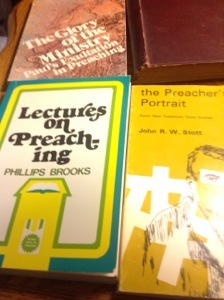
16. Lectures on Preaching by Phillip Brooks, 17. The Preacher: His Life and Models by James Stalker, 18. The Glory of the Ministry by A.T. Robertson, 19. The Preacher’s Portrait by John Stott

Books on the Ministry #8
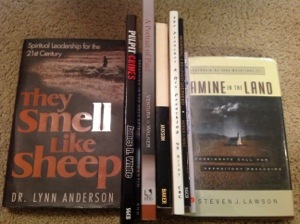
20. Famine in the Land by Stephen Lawson, 21. Pulpit Crimes by James White, 22. They Smell Like Sheep by Lynn Anderson, 23. A Portrait of Paul by Rob Ventura and Jeremy Walker, 24. How To Preach To People’s Needs by Edgar Jackson, 25. The Preacher and His Preacher by W. B. Riley, 26. The Elements of Preaching by Warren and Davis Wiersbe, 27. Preaching in the Holy Spirit by Albert Martin, 28. Mourning a Beloved Shepherd by Charles Hodge and John Hall

Books on the Ministry #9

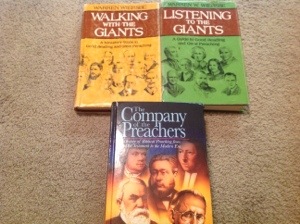
29. Walking With The Giants by Warren Wiersbe, 30. Listening To The Giants by Warren Wiersbe, and 31. The Company of the Preachers by David Larsen. Several other volumes are mentioned here.

Books on the Ministry #10

32. The Expository Method of G. Campbell Morgan by Don Wagner, 33. The Sacred Anointing: The Preaching of Dr. Martyn Lloyd-Jones by Tony Sargent, and 34. Return To Worship by Ron Owens.

Books on the Ministry #11

35. Preaching? by Alec Motyer

Books on the Ministry #12

36. The Pastor: A Memoir by Eugene Peterson

Books on the Ministry #13

37. The Art of Pastoring by David Hansen, 38. The Life of Alexander Whyte by G. F. Barbour, 39. He Is Not Silent by Albert Mohler, Jr., 40. The Pastor’s Guide To Leading & Living by O. S. Hawkins

Books on the Ministry #14

Fail by J. R. Briggs

Books on the Ministry #15
42. The Minister As Shepherd by Charles Jefferson, 43. The Reformed Pastor by Richard Baxter, 44. Expository Preaching Plans And Methods by F. B. Meyer, 45. Master Preachers by Harold Calkins

Books on the Ministry #16
46. Persuasive Preaching by Overstreet

Book on the Ministry #17

47. Preaching With Accuracy by Pelton

Books on the Ministry #18

48. An Unhurried Leader by Fadling

Books on the Ministry #19

49. Spiritual Leadership by Sanders

By Grace Alone by Derek Prince–A Book To Help Purge Legalism In You And Me

by grace alone

This book isn’t what you think, though it may likely be what you need. You would imagine that a witch hunt for who should be labeled a legalist would be what you would find, but that is not the case at all. No, what you have is what grace really is and what it could never be.

The tone is respectful throughout, but the issue is faced head on. He doesn’t try to ditch the Law of God, but use it as the Lord intends. Here is the irrefutable fact: Christ is the end of the Law for righteousness.  Christ, of course, fulfills the Law, but He ends it as a source of righteousness for you and me.

Most Christians I know grasp that as it pertains to salvation. The problem is that we think the opposite when we try to live the Christian life. We try to earn God’s favor, we think we must be worthy of His love. The problem is that we are as in need of grace as before. As Mr. Prince so ably points out it can’t be both. You may get to the Lord through grace or the Law–it is one or the other, now and always!

Here is his definition of legalism: “the attempt to achieve righteousness with God by keeping a set of rules.” Well, that definition alone makes it folly. I once believed that legalism was a concept that only applied to salvation, but I was wrong. Like the foolish Galatians, I can go back as a believer and live as an ardent legalist!

The purpose of the Law is not for the purpose we use it. A teacher, yes; a deliverer, never. In fact, the Law only brings condemnation. Liberty comes from Christ.

He shows how when a Holiness lady, who may love the Lord, doesn’t wear makeup and holds that up as her approval with the Lord, she makes this error. (He kindly never mentions we Independent Baptists who have a few of these ourselves). He does show how this is exactly the same as the orthodox Jew who won’t eat ham.

What really makes this book so valuable is how Mr. Prince teaches in the latter chapters how to receive God’s grace in your life and how to apply it.

If you have been hearing all the debate about legalism and you are at a loss for how to process the debate, I highly recommend this book. If you just want to straighten out your own thinking, then I recommend it even more. 

I received this book free from the publisher. I was not required to write a positive review. The opinions I have expressed are my own. I am disclosing this in accordance with the Federal Trade Commission’s 16 CFR, Part 255 .

Books On The Study Of Ecclesiology (Doctrine of the Church)

9415130_origHere’s a doctrine with a wide variety of viewpoints. For that reason, you will probably find fewer books that you agree with than in the study of other doctrines. Even among independent Baptists (like me) there is an incredible amount of debate. The debate, in my opinion, is hardly worth fighting over.

When did the church begin? What is the Church? Is it only local? Or is there a Universal Church that is the Body of Christ? Then as you spread out among Christian people, there is the issue of church government. How do we do baptism? The Lord’s Supper? Are denominations acceptable or should every local church be autonomous?

It often starts more fights than it answers questions, but there are places to read to decide what you believe.

Best place to start:

In this case I recommend beginning with the Systematic Theologies out there.

1. Systematic Theology Volume Four: Church/Last Things by Norm Geisler

He writes well and as a teacher of many years he is understandable. He fairly presents differing viewpoints and that is especially important on this subject. I love his 4 volume set.

2. Systematic Theology by Wayne Grudem 

He supports a form of church government I wouldn’t follow, but he presents it well and you will understand where they come from. I love to read him after Geisler.

3. Christian Theology by Millard Erickson

Presents in a way different from the above two and well worth having. I am glad to have it.

There are others like Charles Ryrie worth consulting too.

Baptism/Lord’s Supper

1.The Meaning And Use Of Baptizein by T. J. Conant

The nuts and bolts of why we immerse.

2. Baptism: Its Mode And Subjects by Alexander Carson

An influential classic.

3. Understanding Four Views On Baptism, edited by Armstrong and Engle

These Four Views books are awesome to really understand a concept.

4. Understanding Four Views On The Lord’s Supper

Another winner!

Local Church

There are some helpful material out there. I recently reviewed Believe and Belong by Clarence Sexton. Peter Masters has written some helpful pamphlets and books like Do We Have A Policy For Church Membership and Growth? We need more here.

Baptist Church

1. Principles and Practices For Baptist Churches by Edward Hiscox

The first place to look.

2. The Church: Its Polity and Ordinances by Hezekiah Harvey.

A good secondary source.

3. Baptist Church Manuel by J. M. Pendleton

I’ve seen some Baptist churches that made it a higher authority than the Bible! Still,  it lets you see what has been believed.

Happy studying!

Believe and Belong by Clarence Sexton

believe and belong

Here’s a timely subject where you wonder why more hasn’t been written on it before. In this volume entitled Believe and Belong by Pastor Clarence Sexton the subtitle says it all: “The Joy of Church Membership.”

It is a needed corrective to the prevailing notion that church membership is irrelevant at best and unbiblical at worst. It is born of our excessive personal independence that scorns even the most gentle accountability. The interdependence that is inherent to the idea of the local church is just too much for many. No doubt, the loss is truly theirs.

As a pastor, I appreciate his emphasis as this is a battle we all face in dealing with folks. Pastor Sexton writes with the intensity and candor you might expect from someone who has been in it over 40 years.

He makes a good case for membership as well as what a church really is. That is foundational to the local church ever being both what it can be and what The Lord intended it to be. His discussion on God’s Word being our guide is critical in a day when many forget that our cry should be sola scriptura (“by the Scriptures alone”).

He actually covers most of the things found in a discussion on the local church: baptism, the Lord’s Supper, prayer, the pastor. He warns of “grievous wolves” and ends on a push for the Great Commission. Along the way comes out strongly for soul liberty and the priesthood of the believer, which, strangely, is rare among Baptist pastors today. Yes, that was Baptist people’s most unique feature in previous generations.

This book is fine for new Christians as well as seasoned Christians who need to consider a subject they have thought little of in the past. Pastors, we will find ideas here of how we might present this truth. I recommend this book.

DISCLAIMER: Unlike other books I have reviewed on this blog, I know this author. While that could be some bias, I still feel this a truly helpful book.

clarence sexton

Humble Orthodoxy by Joshua Harris

humble orthodoxyWhich one do we need: orthodoxy or humility? Both says Joshua Harris! In fact, we don’t have the luxury to choose one at the expense of the other. Or as the subtitle of this volume published by Multnomah says, we should be “holding the truth high without putting people down.” So what does that leave as the goal? What he calls humble orthodoxy.

This is actually a reworking of the last chapter of his Dug Down DeepIf I were  forced to choose I would prefer that volume to this one as I really enjoyed reading it. Still, this book has something to say and I need to hear it.

Our tendency to be a Pharisee, our latent idolization of self,  our propensity to be so impressed with who we are and what we know, he exposes with care. He says, “The message of Christian orthodoxy isn’t that I’m right and someone else is wrong. It’s that I am wrong and yet God is filled with grace.” Ouch!

He demonstrates how at our core we are about God being on our side. That is a world of difference than wanting to be on God’s side. If it is about God being on my side, then I will argue and fight till my last breath. Sadly, at that point our lives are no longer about God and His glory. We live for what he calls “the tiny kingdom of self.” In that setting, of course, “Knowledge puffeth up.”

We have the wrong focus to make correct theology, as critically important as it is, the goal. Our Lord is the goal. Any other goal is inferior and little more than misspent effort. If correct theology is the goal I can so easily look down on others who I know has less theology than me. I know I have fallen in that trap before and am glad I had Mr. Harris to take me to task for it.

He attacks “arrogant orthodoxy” as actually falling short on the orthodoxy scale rather than the other way around. He sees true theology as telling me that repentance must start with me. Well, he has us there!

He sees a interlocking link between orthodoxy and humility. More orthodoxy leads to more humility and more humility leads to more orthodoxy. When our pride grows, what, then, does that tell us about our orthodoxy? That is a painful, yet particularly helpful, insight.

As much as I want to have my theology right, there is enough remaining sin in me to keep me humble, he says. You can speak for yourself, but that really describes me. A critical spirit, though a spirit quite at home in our age, is pure nonsense in a sinner like me. I must defend my faith without reducing myself to a critical spirit that denies on many levels the very faith I defend.

He also says: “Friend, the truth is not about us. It’s not self-determined. It’s not an accessory. It is about God.” That will help us not develop a Christian subculture with all the weirdo that can accompany it. He also says: ” In eternity we’ll see the silliness of self-righteousness and quarreling over the nonessentials.” That sums it nicely for a book well worth your time to read.

I received this book free from the publisher. I was not required to write a positive review. The opinions I have expressed are my own. I am disclosing this in accordance with the Federal Trade Commission’s 16 CFR, Part 255 .

Bound Together by Chris Brauns

Bound Together

I hesitate to tell you that this book tackles with verve the theological ideas of original sin and union with Christ. I can hear the groans–another theology tome. Please reroute your thinking as this volume is so much more than academic exercise. In Bound Together by Chris Brauns and published by Zondervan we have so much more!

There’s real life questions here. In discussing how we are tied to others in both good and horrifying ways, we find the questions tough. We all know on some level, and are actually glad about it, that blessings have come our way over the choices of some. But when someone’s choice rips our family down the middle, or the choice of a leader lands the whole nation in peril, well, that is another matter. The deeper question is why the Lord designed our world so. Like it our not, He did.

Mr. Brauns uses the analogy of the rope. We are tied together. In some ways if one goes over the cliff, we all will. While that is not true on some levels (personal accountability), it definitely is on others. He shows that what happened to us when Adam fell demonstrates this very thing. Before we sink in despair, we should see the upside of the rope. CHRIST!

We are now tied to Him and as he triumphs over sin He literally pulls us up out of or own sin. You see, the rope rescued us. If you could remove the rope from God’s Universe, you would do yourself far more harm than good. So we praise Him for the rope even if on occasion it appears unfair. He also explains that the new rope in Christ is far stronger than our old rope tied to Adam.

No, he explains, this doesn’t extinguish personal responsibility. I can’t just blame the rope, but I can trace how my choices have the potential to pull up or down. In his one chapter on marriage you see how the home might be the greatest length of the rope. Any idea that I am just my own person and can do as I please is absurd. There are too many hurting children in our world, for example, for this to be true.

He offers hope to hurting families too. He uses Rahab as an illustration. The rope can be used by me for good. She made a daring decision and her entire family was spared. This may not always work out so, but at least it is a shot.

In the latter parts of the book he explains how something so valued in our culture, and truly good on some levels, could be the very thing that is destroying us. That thing is individualism.

He pulls off the theology too. By the book’s end you will add to your obvious knowledge that your personal sin affects you and others as well as the truth that original sin affects you too. That affect is only overcome through Jesus Christ. This is a great book.

I received this book free from the publisher. I was not required to write a positive review. The opinions I have expressed are my own. I am disclosing this in accordance with the Federal Trade Commission’s 16 CFR, Part 255.

Tower of Babel by Bodie Hodge

Tower of Babel
How would you like a book that addresses parts of the Bible that you have always found difficult to get anything out if? How about, for example, genealogies? How about questions on the races and languages of our world and how exactly the Tower of Babel episode really played out and shaped the world we know today? Then you might really enjoy The Tower of Babel by Bodie Hodge and published by Master Books.

I’ll confess some of the material may be too narrow in its appeal your taste. Discussing how to pronounce “Babel” may not be a question you have had a burning desire to have answered, but I assure your other parts like chapter 13 entitled ” What about Extra-Biblical Tables of Nations and Genealogies That Go Back to Noah?” are riveting. Finding the names of the Biblical genealogy is exciting. I didn’t need that discussion to believe myself, but that doesn’t mean I don’t enjoy reading it.

Mr. Hodge is good at seeing what is really at stake. The authority of God’s Word is, as always, the heart of the issue for these type discussions. When he shares what might at best be esoteric knowledge at least he confesses when he is speculating and he faithfully brings us back to core issues.

He may at times revisit subjects that we thought we had a handle on, like the division of the continents being in Peleg’s day or the dating of the Book of Job, but whether you agree with him or not, you will be given substantial food for thought. There may also be places that are too detailed, like an in-depth analysis of the genealogy as it relates to today, but it still makes a wonderful reference to pull off the shelf. Too bad there isn’t an index.

The last chapter is short but ends where it should: Christ. In other words how does this fit in the big picture? How does it fit in me? Put this down as a fun read.

I received this book free from the publisher. I was not required to write a positive review. The opinions I have expressed are my own. I am disclosing this in accordance with the Federal Trade Commission’s 16 CFR, Part 255.

Find here