The World’s Oldest Alphabet by Douglas Petrovich

book-woa

This book is one paradigm-shifting title. Douglas Petrovich is a diligent scholar who is considered an expert in “epigraphy, palaeography, lexicography, and comparative linguistics and literature”. The scholarly world has been in an ongoing debate for many years over what language has the world’s first alphabetic script. Mr. Petrovich has worked through the ancient specimens that we have with their proto-consonantal script and has proven conclusively that it is Hebrew. He has even translated these previously untranslated specimens. That the highly-respected scholar Eugene Merrill has studied his work and given it the highest recommendation proves its trustworthiness.

The beautiful thing about this new book is the boon this it is to those of us who believe in the complete veracity of the Bible. I don’t mean it’s a substitute for faith, but that it is another help to doubters. A quick Google search will show you that several major news organizations have already carried stories on Mr. Petrovich’s work. While many of us so appreciate this book, it will probably be something like a bomb going off in the scholarly world where so many do not believe the Bible they study. Going forward, all doubters should be sent to this book.

Though this book has all the necessary minute data to prove its thesis, non-specialists like me can still follow the argument. He well presents the history of what has been thought over the years and carefully outlines what he went through to reach his conclusions. He is not just pulling his conclusions out of the sky. No, he put an incredible amount of work into solving this long-standing puzzle.

The book itself is attractive and has the design of other fine Carta Jerusalem titles. The maps and illustrations are outstanding and really help you to follow what Mr. Petrovich is saying. This book will be discussed for many years and will likely reach the status of one of the most important volumes ever in its field. I highly recommend it.

I received this book free from the publisher. I was not required to write a positive review. The opinions I have expressed are my own. I am disclosing this in accordance with the Federal Trade Commission’s 16 CFR, Part 255.

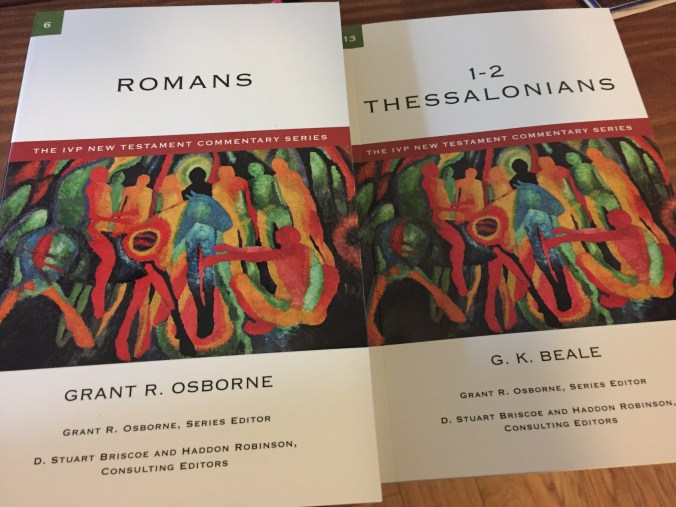
2 Helpful Commentaries in the IVPNT Series

I haven’t reviewed any volumes in this series, so I have two books here that I have heard good things about and here’s my review:

Romans by Grant Osborne

I looked forward to reviewing this book. I’d heard several complementary things said about it, but I wanted to see for myself. Just like is advertised about the IVPNT series, this book is aimed at the church instead of the seminary. There’s plenty of scholarly information given, but great care is taken in the accessibility of the presentation. Pastors, Sunday School teachers, and anyone doing in-depth studies will benefit from using this book. The author, Grant Osborne, is also the editor of this series and produced a well thought out volume here himself.

The Introduction given here on Romans is short, but is not superficial. In discussing authorship, he agrees with the scholarly consensus that it was written by Paul somewhere between A.D. 54 and 58. He does not believe that Peter or Paul founded the church at Rome, but that it originated when Claudius expelled the Jews and Christians and A.D. 49 during a time of conflict between the Jews and Christians. In his section, Genre, Purposes and Themes of the Letter, he succinctly summarizes what has been thought about the point the book of Romans is trying to make. He feels that Paul saw the church at Rome as the ideal sending church to reach that area much too far from Antioch. He states that Paul is not writing a systematic theology in the book of Romans, but that questions raised required much theological discussion.

After an interesting outline, Osborne is off and running on the commentary itself by page 27. I found his commentary at once thoughtful and helpful. I had read some Calvinistic reviewers say that he was the fairest writer against their position out there, and his respectful tone is clearly evident. In fact, he faithfully shares their arguments and then raises some great ones of his own that might be difficult for them to answer.

This book will give you much help while providing deep reflection for your studies without some of the more esoteric discussions that major exegetical commentaries can at times drown in. I highly recommend this volume.

I received this book free from the publisher. I was not required to write a positive review. The opinions I have expressed are my own. I am disclosing this in accordance with the Federal Trade Commission’s 16 CFR, Part 255.

1-2 Thessalonians by G. K. Beale

Scholar G.K. Beale fulfills the designs of the IVPNT series and writes for preachers, teachers, and Bible students rather than scholars. That is not to say that there isn’t careful scholarship behind what he says, but that great care is given in being accessible for readers.

In his Introduction of the Thessalonian letters he explains the historical context of Paul establishing churches at Thessalonica around A.D. 49 or 50. While he feels it’s hard to explain “the exact composition of the Thessalonian congregation”, he is much more certain about why he feels Paul wrote the epistle. Paul defends his apostleship in order that they may follow the Christian teaching he shares. With that apostleship defended, he can branch out into other areas where they are struggling as Christians.

He explains in a few paragraphs the scholarly debate on the sequence of First and Second Thessalonians. He even provides what strikes me as the silly arguments of scholars who think Second Thessalonians should come first. He follows the traditional viewpoint. When he discusses the theological context of these letters, he rightly sees the eschatological emphasis that is given. Both here and in the commentary proper, your evaluation of this commentary will likely be influenced by your own prophetic viewpoint. Frankly, I do not subscribe to Mr. Beale’s viewpoint, but I don’t want to review the work based on agreement with myself. The truth is, there was still much insight to be gained by reading here. His opinion that the “last days” encompasses all the New Testament age, and not only the last few years of it, is one that I agree with. Beale loves to write on the prophetic parts of New Testament and I always gain something from him even if I find much to disagree with.

The commentary itself is quite helpful. Before I received my copy for review, I had read where some other reviewers said this work didn’t live up to other volumes in the series, but I personally don’t see how that could be true. Again, you may disagree with him on the prophetic passages, but at least he will give me something to think about and you will be a better Bible student for it. This book is worth having.

I received this book free from the publisher. I was not required to write a positive review. The opinions I have expressed are my own. I am disclosing this in accordance with the Federal Trade Commission’s 16 CFR, Part 255.
John (ZECNT) by Edward Klink

book-john

Edward Klink has provided us with a major commentary on the beloved Gospel of John. It’s the latest title in the emerging Zondervan Exegetical Commentary on the New Testament (ZECNT) series. Though Mr. Klink has been a successful scholar, he has broadened his outlook for we pastors who use this commentary by himself going into a pastoral ministry. He is very conservative in his viewpoint and strives to be true to the Scriptures. I believe his orthodoxy and vibrant faith will be apparent to any reader. It immediately gives me a greater sense of trust than I find in many commentaries today.

When I began reading the Introduction in this commentary, I at first began wondering exactly where he was going. His approach did not seem the standard fare of most commentaries. By page 25 it all came into focus and I loved it. In short, he says, “Scripture becomes its own kind of genre”. So many modern commentators miss this obvious fact. His arguments were unanswerable, and as he showed, this fact must define all interpretation. He continued making brilliant hermeneutical observations. For example, he said, “the meaning is derived from the event about which the text speaks” rather than the other way around. This volume not only gives good coverage of typical introductory issues, but also suggests several needed interpretive corrections. He covered most all the questions you will have. In my view, only the structure section was a little meager.

Then there’s the outstanding commentary he gave. Though there is some Greek in this commentary, the English is always there making this volume accessible to all. Every passage is given a concise main idea, a literary context section to tie into big picture, an outline of the passage, a synopsis of the structure and literary form, an explanation of the text (regular commentary), and ends with a fine section on theology and application. In my estimation, the commentary given is of excellent quality.

The Gospel of John is greatly loved by most Christians. We are blessed to have a particularly high number of outstanding exegetical commentaries on it. Though the competition is fierce, this new volume will have to be in the discussion of the best exegetical commentary on John available today. I recommend it.

I received this book free from the publisher. I was not required to write a positive review. The opinions I have expressed are my own. I am disclosing this in accordance with the Federal Trade Commission’s 16 CFR, Part 255.
Ruth (ZECOT) by Daniel Block

book-ruth

Daniel Block’s commentary on Ruth is a prototype commentary in the major exegetical commentary category. Perhaps you are like me, and already loved his commentary on Judges and Ruth in the New American Commentary series. Most reviewers always thought his section on Ruth was not quite as outstanding as the one on Judges. Though I still found it valuable, that was probably a fair assessment. So what did Mr. Block go and do here? He has given us what is likely the best exegetical commentary on the Book of Ruth that we have today.

This book is one of the early volumes in the emerging ZECOT series. The bar remains high for future volumes. It continues the discourse analysis approach, which is merely keeping the narrative flow ever in view.

His Introduction to Ruth was tantalizing. He uncovers things usually overlooked and that provides us great help in our goal of grasping the book of Ruth. For example, I hadn’t thought about the fact that the namesake of the book speaks the least often of the three main characters. These kinds of clues really tell us something. His following of the narrative flow helps bring out wonderfully the structure and literary style of the book. Best of all, his brief overview of the theological message of Ruth was outstanding. I might see more in the messianic significance than he does, but the Introduction is still top-notch.

The commentary itself is all that you could hope for. It follows carefully the ZECOT layout and uses it to the best advantage. In addition, there are some charts along the way that really added something helpful to my comprehension. As a bonus, he provides a dramatic reading of the Book of Ruth in an appendix.

Not only is this an extraordinary commentary, it was enjoyable to read someone who not only loved the book of Ruth, but the God of Ruth as well. Label this one – a must buy!

I received this book free from the publisher. I was not required to write a positive review. The opinions I have expressed are my own. I am disclosing this in accordance with the Federal Trade Commission’s 16 CFR, Part 255.
Mark (NIGTC) by R. T. France

book-mark

This volume by respected scholar, R. T. France, now in a more economical paperback edition, is simply one of the best commentaries that exists for the Gospel of Mark. I was intrigued on page 1 when Mr. France explained the type of commentary that he was writing. Specifically, he chose not to write a commentary on the commentaries of Mark, but on Mark itself. He went with a fresh view of what was important from all his scholarly studies. It was exciting to read: “my concern is with the exegesis of the text of Mark, not with theories about its prehistory or the process of its composition.”

He covered everything in his Introduction to the Gospel of Mark that you would expect in a major commentary. He was at his best when he discussed the structure of the book. His seeing this gospel as “drama in three acts”, as well as other possibilities of the design of Mark, was riveting. He really opened up several wonderful lines of thought for me on this Gospel.

You will appreciate as well his discussion of Christology in Mark. His discussion of subthemes like discipleship, the Kingdom of God, secrecy, and eschatology were all well done. He paid keen attention to geography as well. I particularly loved his brevity on the Synoptic Problem followed by this conclusion: “In the light of that situation, I do not need a solution to the Synoptic Problem.”

The commentary proper also lived up to expectations. There was depth and insight tied to succinctness throughout. He kept the more obscure information in the textual notes at the end of each section of commentary.

This is an important commentary on the Gospel of Mark that every serious Bible student will need on his or her shelves. I warmly recommend it.

I received this book free from the publisher. I was not required to write a positive review. The opinions I have expressed are my own. I am disclosing this in accordance with the Federal Trade Commission’s 16 CFR, Part 255.
The Pursuit of God by Tozer–A Spiritual Classic

book-pursuit

This book holds a rightful place on the list of the greatest Christian books of all time. Of the many outstanding books that A. W. Tozer wrote, “The Pursuit of God” is his most popular. If you have ever looked for this title in used bookstores, you probably found it terribly worn. That ragged condition would be from both use and from the inferior binding that I have noticed in many old editions. Moody has thankfully provided us here with an edition that is both economical and of a quality made to last.

This edition has a short article called “Tozer’s Legacy” that tells us a little bit about the man and that he wrote this volume on his knees. You can tell as you read. He sees that our souls are thirsty for God and many Christians have settled for something of such lesser value.

His first chapter on following hard after God sets the tone. For example, he said, “everything is made to center upon the initial act of ‘accepting’ Christ (a term, incidentally, which is not found in the Bible) and we are not expected thereafter to crave any further revelation of God to our souls.” He will, as you imagine, prove that our need is more of the Lord.

In other chapters, he shows issues like being consumed with “things” rather than the Lord. He talks about removing the veil that we might see the Lord. He gives clues to apprehending God when he explains “O taste and see”.  He often draws on the incredible attributes of God, something else he is famous for writing about, to show, for example, what His presence and voice means. He talks about how this leads to rest and how this becomes what he calls “a sacrament of living”.

In short, this is a veritable masterpiece. Every Christian should read this book in his or her life.

I received this book free from the publisher. I was not required to write a positive review. The opinions I have expressed are my own. I am disclosing this in accordance with the Federal Trade Commission’s 16 CFR, Part 255.
Jerusalem Biblical Archaeology: A Carta Map

map-jerusalem-carta

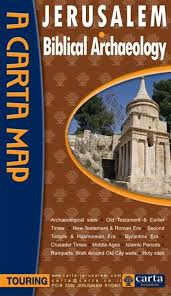
I so wish that I had had this map when I was in Israel. Without a doubt, I will never go to Jerusalem without it again. This foldout touring map has the same high quality that we find in all Carta products. Every biblical archaeology site imaginable in and around Jerusalem is included on this map. You could truly plan days of tours with this map in your possession.

One side of the map is in large map covering the Old City. It includes every site you’ve ever heard of and many more. It takes up half of the backside, would be easy to hold in your hand, and help you do multiple walking tours of Jerusalem. If you have been to Jerusalem in the past, you will be amazed how many things you walked by when you study at this map. I don’t know how they included so much information without cluttering the map, but each side has enough information to let you know exactly what the site is without covering up its place on the map. This would be the only map you would need on a day in the Old City.

The entire front side of the map, besides some attractive pictures around the edges of two sides, covers the greater Jerusalem area. You will need a car, but again there are so many sites. I would even encourage you to get this map if you plan to hire a tour guide as it would help you decide what you wanted to see. Remember many modern maps don’t show all of these sites. For example, when I was in Jerusalem, I had a car and I wanted to see Tell el Full, which is biblical Gibeah, the home of Saul, and I could never find it. Not far from there is Beit Hanina, or a piece of the ancient Road to Jerusalem built by the Romans, which I didn’t even know about. Both of these places would be easy to visit with this map.

The bottom half of the back of the map covers six places an extra detail: the Kidron Valley, Mount Zion, the city of David, the Hinnom Valley, Ein Kerem, and the water aqueducts that served ancient Jerusalem.

This map is fascinating. It would provide an opportunity for great study before a trip and supply the ideal map while on the trip. I give it the highest recommendation.

I received this map free from the publisher. I was not required to write a positive review. The opinions I have expressed are my own. I am disclosing this in accordance with the Federal Trade Commission’s 16 CFR, Part 255.
To buy:

http://store.carta-jerusalem.com/guides-maps/723-jerusalem-biblical-archaeology-9789652208743.html


Interpreting Apocalyptic Literature by Richard Taylor

book-apoc

This book is the latest release of Kregel’s helpful “Handbook for Old Testament Exegesis” series, edited by David Howard. It tackles what is, perhaps, the most difficult genre in the Bible—Apocalyptic Literature. Though the volumes in this series are designed for graduate-level courses, this volume by Richard A. Taylor is accessible and reads well.

Chapter 1 sets the stage by carefully answering the question, what is apocalyptic literature. That chapter begins by explaining the importance of genre in exegeting the Old Testament. He also relates well that which most surprises the student as he reads – scholars have trouble even agreeing on what the definition of apocalyptic literature is. Taylor does give us a definition on page 33, but its paragraph length shows the difficulty of definition here. He also defines the kind of apocalyptic literature types that we may encounter in the Old Testament. Perhaps, like me, you don’t see a lot of “ex eventu” prophecy in the Old Testament as he does.

The next chapter is quite helpful as it surveys the places in the Old Testament that you encounter apocalyptic literature. He also discusses a great deal other extrabiblical Jewish apocalyptic texts. I personally find those texts to be of much less value in understanding true Old Testament apocalyptic texts than modern scholars, but every such book is bound to discuss those spurious texts.

There’s much help for the preacher in carefully defining types of figurative language you might encounter. Clearly, that type of language cannot be explained in the same manner as we do with narrative texts. From there, he goes on to explain the process of interpreting apocalyptic literature.

Along the way, you will find words well-defined, lists of other books you might need for exegesis, and examples of his method on specific Old Testament texts. In addition, there’s a very helpful glossary at the end of the book. The appendix on antecedents of apocalyptic literature would be far less help to most preachers.

Because he covers his subject in about 200 pages, this is probably the perfect book to have on the subject. Some folks might be satisfied with the apocalyptic literature chapter in a regular hermeneutic volume, but if you want more, this is the book for you.

I received this book free from the publisher. I was not required to write a positive review. The opinions I have expressed are my own. I am disclosing this in accordance with the Federal Trade Commission’s 16 CFR, Part 255.

Here’s a Deal For Carta Items–Check It Out!

Yesterday I received a review copy of Jerusalem • Biblical Archaeology from Carta. This is a wonderful resource for anyone traveling to Jerusalem, or anyone interested in the archaeology of the Holy City. The map of the Biblical Archaeological Sites of Jerusalem are printed on one side of this 2 ft. by 3 ft. map. […]

via Special offer on Carta Jerusalem resources — Ferrell’s Travel Blog

The Extent of the Atonement by David Allen

book-atonement

Here is an encyclopedic treatment of the oft debated topic of the extent of the atonement. In particular, it’s a refutation of the limited atonement. To be sure, it’s focus is the atonement and not the totality of the Calvinistic system. This book really serves two distinct purposes. On the one hand, it makes a case for a universal atonement, while on the other hand, it presents an exhaustive history of what has been believed on the subject in the past.

The historical research done is mind blowing. I can hardly believe the volume of pages of reading that would’ve had to have been done to pull it off. No matter which side of the issue you are on, you must appreciate all the historical research that has been marshaled into one place for us.

Though I agree with the author in holding a universal atonement position, many things I learned here were a surprise to me. I already knew that there was no known precedent for the limited atonement in the church fathers, so my surprise came in the Reformation era. The biggest shock was that John Calvin himself did not hold to a limited atonement. In fact, we can find no historical proof of it before Beza. I was further shocked through the next several chapters to find several Calvinistic theologians that I knew did not hold to a limited atonement even if they did the other elements of Calvinistic theology.

Mr. Allen, in my view, presented some compelling exegesis and logical argumentation throughout the book. I felt he was honest with what his research uncovered. If the theologian he studied made any statements positive toward a limited atonement, he readily admitted it. After reading this book, it will now be an encyclopedic resource for me when I want to look up a theologian to remember his position on the limited atonement.

After he completed his historical review, he reviewed in-depth the most popular, common, new title presenting the limited atonement, “From Heaven He Came and Sought Her.” I felt he answered it beautifully, without superficiality or generality, and was quite successful. His closing chapter on why an unlimited atonement is important made an excellent conclusion.

The only negative thing that I noticed in this fine title is that I fear it is more likely to rile than persuade his opponents. At times, he would take his opponents to task for being over-the-top in their statements and would turn around and be overly harsh to them on the same page. Remember it seems that way to me, and I was on his side as I read.

Still, this book is a tremendous resource. It offers outstanding history and makes salient points that may be tough for those who hold to a limited atonement to answer. I highly recommend it.

I received this book free from the publisher. I was not required to write a positive review. The opinions I have expressed are my own. I am disclosing this in accordance with the Federal Trade Commission’s 16 CFR, Part 255.