Knowing God by Packer–A Timeless Classic

book knowing god

Using the idea of knowing God, Packer has struck the perfect balance between theology and Christian living. That has worked well because doctrine in its purest form intersects best at the point of real life. Add to that timely material a simple yet profound writing style, and you have the substance of a masterpiece. It can be cliché to throw around words like “classic”, but if you read this book, you will discover that it is true.

Here IVP gives us the classic in a deluxe edition worthy of its value and a new study guide. Both will serve to extend the value of a book that has lost nothing in the passage of time. It’s found on almost every list of greatest Christian books that I have ever seen. I read it slowly and found it impacting.

Of course you may find a sentence or a paragraph that you disagree with, as I did, but you will be challenged and feel you “know” God a little better as you read. I first thought that I would tell about my favorite chapter(s) in this review, but I underlined too much in every chapter to narrow them to favorites.

I would recommend that every Christian interact at some point with this extraordinary volume.

I received this book free from the publisher. I was not required to write a positive review. The opinions I have expressed are my own. I am disclosing this in accordance with the Federal Trade Commission’s 16 CFR, Part 255.

A Matter of Life and Death by Bill Goldsborough

daeth life

Written primarily for Fundamental Baptists, this volume seeks to address a glaring misunderstanding among many. The subtitle “thoughts for thinking fundamentalists” makes me think that Bill Goldsborough would like to move more fundamentalists over to the “thinking” category.

In chapter one we are told that “identity is determined by birth, not by behavior,” and from that basis he seeks to get us thinking. That basis for identity should give peace and an entirely different approach to the Christian life than the one so many are living. Many Christians have something far short of peace and strive for what could never be earned, though it is freely given. It’s a tragedy he hopes to Scripturally help us get past.

He focuses much on old man verses new man and what he believes the Bible teaches on that subject. He also explains carefully what it means to “reckon” Christ in your life. That can be quite revolutionary for a believer.

He marshals an incredible amount of Scripture to make his case, and unlike some works I’ve seen, those references actually discuss his subject. It also kind of had the feel of old Keswick writings as you go through this book.

He writes with an encouraging and helpful spirit. You might disagree on the interpretation of a particular passage he references, but you will appreciate the warmth of this book. If we see our relationship with Christ more along the lines he describes, we will definitely be blessed.


Impossible People by Os Guinness

book

This book is the one precisely needed today. It speaks to what thinking Christians are dwelling on. His title won’t make any sense until you read his reference to Peter Damian, but the book will strike the right cord on many levels. The problems are as bad as we imagined, yet the answer is not despair, but courage.

He will explain how Western culture is in its death throws. He really doesn’t explain a way to save it as we are too far down the line for that, but Western culture or not, Christians have an obligation just as they did in the hedonistic days of the Roman Empire.

He writes about how Christians are failing dramatically these days. He compares the very thing some of us have been telling others–how did German Christians get duped into accepting Nazism. Sounds so familiar, doesn’t it?

Os Guinness never fails to challenge me and this title is no exception. This book,  particularly, is needed whether that sounds trite or not. There is so much more here that I don’t even know what to say other than I underlined line after line as I read. This is a winner and I give it the highest recommendation.

I received this book free from the publisher. I was not required to write a positive review. The opinions I have expressed are my own. I am disclosing this in accordance with the Federal Trade Commission’s 16 CFR, Part 255.

From Pentecost To Patmos by Craig Blomberg

Blomberg 2

Craig Blomberg followed up his highly successful volume on the Gospels with this title that covers the rest of the New Testament. While it might not be as good as his earlier volume as the Gospels are clearly his specialty, this Introduction is still one I found to be quite an asset.

He presents his material in the typical style taking one NT book at a time. The length of his chapters varies in a fashion corresponding to the length and importance of the NT book discussed. He used good judgment and covered what should be there for us. In fact, pastors and Bible students will love it despite some occasional sidewalks into critical study that some of us put little stock into.

He gave some of his most helpful information when he discussed the structure of the book. I also felt the overview commentary on each book was quite effective in one getting his or her bearings straight. There were more maps than in his earlier volume and some of the charts provided were eye opening for the study of the NT books.

I highly recommend this as a worthy study tool!

I received this book free from the publisher. I was not required to write a positive review. The opinions I have expressed are my own. I am disclosing this in accordance with the Federal Trade Commission’s 16 CFR, Part 255.
Related Post:

Jesus and the Gospels (2nd ed.)

Jesus and the Gospels (2nd ed.) by Craig Blomberg

blomberg

When it comes to New Testament Introduction, the Gospels are so critically important that they are definitely worth a whole volume to themselves. Blomberg has supplied that need as well as any. I read the first edition years ago and was particularly enriched by it. The second edition here is not an extensive revision, though that is a good thing as there are many things too helpful to be changed. The extra material is mostly scholarly developments over the decade between editions.

Part One is outstanding on the historical background including political, religious, and socioeconomic information. He related what you need to step back into that day. Part Two had two chapters on historical and literary critical methods. That was the weakest section to me as there are many elements of that I simply can’t agree with. Still, it was a thorough explanation for what has gone on in the scholarly world involving the Gospels.

Part Three gives a chapter each to specific Introduction for each Gospel. That was likely the section of greatest value for this book. His section on the life of Christ also integrates the individual Gospels approach to it. The final part on historical trustworthiness and theology round out the fine volume.

The book has won awards in the past and this reviewer finds them to be well deserved.

I received this book free from the publisher. I was not required to write a positive review. The opinions I have expressed are my own. I am disclosing this in accordance with the Federal Trade Commission’s 16 CFR, Part 255.
Related Post:

From Pentecost to Patmos


Representing Christ by Anizor and Voss

christ

Anizor and Voss write here on a doctrine, the priesthood of the believer, that is precious to some of us, yet under duress in many places. Whole segments of Christendom deny its existence. This book shows that is both a biblical idea and an idea believed by several across the centuries.

This book is at its best discussing what the Scriptural basis of the doctrine of the priesthood of the believer is. Chapter 2 entitled “A Royal Priesthood” lays out well the case for clear teaching on this doctrine. I had never considered Adam as a priest, but Israel was clearly “a kingdom of priests.” Even more important is when the authors draw out the New Testament teaching on the subject. To me, it is undeniable as they well show.

The balance of the book looks at the subject in more of a church history vein. Luther might not deserve quite as much credit as they give him, but he does play into the history. They also explain what all priesthood really means in our lives, which is the reason for the subtitle “a vision for the priesthood of the believer.”

They take care to write to those who might be in a group that has priests today and deny that all Christians are priests. Some of that explanation might not be necessary to one not in one of those groups.

They write well and make a good contribution to this important dialog. This is a fine theological volume to have.

I received this book free from the publisher. I was not required to write a positive review. The opinions I have expressed are my own. I am disclosing this in accordance with the Federal Trade Commission’s 16 CFR, Part 255.
Herbert Hoover in the White House by Rappleye (Presidential Bio Series)

book

Hoover, so often vilified and ranked as one of the worst presidents, just begs for a good biography. You just know there’s more to the story than we have heard. Charles Rappleye gives us a biography of Hoover’s turbulent presidency and only enough of his life before and after to contrast it with his one term in office. He went into office with tremendous respect and admiration and left it with little love lost.

Rappleye did not write as a fan of his subject, but with keen research he did strive to present a balanced picture. Besides, perhaps, going too far in some of his psychological analysis of Hoover, Rappleye brought Hoover to life in this book.

Hoover was a hard worker, had a peculiar personality that was really not a good match for the presidency, and was somewhat petty. At the same time, he had core principles, determination, and great brains. He was also a most unfortunate victim. The Depression was in no way caused by him and was ready to explode before he even took office. There were international factors out of his control too. Really, everything lined up against him and likely no politican could have stopped it. His popular successor was much better at calming the people, but did not stop the Depression either throughout the 1930s.

I left this biography feeling sorry for Hoover and thinking that many of the things he stood for would have been better than what transpired after him. He just lacked a real connection with the American people.

This well-written biography fills in many of the questions you may have. It is a solid contribution.

I received this book free from the publisher. I was not required to write a positive review. The opinions I have expressed are my own. I am disclosing this in accordance with the Federal Trade Commission’s 16 CFR, Part 255.
Dictionary of the Old Testament: Wisdom, Poetry & Writings (IVP)

dictionary

This volume is another of the massive volumes in IVP’s “Black Dictionary” series. It upholds the quality this series is known for. Edited by Tremper Longman and Peter Enns, with Longman particularly known for his work in Wisdom Literature, and hosting a long list of competent authors, this dictionary  is one of the most important works on the Wisdom books available today.

Beyond the usual suspects of Job through Song of Solomon, this dictionary covers the Megillot, which adds Ruth, Lamentations, and Esther to the information covered. The audience written to is clearly a scholarly one, but pastors and teachers can glean much even if they feel the need to skip a few paragraphs in some articles.

Each of the books are covered in as in-depth fashion as a major commentary. Actually, more information than is covered in many of them will be found. The one on Psalms covered most every issue on the Book of Psalms that could be imagined. Some of the history of interpretation including the wave of form criticism that Psalms has faced is covered even if it beyond what many of us thinks is important. On the other hand, the ways certain psalms are categorized was very enlightening.

I read other articles on a variety of subjects and found them helpful. For example, I read the article on Ahasuerus from the Book of Esther and found it fascinating. There are many other such articles.

This is a fine reference volume to have on hand and I recommend it.

I received this book free from the publisher. I was not required to write a positive review. The opinions I have expressed are my own. I am disclosing this in accordance with the Federal Trade Commission’s 16 CFR, Part 255.
J.C. Ryle: Prepared to Stand Alone–A Great New Biography

biography

This book is the kind of biography that warms your heart. If you happen to be in the ministry, you will get a double blessing. Iain Murray scores again with yet another quality biography in his repertoire. In this case, he has brought to life a man so worth knowing.

Ryle’s story is compelling. Though Ryle had a godly grandfather, his father became enormously wealthy and did not raise his children to follow the Lord. At one point, Ryle seemed like a person who could never become what he finally did. He is a testament of God’s grace.

His father went bankrupt and Ryle, then in his mid-twenties,  hardly knew which way to go in life. He quickly lost two wives though he was blessed with children. Even in later life with much success in the ministry, he lost his third wife! Trials played a part, as with many such men, in the men they became.

He was a man of the Book. He studied intensely and grew to publish many impressive titles. Though he was deeply involved in the Church of England, his first allegiance was to the Lord and His Word. When his beloved son Herbert became infected with higher critical methods, he never wavered though he managed to keep a relationship with his son. The subtitle “Prepared To Stand Alone” was a worthy description of him.

You may find some of his church battles uninteresting, but you will love the man. I was greatly challenged by his life. Murray has done us a service by giving us this attractive volume. I warmly recommend it.
I received this book free from the publisher. I was not required to write a positive review. The opinions I have expressed are my own. I am disclosing this in accordance with the Federal Trade Commission’s 16 CFR, Part 255.
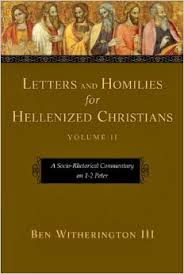
Letters and Homilies for Hellenized Christians: Vol. 1 by Ben Witherington III

commentaryben

This volume covers Titus, I and II Timothy and the Epistles of John in the socio-rhetorical commentary style that Witherington has become famous for. In fact, it is almost beyond belief that Witherington has had such an enormous output of commentaries on New Testament books. If you suspect he may have written too quickly to have covered such ground, you will see in this volume that he hasn’t cut any corners in the subjects he addresses.

He makes quite a distinction about some of these epistles being homilies, but I couldn’t help but think as I read, what real difference does it make for we who study God’s Word? In the Pastoral Epistles he had a lengthy and quite good Introduction on them as a whole. Then there was an Introduction for each individual book before the commentary. I felt it covered the same sort of issues a regular commentary would. I did not agree with some of his conclusions, and feel perhaps his socio-rhetorical method can be overdone, but I still felt it a solid contribution.

I was even less in agreement with his conclusions on the Epistles of John, especially about who the writer is, and wonder if his thoughts about a theme of “wisdom” are beyond what the text can bear. Still, I found it easier to read than many commentaries.

At times he can be a little dogmatic, but the fact that he is a superb writer makes that a small price to pay. He will force you to think about his viewpoint, and even if you disagree, you will be far richer for having done so. In short, though I disagree in places, I give this volume a high ranking as a volume that succeeds in its mission–helping the reader to formulate his or her own positions.

I received this book free from the publisher. I was not required to write a positive review. The opinions I have expressed are my own. I am disclosing this in accordance with the Federal Trade Commission’s 16 CFR, Part 255.