My Quest On Presidential Biographies

Have you heard of the popular idea of reading a quality biography on every President of the United States? There are blogs where bloggers trace their journey through the Presidents, there are groups on Goodreads dedicated to this pursuit, and there are far more people starting this quest than you might imagine. I don’t know exactly what percentage of them finish, but many begin. Presidential biographies do quite well on non-fiction bestseller lists as well.

Why might this be so popular? Well, it makes a good bucket list item–I mean, we have 45 Presidents so far. Still, there has to be more to it than that. More profitably, it is an exciting and thorough way to grasp the history of our country. Even if you love to read, and even if you love history, have you ever read anything more boring than a textbook? Stringing together key facts will never match the living tales of history’s greatest shapers. In addition, disgust with modern history might make going into the past a cathartic experience.

It takes some commitment. A biography of Warren Harding, for example, will never match one of George Washington, but you will have to read one of him to finish this feat. Plus, if you pick the wrong biography, even the more interesting Presidents may be difficult to get through.

I have decided to join the other Presidential biography readers to the lofty heights of achieving this goal. My only difference is that I am going to be a rebel to the typical rules of accomplishing it. I will not force myself to read them in order, but as the spirit moves me. I also might read two or three of one President before I read one of another. The point is pleasant reading, learning, and growth. In other words, I am more excited about the journey than the summit.

If you know me, or read this blog, you know I read all kinds of Christian literature. That is not going to change. I also read other non-fiction, as well as only very occasional fiction, and I don’t plan to change that either. But I am going to fit this in even if it takes a lifetime, assuming I have a lifetime to give it.

If you are even remotely thinking about reading Presidential biographies, you must check out this blog: My Journey Through The Best Presidential Bios by Stephen Floyd. The amazing thing about this blogger is that not only is he doing them in order, but he is reading several on each President. Then he gives a detailed review of each title followed by a summary post on the biographies of each President. He apparently loves the rest of us to compile such an incredible amount of material for us. I will read him before I decide on each President. He even tells us if a volume is expensive or hard to find–talk about doing all the work!

As he has done, I am going to list each volume in my library. (I might read them all as I have more than I might care to read about some presidents).  When I finish and do a review, I will link it to the list. Click on the highlighted ones to go to my individual reviews. I might even do a summary post on particular Presidents to share my thoughts about the man unless laziness overtakes me. If any of my blog readers or Facebook friends and acquaintances, are either on the quest or starting it, please let me know in the comment section or a private message. My readers are overwhelmingly Christians (with varying levels of loving to read), but I would love to know if any others are on this journey.


MY PRESIDENTIAL LIBRARY:

Washington by Ron Chernow

G. Washington: The Forge of Experience by James Thomas Flexner

G. Washington in the American Revolution by James Thomas Flexner

G. Washington: Anguish and Farewell by James Thomas Flexner

His Excellency G. Washington by Joseph Ellis

Founding Father by Richard Brookhiser

G. Washington by Willard Sterne Randall

“Mr. President” (Washington) by Harlow Giles Unger

J. Adams by David McCullough

J. Adams and the American Revolution by Catherine Dinker Bowen

America’s First Dynasty: The Adames by Richard Brookhiser

T. Jefferson: The Art of Power by Jon Meacham

Thomas Jefferson by Willard Sterne Randall

J. Madison by Richard Brookhiser

Madison’s Gift by David Stewart

The Last Founding Father (Monroe) by Harlow Giles Unger

J. Quincy Adams by Harlow Giles Unger

The Life of A. Jackson by Marquis James

American Lion (Jackson) by Jon Meacham

Martin Van Buren by Ted Widmer

William Henry Harrison by Gail Collins

John Tyler  by Gary May

Polk by Walter Borneman

Zachary Taylor by John S. D. Eisenhower

Millard Fillmore by Robert Rayback

Franklin Pierce by Michael F. Holt

James Buchanan by Jean H. Baker

Lincoln by David Herbert Donald

Team of Rivals (Lincoln) by Doris Kearns Goodwin

A. Lincoln: The Prairie Years and the War Years by Carl Sanburg

Great Captain (Lincoln) by Honore Morrow

Lincoln: An Illustrated Biography

Impeached (A. Johnson) by David Stewart

Personal Memoirs of U. S. Grant

Grant by Chernow

The Man Who Saved the Union (Grant) by H. W. Brands

Ulysses Grant: Soldier and President by Geoffrey Perret

Captain Sam Grant by Lloyd Lewis

Grant Moves South by Bruce Catton

Grant Takes Command by Bruce Catton

Rutherford B. Hayes by Hans Trefousse

Destiny of the Republic (Garfield) by Candice Millard

The Unexpected President by Scott Greenberger

The Presidencies of Grover Cleveland by Richard Welch Jr.

Benjamin Harrison by Charles W. Calhoun

President McKinley by Robert Merry

The Triumph of William McKinley by Karl Rove

Mornings On Horseback (T.R.) by Davis McCullough

River of Doubt by Candice Millard

TR: The Last Romantic by H. W. Brands

Theodore Rex by Edmund Morris

The Presidency of T. Roosevelt by Lewis Gould

The Bully Pulpit by Doris Kearns Goodwin

Wilson by A. Scott Berghttps://thereaganreview.com/2020/11/15/wilson-by-scott-berg-pres-bio-series/

Warren G. Harding by John W. Deanhttps://thereaganreview.com/2021/01/19/warren-g-harding-by-john-dean-pres-bio-series/

The Life of Warren G. Harding by Willis Fletcher Johnson

Coolidge by Amity Shales

Herbert Hoover in the White House by Rappleye

H. Hoover: A Biography by Eugene Lyons

Fhttps://thereaganreview.com/2022/09/05/fdr-by-jean-edward-smith-presidential-bio-series/DR by Jean Edward Smith

Traitor To His Class (FDR) by H. W. Brands

No Ordinary Time (FDR) by Doris Kearns Goodwin

Truman by David McCullough

Eisenhower in War and Peace by Jean Edward Smith

Eisenhower by Stephen Ambrose

My Three Years With Eisenhower by Capt. Harry Butcher

President Kennedy by Richard Reeves

Path To Power (LBJ) by Robert Caro

Means of Ascent (LBJ) by Robert Caro

Master of the Senate (LBJ) by Robert Caro

The Passage of Power (LBJ) by Robert Caro

Richard Nixon by Fawn Brodie

In The Arena by Richard Nixon

G. Ford by David Brinkley

An American Life by Ronald Reagan

The Role of a Lifetime by Lou Cannon

Speaking My Mind by Ronald Reagan

When Character Was King by Peggy Noonan

R. Reagan: How An Ordinary Man Became An Extraordinary Leader by D’Souza

The Reagan I Knew by William Buckley

Reagan’s War by Peter Schweizer

Reagan: Inside Out by Bob Slosser

Last Act: The Final Years and Emerging Legacy of Ronald Reagan by Shirley

Hand of Providence by Mary Beth Moore

Destiny and Power (Bush) by Jon Meacham

41: A Portrait Of My Father by George W. Bush

Decision Points by George W. Bush

Bush by Jean Edward Smith

 [Updated 4-27-2020]

These volumes may seem a hodgepodge set and they are. I have picked them up over the years (I clearly have wanted to be on this journey for a long time and have already read some) as I came across them in good deals. I have several more volumes than I need to secure. Would love to hear any recommendations! God bless!


The Message Of Lamentations (BST) by Christopher Wright

lambst

Here is the latest entry in the Bible Speaks Today series by IVP. This is a natural assignment as he already gave us an outstanding volume on Jeremiah in this series. Mr. Wright writes as one in love with the text and it shows on every page. He highlights things that interest pastors and teachers rather than the esoteric information some more scholarly volumes bog down in. He understands where this series is aimed and beautifully delivers.

I thought this volume’s greatest feature was how he captured the suffering and near hopelessness that pervades Lamentations. He drew the historical context with precision and the events of the fall of Jerusalem were too severe to sugarcoat. He still found what hope there was, he explained what lament really means and why such words are used, and where the Lord is in it all.

He filled the pages with good things. His comparison with Isaiah 40-55 and how it contrasts Lamentations helped make sense of the whole. This volume is a winner for a lesser known book of the Bible. I hope Mr. Wright get future commentary assignments as he is a joy to read. Pastors and teachers will love this book.

I received this book free from the publisher. I was not required to write a positive review. The opinions I have expressed are my own. I am disclosing this in accordance with the Federal Trade Commission’s 16 CFR, Part 255.

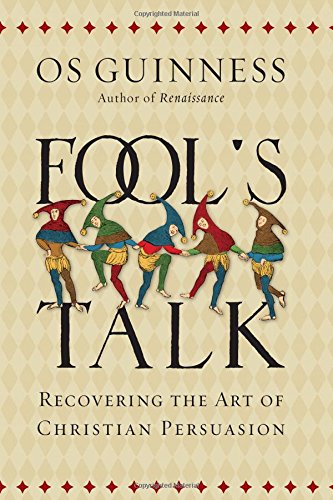
Fool’s Talk by Os Guinness

ftalk-guinness Could a book be more timely? Here is a man who has spent 40 years in the trenches of apologetics in our declining culture and who distills what he has learned and gives it to us in this volume. He sees apologetics in its noblest form—a way to lead others to Christ. I hate to use a trite designation like “instant classic”, but I believe this is the right place to use it. Mr. Guinness had me hooked in the Introduction as he perceptively diagnosed our age as the Age of the Self and the Selfie. We can never engage in this age unless we understand it first. It is the effects of that age that has done a number on what he calls “the art of Christian persuasion.” The loss of evangelism has been the greater cost, he rightly explains. He pays tribute to C. S. Lewis, Frances Schaeffer, and Peter Berger as those who have influenced him over the years and this volume is truly worthy to stand beside their works. I am shocked at how many sentences I underlined and how many paragraphs I starred all through this volume. It never lagged, it had no fluff or filler, and was masterful to the last page. I often give more of a summary of content in a book review, but in this case I just want to encourage Christians everywhere to read and interact with this volume. I fear my summary might obscure how good this book really is.  I give the highest recommendation possible to this volume that will likely be as important in 30 years as it will be when first released. I received this book free from the publisher. I was not required to write a positive review. The opinions I have expressed are my own. I am disclosing this in accordance with the Federal Trade Commission’s 16 CFR, Part 255.

Luke (PNTC) by James Edwards

luke

Looking for an up-to-date commentary on the Gospel of Luke? This latest offering in the Pillar New Testament Commentary series, edited by the venerable D. A. Carson, might be just what you are looking for. Mr. Edwards already contributed the well-received volume on Mark in this series, and this new volume has been eagerly anticipated.

The Introduction is relatively short, but its strength lies in discussing things you read no where else. If you consult several commentaries, they can at times be painfully repetitive. He makes a strong statement on the Word of God in his first paragraph, which makes you feel in good hands. His section on the testimony we get from Early Christianity is fascinating. History is his special trait throughout the entire volume actually.

I could not agree with him on sources. There is much speculation in such a discussion, and he does not just skip to the final form as some do now.

Despite my disagreement on sources, the commentary sparkled with great, pertinent detail that really gave insight into the text. For example, there was plenty of material on the birth of Christ that would help anyone teaching or preaching. In fact, I found that true in every passage I studied in it. I call attention to his masterful handling of the Parable of the Prodigal Son. That was a joy to read and had profound spiritual insight as well. The Cross and the Resurrection were standout too.

I will always consult this volume on any passage on Luke that I study going forward. I predict pastors will love this volume just as I do. This is a winner!

I received this book free from the publisher. I was not required to write a positive review. The opinions I have expressed are my own. I am disclosing this in accordance with the Federal Trade Commission’s 16 CFR, Part 255.

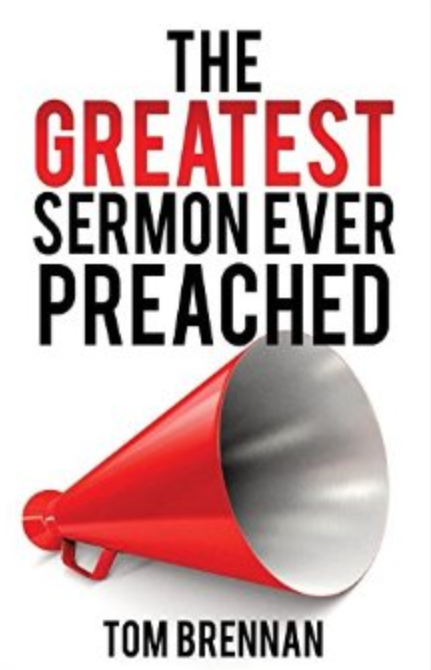
The Greatest Sermon Ever Preached by Tom Brennan

  
This volume by Independent Baptist pastor Tom Brennan tackles the Sermon on the Mount for Christians today. In thirty chapters Pastor Brennan seeks to help us apply this great sermons to our lives. He does not subscribe to the theory that this sermon is not for this dispensation, and so draws out many points.

Published by Xulon Press, this attractive volume is well written and easy to follow. His approach seemed to me to be devotional, just as you might expect a pastor to speak to his people. The intended audience is the person in the pew. He has read widely and was especially good at drawing in illustrations or quotes to bring out his points.

I might quibble with him over a few points, but he tackled even the more difficult passages in the Sermon on the Mount without dodging anything. He even dealt with the one on divorce. It appears to me that he worked really hard to put this book together.

In that we have fewer Independent Baptists writing today, you might enjoy giving this volume a try. 

I received this book free from the publisher. I was not required to write a positive review. The opinions I have expressed are my own. I am disclosing this in accordance with the Federal Trade Commission’s 16 CFR, Part 255.

A Sword Or A Club? (IBTR #70)

sword club

Well, they are quite the different weapons. With skill, the sword can be used for precision cuts. But with a club, all you can do is bludgeon. With a club you can forget precision too as the questions are only what is broken and how much blood is on the floor.

As Christians we have a weapon and it is precise. Hebrews 4:12 says, “For the word of God is quick, and powerful and sharper than any two-edged sword, piercing even to the dividing asunder of soul and spirit, and of the joints and marrow, and is a discerner of the heart.” Now that is a weapon!

It is a powerful weapon—I can actually think of none stronger. It is two-edged for the height of precision. Its precision goes where none other can go. If its precision to cut perfectly the joints and marrow was not enough, it can slice between our souls and spirits. It turns out that its work exceeds cutting and actually discerns hearts. Its greatest feature it that it is “quick”, which means “alive”. Where other weapons excel in death, it distributes life. No wonder we are told that “…the weapons of our warfare are not carnal.”

So it is clear what the Sword of the Word of God is. But we have a problem. Some wielders of the sword confuse it for a club. They see it as a traditional weapon, which, of course, leads to death. This error raises its ugly head all through Christianity, and Independent Baptists have often followed suite. They are quite clumsy with a club, but who wouldn’t be if your club is actually a sword?

There are a variety of damaging moves with the club. Some take God’s Word that is meant to bring life and take those abused by sin and abuse them more. Where God’s Word brings guilt to see our sin only to later remove both the sin and the guilt with its Gospel message, some explain the sin and bring on the guilt only to leave you broken and bleeding from its blow. Some then run from the Word for relief when only the Word can bring relief because some silly Christian soldier thought his sword was a club.

All of this is not to say that God’s Word doesn’t convict or tell me what is wrong. It tells reality in a Holy God’s Universe. But when its precision cuts tell me what a rotten sinner I really am, the grace of God springing from the blood of Jesus Christ comes surging over me. Here is where club users go awry.

I read that the legalist wants you punished. Apparently, the delirium that comes from club swinging makes one forget that Christ took the punishment. We proceed from there. The legalist wants you to pay where Christ has already paid it all. Lest our discussion get off track, let’s remember that is as true years after I’m saved as it was the day I got saved.

If we get that messed up, we speed down the slippery slope. First thing you know, some club gladiator with a Bible in his hands tells some battered woman in the throes of physical abuse that she must stay and submit. Or next we’re told we can’t report a church member for molesting a child because we can’t our take brother to court. The Bible was referring to civil cases in that instance, but a club is not, as we said, an instrument of precision. None of that is “quick”, or life. It sounds like death to me. It may not be a bludgeoned skull, but it is a butchered heart and life.

It is time to lay down our clubs. We are not even trained or called to use them. But let’s take the Sword of the Word of God into our hands as it is the answer for us all.

Find all articles in the series here.

The Message of Daniel (BST) by Dale Ralph Davis

Here is a fine volume on Daniel by Dale Ralph Davis, who is simply one of the best writers today on any Old Testament historical portion, in the Bible Speaks Today series. Helpful in the ways usually found in this series, this volume is also particularly so for preachers. It delivers at a level we have come to expect from Mr. Davis too.

The Introduction is short, but powerful in its easy repudiation of critical theories and dating. I would even call that section fun to read. I found myself agreeing with much of what he wrote.

Again, the history was superb here. Background on Babylon and the Jews in Babylon was illuminating. From thoughts on the diet put before Daniel and his friends to Nebuchadnezzar’s mindset or dream the reader gains much and through the more famous stories as well. He brings out the information and insights most needed

Since I have a different perspective than him on prophecy, I could not agree him on passages like, say, Daniel 9:25-27. Still, he was kind in presenting his amillennial case, and the other historical sections are well worth the price of the book. I would already label this my favorite from that prophetic viewpoint though I hold to a different one.

The book is enriching and I highly recommend it.

I received this book free from the publisher. I was not required to write a positive review. The opinions I have expressed are my own. I am disclosing this in accordance with the Federal Trade Commission’s 16 CFR, Part 255.

danielbst

Return To Me by Mark Boda

return

Here is a volume the New Studies In Biblical Theology (NSBT) series that tackles the theological hot-potato issue of repentance. Author Mark Boda strives to give us “a biblical theology of repentance” with this volume in the series edited by the well-known D.A. Carson.

The most valuable feature of this book is the in-depth tracing of repentance in every part of Scripture. He divides the Old Testament in the Jewish way as he feels that is more sensible for following repentance through the Bible. He has strong convictions about the Word of God, which I appreciate. He feels the typical approach of viewing the subject through the definitions of the words involved is insufficient. Following that theory, he traces more of the big picture of repentance. Repentance is more in some parts of the Bible than others, but he succeeds in finding what degree repentance is there. He is thorough.

It was surprising that the book is 80% Old Testament, but perhaps that is only because the New Testament talks much less of it. I found it easy to agree with many things he said. It seemed a little much to say repentance was a big theme of John when the word is only mentioned once. Still, you felt in the hands of a capable scholar as you read.

He references the theological battles involving repentance, but really does not address them. He seemed to want to lay the data out there so others could take it into the battle and think for themselves. I can not imagine anyone writing on this subject again without consulting this volume. For this volume set out to do, it succeeded all the way.

I received this book free from the publisher. I was not required to write a positive review. The opinions I have expressed are my own. I am disclosing this in accordance with the Federal Trade Commission’s 16 CFR, Part 255.

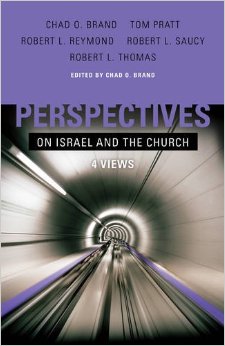
Perspectives On Israel And The Church: 4 Views by Brand

israel church                                                                                                                                                 Here is another fine volume in B & H Academic’s Perspectives series. This volume tackles viewpoints on Israel and the Church, which means a debate between dispensational and covenantal thought. This volume, edited by Chad Brand, discusses the four most prominent views though there is even more variety out there. You will read on the traditional covenantal view (Robert Reymond), the traditional dispensational view (Robert L. Thomas), the progressive dispensational view (Robert Saucy), and the progressive covenantal view (Tom Pratt Jr.). The editor Chad Brand assists on the progressive covenantal view as well.

All the authors are scholars and some have been well known in this subject for years. Each was fairly dogmatic, as you would expect in such a series. Only Mr. Reymond seemed to go too far in harshness. While I must disclose that I do not agree with his position, I even wonder if those who hold that position would think he had a good approach. He also used extreme examples like quoting John Hagee as if he were the best representative for dispensational thinking.

All of the other three wrote more respectively and gave much food for thought. It seems issues on election, the Millennium, and other topics intersected strongly with this subject, but the authors did a good job only referencing the points that made sense to the Israel/ Church issue.

This volume did not change my mind, but it did suggest points that I needed to think through. What more could you ask for in a series like this? I recommend it.

I received this book free from the publisher. I was not required to write a positive review. The opinions I have expressed are my own. I am disclosing this in accordance with the Federal Trade Commission’s 16 CFR, Part 255.

I Don’t Know A Thing About Revival

revival

I really don’t know anything about revival. Very few people could actually say that they have ever seen a real revival, but perhaps you are like me and sure would love to see one. I could say I have always been fascinated by it, and have read of it on several occasions. While I don’t know anything personally about a real breath from Heaven that sweeps through an area in a miraculous way, I would like to point out a few things that I have noticed from those who have experienced and written about it.

Let’s be sure on the front end that we are on the same page in what we mean by revival. I am not speaking of personal revival, or one of those special times in our Christian life. I am not talking about a time where evangelism was highly effective. I refer to a miraculous moving of the Spirit of God that must be traced to the mercy of God.

I think a study of revival from historical sources would bear out these things:

  • Revival is preceded by intense prayer.

Pick up any record of real revival and you will see a pattern of prayer. Usually it involves many praying, but not always. It is a time of serious prayer as opposed to the careless prayer you and I so often get caught up in. Months of praying, nights of prayer with forfeited sleep, intense praying—this is the prayer you find preceding a revival. While God gives revival, He is apparently willing to be asked for it.

  • Revival will first show up in confession of sin.

You will be amazed as you read of God’s people confessing their sins as being the tipping point for revival to break out. There are so many little hurts and hard feelings between us and these are quite obviously a great hindrance to revival. You might say a key to revival is removing hindrances. Apparently, the Lord finds us not too interested in revival as long is sin is unconfessed and grievances unfixed. Many remembrances of revival will point out that people’s sin became almost overwhelming in their minds, but led them to seek the Lord in a way they never had before.

  • Revival will come on the Lord’s terms.

Some who taught that a formula could be followed that would guarantee revival have been proven wrong. Charles Finney sometimes taught that, but his own life disproves it. His great revivals dried up while his formula kept right on going.

  • Revival does not fit our preconceived boundaries.

Of course not every claim of revival has been real, but revival has not stayed within the boundaries we would prefer it would either. Every denomination that held to the Gospel, had a strong Christology, loved the cross, and professed the Bible to be true has had great revivals in the past. Baptists, Presbyterians, Methodists, and on and on have been blessed with glorious revivals, but not one of those groups has really outdone the others in seeing great Revivals. Secondary issues have often even been laid aside in revivals. Not that each involved did not have strong feelings about those issues, but revival is not the time to battle them. Mode of baptism, Calvinistic debates, church government—I have never read of a revival where these things were strongly debated.

For example, Charles Finney and Jonathan Edwards were both instruments in God’s hands in revival. Strangely enough, both men have fans today who strongly criticize the other. Charles Finney was wrong about original sin, but he is more strongly criticized for originating altar calls, or invitations. Others today would strongly criticize the followers of Edwards for never using altar calls. Both sides have a problem—God blessed Finney and Edwards. There is no problem in our deciding which man was more theologically correct, but we are less than honest if we claim God did not use either one of them. Some books have been written, particularly against Finney, which skew the facts. There were abiding results following the revivals both were involved in. There were also anomalies in both revivals. Edwards did a great job in reporting those he knew of. Actually, every real revival seems to have some of those. Apparently, the Lord is not concerned with massaging our egos about the supposed superiority of the group we are in.

  • Revival is local.

For my whole life I am always hearing that we should pray for revival in America. If history is any judge, it will not start on a nationwide level if it comes. Likely our dreamy fascination that some great politician is going to come along and deliver us confuses our thinking. Revival starts somewhere, and at best, grows from there. We would be better served to beg God to send revival to our congregation, or our community, and see where He takes it from there.

Please join me in praying for revival!

Here are some book suggestions that I have read (most of them lately).

  1. Handbook Of Revivals by H.C. Fish

The chapters give history and teaching on revival from first-hand witnesses. The chapters are not of equal value, but the book is worthwhile.

  1. When The Fire Fell by George T.B. Davis

A little book with some great history of various revivals.

  1. By My Spirit by Jonathan Goforth

A gem! Confession really played a role in the revivals he was part of in China and Korea.

  1. Power From On High by John Greenfield

This little volume is a history of the great Moravian Revival of 1727. Gets sidetracked promoting the Moravians at times, but a good read still.

  1. Revivals of Religion by Charles Finney

A very popular title where if you ignore his thoughts that certain steps guarantee revival the rest of the book is quite helpful.

I plan to review others in the future. God bless!