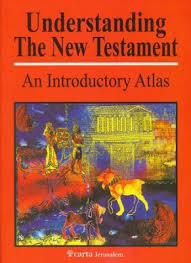
Understanding the New Testament: An Introductory Atlas

book un nt.jpg

Over the last few years, Carta has developed an outstanding set of introductory atlases. This title is one of the earliest releases. While I feel that later titles continue to get better, this earlier entry is a thorough success and one that I would recommend you study first if you choose to work through these atlases. A careful study of these titles would be the equivalent of an awesome college class though these titles are accessible enough for any Bible student. This title gives a broad sweep of important background material for the New Testament in the beautiful Carta style.

After an initial physical map of Israel, you have the succinct and pithy overview of all the books of the New Testament. Next, you have a breakdown of the different areas in Israel where the varying climate impacts its history. From there, you spread out to the larger New Testament world including the areas that Paul carried the gospel to throughout the Roman Empire. There’s an overview of the Intertestmental Period including some great charts on the early Caesars and Herods of that time. There’s also a chronological discussion of the Gospels from a geographic standpoint followed by one for the early church.

The maps are of the sterling quality you’ve come to expect from Carta products. Some of the maps are those you may have seen in some of their larger, beloved Bible atlases. Once you’ve studied this title you can also find others on the Old Testament along with others on archaeology, history, and geography. There’s not a dud in the bunch and I highly recommend them all including this fine title on the New Testament.

I received this book free from the publisher. I was not required to write a positive review. The opinions I have expressed are my own. I am disclosing this in accordance with the Federal Trade Commission’s 16 CFR, Part 255.
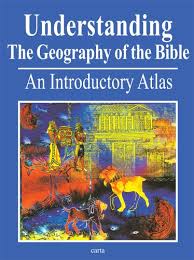
Understanding the Geography of the Bible: An Introductory Atlas by Wright and Har-El

book geograp.jpg

This title in 40 large, attractive pages really pulls off a fine presentation of the geography of the Bible for students at any level. If you will take the time to study this introductory atlas, you will quickly understand how the geography in Bible lands dramatically impacts events. This title goes well with other introductory atlases in this series that give an overview for the Old Testament, the New Testament, kingdoms in and around Israel, and biblical archaeology. These two authors have contributed several of these outstanding titles and Carta has perfected the art of presentation.

Carta never fails us with its maps and pictures. Their titles are always a visual smorgasbord. Don’t miss the charts and maps that show annual precipitation, mean temperatures, climatic regions, principal geological features, and major routes.

The text is highly instructive as well. You will gain a working knowledge of the climate and geography of the entire Middle East where the discussion is especially thorough on prominent areas of the Bible. The range of climate and geography being so small an area is incredibly pronounced and has a distinct impact on those living in the particular areas. In my view, this knowledge is critical background information for any sort of Bible study.

At this point, I’ve seen all of these introductory atlases, and this one is one of my personal favorites. Don’t miss it!

I received this book free from the publisher. I was not required to write a positive review. The opinions I have expressed are my own. I am disclosing this in accordance with the Federal Trade Commission’s 16 CFR, Part 255.
Understanding Biblical Archaeology by Wright

book und bib arch

At this point, Carta has several introductory atlases that could serve as a personal class on some important topics of Bible study. Paul Wright has contributed several of these outstanding introductory atlases covering the New Testament, geography, biblical kingdoms, important people groups mentioned in the Bible, as well as writing a well-received major Bible Atlas. This title gives an excellent overview of biblical archaeology. When you finish this book, you will have a working knowledge of what biblical archaeology is and what has been discovered in Israel from various archaeological periods.

Other works may probe more deeply the broader assumptions of archaeological work while this one focuses more on what we have found. These findings are presented through clear text, gorgeous pictures, and effectively chosen Bible maps. This book could have a secondary use as a guide to what archaeological sites might be worth visiting on your next trip to the holy land too. For example, on a trip, I did I enjoyed immensely visiting biblical Shechem of which there’s a fine picture on page 15.

The diagram on page 9 is worth pages of text in describing how we have such levels of archaeological finds available at many sites in Israel. We also find there an overview of archaeological periods.

The balance of the book takes us from the Early Bronze Age through the Early Roman or Herodian Era. Fortunately, there have been many wonderful archaeological finds in every major era between those two and none are given short shrift here.

This book is worth your time and I highly recommend it.

I received this book free from the publisher. I was not required to write a positive review. The opinions I have expressed are my own. I am disclosing this in accordance with the Federal Trade Commission’s 16 CFR, Part 255.

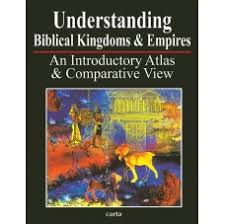
Understanding Biblical Kingdoms & Empires

book under bib kingdoms.jpg

These Carta introductory atlases are a lot of fun. This title introduces and compares the biblical kingdoms and empires that framed the Old and New Testaments. It’s written by Paul H. Wright who has produced a major atlas and other of these introductory atlases. I’ve found all his works accessible, helpful, and well-written. This title is no exception.

After briefly describing the world of the Bible on a physical map, he describes the origin of the people of Israel as well as the earlier kingdoms around them that influenced their history. From there, he gives a good overview of the rising kingdom of Egypt as well as their famous interaction with Israel. After that interaction, Egypt, as you well know, greatly declined and Israel went from a tribal nation to a monarchy. The heights of her glory were the empires of David and Solomon. This is all well described. Next, we have the Assyrian Empire (after this point Israel always had to deal with the dominant world power to some degree) and Israel’s divided kingdom. You will learn about the Assyrian Empire, the Babylonian Empire, the Persian Empire, and Israel’s trials during these periods. Perhaps lesser-known to some Bible students, you will then learn of the Greek Empire of Alexander the Great, the Ptolemaic and Seleucid Empires as well as the Hasmonean Kingdom. The balance of this book of 40 attractive pages introduces us to the Roman Empire that brings us into the New Testament.

The work is the expected Carta experience. Beautiful photographs, timely illustrations, and the best maps in the business. When you factor in the essential nature of understanding the kingdoms that affected Israel during the Old Testament, this book meets a real need and I highly recommend it!

I received this map free from the publisher. I was not required to write a positive review. The opinions I have expressed are my own. I am disclosing this in accordance with the Federal Trade Commission’s 16 CFR, Part 255.
Understanding the Holy Temple of the Old Testament

book holy temple ot

Leen Ritmeyer is my favorite modern writer on the Tabernacle in Israel’s earlier history and the Temple from Solomon’s Temple all the way to Herod’s Temple. His earlier major work, The Quest, is the gold standard on the Temple from either a historical or an archaeological perspective. Now Carta gives us one of their fine introductory atlases (They have a whole series of these helpful books) on the Holy Temple of the Old Testament. For this colorful, attractive work Mr. Ritmeyer is joined by his capable wife, Kathleen, to produce this helpful book that you will find incredibly enlightening.

The book begins with an introduction that reminds us that holiness is a key element in thinking about the Tabernacle. That’s followed by a section called the Genesis Sanctuary as the authors describe what they call the Proto-Tabernacle. That’s an interesting perspective that I hadn’t thought of. Next, we have some information on Melchizedek and Abraham, followed by great information on the Tabernacle. Every major component is explained and profusely illustrated. There’s even a section on the journeys of the Tabernacle and how that was done.

Solomon’s Temple is carefully explained, as well as the differences we find in its description between Kings and Chronicles. There are some great explanations of the rock at the top of Mount Moriah and its relation to the current Dome of the Rock. They will explain Hezekiah’s Temple as well as Ezekiel’s Temple and the Temple Scroll. Next, we will learn about the Post-exilic Temple, the Hellenistic Temple Mount, and the Hasmonean Temple Mount.

This book is the perfect way to learn a clear overview of the Tabernacle and Temple in 48 large pages. The word that comes to my mind for this book is “ideal”. You will want to look up its companion volume, Understanding the Holy Temple Jesus Knew, which is also an outstanding asset.

As with any Carta resource, there are outstanding pictures and maps. What stands out especially in this book is the diagrams of the Temple as well as pictures of reconstructed models. This book is well done!

I received this map free from the publisher. I was not required to write a positive review. The opinions I have expressed are my own. I am disclosing this in accordance with the Federal Trade Commission’s 16 CFR, Part 255.

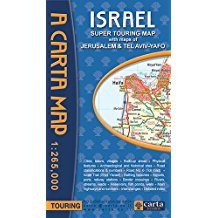
Israel Super Touring: A Carta Map

map israel tour

It’s a no-brainer that Carta, the preeminent maker of Bible atlases, would bring its considerable mapmaking skills to roadmaps for Israel. This map is called it’s super touring map (Scale 1:265,000). I wish I would’ve had this map during my solo tour of Israel a few years ago. It has the perfect amount of necessary information. Roads, cities and communities, some archaeological and historical sites, beaches, airports, rivers, and border crossings. Even if you use GPS, this map will provide a perfect overview, a helpful orientation, and a guide to planning each day’s touring. Area A and B of Palestinian autonomous areas are also helpfully shaded so care can be used in your traveling.

The reverse side of the map gives a helpful map of the center of both Jerusalem and Tel Aviv. In addition, there is a detailed index provided. There’s even a listing of diplomatic missions and embassies.

If I might make a suggestion, you should secure Carta’s similarly designed Israel Biblical Archaeology: a Carta Map. (They have one on Jerusalem’s archaeology as well). Putting these two maps side by side could provide powerful planning opportunities.

This map is well constructed and durable and should easily hold up on any trip. It can also be easily bought in the United States and other countries so some of your preparation can be done before you even hit the ground in Israel. This is a top-notch map!

I received this map free from the publisher. I was not required to write a positive review. The opinions I have expressed are my own. I am disclosing this in accordance with the Federal Trade Commission’s 16 CFR, Part 255.
Understanding the Maccabean Revolt: An Introductory Atlas

book mac revolt.jpg

If you are like me, the silent years between the Old and New Testaments is a place of weakness as a Bible student. There were turbulent events that changed many things about the political world situation that ended the Old Testament to the Roman control firmly in place when the New Testament began. Part of that important transition had to do with the Maccabean revolt. This beautiful introductory atlas by Carta that matches the style of several attractive introductory atlases now in print by them is the perfect place to correct the deficiency of your biblical knowledge.

The work of three highly-respected scholars was effectively molded together to give us a vivid overview. Michael Avi-Yonah who has prolifically written on Bible history and archaeology is the original contributor. Two other scholars from Israel, Shmuel Safrai and Ze’ev Safrai, combined to finish and update this useful work.

In this book, you will learn about the Seleucid Empire, the factors that led to the Maccabean revolt, key battles over the century of the Maccabean revolt, key players, and the effects on Jerusalem. The text reads well. The pictures are beautiful and effectively illustrate the material. In fact, you will find yourself staring at them and feeling you are there.

And as always with these Carta titles, there are the wonderful maps. The preeminent mapmaker of our day really outdid themselves in this work. The number of maps in a work of 40 oversized pages is incredible. It’s as if there’s a map to introduce every movement the text tells you about. The scale and amount of information on every map are perfect. The visual representation of battles was especially effective. I’ve seen whole Bible atlases that had less quality maps to cover all biblical history than this one has for only one century of Israel’s history. I’ve reviewed almost every Bible Atlas on the market today, and nobody comes close to touching what Carta provides on the Maccabean revolt. I’ve loved all the introductory atlases by Carta but be sure not to think that this is the one you can pass by because it’s too obscure. No, you will never regret having this introductory Atlas at your disposal to explain a vital component of Israel’s history.

I received this book free from the publisher. I was not required to write a positive review. The opinions I have expressed are my own. I am disclosing this in accordance with the Federal Trade Commission’s 16 CFR, Part 255.
Understanding the Ecology of the Bible-An Exciting New Carta Introductory Atlas

book carta ecology.jpg

If you’ve had the privilege of reading some of these attractive introductory atlases published by Carta, you know how rewarding they can be. This latest one on the ecology of the Bible by prolific writer Paul H. Wright, who excels on works of Bible geography, history, and even a major Bible Atlas, is one of the best yet. Mr. Wright has already produced in this series of introductory atlases works that include an overview of the New Testament, one on geography, one on biblical kingdoms and empires, and one on biblical archaeology. Mastering these works by Mr. Wright will greatly expand your Bible study.

Don’t for a minute think of 48 large pages on the ecology of the Bible as an esoteric effort. So much is missed in Bible passages when you miss these details. For many of us, the natural world and ecology we live in are so different from that of the Bible that we can easily miss even the main flow of the story itself. I believe a thorough perusal of this work would be the equivalent of a college class. Fortunately, the writing is accessible and even beginners can glean so much here.

It’s thorough enough to be effective as I didn’t see any ecological or natural world item that was overlooked. The pictures were so beautiful that I would catch myself thinking, wow, I’d like to be there! The maps are all top-notch and what we’ve come to expect in any work bearing the Carta imprint. Again, I especially adored this title and I’m a fan of all these Carta introductory atlases. Look this one up!

I received this book free from the publisher. I was not required to write a positive review. The opinions I have expressed are my own. I am disclosing this in accordance with the Federal Trade Commission’s 16 CFR, Part 255.
Understanding the Twelve Tribes–A New Carta Resource!

book carta 12

This volume is another of the outstanding, profusely illustrated resources published by Carta. At this point, they have several of these large paged (9 X 12”) in a similar design that will provide the opportunity for much pleasurable study for Bible students. This new volume by Menashe Har-El is a fascinating treatment that will open up your thinking to all kinds of new things you didn’t know. The author is a biblical geography expert who has taught and written widely. This work illustrates several biblical passages that only gets a cursory look in other volumes. The word “fascinating” is not an exaggerated description.

The subtitle “Boundaries and Surrounding Nations” articulates the value of this book. After a broad introduction, the geographical division of the land among the tribes at the time of Joshua is explained. Some boundaries were natural landmarks while others were erected with piles of stones or fences. There’s further development of the tribe of Dan because it went to the coast and interacted with the area that the Philistines came and possessed. Dan also inhabited the far north of Israel.

From there, the book surveys the boundaries and major neighbors of Israel. First, we have a fascinating look at Egypt. From there we learn about the Amorites, more details about Egypt because of the interaction with Moses and the Exodus, Dedan and Tema (modern Saudia Arabia), and the land of Edom (later called Petra).

Several other people groups and nations are mentioned, and many Scriptures are quoted. These places are too quickly skimmed over by Bible students. In truth, they impact a large swath of Scripture and this book gives incredible help to our understanding.

The book is filled with incredible Carta maps! Without doubt, Carta maps are the best in print today. They are colorful, accurate, use miles/feet for measurement, and specifically illustrate what the author is discussing. The map of ancient routes in the holy land and the one showing the boundaries of the Tribes are exceptional. Other maps effectively bring alive the boundaries of Israel. Additionally, the pictures are beautiful and outstanding throughout.

Do you love digging in your Bible studies? You will want this book!

I received this book free from the publisher. I was not required to write a positive review. The opinions I have expressed are my own. I am disclosing this in accordance with the Federal Trade Commission’s 16 CFR, Part 255.

Lexham Geographic Commentary on the Gospels

book lexham comm.jpg

I call this book a discovery. What is uncovered is the fact of how much we need this book though I had no idea of its importance until I saw it. There’s an incredible amount of geographic information in the Gospels that affect the understanding of passages. This attractive volume will be a handy reference to answer every question about geography, questions that even major commentaries often overlook, that you will encounter as you read the Gospels.

A fine team has been assembled to put this book together. Barry Beitzel, who has already produced well-received Bible Atlas materials, is the editor and head writer in a group that includes Paul Wright, Todd Bolan, J. Carl Laney, and John Beck among others. You might call that something of a dream team.

A quick scan of the contents page will show you the Scriptures addressed in the commentary. Once you peruse these chapters you will quickly see how central geography’s role was in each one of them. In addition to the fine writing, there’s plenty of helpful maps, diagrams or illustrations, and pictures. As one who owns most every Bible Atlas in print today, I’m pleased to report that the maps and pictures are not just repeats from other works. In other words, it will truly give you an additional benefit beyond your favorite outstanding Bible Atlas. I especially appreciated some of the pictures of modern archaeological dig sites too.

The book achieves quality scholarship, copious footnotes, and real theological development of the geographic material. The first thing I thought when I picked it up was – this volume looks nice! Using it only strengthened that assessment. I suspect that this will become a greatly-loved and widely-used resource.

I received this book free from the publisher. I was not required to write a positive review. The opinions I have expressed are my own. I am disclosing this in accordance with the Federal Trade Commission’s 16 CFR, Part 255.