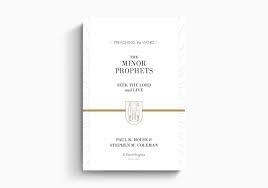
This is a tremendous asset to anyone preaching through the Minor Prophets. At least that’s how I think of it. I’m sure any Christian could enjoy just reading it through as these are real vibrant sermons, not merely scholarly essays. But for preachers, these are well crafted sermons. Of course no preacher worth his salt would ever just take the sermon of another, but these sermons could be especially suggestive as you prepare your own.
The sermons are in a fairly modern style. Some illustrations are good while others are only as good as your familiarity with popular culture. The key value, though, is the smoothness with which they bring life to the text. Whether it’s extensive background information or an awareness of exegetical options, the authors consistently provide real help without leaving the sermon to become a commentary writer. That’s a real skill.
I’ve often heard favorably of Paul House regarding Old Testament work, but Stephen Coleman is unknown to me. He appears to be a younger guy. Amazingly, I saw no difference in quality of work between these two authors.
The Minor Prophets well lend themselves to a work like this one. Mark this one down as a capital production.
I received this book free from the publisher. I was not required to write a positive review. The opinions I have expressed are my own. I am disclosing this in accordance with the Federal Trade Commission’s 16 CFR, Part 255
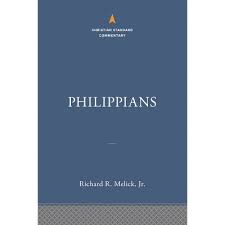
Having done Philippians, Colossians and Philemon in the old NAC, Melick narrows his focus to Philippians here. Perhaps his older volume didn’t set the woods on fire, but I always felt it was a bit underrated. It understood its target audience and delivered satisfactorily. Perhaps also I allowed myself to be a bit too swayed by how some rated it because as I worked through it this time I kept thinking—this is good.
It again writes first to pastors and teachers and could hardly be better in that vein. Academic types are going to go for the big exegetical series anyway, so I am glad to see the emphasis of this volume.
I’m not saying he came up short on scholarship either. Though it was pleasantly accessible, he handled all introductory issues really well. He set up the background of Philippi, explained what was going on with Paul, and understood the theological viewpoint of the book. He as winsome in his conservative conclusions throughout. It read well too, which is especially important when we leave the domain of scholars being the primary audience.
There was a certain maturity that was palpable in the book. I suspect he has been through Philippians many times. Scholars might feel his footnotes lean toward not as recent sources, but if you only are after understanding Philippians what difference could that make?
I found the commentary proper both full and helpful. Preachers are going to appreciate it. The series most in competition with the CSC is, perhaps, the TNTC, and Melick here much exceeds the Philippians volume in that series. I’ll give this one a thumbs up.
I received this book free from the publisher. I was not required to write a positive review. The opinions I have expressed are my own. I am disclosing this in accordance with the Federal Trade Commission’s 16 CFR, Part 255.
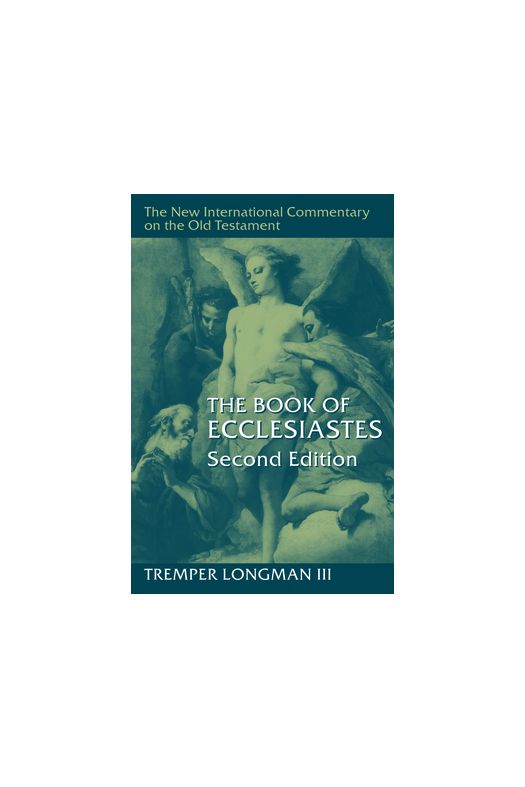
This commentary in its first edition from 1998 was highly influential. I can venture a guess for why that is so (and it’s only a guess). Modern scholarship was taking a turn away from Solomon being the author of Ecclesiastes and Longman was perhaps the first major conservative scholars to go that route. If that is overstating it, could I at least say that he should be credited with popularizing it? He truly is considered one of the major writers in Old Testament studies, particularly in Wisdom literature. He is especially known for commentaries and for editing other major scholarly volumes. Plus, the NICOT is highly influential in its own right as well. How many major commentaries of even a conservative nature hold to Solomon after Longman? No, I don’t know any either.
The charge against that earlier edition has always been that it is a bit too pessimistic. I fully agree. Since you likely are familiar with that earlier edition because of its wide popularity, I should tell you upfront that he has not changed any major conclusions that he has on Ecclesiastes. So in other words, whatever you thought before, you are likely to think now. This new edition merely fine tunes the earlier arguments.
But I can still give it its props. If you like the more modern approach to Ecclesiastes, you will find him more articulate than some others I have read. He is a good writer, and he always handles the scholar’s task with ease. There are good reasons he has been asked to edit so many major scholarly works. For better or worse, no major theological library could be without this work.
I received this book free from the publisher. I was not required to write a positive review. The opinions I have expressed are my own. I am disclosing this in accordance with the Federal Trade Commission’s 16 CFR, Part 255.
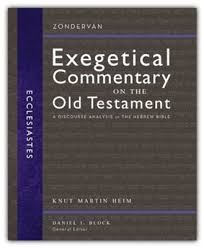
This commentary is a model representation of modern scholarship on Ecclesiastes on most points. I’m not going to review this commentary on those terms because I do not agree with the direction scholarship has gone on this book. In fact, I cannot agree with it at all. The older idea of Solomon being the realistic author is one that still makes perfect sense to me based on the book we have. The problem you have is that once you rule out Solomon, what you are left with is Hocus Pocus and building castles in the sky as to what the true theological importance of the book would be. Now that I have that off my chest, I will attempt to review the book from the lane that drives in – modern scholarship. In that vein, I would have to judge it of mixed success.
All the technical work is fine. Exegesis is competent. His work on discourse analysis is a scholar’s dream whether you’d follow him or not. As he shows, his is the third to dig deep on that subject and he mines the differences of the three to great depths. Perhaps it’s too deep for me as I just couldn’t decide what’s best there.
The weakest point of the book is in how he frames it as a whole. At one point, he even saw a stand-up comic in the author of Ecclesiastes. That approach seems excessively fanciful to me. Since modern scholarship has abandoned Solomon, I fully expect some imaginative speculation; but surely this is a bit much.
This series is fantastic overall, and for that reason alone I would want to have this commentary. Still, I would not rate it as one of the best volumes. In fairness, though, some obviously will like it more than I will.
I received this book free from the publisher. I was not required to write a positive review. The opinions I have expressed are my own. I am disclosing this in accordance with the Federal Trade Commission’s 16 CFR, Part 255.
In this counterpart to a similarly spectacular volume on the Old Testament, we see the New Testament painted in rich hues. It’s again produced by RTS faculty, which of course tells you the systematic theological lane it drives in. I think its gift, though, is its biblical theology. In fact, that’s more the purpose of the volume itself.
The Gospels have some of the most fascinating biblical theology in the New Testament, and as we expect, those chapters are some of the richest here. Sometimes issues like, say, the so-called Synoptic Problem and its weird offspring like “Q” are discussed in a way that might not even be needed in a conservative volume like this one (remember scholars aren’t the intended audience here) even if they conclude correctly. Perhaps Mark and John got the best coverage while Luke was a bit weak on structure. Still, they were all wonderfully helpful.
Robert Cara, who did Luke, took the same approach in Acts. Again, it was helpful. Guy Prentiss Waters did the next four chapters covering Romans through Ephesians. That means, of course, he got the most overtly theological books of the New Testament. Such theological writing is what Mr. Waters is most noted for. He has a sharp mind, but he is often party-line on Presbyterian thinking. That’s not a problem because it only asks the reader to keep the author’s perspective in mind while reading.
I found the going helpful the rest of the way. Revelation is going to probably help you on structure and symbolism, but not some of the other controversial matters.
This is invaluable for an overview study of a New Testament book. There are not as many helpful volumes for that need as you might think. You could hardly do better than this one.
I received this book free from the publisher. I was not required to write a positive review. The opinions I have expressed are my own. I am disclosing this in accordance with the Federal Trade Commission’s 16 CFR, Part 255.
Here’s a massive two-volume commentary in a series in its infancy. Though I take exception to some of the thrusts of this commentary, I must give Mr. Carter his props on writing. He reads so easily. I do enjoy scholarly writing that flows.
In the Introduction he says that this commentary is built around seven propositions that he has on Matthew’s Gospel. I’ll be honest and admit those propositions don’t exactly jump off the page for me (though I love focus). These propositions are quite dependent on a later date for Mathew, which I don’t agree with and I wasn’t persuaded by the case he presented. The logic is too tenuous. Matthew, he says, had to come after Mark and he dates Mark just after the fall of Jerusalem (70 A.D.). If we believe that predictive prophecy is possible, then both could have been before that date. That’s like a house of cards that fell with the gentlest of breezes.
His discussion of genre is interesting, but I just don’t know. I find help in the general categories of genre, but scholars keep adding new ones regularly. I think I’ve seen 30 or so in recent years (I didn’t actually count). So they see this new genre in a biblical book, define it, and read its rules back to the text. Isn’t that a bit circular?
The section on “telling the story of Jesus” is where he discusses structure. I could get on with section relativity more. I was surprised, too, to find him a bit skeptical about the thread worn “Q” theory. For sure, he focuses on the “finished form” of Matthew. His discussion of who Matthew is or authorship is highjacked by “reader-response criticism”. How could that even be a thing?
The rest of his proposals center in the Roman Empire. His fixation on the Syrian Antioch depends completely on his dating discussed earlier. I already told you what I think of that. Additionally, isn’t the story of Jesus even more fascinating because of how He almost ignores Rome even though it dominated the world scene? Squeeze Matthew as hard as you like and I think you’ll be hard pressed yourself to see an organizing feature in the “socioeconomic realities of daily urban and rural life in the ancient Roman world of Syrian Antioch”.
I even have something to say on the bibliography. It stands out by what is not there. Notice how few conservative writers are mentioned. I’ve always felt that conservative writers read more liberal works while the favor is rarely returned. The danger of an echo chamber is real. Notice also the relative lack of commentaries in the bibliography. I will only say that that is surprising.
Though the theological approach is in a different lane than I travel, I liked the commentary proper much better. Not really for the big picture obviously, but for all the fascinating details. At 1800 pages between the two volumes there are plenty of them.
A conservative reader like me is going to like a volume like this for its nuggets not found in other works, its unique biblical theology, and its interesting connections to other texts. In that regard, it delivered.
I received this book free from the publisher. I was not required to write a positive review. The opinions I have expressed are my own. I am disclosing this in accordance with the Federal Trade Commission’s 16 CFR, Part 255.
This release finishes Smith’s grand commentary on Isaiah. I always enjoyed his older commentary in the NAC and this revision is only better. It’s easily one of the best conservative commentaries we have on Isaiah. It’s in the company of Motyer and Oswalt where the rarified air leaves out much of the pollution found in modern Isaiah tomes.
Another Introduction for the second half of Isaiah? You bet! Over 70 pages? And not one is wasted. You can attribute two reasons for so many introductory issues in Isaiah. First, hardly does a second half of a book contrast to the level found in Isaiah. Second, hardly since at least the Pentateuch has a biblical book been subjected to the level of barrage by critical scholars found here. In this volume, you’ll find both interesting coverage of the issues and winning pushback against those scholars.
The Introduction is so well informed on structure. Smith is fantastic in summarizing key observations on these issues. He makes comparison so easy. The same could be said for compositional issues. You know how some scholars want to posit a Second Isaiah and some even a Third Isaiah (40-55 & 56-66). There’s no legitimate need to do that as Smith’s work will show. He is very thorough in this regard.
The commentary itself is exceptional. The help it provides is distinct. I feel the depth is ideal and the footnotes are rich if you want more.
Add the earlier volume and have great coverage on Isaiah. Try it and I think you will agree with me on its value.
I received this book free from the publisher. I was not required to write a positive review. The opinions I have expressed are my own. I am disclosing this in accordance with the Federal Trade Commission’s 16 CFR, Part 255.
This replacement volume in the beloved TOTC series is, in my view, an upgrade over its predecessor. Mr. Williamson is more known to me in the biblical theology realm, but here he gives commentary writing a try.
My least favorite part of this work is the Introduction. It was competent on many levels, but was a bit too agreeable to some dubious scholarly concerns. He seemed to beat around the bush about Mosaic authorship and sources before, I think, concluding conservatively. He couldn’t bring himself to pick a date or a route for the exodus. I much prefer reading that champions a view. His couple of pages on structure, though, were perfectly succinct. Even if this Introduction is not exactly to my taste, I think few readers of this series are coming for that reason.
Not more important for this audience is the commentary proper. It is well done here and strikes the right balance in length for the series. Are you preparing a lesson or sermon? I think you would enjoy this one. His penchant for biblical theology enriches many a passage. You likely know what to expect in the TOTC series and you will get it here.
I received this book free from the publisher. I was not required to write a positive review. The opinions I have expressed are my own. I am disclosing this in accordance with the Federal Trade Commission’s 16 CFR, Part 255.
This is my first encounter with Mr. Starling. He is in Australia and I hadn’t even heard of him, but I must admit that he struck me as a seasoned commentator. 1 Corinthians has several passages that invite debate, but I felt he was at his best guiding us through such passages. I loved his conservative, clear-headed explanations.
He also excels at a biblical theology level. Corinthians isn’t taking some big picture view as some places in Scripture, but it’s a helpful overview for what we face. Mr. Starling helps us here. I’d describe his view as this book guides us through facing and withstanding cultural pressure. I love it. It makes perfect sense. That viewpoint informs the commentary throughout.
He has a solid chapter in the Introduction as well on themes of biblical theology. They are pretty broad themes, but are well done. His explaining the background of Corinth, a major section in every commentary on Corinthians, was on target if not as lengthy as some. Other introductory issues were at least surveyed. His stab at structure is merely an outline.
This series has carved out its own lane and this is a good representative of it. I recommend it.
I received this book free from the publisher. I was not required to write a positive review. The opinions I have expressed are my own. I am disclosing this in accordance with the Federal Trade Commission’s 16 CFR, Part 255.
This latest in the NICOT series is massive, especially to get through only chapter 6. I can sum this one up quickly. If you are coming to this commentary for academic concerns, you will feel like you’ve received candy from your stocking on Christmas morning. If you are more into sermon prep or regular Bible study, not so much. To be fair, this work approaches commentary writing in the pattern that has developed over the last couple decades in this series, though maybe even a bit more detail.
There are good things to share here, but let me share my concerns. First, more weight was laid upon genre than it could bear. The genre “court tales” is simply overused to explain Daniel at large here. Assumptions are made and then those conventions are too often made the central argument to what’s going on. Second, the history of composition and the corresponding historical background of those times also carries too much. I love a big commentary, but I’m not sure we need 30 pages there. Finally, the structure and theology sections were weak. For these reasons, the long Introduction was not too helpful to me.
Again, with an eye to fairness, more scholars would think I’m off base than the authors here, but I think, for example, pastors would agree with me.
On the plus side, the scholarly work here will be graded exceptional in those circles. When something is addressed, no one can deny the sweat evident in the work. Additionally, the commentary hits a higher gear in the commentary proper. Check out the background on young men like Daniel being taken into the service of Babylon. That’s what I call thoroughness!
I’m a fan of this series, and I’ll want the follow up volume to have the full coverage of the commentary proper, but let’s rate it 5 stars for scholars and 4 stars for the rest of us.
I received this book free from the publisher. I was not required to write a positive review. The opinions I have expressed are my own. I am disclosing this in accordance with the Federal Trade Commission’s 16 CFR, Part 255.
 The Reagan Review