Lexham Geographic Commentary on the Pentateuch

Having enjoyed the earlier two volumes of this series covering the New Testament, I was pleasantly surprised to come across this volume. I guess now I’ll expect the rest of the OT to be covered. On the surface, we might suspect that the Pentateuch would be the area most in need of geographical assistance. Father back in time and having generations trample over its environs, there is simply less certainty. Enter, then, this volume.

This volume is a massive undertaking. In some ways it seems like a Bible encyclopedia while at other points it’s more of an atlas. Despite the title, it’s not a commentary per se. What you get is a thorough article on any geographical subject that greatly impacts our understanding of the text. Some are quite scholarly (like ones explaining from a “socio-spatial” perspective!) but they are often still fun. I loved the one arguing, for example, for the traditional site for Sinai. Though I found it less plausible, it was worthwhile to have an article arguing for an alternate site. Not all articles are explicitly geographical like, for instance, ones on burial practices. Still, it’s all good stuff.

Sometimes even theology was addressed and usually effectively when it appeared. Perhaps my only complaint mimics mine of the earlier volumes: some maps strain the eyes to read. Charts, though, are usually fine.

I can’t help but love a book like this one. Even if every article isn’t your thing, you are bound to find several that are simply fascinating. No other volume I know brings these loose ends so tastefully together. What you have is an asset not duplicated anywhere else. That’s saying a lot these days.

I received this book free from the publisher. I was not required to write a positive review. The opinions I have expressed are my own. I am disclosing this in accordance with the Federal Trade Commission’s 16 CFR, Part 255.
Acts 1-9:42 (WBC) by Steve Walton

Well, we have waited for this one a long time. I think I first heard it was coming 15 years ago. Perhaps I noticed because it was anticipated to be an excellent commentary on Acts. I heard that the exegesis that Walton would likely produce were why the expectations were so high. Though it has grown into a three-volume set, and though this is only the first volume, I can see what all the hullabaloo was about.

There is an anomaly—the Introduction for Acts as a whole is not in this first volume. There is a bit about textual issues, but the rest of those things normally addressed in an Introduction will come in the third volume. At first I thought maybe he just wanted more time to write it, but he states that at the end is where those issues should be handled. He is in the minority there and I cannot concur. That also makes the staggered release of the volumes a bit unfortunate. I’m not complaining as most all major publishers of Christian academic works do the same thing. I suspect budgetary concerns are in play. It’s not that serious a problem in any event and the three volumes are going to be fantastic when they are all here.

But volume 1 is here now and the prognosticators were correct: the exegesis is expert level. The Introduction of sorts is worth reading as it explains his approach. In short, he wants a commentary on the text rather than on previous commentaries. I’m glad someone figured that out.

We are all used to the WBC format by now even if it would never occurred to us to design a commentary in such a fashion. He advises that in each periscope that we read the “Explanation” section first, which ironically is the last one in each periscope. The WBC format can’t keep a good man down, or a good commentator I suppose.

The scholarship is mature and thorough. There’s some Greek but English is always at its side. He is considered conservative, but some critical, and a bit wrong-headed orientation, is to be found occasionally. This big volume on only the first nine chapters of Acts proves that this will be detailed enough for the most demanding student imaginable.

He writes well too. It’s hard to really hold attention when we have this kind of depth, but he pulls it off. There are some good one-volume commentaries on Acts that are indispensable, but I’d think we’d have to rank this as the best major, heavy-exegesis volume on Acts we have.

I received this book free from the publisher. I was not required to write a positive review. The opinions I have expressed are my own. I am disclosing this in accordance with the Federal Trade Commission’s 16 CFR, Part 255.
Romans (NTL) by Beverly Gaventa

This volume brings the NTL quite close to completion. The volume on Romans in any New Testament series will tell you much about its theological predilection. That is surely true here. This series gives perhaps the clearest presentation of a mediating or critical perspective. That is not my perspective at all, but I often read at least one entry from that side of the fence to stretch myself. This series’ best contribution is often theology that really gets you thinking. This volume succeeds along all those lines.

In fact, Gaventa is an especially translucent writer (or she has a grand editor). Your eyes will easily glide along the page understanding fully her thinking whether you agree or not. Often, when you don’t agree you will still find not as abrasive of arguments as we commonly find. If you are of her theological persuasion, you may develop a deep appreciation of this book.

After a large bibliography, she jumps into the Introduction. She begins by jumping into an orientation to how she approached this commentary including her influences. I wish more commentators used that method. I found she was true throughout to what she said here and I appreciate the transparency.

Again, appreciating transparency and agreeing with what was transparently presented are not the same thing. For example, she says she reads Paul “with a hermeneutic of generosity.” She then cites as an evidence things Paul has said. She states “and there are, to be sure, elements in the letter that disturb me, particularly Paul’s use of same-sex relations as evidence of humanity’s refusal to recognize God as God.” That statement raises far greater questions than merely commentary matters on Romans like, say, what moral system do we use to judge the Word of God? I mean, what’s higher or truer that we could use? If it can be produced, why aren’t we studying it instead of Romans anyway? See what I mean.

At least she tries. In her commentary on Romans 1&2 she twists the passages relating to homosexuality until they are contorted beyond recognition. Her description of Roman views of gender hierarchy (page 68) are beyond the pale in describing what Paul was saying. It came across as an act of desperation that on the one hand apologizes for what Romans actually says to saying it’s still a good book on the other. I can’t see how that would satisfy people on either side of the fence. Don’t misunderstand—I’m neither obsessing on this issue or stating it’s one of the main themes of Romans, but I do believe it might help you understand what you have in store for yourself between the covers of this volume.

With that settled, expect nice exegesis within the confines of her perspective. When she’s on, she’s really on because of her superior writing skills. Barth is clearly her greatest influence and that tells you what to expect doctrinally. Theological nuggets are to be found as well.

If you are like me and are conservatively minded and seek light on a different perspective with theological assists, you will find what you are looking for here. If you possess a critical mindset, you will too.

I received this book free from the publisher. I was not required to write a positive review. The opinions I have expressed are my own. I am disclosing this in accordance with the Federal Trade Commission’s 16 CFR, Part 255.
Job (EEC) by Duane Garrett

Here’s a bright, new commentary on the fascinating Book of Job from one of the leading commentary series of our day (EEC). The task fell to prolific commentator Duane Garrett. Ages ago he tackled other Wisdom books in the NAC series. Though that was a perfectly usable volume, it was the work of a rookie. Here the seasoned player steps to the plate and delivers a mature work on Job. I have not read everything he has ever written, but this is the best work he has done out of what I have used.

From the first pages of the Introduction his skills are apparent. He’s well researched, he distills that research to clearly state what the scholarly world has thought, and then he is not afraid to make a conclusion. With kindness to us he does it all without excessive verbiage.

I find myself in sympathy with most of his conclusions as well. The scholarly world has moved on from dating Job closer to Abraham and I just can’t go with them. The older generation had far better reasoning there and the new arguments strike me as vacuous. Garrett makes a strong argument for seeing chapter 28 as an inserted Wisdom Poem. I’m not sure, but he lays it out for you to decide.

He begins with the chiastic structure of Job and is spot on. Whether what he said above about chapter 28 is correct or not, it is the center of the chiasm it seems for sure just as says. The rest of the Introduction is well done. He writes with clarity on textual issues, genre, and biblical parallels.

There’s plenty of meat on the bone in the commentary proper as well. Exegesis, explanation, and theology are first rate. Some of those speeches are exceptionally challenging and there’s excellent help here.

So where does this one rank among commentaries on Job? Hartley (NICOT) is the most similar. He blows many others away as they commentate through a dark haze and so rob Job of its theological beauty. I guess, then, we will have to rank this as our best option for Job in the major commentary category.

I received this book free from the publisher. I was not required to write a positive review. The opinions I have expressed are my own. I am disclosing this in accordance with the Federal Trade Commission’s 16 CFR, Part 255.
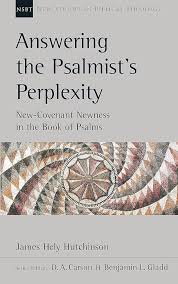
Answering the Psalmist’s Perplexity (NSBT) by James Hely Hutchinson

Though the topics can be narrowly constructed, I’ve thoroughly enjoyed the NSBT series. Can you believe this volume is #62 in the series? Regarding narrowly defined subjects, perhaps this one is even more so. Because of that, this book may not find as big a round of acceptance as the others. When you are sixty-two titles deep into a project, you clearly have a homogeneous audience that can be easily described. So why do I feel perhaps that mutual admiration society might not hold up in this case? Well, it’s more, to be sure, the fault of the subject than the author.

He’s jumping into the covenant theology- dispensational theology divide. But he dives deeper still using a 7-model spectrum running from Westminster Covenantalism to Classical Dispensationalism. Though Models 1-5 are more on the Covenant Theology side and 6-7 on the Dispensational Theology side, you are still going to make six out of seven groups at least marginally unhappy.

Let’s give credit where credit is due—he lays out well the seven groups and is fair minded to those even farthest from him. He makes clear the whole Continuity versus Discontinuity that is the trendy way to lay out the issue. Continuity is God’s people (Israel and the Church) are mostly the same ties to Covenant Theology while Discontinuity separates them in distinct ways and ties to Dispensationalism.

Instead of stating Hutchinson’s viewpoint or my own, I’d rather mention the larger problem. His approach reminds me of walking into an opulent room and focusing on one immaculate lamp. It is a nice lamp, but what about that gorgeous mahogany desk? Must the room forever be oriented to the lamp? You mean I can’t talk about the couch or the ceiling tiles unless I speak in terms of the lamp? That’s the problem to my mind with either Covenant Theology or Dispensationalism. They are asked to explain more than they can. Their adherents see them as more a throne in a throne room, but I say they’re still a lamp. Nice lamps, ok, but not strong enough to bear the weight of the room. They explain something, but no where near everything. Less esoteric, less enticing to scholarly vanity, and more accessible to the common Bible believer, are ideas like Jesus, or say relationship between the Trinity and us. Make these ideas (I’ve learned much from all seven of the viewpoints while having some clear opinions on some of those issues) the condiments and Jesus the meal and what a feast we can have.

Let’s move on before someone gags on my review. The richness of this volume is to take the Scripture Index and use with all the texts he uses in Psalms. He can help with exegesis.

He’s a clear writer too. Surely we can do better than the term “New-Covenant Newness”, but he communicates his line effectively.

Agree with Hutchinson and you’ll love the book; not fully agree and you’ll see the boundaries more carefully; agree or not and use the exegesis for Psalms and you’ll be helped at least.

I received this book free from the publisher. I was not required to write a positive review. The opinions I have expressed are my own. I am disclosing this in accordance with the Federal Trade Commission’s 16 CFR, Part 255.
Galatians (Word Biblical Themes) by Nijay Gupta

This is the inaugural volume of the New Word Biblical Themes series. For some reason, only 15 volumes were ever written in the old series meaning that by far most in the WBC series did not have a corresponding offering in this series. The first thing you notice now is that unlike the old series each volume is not written by the author of the corresponding WBC volume. That’s not necessarily a bad thing, but it makes this new series more distinct, less likely to rehash information from the WBC series, and not bound by any of the weaknesses (or strengths) of the commentary. This series will be entirely in the hands of the new authors and the work they do.

That brings me to Nijay Gupta, who additionally happens to be the series editor. Richard Longenecker did the WBC volume back in 1990. That has been ranked as a high-class exegetical work ever since, though it has been consistently labeled a bit overboard with its entertainment of newer perspectives by many in the more conservative camp. Spring forward 34 years and I will say the same thing about Gupta. He works well from where he reasons, but do you accept that line? I found his work here easy to read and follow with all necessary scholarly spade work behind it, but he is dialed in to the wrong frequency for me.

Perhaps you’ve already guessed he is sympathetic to the New Perspective on Paul (NPP) and (full disclosure) I am not. Still, he divides how we view Paul’s thought in four main ways: 1) The Reformation Approach, 2) NPP, 3) the Apocalyptic Paul Approach, and 4) the Salvation-Historical Approach. He sees it as a combination of #2 and #4 while I would see it as a combination of #1 and #4. My viewpoint is unimportant as you are seeking a review of his book. My point is, more than in most books, your viewpoint is going to greatly affect your valuation of this book. Gupta himself says, “… leaning into one of these approaches leads to a particular kind of reading of Galatians, and promoting another one presents a different reading, sometimes starkly different.” This is a book about themes and your guiding theme orients everything else you say.

I still must commend certain things about this book. He lays the issues out well even if he, in your opinion, chooses the wrong option. There is value sometimes in reading on an entirely different track. Also, he very cogently and succinctly lays out his position in an understandable way. It’s quite easy to see what he believes, and why he believes it, even if you cannot agree with it.

And there you have it. Part of this book’s final score will be the viewpoint you had before you even cracked it open.

I received this book free from the publisher. I was not required to write a positive review. The opinions I have expressed are my own. I am disclosing this in accordance with the Federal Trade Commission’s 16 CFR, Part 255.

Galatians (CCF) by N. T. Wright

This was the inaugural volume of the new Commentaries for Christian Formation (CCF) series. I’m sure they were pleased to snag N. T. Wright since he is such a major scholar. To be sure, he is controversial because he is one of the proponents of the New Perspective on Paul. Because I especially liked the new volume on Hebrews in this series, I backed up to check out this one. Since I’m not a NPP guy and because Wright isn’t in any of the main series I’ve consistently reviewed, this was my first foray into Wright’s writing.

By the end of the Introduction here, I felt I understood Wright and could see what all the hoopla was about. He is an engaging, even provocative writer. Rather than an academic work, I felt I was reading a captivating essay. The more I read, the more I wondered if it would help a lot of works to adopt that style. It is much more gripping and makes for more of what we might call a real reading experience. I must give Wright all the props for his writing.

Still, I wasn’t fully persuaded by his arguments. They had enough going for them that I could find places for caution in running mindlessly to our usual conclusions, but not enough to just overthrow them. (You can decide if I was too biased a reader). For example, he is convinced that the Reformation oriented New Testament studies away from what they were in the First Century (that will never do in some circles! ). Again, I think he gives us enough to consider more carefully earlier concerns, but no where near enough to think the Reformation recreated Christianity in its own image. From there his comments had value mostly in regard to when he was not trying to advance his scheme because, as I said before, the man unquestionably possesses advanced writing skills.

His work still has value in the commentary section. I see him as a guy standing at a different vantage point. Sometimes it’s too far away to see through all the bushes, but where he has a clear line of sight, it’s something else.

He’s probably geared quite nicely for Christian formation, probably more so than for theological precision for sure too. Based on what I’ve said, you’ll know how many stars to give this work.

I received this book free from the publisher. I was not required to write a positive review. The opinions I have expressed are my own. I am disclosing this in accordance with the Federal Trade Commission’s 16 CFR, Part 255.
Galatians (EEC) by Michael Burer

Galatians gets its turn in the outstanding EEC series. The series is one of my favorites in the major exegetical commentary category. In that vein, many releases are coincidentally coming out on Galatians (probably not the timing publishers really wanted), but this is easily one of the best.

The Introduction is well done and pretty conservative. It’s engagingly written and touches all the needed places. He takes the South Galatia View and lays out his case well. I wish he would have more directly addressed structure beyond his simple outline.

Even better than the Introduction is the Commentary proper. Exegesis fills his wheel house from wall to wall. In each passage, he gives some very detailed textual notes followed by his own translation. From there, he offers his most helpful work in the commentary section. It’s detailed, copiously footnoted, and hits the sweet spot on depth. After that, he gives theological comments of varying lengths. Pastors will appreciate the application and devotional implications section. Most sections have an additional exegetical comments, though I couldn’t quite gauge what determined if it went here or the earlier section. Each passage had its own selected bibliography.

If you’re building a theological library, you could start here. I’m pleased with this offering in this series I admire.

I received this book free from the publisher. I was not required to write a positive review. The opinions I have expressed are my own. I am disclosing this in accordance with the Federal Trade Commission’s 16 CFR, Part 255.
Revelation Through Old Testament Eyes by Tremper Longman

Tremper Longman in the New Testament? That was a surprise! With a little more thought I can guess why. There are many OT allusions in Revelation as well as the fact that Daniel is especially related to Revelation and Longman has written on it.

I must admit up front that I don’t share Longman’s overall prophetic position, but I expected it before I began. The final product is also what I expected.

While this work cannot serve as a main commentary choice, it is useful as an additional resource. Longman is clearly an OT expert and it shows. I often disagree with him even in his OT content, but there’s always good stuff to find as well. That ends up being true in this book too. Beyond some speculative material is solid OT insights.

The style of the work matches previous volumes in this series. Here the OT nuggets and comments on structure are far and away the best features here. No matter one’s perspective on prophecy, nuggets on structure are delightful to the Bible student.

Where I’d use this commentary is narrow (more so than others in series), but in those places it is rich.

I received this book free from the publisher. I was not required to write a positive review. The opinions I have expressed are my own. I am disclosing this in accordance with the Federal Trade Commission’s 16 CFR, Part 255.

Malachi (ZECOT) by W. Dennis Tucker, Jr.

This latest entry in the Zondervan Exegetical Commentary (ZECOT) series continues to deliver the goods. Additionally, the series continues to provide us these nice volumes on individual books in the collection of Minor Prophets. The author of this one on Malachi, Dennis Tucker, has a nice collection of successful writings, though a bit more in the Psalms. He has worked on Jonah as well, though I’ve not used that one.

Immediately in the Introduction, he establishes what he feels is Malachi’s theme—“fidelity to the great King”. He gives conclusions that he well works out on things like author and date. I notice he is quite thorough in listing all the main opinions before his conclusions, which might be the concern of some. Far more important is calling balls and strikes on these plethora of scholarly opinions and that he does.

His historical analysis was succinct, but clear. When he tackled literary analysis, he especially highlighted “direct discourse (DD)” and saw it as a key to unearthing structure. He’s probably on to something there. This series has high expectations for structure, and I think he came through. it made sense, though other possibilities exist.

Somewhat related is the theological message of Malachi, and he gave us what he felt were the three most important things in that regard. Perhaps that section could have been longer, but it was still helpful. Next, he gave an outline of the style we have come to expect in this series.

The commentary was good throughout. The exegesis was sound and thorough. If you are looking for a single volume on Malachi, here’s you a great option. Many of these shorter prophetic books are packaged in commentaries, so this is a nice asset to have at hand. Perhaps I liked the volume on Nahum better, but this one can stand along side the other existing ZECOT volumes on Minor Prophets.

I received this book free from the publisher. I was not required to write a positive review. The opinions I have expressed are my own. I am disclosing this in accordance with the Federal Trade Commission’s 16 CFR, Part 255.